Gordon McCreight

116 posts

Gordon McCreight banner
Gordon McCreight

Gordon McCreight

@gmccreight

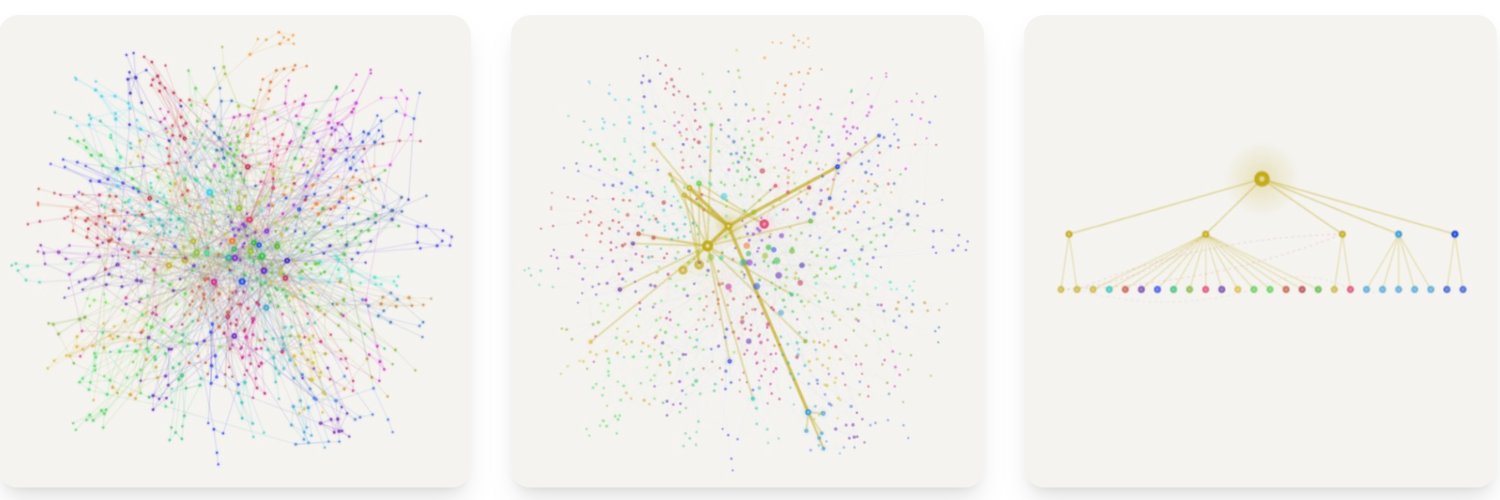
Do you have densely-connected Markdown notes in Obsidian, Clearly, Tolaria, or Logseq? Meadow publishes them as living websites that you can share with others!

Katılım Şubat 2009
57 Takip Edilen79 Takipçiler
Gordon McCreight
Gordon McCreight@gmccreight·
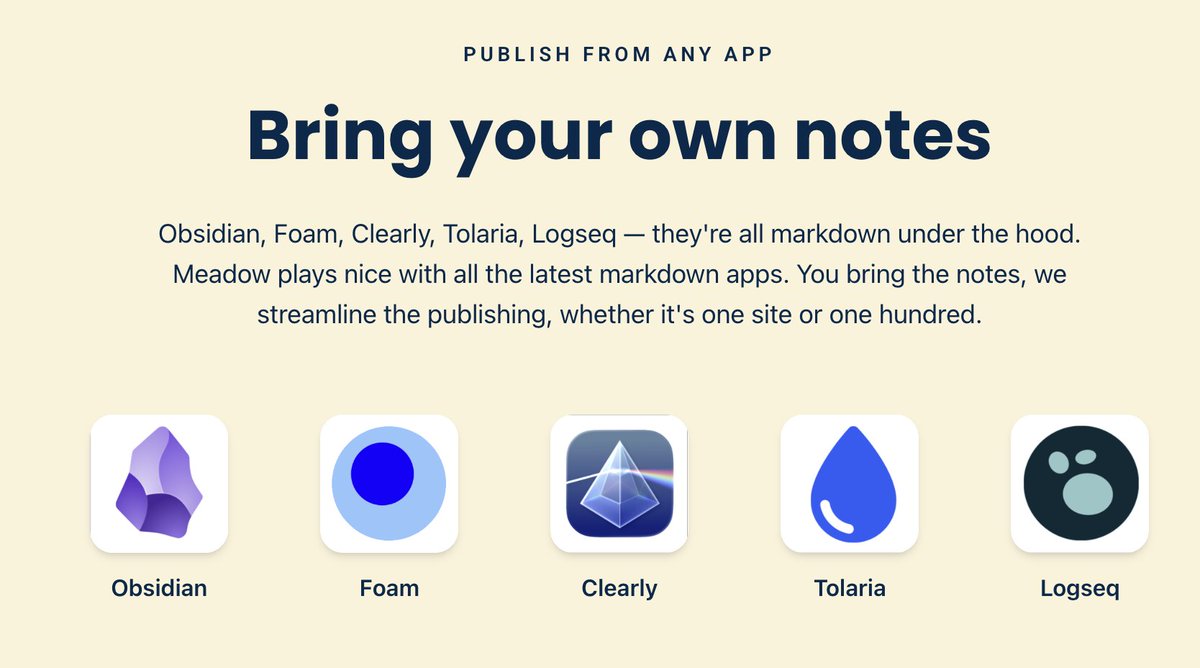
@Shpigford I'm trying to make a business on the publishing side. I mention Clearly as one of the upstream markdown editors, cuz it's cool. William: "nah, total tar pit". Yeah, I have my suspicions... but I also have my obsessions, sooo... 😅 Check out meadow-notes.com !
Gordon McCreight tweet media
English
0
2
3
314
Josh Pigford
Josh Pigford@Shpigford·
i wonder if there's a business to be had with clearly.md it's totally fine if not. there's no system overhead to run it. but given markdown is having a massive surge in popularity, i *do* wonder if there's something worth exploring. 🤔
English
13
1
35
7.5K
Gordon McCreight
Gordon McCreight@gmccreight·
Yeah, the tension is real. I think an emphasis on "file over app" is a reasonable middleground here, though, even if we're not talking about "pure" markdown. The Obsidian guys put a _lot_ of effort into making those underlying files easy to work with, and should be commended for their efforts there. They're essentially inviting competition. Speaking of which, I've been able to build something that extracts the underlying graph structure without relying on the database (just uses Rust to figure out the graph in real time). It is also able to work with the embedded Excalidraw and spaced repetition plugins, so that it can publish websites from your notes easily. Check it out, it's open source: meadow-notes.com
English
0
0
2
315
Tiago Forte
Tiago Forte@fortelabs·
I want to debunk the claim that I see a lot around here that Obsidian is "just plain text markdown files" which means "you can take them anywhere and open them with any app" That simply isn't true Yes, maybe the raw text of the notes is markdown, but many other parts cannot be moved elsewhere and opened by other apps: 1. The .obsidian/ directory contains your JSON config with plugins, settings, hotkeys, workspace state, link format, attachment paths – those can't be moved elsewhere 2. Plugin state files – Readwise's path-to-ID map, Templater's settings, Tasks plugin's database, Excalidraw's drawing data – even if plugins can be recreated, these settings cannot 3. .canvas files – JSON, not markdown. They reference notes by path and won't survive a move 4. .base files – JSON-based database/views over your notes. Same path-fragility 5. .excalidraw.md files – markdown wrapper around an Excalidraw JSON blob. Looks like markdown, isn't really 6. The link graph itself – backlinks, graph view, "linked mentions" – all computed from filenames and link references. They survive because the references are in the markdown, but they require Obsidian (or an Obsidian-aware tool) to materialize 7. Plugin-managed folders – Readwise output, Web Clipper output, Daily Notes location, Templates folder. Each is a folder whose contents are owned by an external system tracked in plugin state 8. Sync state – Obsidian Sync, iCloud, Dropbox, Google Drive each maintain their own state about what's where and what's been resolved. Move operations interfere with this state 9. Embedded query results – Dataview queries, Tasks queries, Bases queries. The query is in the markdown; the result is computed live and never persisted So technically you CAN move your files elsewhere, but you'd destroy most of what makes them valuable – the graph, the plugin state, the canvases, the embedded queries, the sync state, and any structural intent encoded in folder placement Which means you're just as locked in to Obsidian as any other "proprietary" app, it's just a hidden lock-in that's obscured by inaccurate marketing Saying "Obsidian is just markdown files" is like saying "your house is just bricks" The bricks are real and moveable – but the architecture, plumbing, and wiring aren't bricks, and those are most of what makes the house function
English
156
22
374
108.6K
Gordon McCreight
Gordon McCreight@gmccreight·
@siliconmania Great format! Feels a little like those Dad joke videos where they try to get each other to laugh. It looks like everyone's having a good time, which makes it much more watchable than the overly dramatic and judgmental Shark Tank format. Excited to see more of these!
English
1
0
1
296
Silicon Mania
Silicon Mania@siliconmania·
Shark Tank is dead. no one has 2 hours to watch a fake, cinematic, scripted drama. we just fixed that. introducing... The Buzzer 🔴 1 founder. 1 investor. 5-minutes speed date. every time the set turns red, either one can reject the other and get a new match (yes... founders can reject investors too LOL) if they both survive the 5 minutes, it's a match. and they get a private second date. it's entertaining. it's educational. and it's actually very fun to watch. this is the new Shark Tank. and it's called The Buzzer 🔴 enjoy! 🍿 (and shoutout to CUT for the inspiration, and to @compai for sponsoring this episode 💚)
English
133
61
1.1K
173.1K
Gordon McCreight
Gordon McCreight@gmccreight·
@emollick Trouble is if you interact with AI enough, you start picking up on its phrasing, too. You start to sound like a bot. Hard to not be influenced by what you read!
English
1
0
24
641
Ethan Mollick
Ethan Mollick@emollick·
"Load bearing," "I keep coming back to," "Not X, but Y" A curse of using AI a lot is that you realize how much of the writing around you is just AI, now People who don't use AI have been unable to identify AI prose on sight, but those who use it a lot can spot the tells easily
Ethan Mollick tweet media
English
91
92
850
91.5K
Gordon McCreight
Gordon McCreight@gmccreight·
I'm excited (no, really!) to announce that you can now publish 3 free sites on meadow-notes.com I genuinely hope this is helpful to people. I find it great for publishing sites like the one I did about Gas Town meadow-notes.com/sites/v5v5wwby… I also publish sites for all of the people I have 1:1s with. I prepare per-meeting documents with links to concepts I'm trying to move forward on together, or for projects that I think are interesting. Then after the meetings, I synthesize any new ideas that came up, then re-publish. I find it much more effective than traditional meeting notes because the insights drive the right conceptual areas forward vs. getting stuck in a meeting note that nobody revisits. It's also more effective because the notes reflect _my_ understanding of things, so I can be opinionated and update things with my wild hypotheses with abandon. It feels freeing in the way that distributed revision control did... because there is a discrete publishing phase that you can trigger only after you feel comfortable doing so. I like it.
English
0
0
1
43
Gordon McCreight
Gordon McCreight@gmccreight·
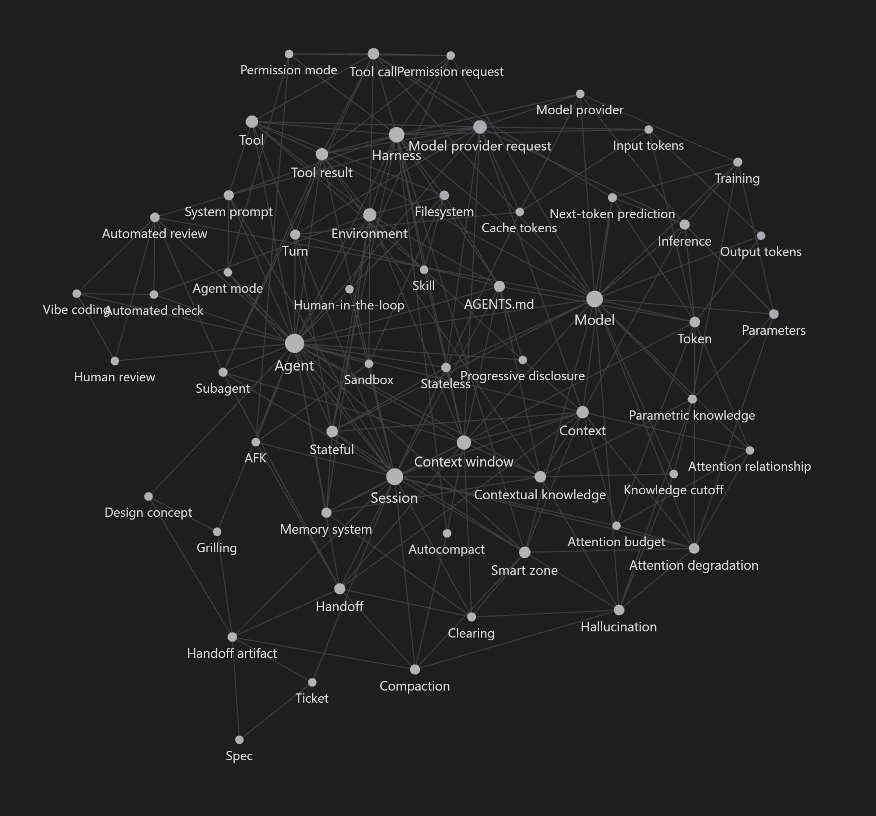
I'm so excited that people are creating and sharing these types of sites now! I created one about Gas Town (with a carefully constructed Glossary of densely linked terms and spaced repetition prompts) a few months ago: meadow-notes.com/sites/v5v5wwby… It uses our meadow-notes.com application, which is free and open source, and lets you publish 3 free sites. Basically, it helps you extract and publish microsites from your densely linked notes. Let me make the pitch for why that's great. If you _don't_ densely link your notes across domains, then you end up with isolated graphs. Like I see a note above called "human review". That's a critically important concept. In my notes, I have so many other notes tied to it... that human review is a critical bottleneck, that we want to try to batch up work for more effective human review, that we should try to identify structured failure modes that lead to the need for human review, etc. So if Matt's notes are great, the first thing I'll want to do is to assimilate them into my notes, draw connections, etc. And then I'll want to be able to publish some purpose-specific slice of my densely connected notes for some other purpose, later. Ok, I could go on and on, but I'll stop. Check it out!
English
0
0
0
588
Matt Pocock
Matt Pocock@mattpocockuk·
A Dictionary of AI Coding This was extremely fun to put together. Shipping soon
Matt Pocock tweet media
English
21
20
535
23.5K
Gordon McCreight
Gordon McCreight@gmccreight·
@fortelabs Honestly, that sounds exactly like what @Shpigford is doing with clearly.md . Super simple. Native. Uses markdown notes on disk. You may not care, but it's also open source, which I think is pretty cool.
English
1
0
21
5K
Tiago Forte
Tiago Forte@fortelabs·
Can anyone recommend a dead simple, easy to use notetaking app based on markdown files? Obsidian is far too complicated for me. I'm looking for Apple Notes, but with markdown storage
English
748
21
977
299.6K
Yacine Mahdid
Yacine Mahdid@yacinelearning·
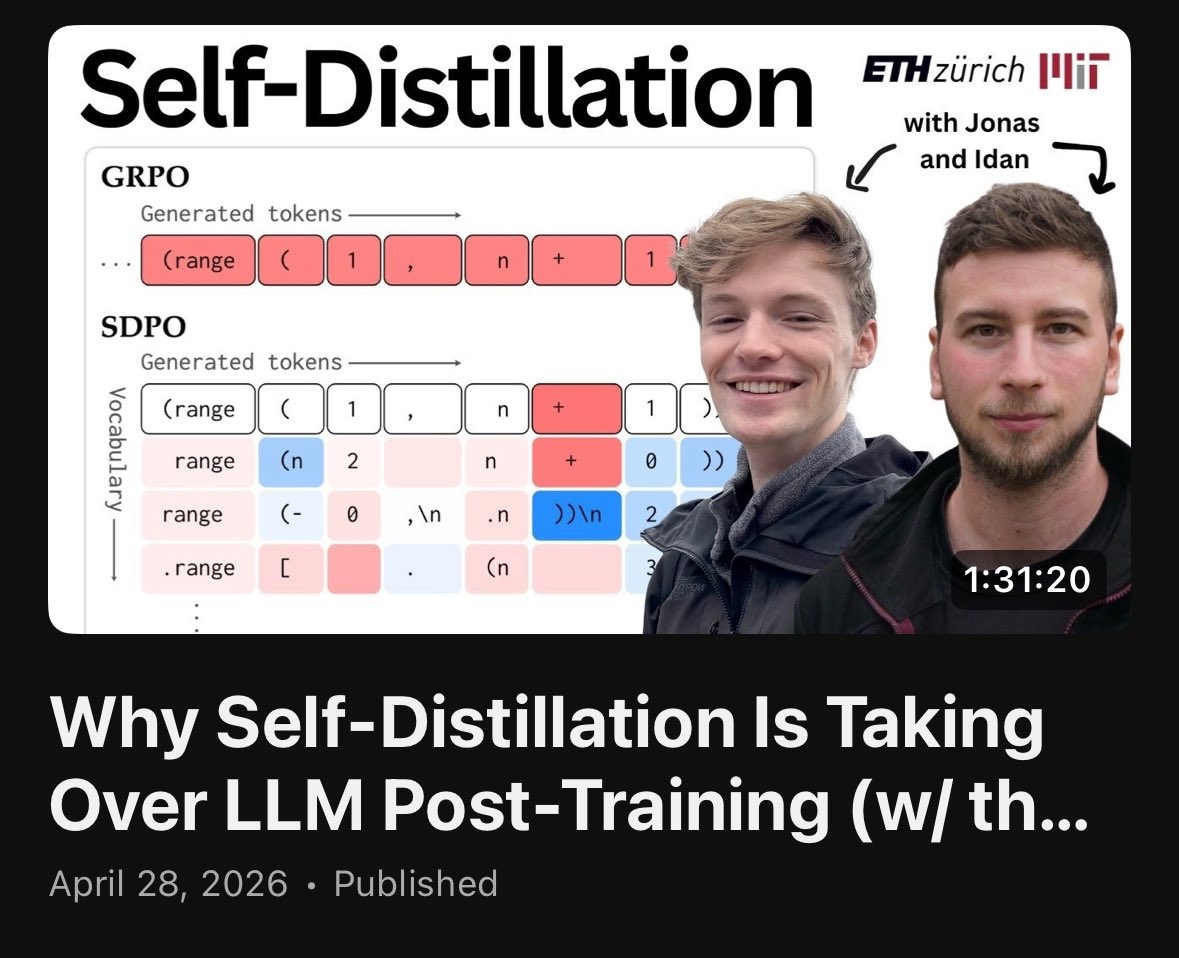
if you are interested in a great lecture on self-distillation I’ve finished editing a ~1h30min lecture with two stellar researchers in that space @jonashubotter and @IdanShenfeld lots of different article distilled into one presentation and a whole lot of questions answered!
Yacine Mahdid tweet media
Jonas Hübotter@jonashubotter

Today and tomorrow we’ll be presenting self-distillation with orals at ICLR in Rio 🇧🇷 1. “Self-Distillation enables Continual Learning” at lifelong agents workshop (Sun 11:30am) 2. “Reinforcement Learning via Self-Distillation” at scaling post-training workshop (Mon 2:40pm) 3. “Test-Time Self-Distillation” at test-time updates workshop (Mon 4:15pm)

English
14
120
1.1K
79K
killian
killian@hellokillian·
Inspired by @karpathy :) A local markdown editor + terminal agent workspace.
English
32
38
933
94.5K
Gordon McCreight
Gordon McCreight@gmccreight·
@dep @hellokillian @karpathy Bumped into this alternative approach this morning that seems more focused on the sites automatically keeping themselves up-to-date, in case that's something you're interested in: x.com/waynesutton/st…
Wayne Sutton@waynesutton

Grass was not touched, but the agents were. Built something cool, thought it was going to be quick, but it wasn't. I'll share tomorrow, but you can see how it works on markdown.fast, which has a lot of updates like an interlinked knowledge base and markdown slides.


English
1
0
0
23
Gordon McCreight
Gordon McCreight@gmccreight·
I should mention that I don't actually use Gas Town (yet?)... I just wanted to understand it.
English
0
0
1
58
Gordon McCreight
Gordon McCreight@gmccreight·
I had the exact same reaction to the naming. "What is this nonsense?" I've come around because it's unambiguously weird, which is actually helpful in this world where nobody knows what anything really means. But I had to build a glossary very carefully, and even write spaced repetition prompts to be able to hold the pieces together. I've published all that stuff here, in case it helps: meadow-notes.com/sites/v5v5wwby…
English
1
0
8
1.4K
Gary Bernhardt
Gary Bernhardt@garybernhardt·
I wanted to experience the extreme end of agentic programming, so I went to a gastown workshop. I don't know whether it's the future. I do know that I've never seen an ecosystem with docs so consistently wrong, or terminology apparently designed to confuse and infuriate.
English
18
13
362
25.3K
Ryan Lopopolo
Ryan Lopopolo@_lopopolo·
@gmccreight Yup that’s exactly it! Think of it as guided run book synthesis
English
2
0
4
166
Ryan Lopopolo
Ryan Lopopolo@_lopopolo·
A neat thing we’ve been experimenting with: Codex workout sessions. Getting Codex to close the loop and validate its work is critical for higher complexity changes. To do that we want skills for high level workflows: “log in”, “upload file attachments and start a chat”, “grant this group access to a Workplace Agent”. To do this reliably, we’ve been getting Codex to iterate on its own skills by planting “flags” CTF-style in the UI and ralphing Codex using automations in the app, making commits to iteratively refine the skills after self reflection on each attempt. Capturing the flag is the win condition and from there codex optimized for reliability, wall clock time, and keeping up to the changing codebase. Put in the reps with your agents!
English
13
4
205
27.5K
Gordon McCreight
Gordon McCreight@gmccreight·
If I follow, this feels like an effort to make skills that are essentially deterministic, so they can drive small workflows (without giving in and codifying them into something like Playwright, which would be less flexible, and would definitely require code changes if/when the UI changes even a little). If so, makes sense! I was just curious about the mechanics of how you're improving each skill as part of this optimization process. I think I get it, now. The flags are essentially placed at steps in the workflow. One workflow might consist of 5 steps, so maybe you have 5 flags that align with those steps? If your skill's first attempt only gets to step 3 then fizzles out, the agent tries to optimize the skill, then tries again. Eventually it will get through all 5 intermittently. Then the optimization turns to getting it to pass repeatedly without error (with counter-metrics around wall clock time). Sounds cool! (Assuming it got it right)
English
1
0
3
188
Ryan Lopopolo
Ryan Lopopolo@_lopopolo·
@gmccreight building these skills is ultimately tracking toward getting Codex to do full end to end verification of full stack PRs it makes in chatgpt.com
English
1
0
2
836
Gordon McCreight
Gordon McCreight@gmccreight·
One thing I do is that I treat the PR review artifact as a fully customized application. I haven't bumped into anyone that has taken the idea as far as I have, yet (I'm sure they're out there) In practice this means that all meaningful features get codified into E2E tests and the system takes videos of the new feature, but also of all the pre-existing E2E tests. It highlights the videos created specifically for the feature branch. Inside each scenario artifact, a bunch of stuff is synchronized with the video. The test code, but also all of the state. It's all time-travelable. The logs, , the conf on the local filesystem, Dynamo, S3 (Minio). It has been _incredible_ for getting a high-level view of broad strokes (just watch all the videos related to some area of the app) and also for debugging state. An improvement I'll probably implement soon is the ability to go to a specific time in the video and then say "launch my dev tooling with this exact state". Man, that'll be dope! Here's an 18 second video showing that stuff.
English
0
0
2
262
Matt Pocock
Matt Pocock@mattpocockuk·
What 'advanced' AI coding techniques are you using? I.e. what do you feel like you've discovered that no-one else knows about yet?
English
199
18
552
113.5K
killian
killian@hellokillian·
@gmccreight @karpathy thanks Gordan! and VERY cool direction on meadow notes. I can see the future of article publishing looking like a public view of personal wikis / second brains, intermediate tools appearing redundant in retrospect. good luck with the launch!
English
1
0
1
1.4K
Gordon McCreight
Gordon McCreight@gmccreight·
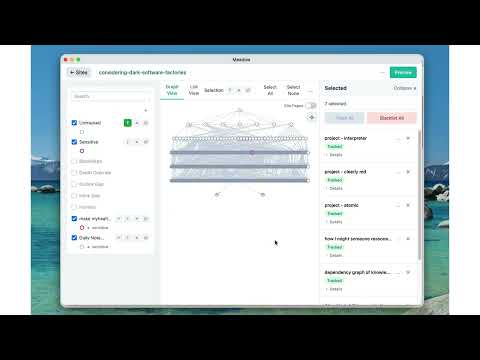
Hi Danny, nice to meet you! So, they are snapshots, but Meadow has fancy tools for evolving from one snapshot to the next. I see you're very technical, so... basically it uses custom-built Rust binaries that wrap GitOxide to maintain and diff in a local repo (we package all that junk up in the distributed app, so users don't need to have git installed or anything like that). I maintain a bunch of sites, including one about dark software factories. It has been about a week since I updated that site, so I decided "I'll just record myself updating it so I can show Danny how that works" youtube.com/watch?v=2P9Myt… The video's 5 minutes. I got a little excited showing things off, but you'll get the gist within the first 30 seconds, I bet. Also, I need to stop saying "you know" so much. I hear myself. My god, man.
YouTube video
YouTube
English
2
0
0
45