Gabriela 🦋❤️‍🔥

1.2K posts

Gabriela 🦋❤️‍🔥 banner
Gabriela 🦋❤️‍🔥

Gabriela 🦋❤️‍🔥

@gmoipar

be not afraid

Montreal Katılım Haziran 2020
2.4K Takip Edilen998 Takipçiler
akhil
akhil@fkasummer·
Somehow, I have found myself at the intersection of computability and differential geometry.
English
6
1
30
1.2K
Gabriela 🦋❤️‍🔥 retweetledi
Charles Rosenbauer
Charles Rosenbauer@bzogrammer·
Andean civilizations used a writing and accounting system based on colored, knotted strings, called Khipus. It's astonishingly complex, and far more advanced than most give it credit for. The Spanish pushed them to adopt books instead, and one objection the Native Andeans raised was their belief that the deepest knowledge is fundamentally multisensory; a book is only read with the eyes, while a khipu is read with a combination of the eyes and fingers. Moving your body is quite literally thinking with your motor cortex. The brain is a very non-Von-Neumann style computer; there is a tight coupling between where memory is stored and where it is computed. Incorporating more brain regions - sensory, motor, or high-level regions - means you are using more of your brain, and multiplying the memory and compute available for the task. I suspect a lot of ancient practices discovered this by accident. Ancient cultures are full of neurotechnology for squeezing more out of the brain. Poetry and music for memorization, for example. I have a suspicion that anthropomorphization in religion may be balancing abstract thought across both hemispheres. I don't think we really understand or appreciate much of this today, and we're worse off for it. We have an exascale computer between our ears and we're running the equivalent of poorly-written and single-threaded Python or Ruby code on it.
Charles Rosenbauer tweet media
Ihtesham Ali@ihtesham2005

A Norwegian neuroscientist spent 20 years proving that the act of writing by hand changes the human brain in ways typing physically cannot, and almost nobody outside her field has read the paper. Her name is Audrey van der Meer. She runs a brain research lab in Trondheim, and the paper that closed the argument was published in 2024 in a journal called Frontiers in Psychology. The finding is brutal enough that it should have changed every classroom on Earth. The experiment was simple. She recruited 36 university students and put each one in a cap with 256 sensors pressed against their scalp to record brain activity. Words flashed on a screen one at a time. Sometimes the students wrote the word by hand on a touchscreen using a digital pen, and sometimes they typed the same word on a keyboard. Every neural response was recorded for the full five seconds the word stayed on screen. Then her team looked at the part of the data most researchers had ignored for years, which is how different parts of the brain were communicating with each other during the task. When the students wrote by hand, the brain lit up everywhere at once. The regions responsible for memory, sensory integration, and the encoding of new information were all firing together in a coordinated pattern that spread across the entire cortex. The whole network was awake and connected. When the same students typed the same word, that pattern collapsed almost completely. Most of the brain went quiet, and the connections between regions that had been alive seconds earlier were nowhere to be found on the EEG. Same word, same brain, same person, and two completely different neurological events. The reason turned out to be something nobody had really paid attention to before her work. Writing by hand is not one motion but a sequence of thousands of tiny micro-movements coordinated with your eyes in real time, where each letter is a different shape that requires the brain to solve a slightly different spatial problem. Your fingers, wrist, vision, and the parts of your brain that track position in space are all working together to produce one letter, then the next, then the next. Typing throws all of that away. Every key on a keyboard requires the exact same finger motion regardless of which letter you are pressing, which means the brain has almost nothing to integrate and almost no problem to solve. Van der Meer said it plainly in her interviews. Pressing the same key with the same finger over and over does not stimulate the brain in any meaningful way, and she pointed out something that should scare every parent who handed their kid an iPad. Children who learn to read and write on tablets often cannot tell letters like b and d apart, because they have never physically felt with their bodies what it takes to actually produce those letters on a page. A decade before her, two researchers at Princeton ran the same fight using a completely different method and ended up at the same answer. Pam Mueller and Daniel Oppenheimer tested 327 students across three experiments, where half took notes on laptops with the internet disabled and half took notes by hand, before testing everyone on what they actually understood from the lectures they had watched. The handwriting group won by a wide margin on every question that required real understanding rather than surface recall. The reason was hiding in the transcripts of what the two groups had actually written down. The laptop students typed almost word for word, capturing more total content but processing almost none of it as they went, while the handwriting students physically could not write fast enough to transcribe a lecture in real time, which forced them to listen carefully, decide what actually mattered, and put it in their own words on the page. That single act of choosing what to keep was the learning itself, and the keyboard had quietly skipped the choosing and skipped the learning along with it. Two studies. Two countries. Same answer. Handwriting makes the brain work. Typing lets it coast. Every note you have ever typed instead of written went into your brain through a thinner pipe. Every meeting, every book highlight, every idea you captured on your phone instead of on paper was processed at half depth. You did not forget those things because your memory is bad. You forgot them because typing never woke the part of the brain that would have made them stick. The fix is the thing your grandmother already knew. Pick up a pen. Write the thing down. The slower road is the faster one.

English
2
20
139
8.6K
Gabriela 🦋❤️‍🔥
@QiaochuYuan I remember reading the Da Vinci Code and Angels and Demons in the fourth grade instead of paying attention in class. 10 year old me thought they were good enough, but I’m now realizing I completely forgot what the prose was like
English
1
0
1
96
Richard Kelley
Richard Kelley@richardkelley·
@gmoipar Yup! I've only read his math. But his writing is very good.
English
1
0
1
23
Richard Kelley
Richard Kelley@richardkelley·
What's fun is that the linked NYT article is only nominally about JP2 - it's actually a pop summary of phenomenology. Never really looked into phenomenology, but a movement that can claim a pope and the founder of modern combinatorics probably deserves a chance.
Simple@SimonSimplicio

No one will like this take, but, were he alive today, John Paul II would write an absolutely brilliant encyclical about "the human person in the age of AI" nytimes.com/1978/11/26/arc…

English
2
0
3
429
Gabriela 🦋❤️‍🔥 retweetledi
Alina Stefanescu
Alina Stefanescu@aliner·
AI has done the impossible, namely, made “authenticity” a topic among jaded young professionals again. Defiant teens have been using the A-word since they discovered adults are liars and hypocrites, but now it is inching back into convos among the “mature” again.
English
2
6
83
3.2K
Simple
Simple@SimonSimplicio·
No one will like this take, but, were he alive today, John Paul II would write an absolutely brilliant encyclical about "the human person in the age of AI" nytimes.com/1978/11/26/arc…
English
5
0
16
1.6K
Gabriela 🦋❤️‍🔥 retweetledi
Diane Montagna
Diane Montagna@dianemontagna·
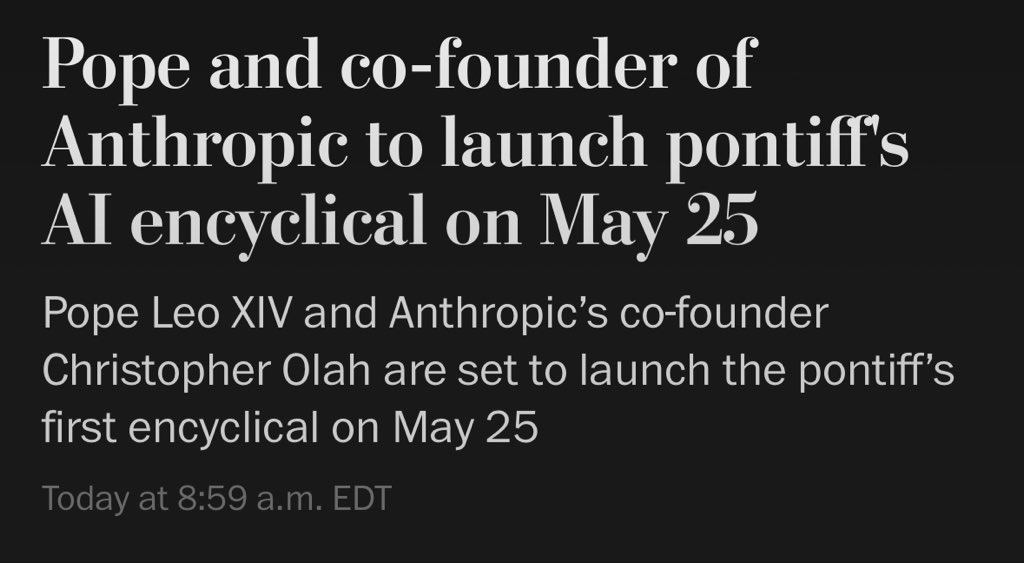
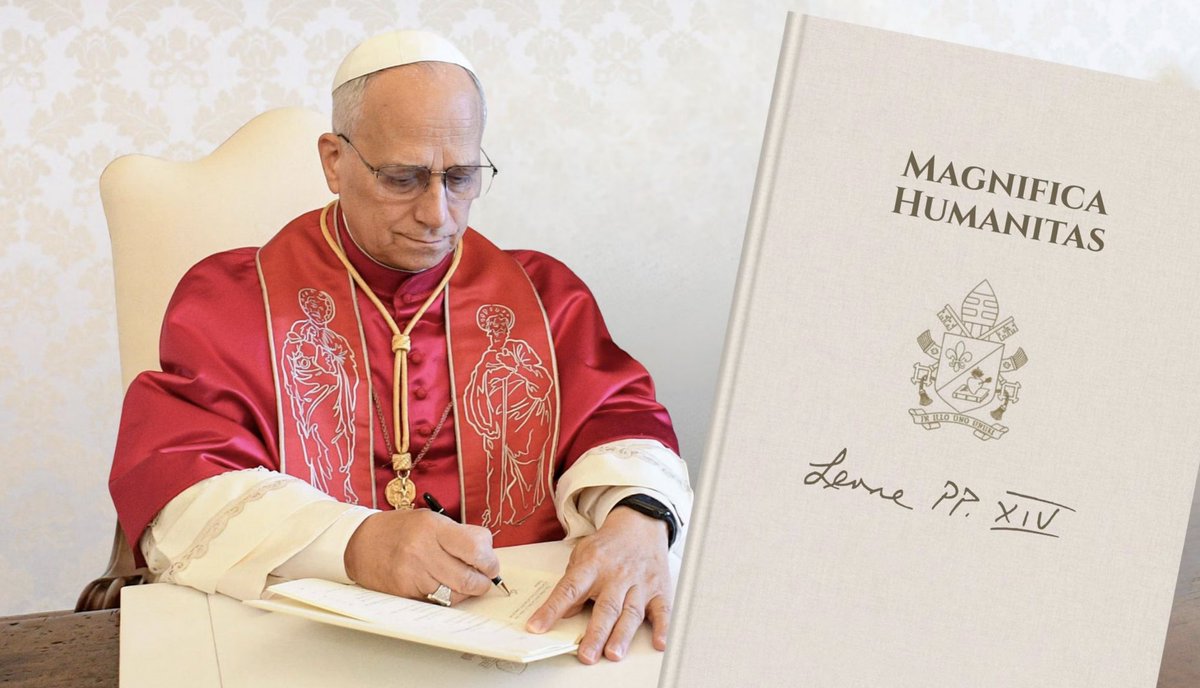
JUST IN: Vatican announces that Pope Leo XIV’s first encyclical — titled Magnifica Humanitas, on the safeguarding of the human person in the age of AI — will be presented at 11:30am on Monday, May 25, in the Vaticanʼs Synod Hall, in the presence of the Holy Father. Speakers at the presentation will include: Cardinal Víctor Manuel Fernández, Prefect of the Dicastery for the Doctrine of the Faith; Cardinal Michael Czerny, Prefect of the Dicastery for the Service of Integral Human Development; Professor Anna Rowlands, Political Theology, including Catholic Social Teaching, and theological ethics of human migration, Department of Theology and Religion, Durham University, United Kingdom; Christopher Olah, co-founder of Anthropic (USA) and head of interpretability research for artificial intelligence; Dr. Leocadie Lushombo, Political Theology and Catholic Social Thought, Jesuit School of Theology / Santa Clara University, California. Concluding remarks will be delivered by thel Secretary of State, Cardinal Pietro Parolin. The presentation will also include an address by Pope Leo XIV. Magnifica Humanitas was signed and dated on May 15, the 135th anniversary of the promulgation of Pope Leo XIII’s Encyclical Letter Rerum Novarum.
Diane Montagna tweet media
English
156
1.3K
6.6K
570.7K
Gabriela 🦋❤️‍🔥 retweetledi
Zak Slayback
Zak Slayback@zslayback·
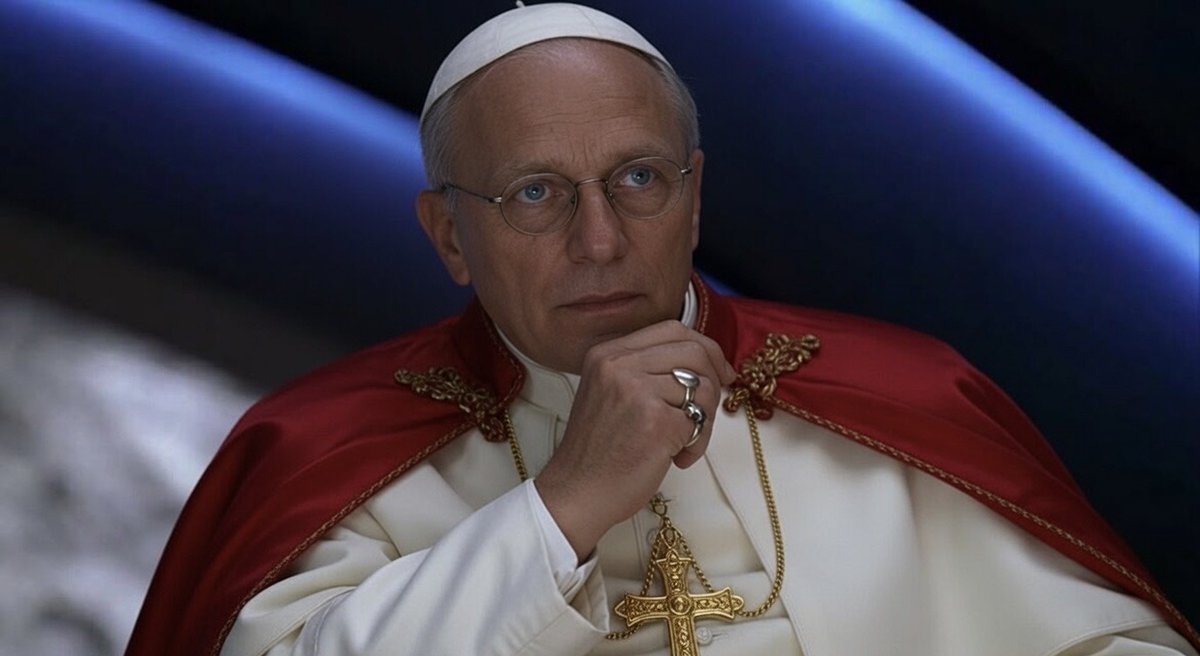
"The commentariat has prepared for a Butlerian Jihad. Now announce you'll have the cofounder of Anthropic help present the AI encyclical."
Zak Slayback tweet media
English
1
3
53
3.9K
nicole ruiz
nicole ruiz@nwilliams030·
@gmoipar pretty wild, i'm biased but seems like a good person to speak among many of the other listed speakers tho
English
1
0
1
68
Gabriela 🦋❤️‍🔥 retweetledi
Vivid Void
Vivid Void@vividvoid·
@QiaochuYuan Mine means "God is my strength", O Person of Outstanding Talent
English
2
0
8
620
QC
QC@QiaochuYuan·
cool thing about reading the bible is i’ll finally know what all the white people’s names mean
English
21
5
243
8.4K
Connor
Connor@connorgrasso_·
food in san fran
Connor tweet mediaConnor tweet mediaConnor tweet mediaConnor tweet media
English
3
2
41
3.4K