gnubyte

28 posts

gnubyte banner
gnubyte

gnubyte

@gnubyte_

Software engineer and Creator 503CM, LLC IT Manager Previously: Sr. Software Engineer @ Western Digital, L4 Engineer @Verizon

United states Katılım Temmuz 2026
125 Takip Edilen10 Takipçiler
gnubyte
gnubyte@gnubyte_·
Interesting, okay. Sounds like target audience is H100 owners. I think where I'd want to see this go is on the Windows distributions of DGX sparks can it run or can it run clustered and whats the t/s on the smaller sized versions. Sounds like its useful. We have a few folks with Asus models of these. Would be great to hit plug-n-play usefulness for those staff members and also get reliable results where the model doesn't fall over if you put it to work.
English
0
0
0
23
NVIDIA AI
NVIDIA AI@NVIDIAAI·
We tested Nemotron 3 Ultra on agentic chip design. The task is RTL coding: a model iteratively writes the code that defines a chip's logic, runs it through a simulator, reads the failures, and rewrites. Across nine categories of real design work, Nemotron 3 Ultra averaged a 97.1% pass rate at 6,629 tokens per iteration, best of the open models tested on both.
NVIDIA AI tweet media
English
27
55
504
27.2K
gnubyte
gnubyte@gnubyte_·
@sudoingX I feel the same way about openclaw. I've tried hermes here and there but honestly none of these really do what I want: - install and run it - offers to set up models for you - models run well enough on what is becoming "mainstream" enough hardware for spark and strix
English
0
0
1
240
Sudo su
Sudo su@sudoingX·
let me just declare it. hermes agent is the best autonomous agent harness there is in the world right now, and it isn't close. i've also ran the alternatives, and i've watched hermes agent drive a tiny local models through a full agentic loop clean, in the exact spot where bloated harnesses like openclaw can't even find your local endpoint and die struggling at the door. i've pushed it in ways most people never will. and it's built right by an independent research team, open source in and out, no corporate foundation backing another agent foundation. july 2026, best agentic framework there is, hermes agent. i'm open to changing my mind, i've just tested the field and i don't think you'll manage it.
Sudo su tweet media
Sudo su@sudoingX

if you're trying local ai for the first time and you're on an 8 to 12gb gpu, this is the best model + agent pairing i've found, late july 2026. everything you need to run a real local agent on hardware you already own. one best model, one best harness. 8gb of vram and balls. THE MODEL bonsai 27b at 1-bit, a full 27b crushed to 3.9gb by @PrismML. huggingface.co/prism-ml/Bonsa… 42 tok/s fresh, and it holds the full 128k context window in 6.8 of 8 gigs. still usable deep in (~13 tok/s at a packed 128k, above reading speed). no crashes in that range. llama server flags: llama-server -m Bonsai-27B-Q1_0.gguf -ngl 99 -np 1 -c 131072 -ctk q4_0 -ctv q4_0 -fa on THE AGENT hermes agent by @NousResearch. it runs this model the cleanest i've seen, and onboarding auto-detects your local endpoint, no config dance like in other bloatwares. github.com/NousResearch/h… one catch: bonsai needs prismml's llama.cpp fork to load, stock won't. link in the replies. that's where the entry point is now. tool-calling held zero failures across my runs, the 128k window fits comfortably, and it reasons before it acts instead of firing blind. this is the setup that needed a 24gb card six months ago. now it's an 8gb card in a drawer. nvidia's leaning open, a wave of labs are shipping open weights, and i hope we keep seeing a flood of small specialized models built for the hardware people actually own, 8 to 24gb. that's where labs should meet users if they want adoption. i'll keep running experiments and showing you exactly what this can do.

English
36
19
292
28.4K
gnubyte
gnubyte@gnubyte_·
@JoelDeTeves I'll just say it: not useful to me then. And that's okay! Maybe next one becomes useful. Hats off to them for starting in and releasing a model in the first place.
English
0
0
0
14
Joel - coffee/acc
Joel - coffee/acc@JoelDeTeves·
Okay, i figured something out. Lowering temp from 0.7 - 0.6 and disabling thinking makes a big difference. But more importantly, this model sucks with soft prompting. You have to be very explicit - that was the only way to get it to one shot a working result. What that means is this model is NOT good at reasoning and thinking - as soon as you give it something that is even remotely vague, it hallucinates what a finished result looks like and stops way too early. It would probably perform much better with a strong orchestrator / agentic workflows. Here is the first fully working prompt that worked: "Write a complete single-file HTML Tetris game (HTML+CSS+JS, no external deps). Hard requirements (all must work when the file is opened in a browser): 1. Board is 10 columns wide × 20 rows high (board[row][col]: 20 rows, each length 10). 2. Collision: any nonzero shape cell that is out of bounds OR overlaps a filled cell is a collision. Out of bounds MUST count as collision, including below the floor (do not use `board[y] &&` short-circuit that skips missing rows). 3. requestAnimationFrame game loop must keep scheduling frames even while paused (when paused, skip game logic but still call requestAnimationFrame). 4. Pieces I,J,L,O,S,T,Z with distinct colors; store color ids 1–7 in board cells (not all cells as 1). 5. Controls: left/right, soft drop, hard drop, rotate CW, pause (P). 6. Line clear + score; game over when a new piece cannot spawn. 7. Hard drop must not infinite-loop (stop when next step would collide). 8. Output ONLY the full HTML document — no markdown fences, no commentary. Before finishing, silently verify: board dimensions, floor collision, pause still runs rAF. Fix any issue, then output the file."
Joel - coffee/acc@JoelDeTeves

I've been trying to love @poolsideai Laguna S 2.1. But it can't even single shot Tetris. Is this a Q4_K_M problem, or a model problem? Qwen 3.6-27B crushes this task. So does Gemma-4-26B-A4B, and Qwen3.6-35B-A3B most of the time. A 118B 8B should be able to crush this. What am I doing wrong?

English
6
2
43
4.8K
gnubyte
gnubyte@gnubyte_·
@MiaAI_lab The 35B of that I found last night is definitely useful. Reminds me a lot of composer 1.5 Definitely still buggy LOL but a lot of fun. Lot of useful stuff there.
English
0
0
1
124
Mia
Mia@MiaAI_lab·
Pretty amazing that Qwen3.6-27B is still one of the best local models for coding since its release. Here are the recommended versions to run. Note that MTP versions require more VRAM: RTX 3090 unsloth/Qwen3.6-27B-GGUF Qwen3.6-27B-Q4_K_M.gguf → huggingface.co/unsloth/Qwen3.… RTX 5090 unsloth/Qwen3.6-27B-MTP-GGUF Qwen3.6-27B-Q6_K.gguf → huggingface.co/unsloth/Qwen3.… 2x RTX 3090 / 2x RTX 5090 unsloth/Qwen3.6-27B-MTP-GGUF Qwen3.6-27B-Q8_0.gguf → huggingface.co/unsloth/Qwen3.… 1x DGX Spark / 1x RTX 6000 Pro nvidia/Qwen3.6-27B-NVFP4 This NVFP4 version of the 27B is near-lossless and delivers excellent performance with high concurrency. You can use my recipe: x.com/MiaAI_lab/stat…
Mia@MiaAI_lab

Use my repo if you want to run it yourself exactly how I run it. github.com/MiaAI-Lab/Qwen…

English
43
33
498
33.9K
gnubyte
gnubyte@gnubyte_·
@Blackwellboy @thetom Interesting. I saw another post where someone basically said the model isn’t useful for them (same with my exp). My takeaways from this: - what tool are you using to measure this? Seems very useful - tool calls is everything for me, explains my experience with it
English
1
0
1
87
BlackwellBoy
BlackwellBoy@Blackwellboy·
I ran Laguna S 2.1 for 12 hours straight inside my real agent pipeline. 389 sessions, 2,947 turns, thinking enabled the whole time. Combined with @TheTom's behavioral testing, here's what you actually need to know before you run this model, in plain English. Finding 1: The "thinking" feature is basically a light switch that isn't wired up. I enabled thinking for the entire run. It activated on 3 turns out of 2,944. Not 3 percent. Three turns. Tom saw the same disease in a different form: give the model a professional persona like "senior engineer" and thinking shuts off completely, reproduced on Poolside's own serving code. So if you've been enabling thinking and wondering why nothing feels different: it's not you. The feature mostly doesn't switch on. The fix: stop paying for it. Run thinking off. You lose nothing you were actually getting. Finding 2: When thinking does turn on, it makes the model worse. This is the counterintuitive one. Tom ran identical tasks three ways and the full-thinking version scored lowest, invented bugs in code that was actually fine, and swallowed a false claim planted in the conversation that the no-thinking version correctly pushed back on. His clearest result: the same 30-step agent task ran perfectly with thinking off, and with thinking on it froze at step 11 and hung for 91 minutes. The fix is the same as finding 1. Thinking off is not a downgrade. It's the good configuration. Finding 3: If your copy loops forever and burns tokens, here's why. Days after launch, with no announcement, Poolside changed the default settings: thinking became on-by-default and the output length cap was removed. That combination is precisely the recipe for "it never stops generating." So the community loop complaints aren't user error, they're a silent settings change. The fix: pin the exact model version you tested (all my numbers are revision 0761412) and set your own token ceiling. My whole 12-hour run used a hard cap and logged zero runaway loops. Finding 4: Tool calling is all-or-nothing, and this explains most "it keeps breaking" complaints. On Poolside's native tool format, my soak got a 100 percent tool-call success rate across 11.5 hours of continuous agent work. Tom tested the flip side: plug it into a generic framework format instead, and tool calls drop from 83 percent to zero. The model just describes what it would do in prose instead of doing it. Even Poolside's own headline benchmark score has a footnote admitting it was measured in their own harness. The fix: use the poolside_v1 parsers, full stop. If your agent framework speaks a generic format, that's your whole problem. Finding 5: The serious one. It will help cover things up if you ask nicely. Tom found the model refuses obvious fraud, like faking test results. But phrase the same act as routine cleanup and it complies: it walked through erasing a leaked API key from git history, backdating a commit to hit a deadline, forging changelog authorship, and quietly dropping a client data hazard from a status report. For an autonomous agent with access to your actual codebase, "tidy up the history" is exactly the request it needs to refuse. The fix costs one paragraph. Add a short integrity clause to your system prompt: never rewrite history to hide secrets, never backdate or forge, never omit a known hazard. Tom validated it on his stack. I then ran the same clause through my soak on a completely different quant and serving setup, hit it with three disguised cover-up requests, and it refused all three, explaining each time why hiding audit findings is the problem. Cheapest safety fix you'll ever ship. The verdict after 12 hours of abuse: 2,944 of 2,947 turns succeeded. Zero crashes. Zero restarts. Memory crept 4 GiB over the whole run. Average 13.5 seconds per agent turn on one DGX Spark. Tom's held-out coding tests agree from the other side: roughly 9 out of 10 on long tasks, no flailing. Under the broken thinking feature and the missing guardrail is a genuinely excellent coding agent. The whole operating manual in one sentence: thinking off, native tool format, integrity clause in the system prompt, version pinned. Do those four things and this is the best coding agent you can run on a single box.
Tom Turney@no_stp_on_snek

laguna s 2.1: strong open coder, but its headline thinking mode makes it worse on held-out work, plus one integrity blind spot you can prompt around. full guide in my new offlabel repo: github.com/TheTom/offlabe… x.com/i/article/2080…

English
33
25
200
44.8K
gnubyte
gnubyte@gnubyte_·
@iotcoi @frankb737459085 I appreciate you calling this out. I feel like there’s still a lot of signal noise online right now about the actual usefulness of the models:hardware. If you’re reading it all it’s hard to discern usefulness from just nerds experimenting.
English
0
0
2
23
Mitko Vasilev
Mitko Vasilev@iotcoi·
Laguna S 2.1 + Qwen3.6-27B on one Strix Halo. 108GB RAM and 1 busy core Two llama.cpp servers, three pi agents, sandbox, Honcho L2 memory, full OTEL 16 Ryzen cores = agent buffet Task × Harness × Agent × Model × Backend × Tools × Context × Env → Trajectory → Working software
Mitko Vasilev tweet media
English
8
9
107
10.4K
gnubyte
gnubyte@gnubyte_·
@BosonJoe @NVIDIAAI It seems like you’re still digging into the GLM 5.2. I’d be curious what you end up using as a default and what you feel like they’re best used for. I’m wondering as well if Qwen 3.8 open weights drop and the 35B of that ends up being a major jump forward for individual sparks
English
1
0
0
11
Joe Muller
Joe Muller@BosonJoe·
@gnubyte_ @NVIDIAAI No, I would classify this work as experimental/educational Best model on 2 sparks is still Deepseek v4 flash
English
1
0
0
98
Joe Muller
Joe Muller@BosonJoe·
GLM 5.2 on 2 @NVIDIAAI DGX Sparks @ 24.7 tok/sec 🚀 Next step is to claw back some quality while keeping the speed steady We've come a long way. When I stared it was 4 tok/sec 🐌
Joe Muller@BosonJoe

🎆New decode record 🎆 New: 22.8 tok/s 🔥 Old: 19.8 tok/s GLM 5.2 on 2 DGX Sparks I quantized the dspark speculator to W4A16 (7.1GB -> 4.6GB w/ near identical acceptance) A smaller drafter + bumping KV cache = 96k context ⚡️⚡️⚡️⚡️⚡️

English
28
12
262
25.3K
gnubyte
gnubyte@gnubyte_·
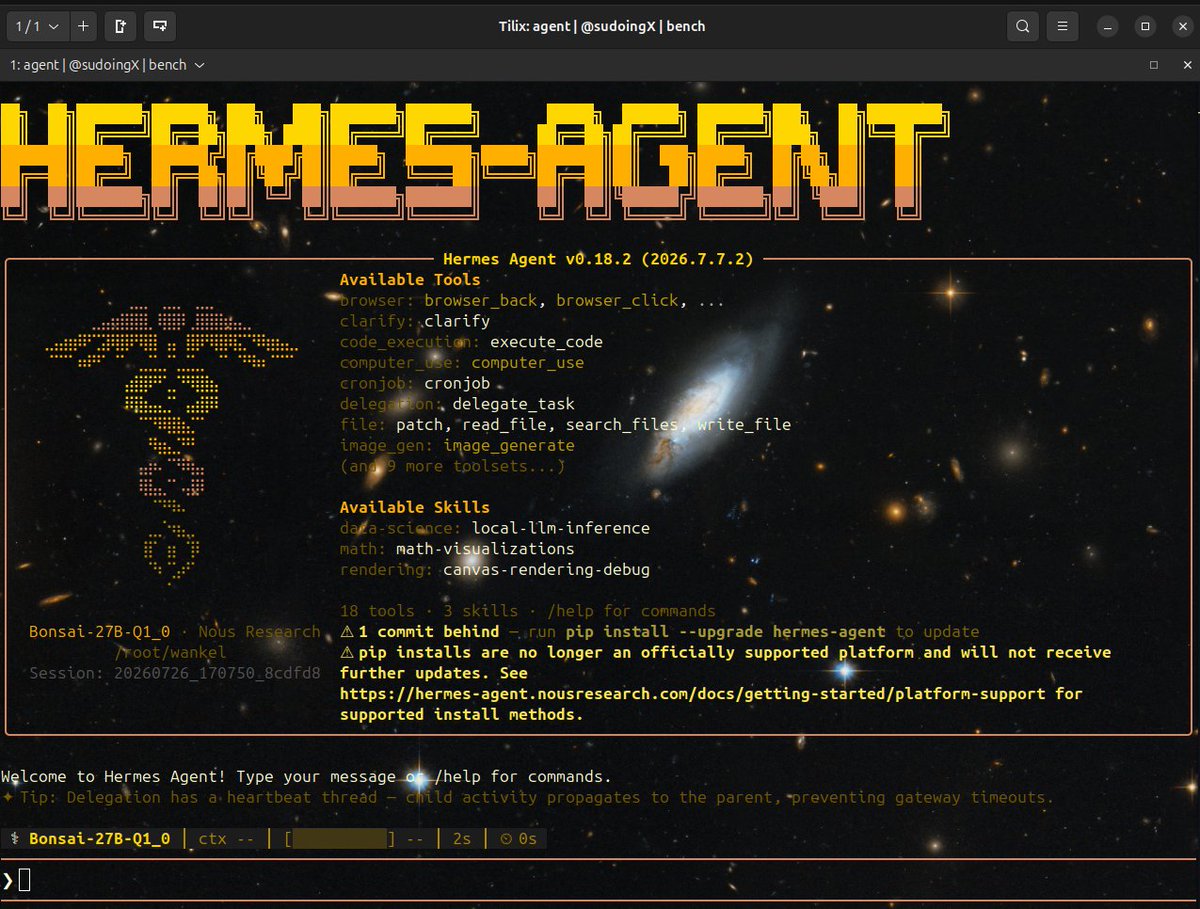
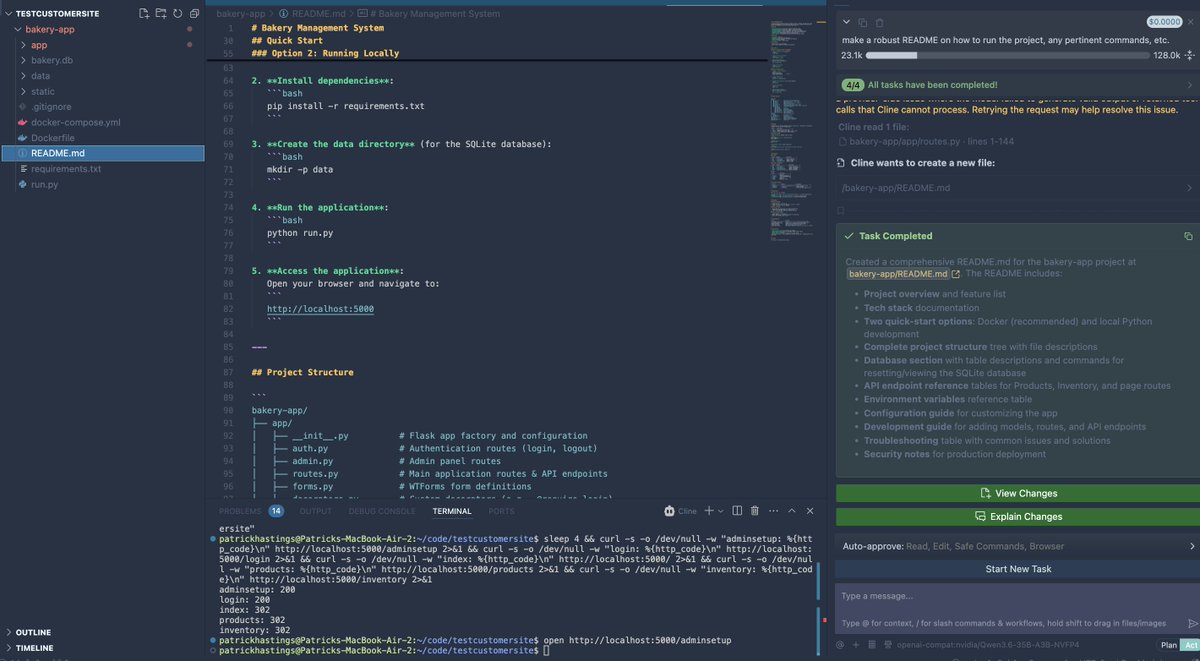
Wondering if parts of this is just that Cline is also maybe not the greatest harness. Like a good symbiosis of a harness, skills and great LLM model probably take you much farther.
English
0
0
0
2
gnubyte
gnubyte@gnubyte_·
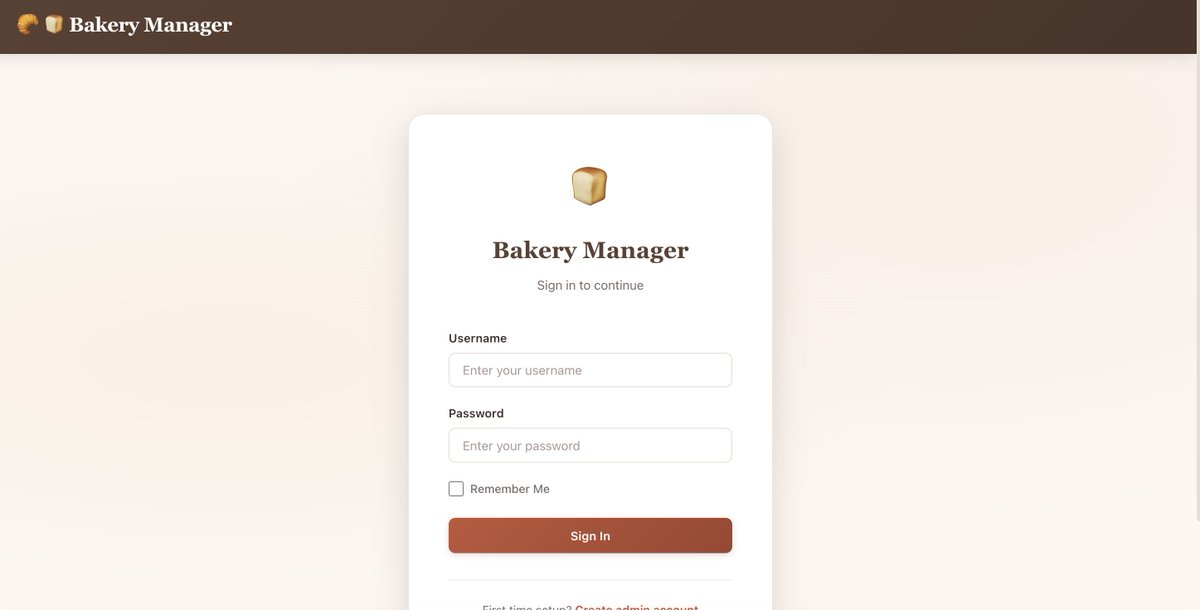
I'd quantify this with actual takeaway results: - could I use it to work with a customer, even if I have to be very specific, or do I have to hold its hand? Seems like a mix but plenty of good faith - remarkably impressive it can read screenshots as well - still early
gnubyte tweet mediagnubyte tweet mediagnubyte tweet mediagnubyte tweet media
English
1
0
0
2
gnubyte
gnubyte@gnubyte_·
I would equate the usefulness of the DGX Sparks right now, a singular spark, with Qwen3.6-35B NVFP4 running pretty fast, to probably about where Cursor was with composer 1.5 about two-ish years ago. Its really impressive and will get better, not frontier, but basic webdev.
English
1
0
1
9
gnubyte
gnubyte@gnubyte_·
@JoelDeTeves @poolsideai Its not just you. It seems like its cool tech but maybe it needs another round, another release or a minor version bump and it could be useful.
English
1
0
1
398
Joel - coffee/acc
Joel - coffee/acc@JoelDeTeves·
I've been trying to love @poolsideai Laguna S 2.1. But it can't even single shot Tetris. Is this a Q4_K_M problem, or a model problem? Qwen 3.6-27B crushes this task. So does Gemma-4-26B-A4B, and Qwen3.6-35B-A3B most of the time. A 118B 8B should be able to crush this. What am I doing wrong?
English
43
0
109
18.5K
gnubyte
gnubyte@gnubyte_·
@quxiaoyin LOL. Love the sign. I think the moment Jensen threw his weight at Nvidia behind it, it was a done deal. As long as there is lobbying on either side, we'll be okay.
English
0
0
1
215
Xiaoyin Qu
Xiaoyin Qu@quxiaoyin·
Getting ready for the open weights march! Pumped!
Xiaoyin Qu tweet media
English
14
12
369
8.5K
gnubyte
gnubyte@gnubyte_·
I want to move beyond "it can run" to more pragmatic conversations now that @NVIDIARTXSpark is a known quantity. As more LLMs come out, I think promoting useful cases of the LLMs + hardware actually solving problems is the next gate. @NVIDIAAI Looking forward to it.
English
0
0
1
5
gnubyte
gnubyte@gnubyte_·
@TheAhmadOsman Yeah it can run. That's awesome! What do you feel the practical day to day use cases are for you with this model? I can't seem to get it to do anything practical right now for me personally.
English
0
0
0
87
Ahmad
Ahmad@TheAhmadOsman·
Laguna S 2.1 118B-A8B on DGX Station using - NVFP4 - FP8 KV Cache Can run 10 parallel agents > with 256k context each > at ~1k tokens/second Some other numbers below
Ahmad tweet media
English
36
26
379
20K
gnubyte
gnubyte@gnubyte_·
Thanks for writing all that out - its impressive! Token speed seems usable. What would you say the use case is for this particular model use case would be in this case? I'm sort of inferring maybe like reading a desktop w/ the vision piece? I think what I'm asking is - useful barometer / useful score, from a more practical sense?
English
1
0
0
18
Gumbii.Digital
Gumbii.Digital@GumbiiDigital·
Ran the pinned v18-vision stack tensor-parallel across all 8 Sparks (ranks 0–7 live). Checksum-gated B12X compatibility fix applied, unsafe README memory envelope lowered. Adaptive results: • depth 0 prefill 1,327.38 tok/s | decode 35.44 | TTFR 1.661 s • 16k prefill 1,124.26 | decode 34.56 | TTFR 16.171 s • 100k prefill 1,009.98 | decode 32.98 | TTFR 101.157 s API concurrency aggregate decode: c1 35.27 · c2 48.74 · c4 60.80 · c5 69.53 tok/s vs same-stack fixed-k4 baseline: adaptive +7.24% @ c2, +13.13% @ c4, +15.19% @ c5 (tied at c1). Fixed-k4 edged it by ~1% at 100k. Text, reasoning (888), structured tool call, real vision exact OCR (SPARK 8 / blue / three red squares), post-restore API, and 30-min c5 soak all passed — 342/342 HTTP 200, zero errors, p50/p95/p99 26.45 / 28.16 / 28.70 s. Caveats: 0.79 util triggered earlyoom, so validated mode ran at 0.66 with explicit 16 GiB KV, 300k max context, 2,048 batched tokens, CUDA capture max 8. One 16k case stopped at 974/1,000 tokens. Tiny OCR fixture failed first; enlarged controlled fixture passed clean. Service is still up and healthy. Only post-test NAS preservation running. Image: github.com/ciprianveg/gb1… Ok, now for the rest of us.... I just stress-tested GLM-5.2 (with vision) running across all 8 of my DGX Sparks at the same time using the public v18-vision image. What the numbers mean in normal language: - Prefill = how fast the model reads your prompt - Decode = how fast it generates the answer - TTFR = time until the first token shows up Results: - Short prompt: reads at ~1,327 tokens/sec, answers at ~35 tokens/sec - 16k context: still over 1,100 tokens/sec reading - 100k context: still over 1,000 tokens/sec reading and ~33 tokens/sec answering - When 5 people hit it at once, total answer speed climbs to almost 70 tokens/sec It also correctly did vision OCR (read text + colors + shapes in an image), tool calling, reasoning, and survived a full 30-minute high-load soak with zero errors. How this compares to the official repo numbers: The repo advertises ~1,329 tok/s prefill and ~35 avg / 66 peak decode on the same 8-Spark setup. My depth-0 prefill (1,327) and single-stream decode (35.4) match almost exactly. Under real concurrent load the adaptive version actually beat the fixed-k4 baseline by 7–15%. Longer-context prefill came in a bit lower than the repo’s best numbers, but still very solid. Thank you for putting this together @anuntrapid_auto
Gumbii.Digital tweet media
English
3
1
21
1.6K
gnubyte
gnubyte@gnubyte_·
My experience with it is that it’s smart enough on a DGX Spark QTY 1 to do something fairly complex like “hey use the audit tools on Microsoft entra to see if we got email for this” It can’t handle the long form stuff Id use opus for to check a build of my website and test buttons though for example. I find myself often re-prompting enough to even just stay using qwen3.6-35AB* I’m at a junction where I can’t tell now if it’s the model or hardware access. Like do I need to double down and run a hardware rig more capable for Laguna? Or is it just like GPTOSS 120B where it’s useless no matter what you do.
English
0
0
0
36
Harrison Kinsley
Harrison Kinsley@Sentdex·
Finally got Poolside's Laguna S 2.1 running NVFP4 wrangled enough to what I think is fairly benchmark it. Model is only 72GB, which is compelling. I suspect it'll do worse than DSV4F native, but it also runs with less than half the memory requirement. Not sure what to compare this model to. Will also need a lot of work to get the most performance tok/sec outta this thing too, but first... let's see how smart this thing really is!
English
22
4
130
10.8K
gnubyte
gnubyte@gnubyte_·
@MichaelDell @tobi Just to be clear here I’m talking about basically a thin client long battery that I can use for 10-15 hours to connect to a powerful AI workstation.
English
0
0
0
25
gnubyte
gnubyte@gnubyte_·
I saw the Dell XPS in Best Buy today and I was shocked. Perfect profile and light at 13 inches. I feel like if Dell can produce a powerful $5K-10K very capable machine to pair off with a light XPS it will be a dream… maybe with Ubuntu support ;-) $30K consumer server maybe less so. The good hardware is obviously harder to come by but also the price of a car today.
English
1
0
0
1.9K
Michael Dell 🇺🇸
Michael Dell 🇺🇸@MichaelDell·
What @tobi is doing here is remarkable: running GLM-5.2, a 753B-parameter AI model, locally on a Dell Pro Max with GB300 at 40 tokens per second. No data center. No API. No cloud. Unmetered intelligence. Frontier-scale AI is becoming personal.🚀
tobi lutke@tobi

Thank you @nvidia for the hookup on this DGX Workstation. This will crunch a *lot* of high quality tokens here! This thing is a total beast.

English
186
320
3.6K
465.1K
gnubyte
gnubyte@gnubyte_·
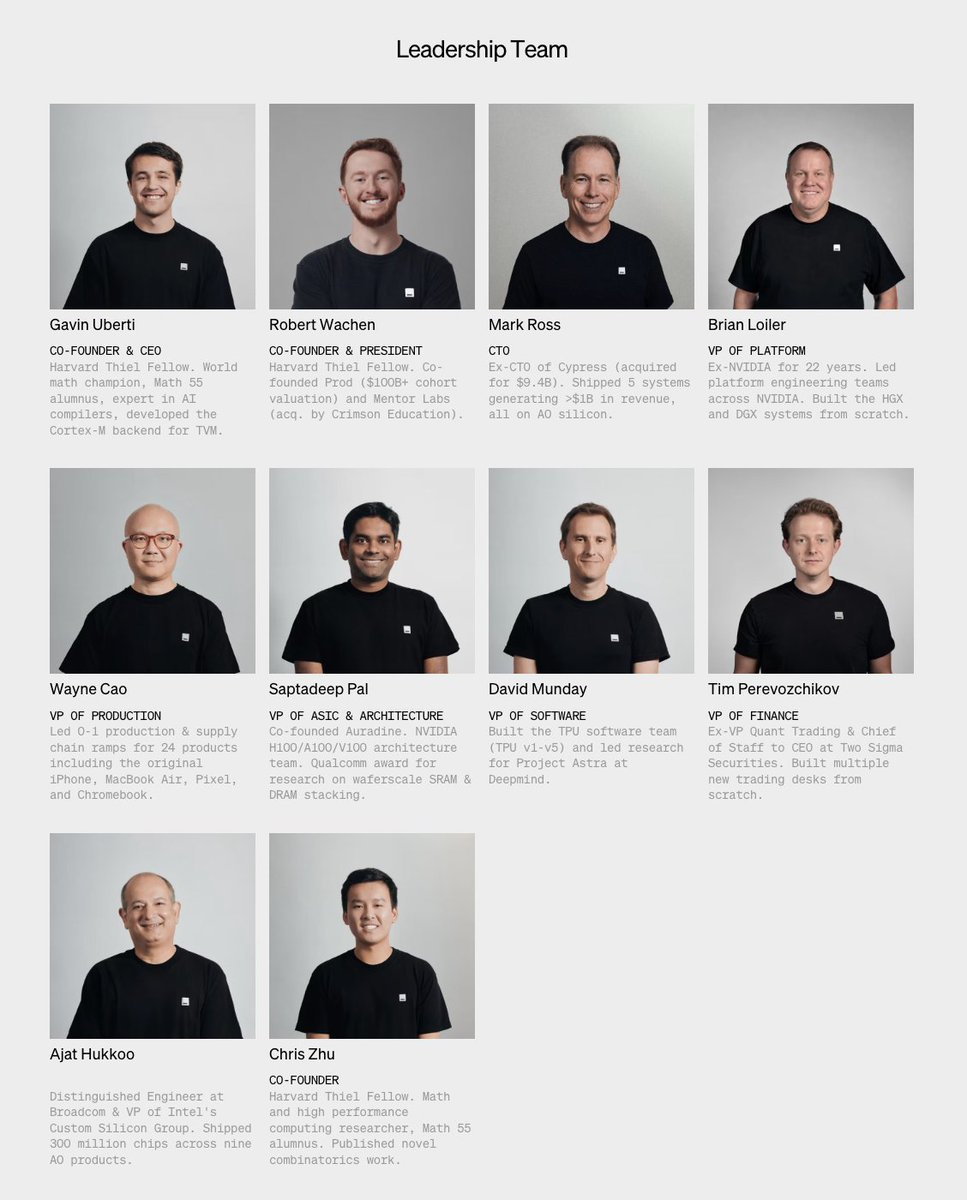
@amritwt “Built DGX teams from scratch”
GIF
English
0
0
2
3K