@jefftomich Yes insolation and thus solar module output goes up as sulfate aerosols go down. I know projections of solar output can be low if they are based on historical insolation data prior to the 1990 Clean Air Act amendments and resulting reductions in SO2.
Attorney for ag groups in Missouri Grain Belt Express hearing just asked Invenergy witness if lower SO2 levels in atmosphere will affect solar production. Is this a thing?
Pedantry Alert! 👨🎓
A GridStrategies report points to the increasing congestion rents reported by the ISOs to evidence the increasing cost of generation driven by congestion. But congestion rents and congestion costs are not the same thing.
🧵
gridprogress.files.wordpress.com/2023/04/transm…
1/8
New reports coming out next week:
Energy & ancillary market reforms are needed in MISO and PJM to level the playing field and allow wind, solar, and battery storage to fairly compete and utilize their full capabilities.
Link to register: acore.secure.nonprofitsoapbox.com/marketscanpower
Are there any battery storage systems that have been installed in the US to date with grid-forming inverters that are capable of providing blackstart service?
If there are examples / case studies, I'd love to see them!
Great article discussing the game-changing provisions in legislation being proposed today to facilitate paying for and permitting electricity transmission, which Grid Strategies estimates will reduce CO2 emissions by hundreds of millions of tons per year.
theatlantic.com/science/archiv…
@AlexEpstein Wind provides 32% of the electricity for the grid operator in Oklahoma, Nebraska, Kansas, and neighboring states, and power prices there are low and getting lower. Add solar, and our existing nuclear and hydro, and 80% is easy. spglobal.com/platts/en/mark…
The most persuasive argument for the reconciliation bill's radical policy of 80% "clean electricity" by 2030 is that other countries are already at 80%. But this is BS because those countries, unlike us, can use huge amounts of 1) nuclear, 2) hydro, or 3) imported power.
THREAD
#transmission planning is SO important and we KNOW how to do it but it isn't happening? Reasons? Read this report. Solutions? Read this report. Want action? Send a comment in to @FERC in docket RM21-17 by Tuesday. Thread. 1/8 gridprogress.files.wordpress.com/2021/10/transm…
“Extreme weather typically only affects a limited area, so expanding the power grid is one of the best ways to protect consumers & national security." - @gogginmichael, Grid Strategies LLC
Learn more about the value of additional transmission:
acore.org/transmission-m…
@TabakGabe@electronecon The ramp rate number I’ve heard for wind is 10% of nameplate capacity per second, i.e. full ramp in ten seconds. Going up to 100% may be slower. Wind has no minimum load and can tightly follow AGC if it was installed with that capability. For more see nrel.gov/docs/fy14osti/…
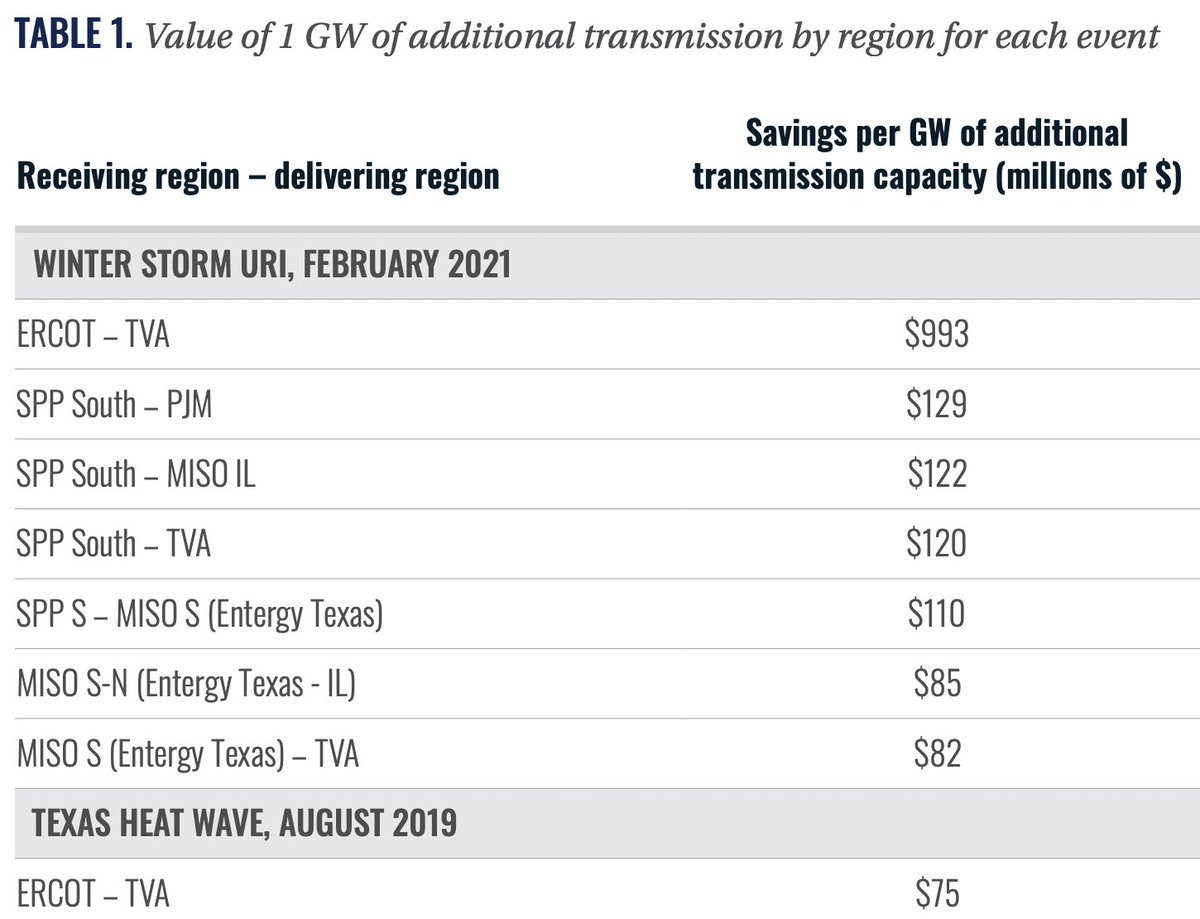
With better transmission interconnections to neighboring states, Texas could have saved around a billion dollars in winter storm Uri in Feb. 2021. Similar findings in other regions: more transmission = millions in savings through bad weather. acore.org/wp-content/upl…
President Biden: “Our grids are vulnerable to storms, hacks, and catastrophic failures, with tragic results as we saw in Texas and elsewhere during winter storms. (1/2)
@TabakGabe@brendanpierpont@daveregrets@WYOHensley Page 214 (272 in pdf) in Wind Vision report has land use stats for obtaining 20% and 35% of US electricity from wind. They assume 3% of land within the wind plant is actually occupied or transformed, based on USGS satellite analysis.
energy.gov/sites/prod/fil…