gokul
188 posts

gokul
@gokulp01
PhD candidate @UofIllinois (UIUC) @CSL_Illinois | Current: robotics research intern @Nvidia | ex-research science intern @Adobe Research
Champaign, IL Katılım Eylül 2017
3.4K Takip Edilen554 Takipçiler
Sabitlenmiş Tweet

We are presenting Muninn at RSS 2026, and we're incredibly honored that it has been selected as a finalist for both the Outstanding Paper & Outstanding Student Paper awards! #RSS2026
TL;DR: diffusion planners generate great robot trajectories, but nobody wants 100 denoiser calls inside a control loop. Existing speedups (truncation, distillation, fixed skipping) trade quality for speed in ways you can't predict before deployment. Muninn is a training-free wrapper that skips denoiser calls only when it can certify the final plan stays within your tolerance 🧵 (1/9)
📄 Paper: arxiv.org/abs/2605.09999
💻 Code: github.com/gokulp01/Muninn
English

We are presenting Muninn at RSS 2026, and we're incredibly honored that it has been selected as a finalist for both the Outstanding Paper & Outstanding Student Paper awards! #RSS2026
TL;DR: diffusion planners generate great robot trajectories, but nobody wants 100 denoiser calls inside a control loop. Existing speedups (truncation, distillation, fixed skipping) trade quality for speed in ways you can't predict before deployment. Muninn is a training-free wrapper that skips denoiser calls only when it can certify the final plan stays within your tolerance 🧵 (1/9)
📄 Paper: arxiv.org/abs/2605.09999
💻 Code: github.com/gokulp01/Muninn
English
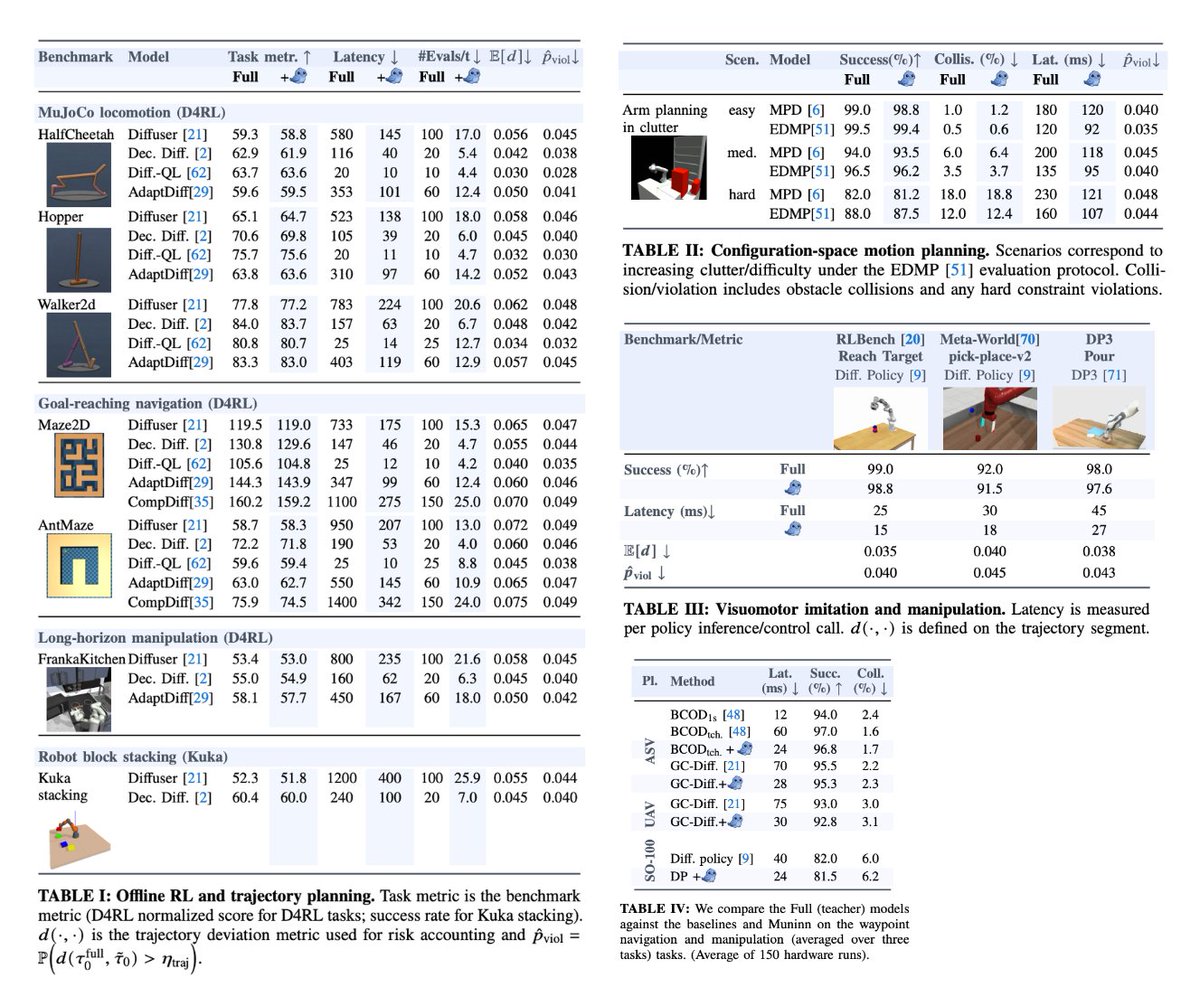
Muninn is training-free, never touches your model's weights or sampler, and composes with distilled/few-step models — it removes the per-step redundancy that remains even there! (9/9)
We are presenting Muninn at RSS on July 15 (today!), please stop by!
📄 Paper: arxiv.org/abs/2605.09999
💻 Code: github.com/gokulp01/Muninn
More videos below 👇
English

Because Muninn tracks its deviation bound online, you also get a runtime health signal. In closed-loop deployments in marine navigation, aerial navigation and manipulation, the tracked bound spikes right at near-collision and contact events (a natural trigger for escalating to full compute or a conservative safety controller). Hardware speedups: upto 2.5×, with success rates matching the full models. (8/9)
English

The reuse pattern itself turned out to be informative. Muninn's compute concentrates where planning is hard: episodes in open space settle around ~12 denoiser evals, tight-clearance scenes climb to ~22 without anyone telling it what "hard" means. Fixed accelerations spend identically everywhere; Muninn reallocates compute to the risky moments for free. (7/9)
English

At deployment you pick two numbers: how much final-trajectory deviation you can tolerate, and what failure probability you can accept. Muninn then decides, step by step and per sample, whether to reuse or recompute, and guarantees the accelerated planner stays within your tolerance with the probability you asked for. Interpretable knobs, no schedule tuning, no per-task magic constants. (5/9)
English

Muninn connects the two offline. We run the planner at full compute on calibration rollouts and, at every step, also log what the error would have been had we reused the cached output (a "ghost" reuse chain). Conformal prediction on these pairs yields an upper bound on reuse error as a function of the probe signal, valid without assumptions on the model or the error distribution. (4/9)

English

We realized trajectory diffusion planners expose two signals that make safe reuse predictable: (1) the denoiser's input stem is cheap to run, and when its features stop changing between consecutive steps, the full output has usually stabilized too; (2) for DDPM/DDIM-style samplers the update is analytic, so you can compute how much an error injected at step t gets amplified by the end of the chain. One tells you how wrong reuse might be, the other tells you how much that wrongness matters. (3/9)

English

Why is caching hard here? Because a reused denoiser output is not a local approximation. The sampler mixes it back into every timestep of the plan, errors compound over the remaining steps, and control objectives are discontinuous: two trajectories that look nearly identical can be the difference between reaching the goal and hitting the obstacle. Skip heuristics tuned on average behavior fail exactly in the states where you can't afford it. (2/9)

English

Very cool line of work! We build on Drifting Models in our v recent work on Keyed Drifting Policies to get one-step, condition-aware trajectory planning for offline RL and robotics. diffusion-like planning behavior, without the denoising loop (:
Goodeat@Goodeat258
We’ve released the code for Drifting Models :) Includes full training, inference, and pretrained weights. Curious to see what people build on top of this. github.com/lambertae/drif…
English

VLAs have become the fastest-growing subfield in robot learning. So where are we now?
After reviewing ICLR 2026 submissions and conversations at CoRL, I wrote an overview of the current state of VLA research with some personal takes:
is.gd/1pqw9w
English
gokul retweetledi

Well, this aged well...

The Nobel Prize@NobelPrize
BREAKING NEWS The Royal Swedish Academy of Sciences has decided to award the 2025 #NobelPrize in Physics to John Clarke, Michel H. Devoret and John M. Martinis “for the discovery of macroscopic quantum mechanical tunnelling and energy quantisation in an electric circuit.”
English

@TimDarcet Oh sorry, I meant this as a reply to your original post. But this is one’s fine as well 🤷
English

@TimDarcet proceedings.mlr.press/v80/balles18a/…
@TimDarcet I believe this would help — equation 7, 8, 9 is possibly what you are looking for
English