Leonardo Perez

5.4K posts

Leonardo Perez

Leonardo Perez

@leoperzz

Mathematics @pucp | Robot Learning | building @0xnonhuman & @robonet_

Katılım Aralık 2021
222 Takip Edilen219 Takipçiler
Jiafei Duan
Jiafei Duan@DJiafei·
Finally back in Singapore 🇸🇬! Excited to start my first day at @NUSComputing and joint appointment with @ASTARsg ! I’m excited to contribute to Singapore’s Embodied AI landscape, which has grown tremendously since I left for my PhD four years ago. If you’re working on Physical AI in Singapore, feel free to reach out, I’d love to chat about potential collaborations and opportunities!
Jiafei Duan tweet media
English
14
4
207
7K
gokul
gokul@gokulp01·
We are presenting Muninn at RSS 2026, and we're incredibly honored that it has been selected as a finalist for both the Outstanding Paper & Outstanding Student Paper awards! #RSS2026 TL;DR: diffusion planners generate great robot trajectories, but nobody wants 100 denoiser calls inside a control loop. Existing speedups (truncation, distillation, fixed skipping) trade quality for speed in ways you can't predict before deployment. Muninn is a training-free wrapper that skips denoiser calls only when it can certify the final plan stays within your tolerance 🧵 (1/9) 📄 Paper: arxiv.org/abs/2605.09999 💻 Code: github.com/gokulp01/Muninn
English
3
0
30
2.4K
Leonardo Perez retweetledi
Brik H. Meza
Brik H. Meza@autobrik·
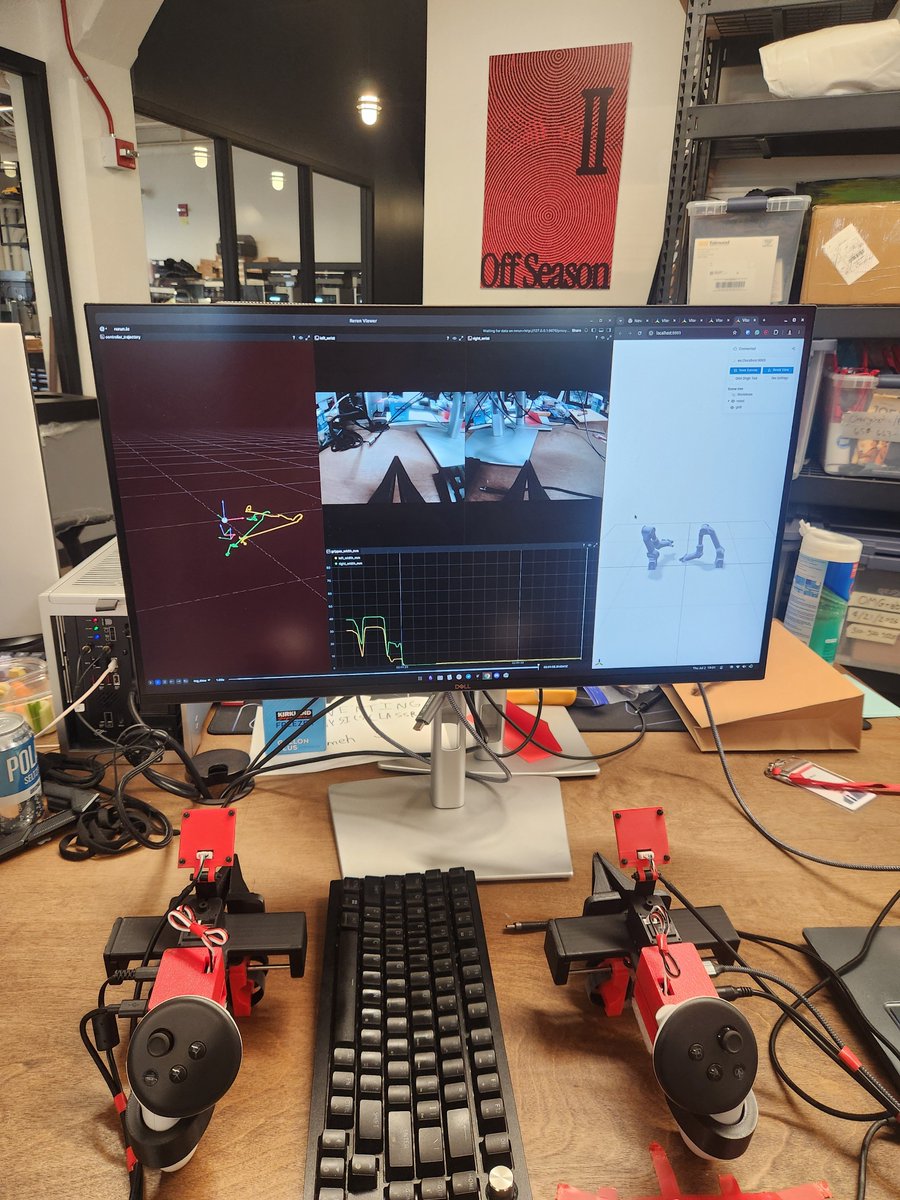
@raulb4s and @mbrq_13 testing teleop with HandUMI at the @0xnonhuman lab in Peru 🇵🇪, 7,250 km away from SF. This is part of the tests to make sure the IK works correctly and that the data collected with HandUMI feels like teleoperated data, but much cheaper. The complete software will be open sourced in the coming days! Data collection, teleop in sim and in real, data postprocessing, etc. Stay tuned! Want to collaborate on HandUMI or build your own? Join our Discord: discord.gg/V47FuUkFA
English
2
10
14
450
Brik H. Meza
Brik H. Meza@autobrik·
Why do people keep collecting data with teleoperation when a bimanual robot setup costs more than $10k? Isn't there a solution that gives you the same data quality without the robot? At @robonet_, we want to build the Internet of Robotics. As part of that mission, we built HandUMI, a hand-worn data collection device for bimanual arms with parallel-jaw grippers. Specs per unit: - 276.5 grams - $110.68 - Encoder-precision gripper aperture - Integrated wrist camera - Tracking with the VR headset of your choice (Pico/Quest) - More than 5 grippers supported (Piper, Trossen, ARX, Soft gripper, Dream gripper) The best part: all the hardware is open source! Thanks @fdotinc for the hardware lab and the space to make this possible. ft. @alvax64 @leoperzz @raulb4s @mbrq_13 @BryanBRstds @Aryan_Mangla_ , and the rest of the @0xnonhuman team.
Brik H. Meza tweet media
English
16
25
147
15.9K
Leonardo Perez
Leonardo Perez@leoperzz·
Hardware is open source and the software is coming this week. Stay tuned👀
Brik H. Meza@autobrik

Why do people keep collecting data with teleoperation when a bimanual robot setup costs more than $10k? Isn't there a solution that gives you the same data quality without the robot? At @robonet_, we want to build the Internet of Robotics. As part of that mission, we built HandUMI, a hand-worn data collection device for bimanual arms with parallel-jaw grippers. Specs per unit: - 276.5 grams - $110.68 - Encoder-precision gripper aperture - Integrated wrist camera - Tracking with the VR headset of your choice (Pico/Quest) - More than 5 grippers supported (Piper, Trossen, ARX, Soft gripper, Dream gripper) The best part: all the hardware is open source! Thanks @fdotinc for the hardware lab and the space to make this possible. ft. @alvax64 @leoperzz @raulb4s @mbrq_13 @BryanBRstds @Aryan_Mangla_ , and the rest of the @0xnonhuman team.

English
0
0
2
232
Leonardo Perez retweetledi
Brik H. Meza
Brik H. Meza@autobrik·
Who is struggling with data collection for robotics? Stay tuned tomorrow, and you will save up to 8x on data collection costs. Building at Fuera de temporada II @fdotinc
Brik H. Meza tweet media
English
0
2
10
442
Leonardo Perez retweetledi
Yen-Jen Wang
Yen-Jen Wang@wangyenjen·
How can we scale perception-based humanoid learning without collecting massive humanoid teleoperation data? 🚀 Excited to finally share VLK! What excites me most about VLK is that it reframes data collection as a data generation problem. Instead of relying on expensive humanoid teleoperation, we automatically generate synchronized vision, language, and whole-body kinematics from reconstructed real-world scenes. Making this vision a reality required bridging three fundamental challenges: 👀 Perception: Bridging the RGB sim → real gap through visual domain randomization and motion blur mitigation during both training and deployment. 🤖 Embodiment: Bridging the kinematics → dynamics gap with real-time VLA deployment, test-time RTC, and SceneBot, enabling seamless deployment on a real humanoid. 🌍 Environment: Bridging the real-world → synthetic gap to enable scalable Vision-Language-Kinematics data generation through scene reconstruction and interaction synthesis. It has been an amazing journey working with such an incredible team. For a complete walkthrough of the project, check out @jiaman01's thread below 👇 🌐 Project: vision-language-kinematics.github.io 📄 Paper: arxiv.org/abs/2606.30645 🎦 Video: youtu.be/ZB6k_iMJP7M Huge thanks to my amazing collaborators @jiaman01 @eric_srchen @TakaraTruong @ Pei Xu, and to our advisors @pabbeel @rocky_duan @KoushilSreenath @akanazawa @carlo_sferrazza @GuanyaShi @ckarenliu.
YouTube video
YouTube
Jiaman Li@jiaman01

🤖 How can we scale up humanoid robot learning? Introducing 🌟VLK🌟: generating large-scale synthetic data with paired egocentric observations, text, and full-body G1 kinematics for learning humanoid loco-manipulation. No teleoperation needed! Website: vision-language-kinematics.github.io

English
11
40
290
867.4K
Leonardo Perez retweetledi
Junfan Zhu 朱俊帆 ✈️ SIGGRAPH
The next robotic foundation model may not be a model. It may be an autonomous self-improvement learning system. Recent work across @physical_int and @NVIDIARobotics GEAR reveals something more structural than stronger policies. It reveals a shift in what counts as the unit of intelligence in robotics. 1️⃣ Context Conditioning Layer — multimodal context (language, visual subgoals, metadata) that makes policies steerable instead of rigidly task-specified. 2️⃣ Foundation Policy (@physical_int π0.7—future) — a context-conditioned VLA whose steerable prompting produces language coaching and zero-shot cross-embodiment generalization by treating rich context as controllable input. 3️⃣ Skill Acquisition (@nvidia CHORD) — human demonstrations are transformed into object-centric contact-wrench trajectories. The system learns to instantiate the dynamics that move objects rather than imitate human motion. On 1,831 long-horizon tasks this yields 82% success and enables whole-body transfer from hand-only data. The change is not better imitation; it is a change in what is being imitated. 4️⃣ Skill Memory (@nvidia ASPIRE) — evolutionary search over executable control programs, debugged via multimodal traces and distilled into a reusable library of sensorimotor code. Memory now takes the form of programs that can be retrieved and composed, not weights that must be retrained. 5️⃣ Autonomous Research (@nvidia ENPIRE) — coding agents close a physical feedback loop in which they reset scenes, run policies on real robot fleets, analyze results, rewrite code, and iterate. The optimizer is no longer gradient descent on a fixed loss. It is autonomous experimentation that continuously rewrites both the policy and the training process itself. Robotics here is no longer model-centric; it is loop-centric. Our @saturdayrobotic Robotics & World Models Reading Club will delve deep into technical details of NVIDIA #ENPIRE on July 25, stay tuned 👉🏻 RSVP: luma.com/5ltk12w5. 6️⃣ Fleet-Scale Feedback — parallel physical interaction makes robot-hours a first-class scaling dimension. Static datasets are no longer the dominant source of supervision. The physical world becomes a continuously self-generating training signal. The shift is not that these components are becoming better aligned. It is that optimization, memory, representation, and control are collapsing into the same closed loop. The model is no longer the unit of intelligence. The loop is. Foundation models compressed intelligence into weights. Agentic robotics is decompressing it into steerable context, object-centric dynamics, executable programs, autonomous experimentation, and continuous physical feedback. Robotics is shifting from learning policies to building learning systems whose intelligence grows through self-modifying interaction with the world. The first generation of robot foundation models learned from datasets. The next generation may learn from running labs.
Junfan Zhu 朱俊帆 ✈️ SIGGRAPH tweet mediaJunfan Zhu 朱俊帆 ✈️ SIGGRAPH tweet mediaJunfan Zhu 朱俊帆 ✈️ SIGGRAPH tweet mediaJunfan Zhu 朱俊帆 ✈️ SIGGRAPH tweet media
Junfan Zhu 朱俊帆 ✈️ SIGGRAPH@junfanzhu98

💐 Saturday Robotics & World Models Reading Club @saturdayrobotic is 3 months old! (March 28 → June 28) In 3 months, we've been devoted to building the best technical robotics research forum in Silicon Valley. What started as a small weekly reading group has grown into a thriving community where researchers, founders, engineers, and students come together to discuss the latest advances in: 🤖 Robotics 🌍 World Models 🦾 Embodied AI 🧠 Foundation Models for Physical Intelligence Every Saturday, we dive deep into papers, challenge assumptions, and host technical talks from leading researchers and builders across academia and industry. A huge thank you to every speaker, volunteer, and community member who has made this possible. Your curiosity, generosity, and technical depth are what make Saturday Robotics special. We're just getting started. Here's to the next chapter—bringing even more cutting-edge robotics research, world models, and embodied AI discussions to Silicon Valley. See you next Saturday! 🚀 👉🏻 luma.com/saturdayrobotic #SaturdayRobotics #Robotics #EmbodiedAI #WorldModels #PhysicalAI #MachineLearning #ArtificialIntelligence #SiliconValley

English
1
4
16
3.1K
amv
amv@aryanmadhaverma·
v minus 1
amv tweet mediaamv tweet mediaamv tweet media
Lietuvių
6
1
49
2.2K
Leonardo Perez retweetledi
Artificio
Artificio@Artificio_Org·
Debugging
English
1
4
9
357
Leonardo Perez
Leonardo Perez@leoperzz·
@iyanmoonyang I think vision is mainly used for trajectory planning. Your brain can still adjust your movements using only sensory feedback from the ground
English
0
0
1
183
Iyan Moon
Iyan Moon@iyanmoonyang·
new personal robotics finding!!: sometimes you need to train the model to do intuitive things (i.e walking) but you need to teach it in an unintuitive way (force feedback > vision). feels ironic
English
7
2
86
7.1K
Nan Liu
Nan Liu@nanliuuu·
Video model research feels like there’s so much to explore, yet so little you can actually do when you’re compute-poor. After spending ~1 year on image/video pretraining in the past, latent diffusion has become increasingly awkward to me. You train a VAE with predetermined spatial/temporal compression, then hope a DiT can model that latent space well. But you bang your head onto the wall because you realize your reconstruction quality ≠ diffusibility. IMO, the training paradigm itself needs to change. I’m getting more and more skeptical that video-based world models become economically useful without a more efficient formulation. For robotics, video pretraining seems valuable, but do we really need to generate a long video that has a good visual quality? Prob not. Maybe predicting the next state as a single image (or latent state such as dreamer style) + actions will be enough to be usable as a layer for robotics.
English
20
19
324
68.8K
Leonardo Perez retweetledi
Lester Li
Lester Li@sizhe_lester_li·
Robot learning is moving beyond policies built for one robot, one scene, one task. At MIT, we’re exploring a different path: turning video world models into embodiment-agnostic robot policies. Introducing VERA: a 14B video-to-action system that controls robots across embodiments, skills, and environments. From zero-shot pick-and-place on a real Panda arm to contact-rich cube reorientation with a 16-DoF robotic hand. Different robots. Different environments. Different tasks. Same video planner. Same weights. We’re open-sourcing everything so you can fine-tune VERA for your own robot setup too. Deep dive in the thread: 🔗 vera.csail.mit.edu 🧵 (1/7)
English
15
61
450
167.4K
Leonardo Perez retweetledi
SAGE
SAGE@SAGE_1125·
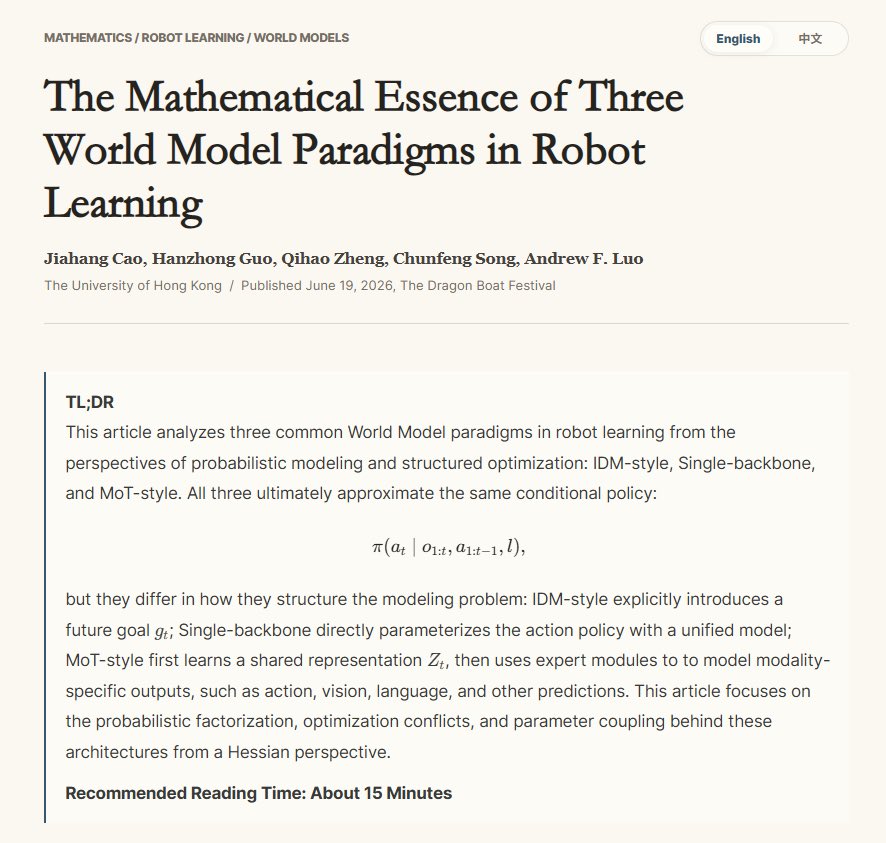
We recently wrote a short blog on the mathematical essence behind three common World Model paradigms in Robot Learning. It looks at Future-conditioned / IDM-style, Single-backbone, and MoT-style models from the lens of probabilistic modeling and structured optimization.
SAGE tweet media
English
6
9
45
14.4K
Iyan Moon
Iyan Moon@iyanmoonyang·
anyone willing to give me a robotics ML crash course over lunch. Being surrounded by amazing researchers is making me very curious but I fear I cannot disturb them all the time. I’ll pay for your food?
English
26
2
196
38.8K
Iyan Moon
Iyan Moon@iyanmoonyang·
Anything I missed? Leave your reccs because I’d love to read them :)
English
2
0
2
1K
Iyan Moon
Iyan Moon@iyanmoonyang·
X used to be where substance & knowledge lived but now I find it on unassuming word press sites that aren’t SEO optimised. Here are some I’ve read that completely transformed how I think through problems. (It’s possible to go through all of them in one evening if you wish) 🧵
English
3
1
31
4K
Leonardo Perez retweetledi
Ethan Clark
Ethan Clark@ethanmclark1·
Working in robotics right now is what I imagine working with language models felt like in 2023. Everyone throwing things at the wall to see what sticks Pixel prediction (Cosmos), action prediction (VLA), reward prediction (TD-MPC), and representation prediction (JEPA). Different paths for the same problem The recipe that won in language was self-supervised pretraining at internet scale then light finetune on top. Only representation prediction runs that playbook. It learns from action-free video data so you can pretrain on YouTube and egocentric data then add a control layer. Everything else needs action-labeled data that doesn't scale As an RL maximalist, I used to hate LeCun's cake. Turns out he was right all along which is how I ended up a JEPA truther
English
19
36
495
67.2K