Justin S. Smith

435 posts

Justin S. Smith banner
Justin S. Smith

Justin S. Smith

@gpusciguy

Machine learning and AI for chemistry and materials science at NVIDIA. Views and opinions expressed are my own.

Boston, MA Katılım Kasım 2015
564 Takip Edilen580 Takipçiler
Justin S. Smith retweetledi
Orbital
Orbital@OrbitalHardware·
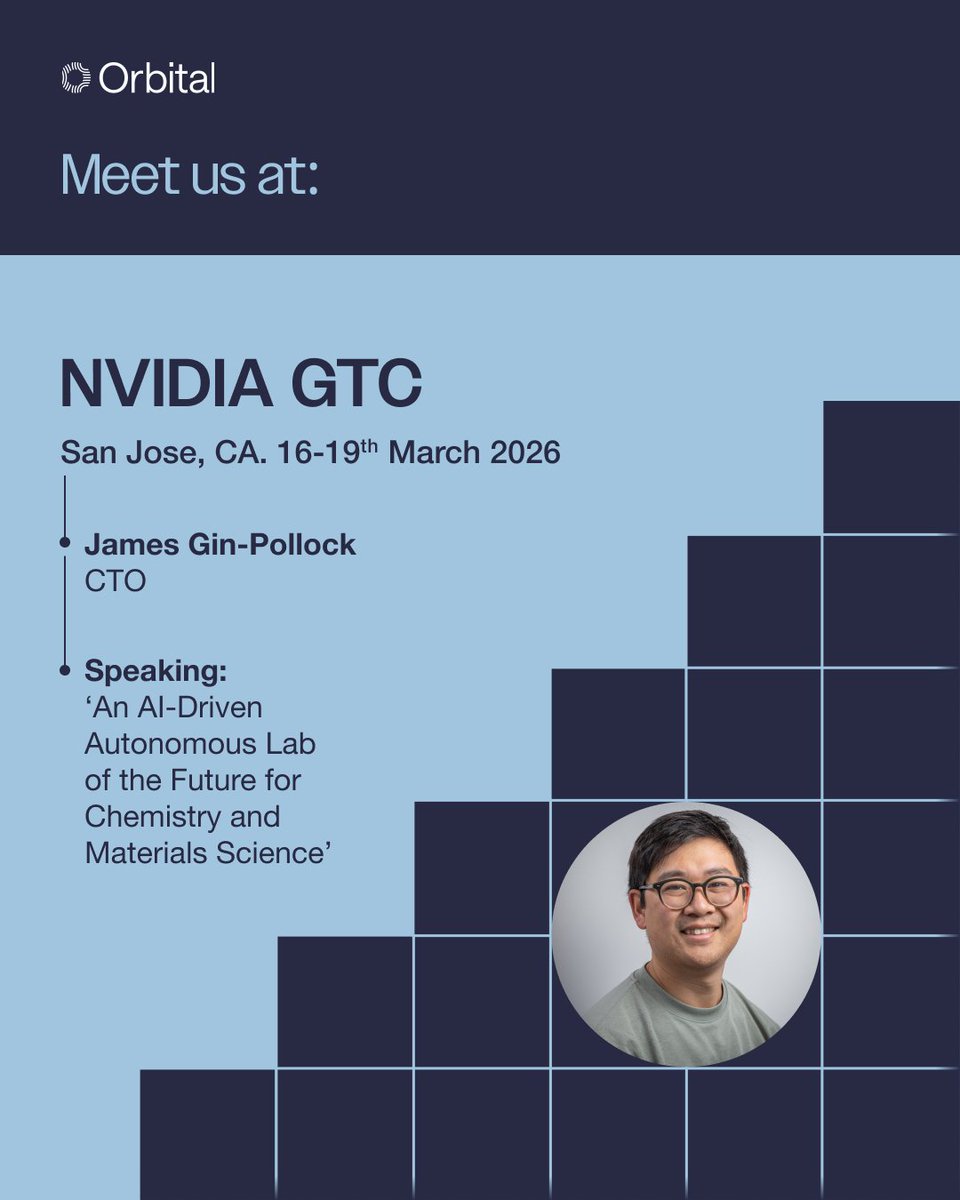
Less than a week to go until we’re at @NVIDIAGTC! A highlight we're especially excited about: our CTO James Gin-Pollock (@gin_james) will be joining an incredible panel on March 17th at 3pm speaking on "An AI-Driven Autonomous Lab of the Future for Chemistry and Materials Science"🧪 If you're attending GTC, we'd love to connect. Drop us a DM and we'll find some time to meet. See you in San Jose!🤝 #NVIDIAGTC
Orbital tweet media
English
0
4
7
453
Justin S. Smith retweetledi
Orbital
Orbital@OrbitalHardware·
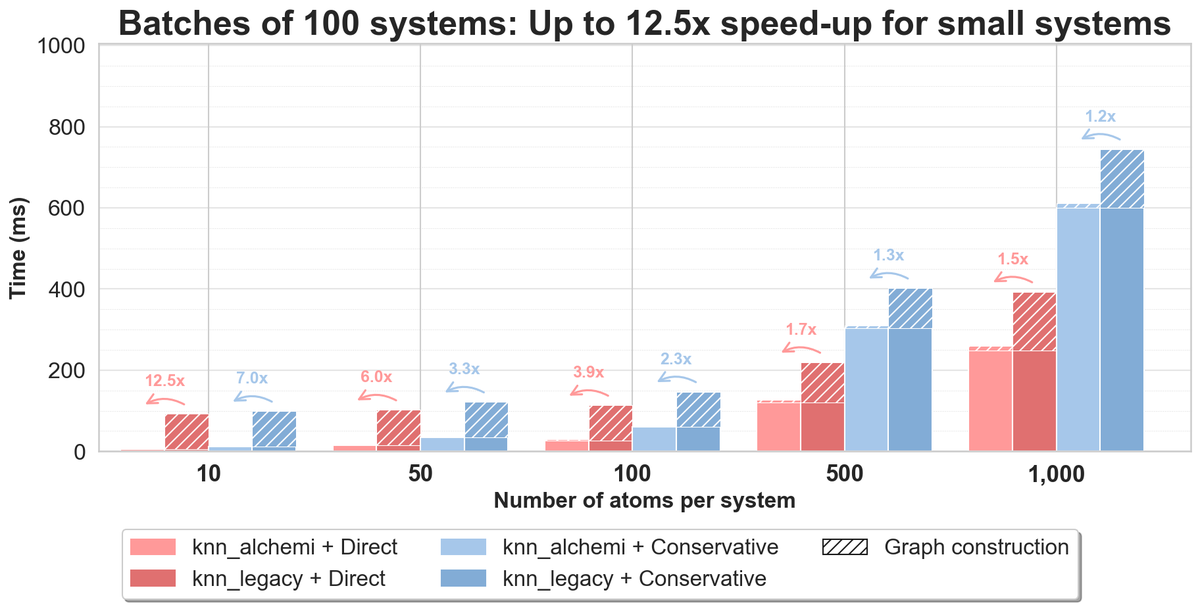
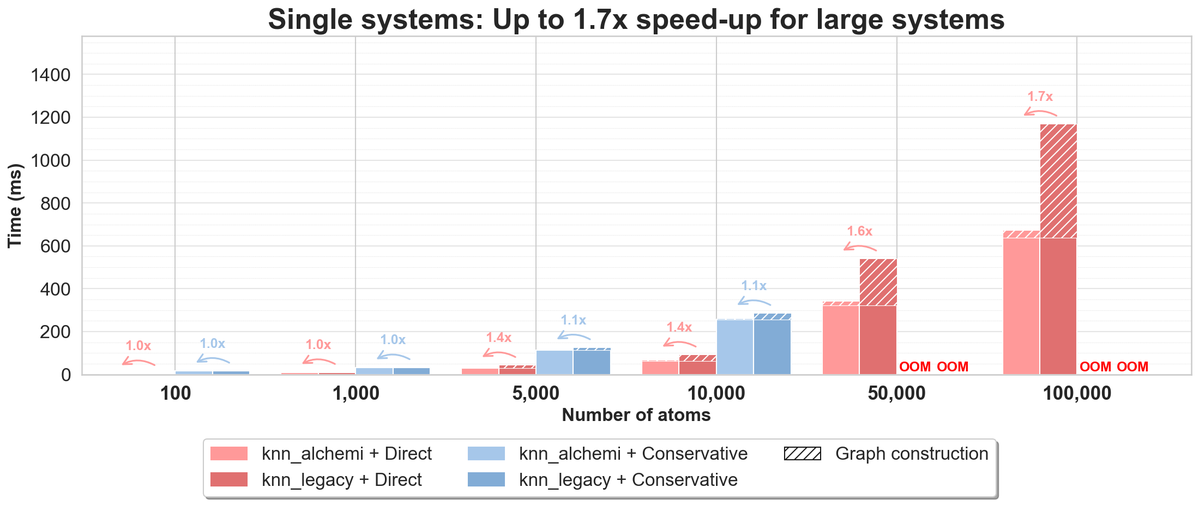
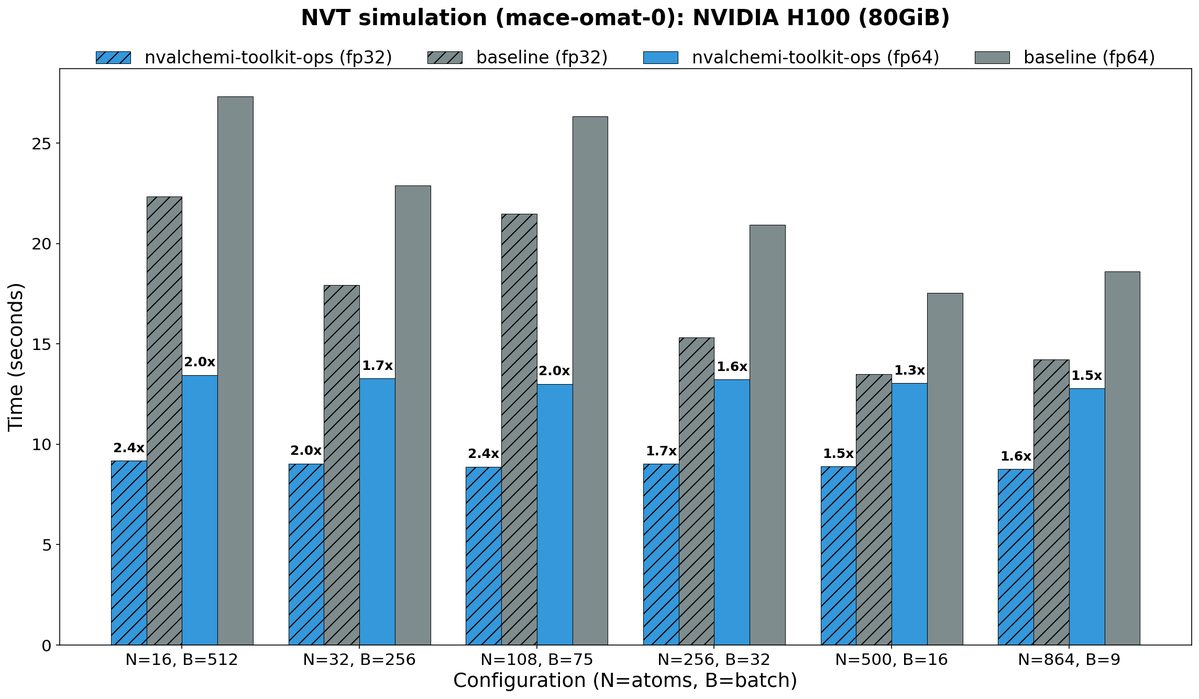
Orb just had a major update - same model, same accuracy but much faster inference! 🤖 Here's what's changed: ⚡ Up to 33x faster inference for batched small systems, with full TorchSim support ⚡ Up to 1.7x faster for large systems (up to 100k atoms) These gains are powered by @nvidia's ALCHEMI Toolkit-Ops, which brings GPU-accelerated nearest-neighbour computation to molecular simulation workflows. A huge thank you to Justin S. Smith (@gpusciguy), Kelvin Lee, Dallas Foster, Roman Zubatyuk and Nikita Fedik at NVIDIA for building this library. Have a look at the results below for single-systems and batches of 100 and 1,000 systems:
Orbital tweet mediaOrbital tweet mediaOrbital tweet media
English
1
5
29
3.8K
Justin S. Smith retweetledi
Ben Blaiszik
Ben Blaiszik@BenBlaiszik·
🔥Exciting news for the ML atomistic simulation community - big speedups on the way for MLIP inference and more! We're thrilled that TorchSim is featured as a key integration partner in @nvidia's newly released ALCHEMI Toolkit-Ops. What does this mean for you? Better performance on GPUs (see figs), less one-off implementation, and easier maintenance. ALCHEMI Toolkit-Ops directly addresses this with GPU-accelerated, batched primitives for: 🔹Neighbor list construction (both O(N) cell list and O(N²) naive) 🔸DFT-D3 dispersion corrections 🔹High-throughput performance for thousands of systems on a single GPU 🔸Long-range electrostatics (Ewald & PME) 🔹Direct API compatibility with PyTorch As part of this sprint, we've released TorchSim 0.5.0 as well so many of these features are immediately available! We’ve added support for: 🔹A refactored neighbor list module with batched support and multiple backends (see figures for perf. improvements) 🔸CSVR / V-Rescale thermostat and anisotropic C rescale barostat 🔹Electrostatics 🔸AMD GPUs I’m very curious to see how research teams take advantage of these new capabilities. Let me know how you think it might affect your work!
Ben Blaiszik tweet media
English
4
9
44
3.5K
Justin S. Smith retweetledi
Vega Shah
Vega Shah@dr_alphalyrae·
Today @NVIDIA launched ALCHEMI Toolkit-Ops to accelerate chemistry and materials science simulations using machine learning interatomic potentials (MLIPs). ALCHEMI combines the accuracy of quantum chemistry methods with the scalability of AI to enable large-scale atomistic simulations that were previously impractical, helping run faster, more accurate simulations for materials discovery and molecular modeling. Read the technical blog authored by Justin S. Smith et al ⬇️
Vega Shah tweet mediaVega Shah tweet media
English
5
16
111
9.9K
Aditi Krishnapriyan
Aditi Krishnapriyan@ask1729·
At this point the AI for Science community should stop focusing on achieving "state-of-the-art” on datasets like QM9 & MD17: chasing small improvements on these outdated datasets is scientifically meaningless. It's like telling vision researchers to ditch internet-scale and go back to benchmarking on MNIST/CIFAR10
English
6
20
126
24K
Xiang Fu
Xiang Fu@xiangfu_ml·
I joined @periodiclabs in May. We’re building AI scientists + autonomous labs to create breakthroughs you can hold. Longer take: xiangfu.co/science More on Periodic: periodic.com
William Fedus@LiamFedus

Today, @ekindogus and I are excited to introduce @periodiclabs. Our goal is to create an AI scientist. Science works by conjecturing how the world might be, running experiments, and learning from the results. Intelligence is necessary, but not sufficient. New knowledge is created when ideas are found to be consistent with reality. And so, at Periodic, we are building AI scientists and the autonomous laboratories for them to operate. Until now, scientific AI advances have come from models trained on the internet. But despite its vastness — it’s still finite (estimates are ~10T text tokens where one English word may be 1-2 tokens). And in recent years the best frontier AI models have fully exhausted it. Researchers seek better use of this data, but as any scientist knows: though re-reading a textbook may give new insights, they eventually need to try their idea to see if it holds. Autonomous labs are central to our strategy. They provide huge amounts of high-quality data (each experiment can produce GBs of data!) that exists nowhere else. They generate valuable negative results which are seldom published. But most importantly, they give our AI scientists the tools to act. We’re starting in the physical sciences. Technological progress is limited by our ability to design the physical world. We’re starting here because experiments have high signal-to-noise and are (relatively) fast, physical simulations effectively model many systems, but more broadly, physics is a verifiable environment. AI has progressed fastest in domains with data and verifiable results - for example, in math and code. Here, nature is the RL environment. One of our goals is to discover superconductors that work at higher temperatures than today's materials. Significant advances could help us create next-generation transportation and build power grids with minimal losses. But this is just one example — if we can automate materials design, we have the potential to accelerate Moore’s Law, space travel, and nuclear fusion. We’re also working to deploy our solutions with industry. As an example, we're helping a semiconductor manufacturer that is facing issues with heat dissipation on their chips. We’re training custom agents for their engineers and researchers to make sense of their experimental data in order to iterate faster. Our founding team co-created ChatGPT, DeepMind’s GNoME, OpenAI’s Operator (now Agent), the neural attention mechanism, MatterGen; have scaled autonomous physics labs; and have contributed to some of the most important materials discoveries of the last decade. We’ve come together to scale up and reimagine how science is done. We’re fortunate to be backed by investors who share our vision, including @a16z who led our $300M round, as well as @Felicis, DST Global, NVentures (NVIDIA’s venture capital arm), @Accel and individuals including @JeffBezos , @eladgil , @ericschmidt, and @JeffDean. Their support will help us grow our team, scale our labs, and develop the first generation of AI scientists.


English
18
22
348
53.5K
Adil Kabylda
Adil Kabylda@kabylda_·
Our recent work on SO3LR, a general-purpose machine learned force field for molecular simulations, has been published in @J_A_C_S! 🌞
Adil Kabylda tweet media
English
6
24
169
12.9K
Justin S. Smith retweetledi
Corin Wagen
Corin Wagen@CorinWagen·
New preprint! With @JosephJGair1 + the Gair lab @MSUChem, we built a set of strained conformers for benchmarking DFT functionals and NNPs. Our new benchmark set, "Wiggle150", is substantially harder than previous conformational benchmarks, with an avg ∆E of 103 kcal/mol.
Corin Wagen tweet media
English
4
25
117
11.4K
Justin S. Smith retweetledi
NVIDIA HPC Developer
NVIDIA HPC Developer@NVIDIAHPCDev·
✅ Mark your calendars to explore the latest breakthroughs in #AI and computational science at the NVIDIA #SC24 Special Address featuring Jensen Huang and Ian Buck. ➡️ nvda.ws/4hIkolq 📆 Nov 18 at 10:30 a.m. PT, 1:30 p.m. ET
NVIDIA HPC Developer tweet media
English
0
3
15
1.3K
Frank Noe
Frank Noe@FrankNoeBerlin·
I am so happy & proud to have been elected fellow of the American Physical Society (APS) via the topical group on data science. I've never studied proper physics, but physics is what excites me. A recognition that I've made a contribution means a lot. aps.org/funding-recogn…
Frank Noe tweet media
English
51
11
288
23.8K
Justin S. Smith retweetledi
Christian Dallago
Christian Dallago@sacdallago·
Phd students: submit your projects for a chance to get an NVIDIA fellowship! Time until Sept 11! And yes: applications in digital biology are very welcome! research.nvidia.com/graduate-fello…
English
0
31
69
10.7K
Justin S. Smith retweetledi
MDDB
MDDB@mddbEU·
Signed by over 120 experts, our letter highlighting the urgent need for a collaborative effort to establish a #FAIR database for #MolecularDynamics simulation data, is now on Arxiv. 📎 Read it here: bit.ly/3WjcC7x 📝Support our statement: bit.ly/3zVS3qm #MDDB
English
1
59
143
26K