Grassroots Economics

907 posts

Grassroots Economics banner
Grassroots Economics

Grassroots Economics

@grassEcon

Empowerment through Community Inclusion Currencies

Kenya Katılım Şubat 2015
183 Takip Edilen3.1K Takipçiler
Grassroots Economics
Grassroots Economics@grassEcon·
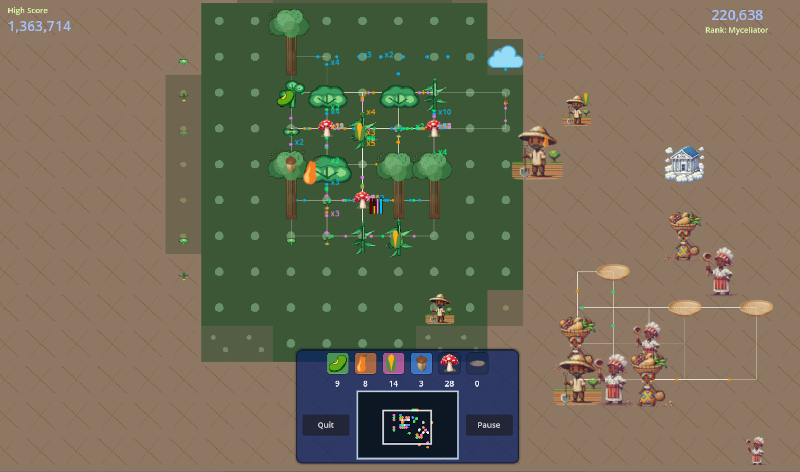
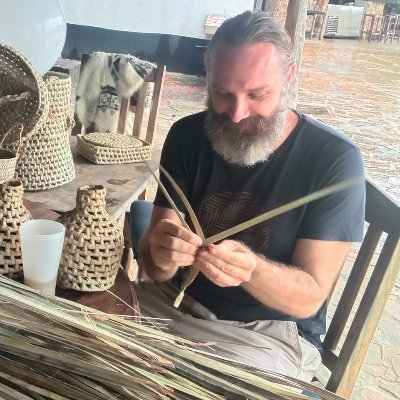
Introducing Social Soil, an educational strategy game In Social Soil, players plant crops, grow fungal networks, harvest food, and build village exchange systems. (play it here: play.grassecon.org)

Grassroots Economics tweet mediaGrassroots Economics tweet media
English
0
3
12
639
Grassroots Economics retweetledi
Will Ruddick
Will Ruddick@wor·
¡Por fin, por fin! 🌱📘 The Grassroots Economics book is now available in Spanish! I want to give a huge thank you to @Aude Peronne for her amazing work, not only in translating, but in helping the concepts grow into new language, new context, and new life. As Aude writes: “Traducir no es solo cambiar palabras de un idioma a otro.” That line captures so much of what makes this work special. Translation is not just word-for-word conversion. It is listening for how ideas live inside another memory, another culture, another way of organizing care, trust, reciprocity, and shared abundance. In my opinion, the French version became even better than the English because of this process. And now, the Spanish version feels even richer. Not because it replaces the original, but because each translation has pulled out the concepts in a new way, with more clarity, more grounding, and more connection to the territories where these ideas can take root. Grassroots Economics is about commitments, trust, reciprocity, and community-led ways of coordinating resources beyond the limits of conventional money. It is about old wisdom and new tools meeting in service of collective wellbeing. Gracias, Aude, for helping these ideas travel with care. And thank you also to everyone who helped bring the Spanish edition into being. You can now get the English, French, and Spanish editions here: grassrootseconomics.org/book/ Que estas ideas sigan circulando como semillas. ¡Vamos, comunidad! 🌍🌱 p.s. Love to our our illustrator Cara Eyre from Octopi 💌
English
1
4
5
292
Grassroots Economics retweetledi
Will Ruddick
Will Ruddick@wor·
A Common Grammar for Finance and Mutual Aid A burial society is not a bank. A rotating savings group is not a clearing house. A labor-sharing group is not a financial exchange. And yet, underneath them, there may be a shared grammar: commitments, valuation, limits, exchange, settlement, governance, and repair. That is the idea explored in my new SSRN working paper on Commitment Pooling Protocol. (linked in comments) Invitation to review ...
Will Ruddick tweet media
English
1
7
23
955
Grassroots Economics retweetledi
Will Ruddick
Will Ruddick@wor·
Beyond the Punctuated decline of human cooperation. .. A really thoughtful paper just came out in Nature on cooperation in lending systems ... and it’s worth your time: Sabin, Klinowski & Reed-Tsochas (2026) Punctuated decline of human cooperation The authors track group lending over five years and find something many practitioners will recognize: ➡️ Cooperation starts high ➡️ Gradually declines ➡️ Then resets when a new loan cycle begins Their explanation focuses on behavioral fatigue ...people becoming “tired of paying.” That’s real. But I think there’s another layer worth exploring: 👉 What if part of the decline is not just human behavior… but institutional design? In many lending systems (including the one studied), repayment is: cash-only-based thresholded (repay fully or fail collectively) and not easily clearable across a network This creates what I’d call a “closed liability container without clearing.” So even when people are still contributing, the system can still collapse. An alternative we’re exploring is commitment pooling: Instead of only asking: “Can you repay in cash?” We also ask: “What can you credibly contribute and how can that be exchanged to settle your obligation?” That could look like: students swapping tutoring for tuition credit farmers swapping produce for loan repayment service providers issuing vouchers that others can redeem Same lending institutions. Same safeguards. Just additional pathways: repayment through marketable commitments. This doesn’t replace lending - it extends it. Curious to hear from: lenders researchers practitioners 👉 Where have you seen repayment capacity exist - but not be recognized by the system?
Will Ruddick tweet media
English
1
3
12
422
Grassroots Economics retweetledi
GEN Ukraine Ecovillage #Octant #GG23
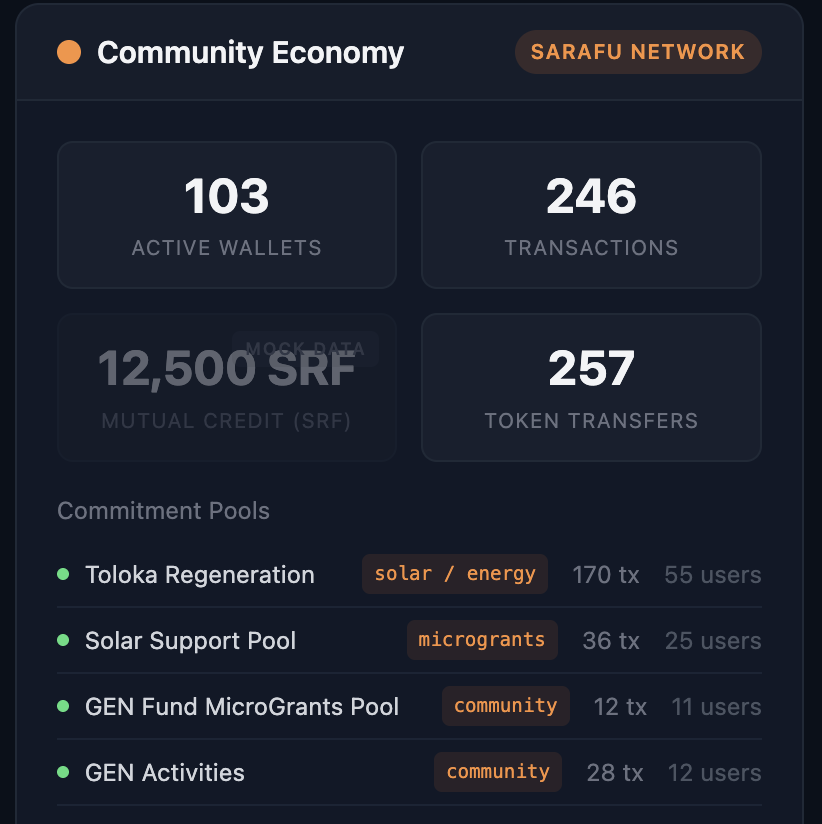
How can decentralized coordination actually support real communities? Since November 2025, GEN Ukraine has deployed a set of Sarafu-based pools @grassEcon to coordinate funding and activities across ecovillages. The system includes: – Microgrants distribution (GEN Fund) – Solar resilience support – Community activities coordination – Regenerative “Toloka” work pools Current metrics: • 103 active wallets • 246 transactions • 12,500 SRF mutual credit • 257 token transfers Each pool operates as a lightweight DAO: tracking contributions, distributing value, and enabling transparent coordination. This approach supports W3I goals: – local economic recovery through mutual credit – digital trust via on-chain records – ecosystem access for distributed communities – support for regenerative practices We are still early, but the system is already functioning as coordination infrastructure, not just a pilot. Next step — linking this with measurable ecological impact (MRV, biodiversity, carbon). This initiative was implemented within the @gardens_fund W3I Network Initiatives Pool to develop practical infrastructure for decentralized coordination, economic resilience, and transparent resource distribution across Ukrainian ecovillages.
GEN Ukraine Ecovillage #Octant #GG23 tweet mediaGEN Ukraine Ecovillage #Octant #GG23 tweet mediaGEN Ukraine Ecovillage #Octant #GG23 tweet media
English
0
4
8
270
Grassroots Economics retweetledi
Will Ruddick
Will Ruddick@wor·
I’m glad to share that my paper, Proto-Social Infrastructure and Stewardship of Commitment Pooling, has just been published in IJCCR. In it, I explore commitment pooling as a commons-based way of coordinating resources through reciprocity, stewardship, and shared responsibility. The paper draws from rotational labor traditions, ecological relationships like mycorrhizal networks and the Three Sisters, and the digital systems we have been building through Community Asset Vouchers and blockchain. At its heart, it is an argument that the future of economics may depend less on reinventing money and more on strengthening the social and technical infrastructures that allow communities to coordinate abundance together. Writing this about a year ago, I can already see how much I have learned since. So I share it as both a milestone and a snapshot of an ongoing journey. My sincere thanks to Jens Martignoni from IJCCR for his support, and to Patricia Marcella Evite for her thoughtful editing and diagrams, which helped bring the ideas into much clearer form. ijccr.net/article/view/9…
English
0
6
24
740
Grassroots Economics retweetledi
Will Ruddick
Will Ruddick@wor·
Knowing a Village. It has been a joy to write this together. Aude Peronne and I share it with gratitude for the villages, landscapes, and relationships that continue to teach us. We hope it is useful to anyone seeking to enter a village, a landscape, or a community with more humility, attention, and care, and to those trying to connect practical work with a deeper understanding of what keeps life alive together. Enjoy: willruddick.substack.com/p/knowing-a-vi…
Will Ruddick tweet media
English
0
2
8
261
Grassroots Economics
Grassroots Economics@grassEcon·
This is the way: "The point is to offer a way for outside funding to strengthen existing systems of cooperation rather than bypass them."
Will Ruddick@wor

Most basic income experiments do not last forever. But what if a one-time grant or short-term basic income could become a lasting community resource? At @grassEcon , we are exploring how pooled basic income and one-off endowments can be seeded into commitment pools in villages and refugee camps. Instead of ending as one-time transfers, these funds become shared liquidity that community members access in rotation while continuing to support one another through labor, services, goods, and mutual accountability. This approach helps donations circulate further, strengthens local cooperation, supports productive livelihoods, and leaves behind stronger systems of exchange and care. Recent collaborations with fairspirit.com and @RelayFunder show how even modest amounts of outside funding can become more sustainable when stewarded inside community-governed pools. From farm inputs in Kiriba to zero-interest rotating support in refugee communities, commitment pooling turns short-term aid into regenerative community infrastructure. grassecon.substack.com/p/when-basic-i…

English
0
1
3
204
Grassroots Economics retweetledi
Crypto Altruists
Crypto Altruists@Crypto_Altruism·
Throughout history, ruling powers sought to enclose & control community networks 👑🛑 @wor of @grassEcon believes blockchain is a missing piece that can help communities coordinate across networks & break free of central control 💪🌐 Full chat ft. Will & co-host @ColeenChase👇
Crypto Altruists@Crypto_Altruism

What if the future of money was powered by communities, not banks? We sat down with @wor of @grassEcon & @ColeenChase of @Solar_FND to explore how commitment pooling & mutual aid models can help communities build resilient local economies 🌱🌍 🎧Listen: cryptoaltruists.com/blog/crypto-al… We discuss: 💸 What commitment pooling is, and why it's a powerful tool for economic & community development in underserved regions ⛓️ How blockchain enhances these community-driven models by enabling trust, coordination, and scale ☀️ How The Solar Foundation is leveraging blockchain-powered savings circles in Tanzania 💡 Wisdom from the legendary Will Ruddick, and some of his key writings that you need to check out!

English
0
2
16
927
Grassroots Economics retweetledi
Michel Bauwens
Michel Bauwens@mbauwens·
Once more on that radical innovation that is in the works: * Cosmo-Local Credit, wiki.p2pfoundation.net/Cosmo-Local_Cr… Will Ruddick: "A global network that routes credit across every wallet of every agent on the planet. Not just banks. Farmers. Cities. Co-ops. Energy pools. Mutual aid groups. Diasporas. Small businesses. Households. Not one currency. Not one issuer. A web of commitments. States already do this at scale (money is a state issued commitment by another name, as empires understood long before modern finance). States will still assert constraints (tax, consumer protection, capital controls, sanctions, and anti money laundering rules). A cosmo-local network survives this by staying modular. Pools can choose compliance regimes, publish them clearly, and route accordingly. The network does not require one global compliance court. It requires clear labels and the ability to route around incompatible regimes. This is what Cosmo-Local Credit DAO is pointing toward. A coordination layer where local pools remain sovereign while routing across each other through shared registries and settlement logic. The goal is not one global network with one center. The goal is a plural fabric of networks that can interoperate without surrendering sovereignty. The moment any single atlas, interface, or registry becomes mandatory, the gravity problem returns. In a sense, this is chaordic design at planetary scale. Sovereignty at the edge. Shared standards at the core. The difference is that the participants are no longer just regulated banks. They are communities, cities, cooperatives, and individuals. The gravitational forces are stronger. The constitutional layer must be stronger too." (willruddick.substack.com/p/the-constitu…
English
0
2
12
363
Grassroots Economics retweetledi
Will Ruddick
Will Ruddick@wor·
Alex (Yeshey) Cahana, MD and I just finished John Fullerton’s new book on Regenerative Economics and it gave us something rare (a “shape” for noticing when an economy is behaving like a living system vs. a machine). From Kenya and Bhutan, we have been asking a practical follow-on question: how do regenerative principles become daily practice (credit, exchange, repair) without commodifying relationship? This essay is a humble field response from two places that have become home in our hearts. It explores living reciprocity, Gross National Happiness, and why “commitment pooling” may be a missing coordination layer for regenerative economics (grounded in real provisioning, governed as a commons, and protected against extraction and runs). If you care about the commons, wellbeing, and the plumbing of trust, we would love your thoughts. - link in comments -
Will Ruddick tweet media
English
2
11
18
441
Grassroots Economics retweetledi
Crypto Altruists
Crypto Altruists@Crypto_Altruism·
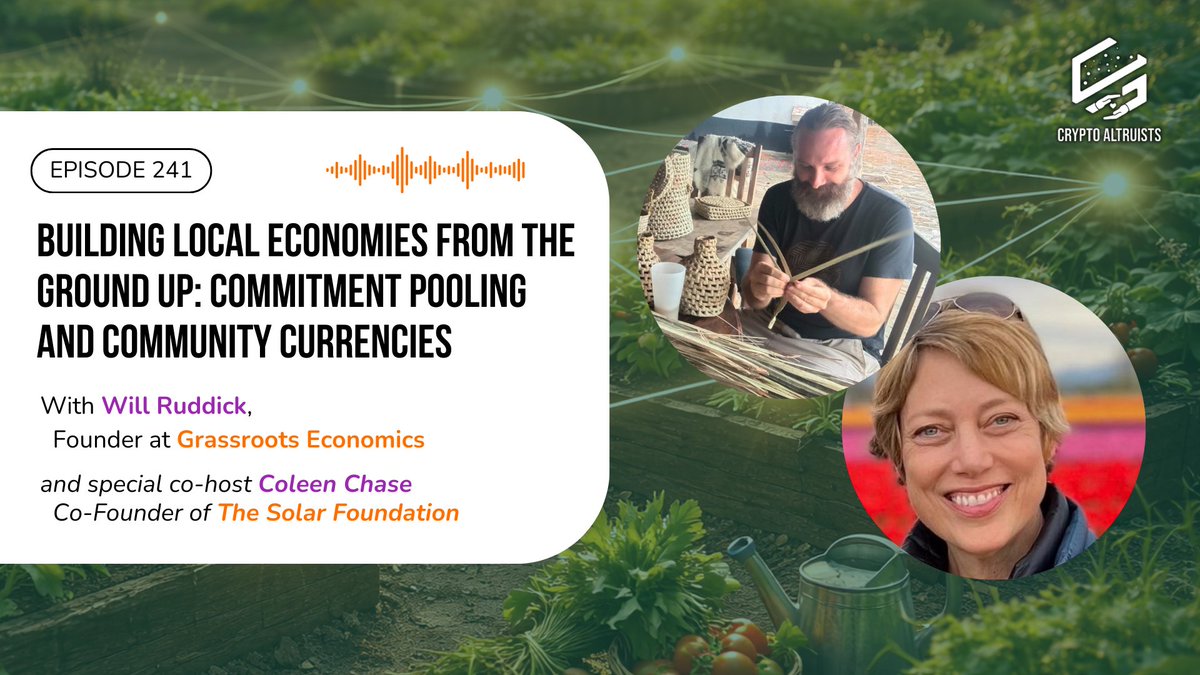
What if the future of money was powered by communities, not banks? We sat down with @wor of @grassEcon & @ColeenChase of @Solar_FND to explore how commitment pooling & mutual aid models can help communities build resilient local economies 🌱🌍 🎧Listen: cryptoaltruists.com/blog/crypto-al… We discuss: 💸 What commitment pooling is, and why it's a powerful tool for economic & community development in underserved regions ⛓️ How blockchain enhances these community-driven models by enabling trust, coordination, and scale ☀️ How The Solar Foundation is leveraging blockchain-powered savings circles in Tanzania 💡 Wisdom from the legendary Will Ruddick, and some of his key writings that you need to check out!
Crypto Altruists tweet media
English
0
4
21
1.3K
Grassroots Economics retweetledi
Relay Funder
Relay Funder@RelayFunder·
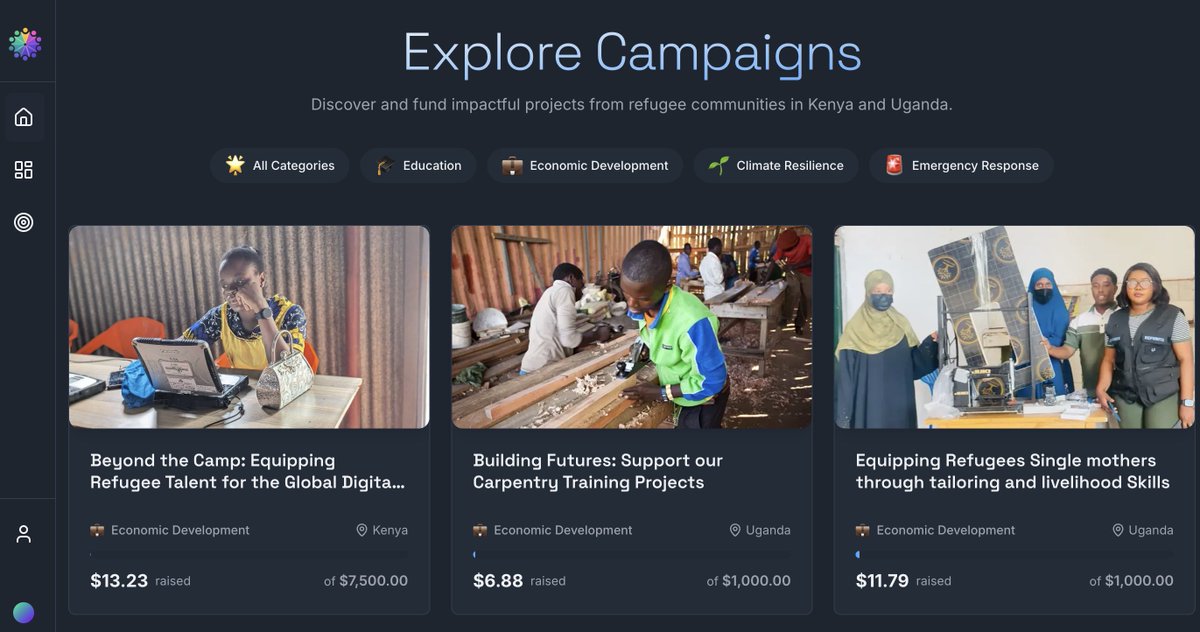
We’re halfway through the round. ⏳ Closes Feb 26. The next 2 weeks determine which refugee-led projects unlock the most match funding. @refunite @grassEcon @Save_Vuc Even $5 changes the outcome. Explore the campaigns → app.relayfunder.com
Relay Funder tweet media
English
1
7
15
368
Grassroots Economics retweetledi
Taylor Lahey
Taylor Lahey@taylahey2·
Once upon a time, I wrote a children's book about what I learned from working in crypto. Then I applied what I learned in crypto to my solving real problems in my community. @Celo @grassEcon
English
0
1
3
113
Grassroots Economics retweetledi
GEN Ukraine Ecovillage #Octant #GG23
ReFi Integration Map: How Ukrainian Ecovillages Enter the ReFi Economy We often speak about bridging local communities with global climate finance. For us, this is no longer a concept — it is becoming an infrastructure. Over the last years we have been building an integration map of Ukrainian ecovillages into ReFi platforms. Stage 1 — Community Economy (Sarafu Network) @grassEcon Local pools and community vouchers allow groups to exchange value without waiting for external funding. This stabilizes daily life: food, services, mobility, mutual aid. The economy starts circulating inside the community before grants arrive. Stage 2 — Ecological Value (Regen Network) @RegenNetworkDev Biodiversity monitoring and regenerative land practices become measurable assets. Bio-carbon and ecological indicators connect local land stewardship with global climate markets. Stage 3 — Energy Layer (Arkreen) @arkreen The next step is energy. Smart meters for our first 5 pilot solar stations are already on the way to Ukraine. Small distributed solar installations will produce not only electricity — but verifiable energy data and tokenized environmental impact. Together these layers form a stack: community trust → ecological verification → energy production → programmable climate finance What is interesting — most of Eastern Europe and the Balkans are still empty on the regenerative infrastructure map. Except Lithuania and Estonia. In Ukraine, almost every point on this map represents our community network: lnkd.in/dQQ8MzFd We are not building projects. We are building a bioregional operating system for resilience during instability — and for the post-war future.
GEN Ukraine Ecovillage #Octant #GG23 tweet mediaGEN Ukraine Ecovillage #Octant #GG23 tweet media
English
2
2
8
136
Grassroots Economics retweetledi
Relay Funder
Relay Funder@RelayFunder·
48 hours left in this matching round ⏳ More donors = more matching funds unlocked. Even small contributions make a real difference. Support refugee-led solutions before it ends 👇 app.relayfunder.com
Relay Funder tweet media
English
0
6
12
414
Grassroots Economics retweetledi