Chilla@chilla_ct
We’ve seen it time and again: chains that raised massive sums in past cycles, fueled by the hype of being the next Ethereum killer, only to fade as years went by. The list is long, the promises too. Just a few managed to get adoption.
Most have experienced a long, steady decline, while others have been able to react and adapt to a constantly evolving ecosystem that leaves no room for those left behind.
This is why i got curious about a chain that was quite popular at the beginning of 2020, and which, in recent years, following various ups and downs and changes, has been evolving and finding its own place in crypto. While many OG chains have lost their way by not focusing on a specific product, like a spray and pray tactic, @Celo has a different strategy.
Indeed, this may be news to most (me too until very recently, actually), but Celo has seen its revenue increase by 10x since the beginning of 2024. No sudden flashes but linear growth, as shown in the image.
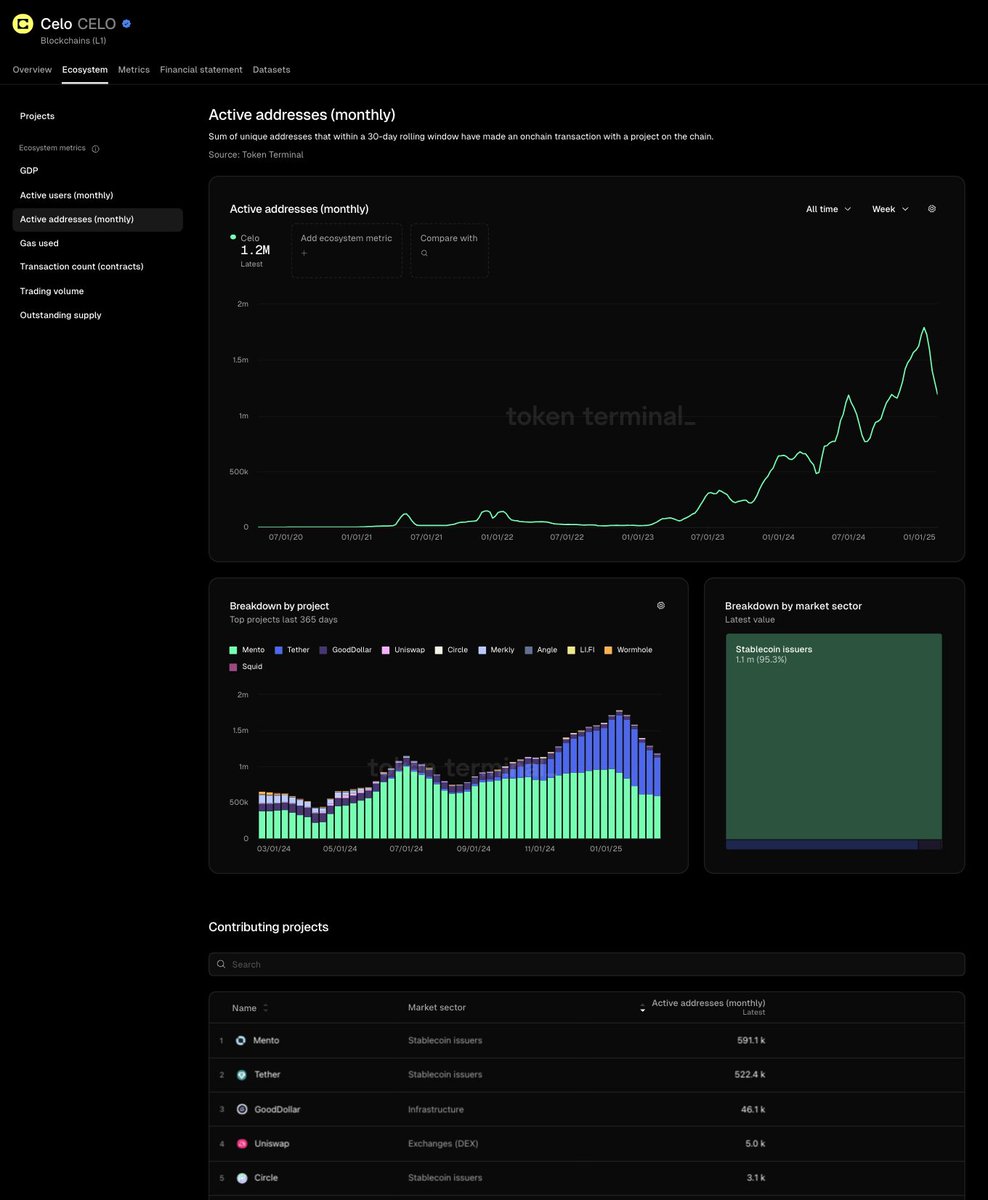
What was initially an independent EVM-compatible L1, in 2024 followed the community's proposal to become an Ethereum L2, leveraging the OP stack and Eigen Layer, to achieve greater security and interoperability and reduce costs. And as you can see from the previous graph, this choice, combined with the focus on specific verticals and distribution, is paying off with user growth.
It seems that, unlike other options, the goal was to become more accessible to emerging markets, where everyday users dominate. So yeah, it’s not surprising the latest stablecoin-focused chains let users pay gas with USDT or USDC (though never with both). But Celo actually did it first, offering both stablecoins instead of just sticking to one.
Perhaps the motivations behind all this stem from a market already saturated with protocols that often move in the same direction, touching on the usual verticals, so strong in the crypto world but still needing to find a real product-market fit in the traditional one, where the total addressable market is way bigger.
While innovation in DeFi, AI, and other areas is crucial for a chain's growth, it seems that putting the fundamentals first in terms of UX has given this solution resilience. Indeed, although the ecosystem's total TVL is around $50M, everyday users keep on growing.
Indeed, after starting to look at the data, i ended up being genuinely surprised by what i discovered. For example, in the last six months, Celo has steadily been in the top three L2s for weekly active users, and averaging 1M WAU in the last two weeks, consolidating its second placement.
While perhaps the most interesting fact is this: Celo has been steadily in first place for the number of daily active addresses compared to the entire Ethereum ecosystem, including mainnet, since November 3rd, after overtaking Base, and steadily positioning itself above 700,000 daily users, as shown by this picture taken from @growthepie_eth.
This can only be evidence of a broader target, potentially with less value exchanged per capita, but with a broad distribution.
And in any case, having Vitamin personally shilling your product must be something, especially considering that Celo is now much more integrated into Ethereum than before, given its new role as L2. This is one of the reasons that made me collaborate with them to objectively show this data.
In any case, the boost that perhaps kick-started this growth was the 2023 integration with @opera. From this partnership, @minipay was born, a non-custodial wallet on Celo that lets users send and receive stablecoins at very low costs, which has onboarded 11M+ users and facilitated 300M+ stablecoin transactions since launch. Along with this, integration with local or traditional payment methods such as cards, transfers, or on/off-ramp services has made this transition smoother for everyday users. And recently, at Binance Blockchain Week, the extension of this partnership was announced.
MiniPay was probably one of the moves that led Celo to greater financial inclusion by interfacing with more emerging markets, increasing its numbers, where Opera is seeing wallet growth hitting 175% YoY with particularly strong expansion in markets like South Africa, Ghana, Kenya, and the US.
Conclusion
There are several ways to reach PMF and find your own loyal user base. This can be through innovative apps, gambling, institutional liquidity, gaming, or through stronger distribution. It seems that Celo is aiming for the widest possible distribution, targeting users where there is a real need for crypto to improve the quality of life.
Ultimately, it's not necessary to invent the new shiny thing to attract users, unless there's a way to distribute the product to a wider audience. Yes, the chain's TVL can't be compared to that of other L2s currently in circulation, but at the same time, the market share is different, and in its own way, Celo, as Vitalik says, has survived all these years in a highly competitive market where people too often think that all infrastructures must have the same end goal.
But this isn't inherently true, given the vast amount of verticals from which chains can choose.
Meanwhile, some are focusing on consumer apps, some on DeFi, some on gaming, and some on payments.
Posterity will choose winners, and losers.