
Grey Wolf Teams

4.5K posts

Grey Wolf Teams banner
Grey Wolf Teams

Grey Wolf Teams

@greywolfteams

I help sport coaches become better leaders. 20 years high performance experience | PhD student | Consultant | Charity Founder | Veteran

United Kingdom Katılım Aralık 2021
52 Takip Edilen967 Takipçiler
Grey Wolf Teams retweetledi

Steve Magness
Steve Magness@stevemagness·
The U.S. Navy studied 2,000 SEAL candidates to find what predicted survival in Hell Week. Not strength. Not agility. Not size. The best predictor? A 4-mile run. The faster you ran, the better your odds. But the reason why goes deeper than endurance.
English

15
88
809
130.4K
Grey Wolf Teams retweetledi
Helen Bevan
Helen Bevan@HelenBevan·
MG Taylor methodology is a structured approach to engaging large groups of people in collaborative problem-solving. It has had a significant impact on my practice as a change leader and I use aspects of it every day. What I like about MG Taylor the most is that it helps us to design really strong change processes which enable the participants to concentrate on the problem, the task at hand and on collaboration, which leads to the emergence of better outcomes. The “Recode Cube” is an MG Taylor framework designed to support the design, facilitation and evaluation of complex collaborative processes. It guides practitioners to strategically align six critical dimensions (Purpose, Players, Field, Design, Facilitation, and Knowledge) to enable greater systemic impact from a change intervention. When to use it: 1) In the design of workshops for complex change interventions: It helps change leaders to create the conditions for powerful, collective ways forward to emerge 2) As a real-time navigation tool during complex engagements: it supports adaptive planning, learn as we go and course correction 3) As a reflection tool for after-action reviews and “retrospectives”: It’s a great tool for reviewing decision making, learning and progress through the six dimensions. More about the Recode Cube: drive.google.com/file/d/1BPaJhX… The Value Web, a global community of change leaders who work with the MG Taylor methodology, is hosting a free seminar including the Recode Cube on Wednesday 3rd Sept. Open to all. To register: mailchi.mp/94d010c1b8b5/1….
Helen Bevan tweet media
English
3
24
78
8.7K
Grey Wolf Teams retweetledi
Helen Bevan
Helen Bevan@HelenBevan·
Question: How can we build a link to purpose that improves performance for all employees? Answer: Activate the power of frontline (team) leaders in making purpose meaningful in daily work. A study of 57,000 employees across 469 organisations showed that when team leaders have regular conversations with their teams about organisational purpose ("purpose dialogue") it has a significant impact on performance. Commitment grows when people feel the organisation’s wider goals are meaningful, relevant & openly discussed. A 1 point increase (on a 6 point scale) in team-level purpose dialogue boosted team commitment scores by 10%, which in turn led to improvements in team performance, lower turnover & more innovation. Two other factors amplified the impact of purpose dialogue: -Relationship quality: where every team member experienced respect, trust, & fair access to support & opportunities -A sense of agency & control: where teams were felt they were granted real autonomy to act on organisational purpose. Three ways to “operationalise purpose”: 1. Build purpose dialogue into the operational fabric: Make deliberate, two-way conversations about purpose a standard part of organisational routines, role modelled by leaders at every level. 2. Ensure balanced relationships: Support all team members to experience purpose-driven leadership & receive equitable support and recognition. 3. Encourage ownership and initiative: Seek to give teams autonomy in how they achieve strategic objectives, reinforcing accountability and engagement. Sustaining organisational performance is not about grand purpose statements but the everyday work of connecting, engaging & enabling teams around shared goals. Team leaders are critical agents for achieving this: sloanreview.mit.edu/article/the-mi…. By @rudyOrg & colleagues @mitsmr
Helen Bevan tweet media
English
4
32
101
7.7K
Grey Wolf Teams retweetledi
Andrew Brownhill
Andrew Brownhill@AndrewBrownhil·
Steve Kerr’s Philosophy👇 🗣"It's their team. That's the first thing you have to consider as a coach. It's the players team, they have to take ownership. As coaches our job is to nudge them in the right direction & guide them. We don't control them."
English
0
3
13
1.5K
Grey Wolf Teams retweetledi
Helen Bevan
Helen Bevan@HelenBevan·
How do we enable behaviour change? These authors synthesised findings from 147 meta-analyses to identify which determinants of behaviour are most impactful & which should be targeted for change interventions. Many of the studies focus on large-scale, health-related, environmental or consumer behaviours but the conclusions are also worth reflecting on for organisational change. What leaders of change should do: 1) Remove barriers & make desired behaviour easy: Focus on changing the environment & systems so that the desirable behaviour is simple, convenient, & supported; e.g, provide direct access to resources, streamline processes & foster social support. 2) Build social structure: Facilitate a culture where positive behaviours are the norm. Engage peers & create opportunities for team encouragement & collective participation. 3) Enable habits & provide ongoing support: Support repeated practice & help people make the new behaviour part of their routine. Reinforce changes with reminders, prompts, & positive reinforcement. 4) Prioritise practical changes over persuasion: Rather than trying to shift attitudes or beliefs, invest in changes that directly enable & reinforce the desired actions. What leaders of change should NOT do: 1) Don’t rely solely on information or education: Simply telling people what to do, increasing knowledge or launching awareness campaigns has limited impact on actual behaviour. 2) Avoid focusing mainly on changing attitudes or beliefs: Programmes that target broad mindset change, general skills or even trustworthiness are less effective than those that address practical barriers. 3) Don’t overlook structural support: Failing to provide the physical, social, or material support needed for people to act makes adoption less likely, even if people know it’s important. The article reinforces the importance of creating the conditions for change: making the “right thing to do” the easy, supported, default option, across multiple dimensions: nature.com/articles/s4415… Original manuscript version: marketing.wharton.upenn.edu/wp-content/upl…. By Dolores Albarracin (@socialactionlab) & colleagues. I accessed this article via @ReubenRusk who also created the graphic.
Helen Bevan tweet media
English
8
89
248
27.9K
Grey Wolf Teams retweetledi
Helen Bevan
Helen Bevan@HelenBevan·
For many years, I have collaborated with (& learnt greatly from) leaders from Jönköping Region in Sweden & with Jönköping Academy. Jönköping has so much to teach the world about building integrated leadership development for a high-performing system. A key aspect of the Jönköping approach has been continuity of leadership approach & leadership purpose over decades. We can follow their journey which has seen: 1) A shift from siloed to system-wide leadership development: moving away from unit or area-specific interventions toward approaches that foster learning & leadership growth across the whole system. 2) Reframing the purpose of leadership development: from traditional personal leader development to anchoring development in real improvements for the people that the system serves. 3) Integrating leadership development into daily work: from a reliance on separate or targeted leadership programs to integrating leadership principles (using “simple rules”) into the daily work of leaders. The Jönköping experience demonstrates that effective system leadership emerges when development is integrated, adaptive & continuously aligned with both user/citizen needs & organisational needs. A big lesson from Jönköping is that we need to normalise leadership development as an everyday, lived, system-wide practice, not a sporadic activity: journals.sagepub.com/doi/full/10.11…. Via @goranhenriks. See this in the context of “the Nordic way of leadership”: bradenkelley.com/2025/08/the-no… Via @SteLindegaard @innovate.
Helen Bevan tweet media
Svenska
2
38
148
11K
Grey Wolf Teams
Grey Wolf Teams@greywolfteams·
I went picking blackberries with my kids today and then made a crumble. What leadership lessons or insights can we learn from this experience? None. It’s just a crumble.
Grey Wolf Teams tweet media
English
1
3
5
1.7K
Grey Wolf Teams retweetledi
Wu Tang is for the Children
Wu Tang is for the Children@WUTangKids·
Oh wow dusty up in here now….Florida Panther Mackie Samoskevish grew up in Sandy Hook, CT, brought the Stanley Cup to the Sandy Hook Elementary School Memorial for his day with the cup. "I thought we'd just bring it back in honor of them"
English
110
1.1K
10.4K
301.8K
Grey Wolf Teams retweetledi
Helen Bevan
Helen Bevan@HelenBevan·
If we want to create change across systems, we need to shift the balance, with less focus on redesigning structures/processes & more focus on collaboration, empathy & genuine human connection. “The Human Heart of Systems Change” - a new report from CoCreative sets out learning from research with impact leaders. Some of the key themes: 1) Managing complexity through collaboration: Leaders emphasise bridge-building, supporting collective knowledge that goes beyond organisational silos, & adapting solutions to local contexts. 2) Investing in "connective tissue": Relationship-building & coordination are often underfunded, but critical. These activities should be recognised & resourced as core strategic infrastructure. 3) Leveraging technology for transparency: There is an opportunity to leverage AI & visualisation tools to make complex, dynamic systems visible in real time—enabling leaders to see, understand & act on key leverage points. 4) Evolving measurement & accountability: Output-based metrics are often inadequate to show the impact of systems work. There needs to be a shift toward collective impact measurement—capturing changes in relationships, power dynamics & the capacity for systems thinking 5) Building a robust leadership ecosystem: Isolation and lack of ongoing support for leaders can hinder sustainable progress. There is a strategic imperative to invest in continuous learning, peer reflection & collective knowledge development—strengthening not just individuals but entire leadership ecosystems. drive.google.com/file/d/1b3mQrU…
Helen Bevan tweet media
English
1
62
155
10.1K
Grey Wolf Teams
Grey Wolf Teams@greywolfteams·
Execute. Let your team do their thing, that's what they are good at. In any change of circumstance the tendency is to over-manage. This has the opposite effect and can create further issues down the road.
English
0
3
2
1.7K
Grey Wolf Teams
Grey Wolf Teams@greywolfteams·
Communicate, ruthlessly, with your team. Keep them informed as you all need to know the latest info. But also allow them to have input into the new plan.
English
1
3
1
1.6K
Grey Wolf Teams
Grey Wolf Teams@greywolfteams·
What does a dead Prussian General and sport teams have in common? Let's take a look.
English
1
3
3
1.5K
Grey Wolf Teams retweetledi
Lionesses
Lionesses@Lionesses·
WINNERS 🏅
Lionesses tweet media
English
479
4.2K
66.3K
1M
Grey Wolf Teams retweetledi
Steve Magness
Steve Magness@stevemagness·
What predicts performance? In a study on elite field hockey players, athletes performed better when they had: -Sense of Autonomy -Sense of Mastery -Feel Belonging -See the game as a challenge instead of a threat Satisfying our basic needs predicted performance.
Steve Magness tweet media
English
2
13
70
12.6K
Grey Wolf Teams retweetledi
Dave Kline
Dave Kline@dklineii·
Everyone wants to be part of a great team. But no one wants to hold each other accountable. What if we could have both? Here's how:
English
4
5
20
6K
Grey Wolf Teams retweetledi
Helen Bevan
Helen Bevan@HelenBevan·
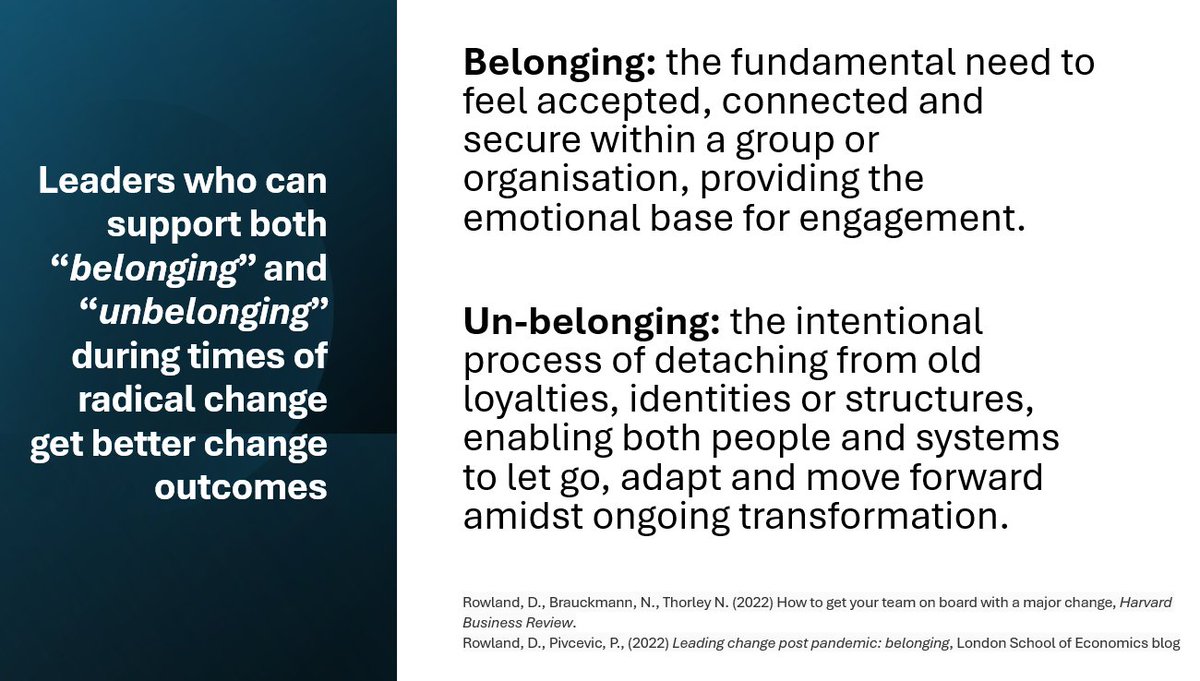
I’m continuing with the theme of not just managing new structures & processes in big system change but the need to work with deeper systemic forces at play. These are often emotionally driven. We ignore them at our peril. Some of the most interesting work in this field comes from Deborah Rowland & colleagues. Their research shows that a key differentiating factor in the leaders who succeed at guiding organisations through large-scale, uncertain change is their ability to create both a sense of “belonging” & “unbelonging”. We want people to feel belonging at work: a sense of being included, appreciated for their unique contributions, connected to their co-workers & supported in their daily work . However, in any major change, this sense of belonging is threatened, as group identities, loyalties & structures are disrupted. So “un-belonging” becomes a necessary & generative force during transformation. Un-belonging is the capacity to step back from established group loyalties & identities, allowing both individuals & teams to let go of attachments that may inhibit innovation or new ways of working. Effective change leadership involves recognising, naming & navigating both the pull of belonging & the necessity of un-belonging, rather than denying or minimising the discomfort of transition. Rowland & colleagues say that leaders who can name & work with both the pain of loss (un-belonging) AND the creation of new forms of connection (belonging) are the leaders who will foster genuine engagement & build sustainability through transitions. See: hbr.org/2022/08/how-to…& eprints.lse.ac.uk/116742/1/busin…
Helen Bevan tweet media
English
7
34
125
9.7K