

@telegram--like many other tech platforms lately--would really, really like to know your birthday. You know... to celebrate?

English
Grim Jester
7.3K posts
@GrimJester
I am but a simple gooner seeking to understand the universe. (Formerly Cantankerous_Me)


A super interesting new study from Harvard Business Review. A 8-month field study at a US tech company with about 200 employees found that AI use did not shrink work, it intensified it, and made employees busier. Task expansion happened because AI filled in gaps in knowledge, so people started doing work that used to belong to other roles or would have been outsourced or deferred. That shift created extra coordination and review work for specialists, including fixing AI-assisted drafts and coaching colleagues whose work was only partly correct or complete. Boundaries blurred because starting became as easy as writing a prompt, so work slipped into lunch, meetings, and the minutes right before stepping away. Multitasking rose because people ran multiple AI threads at once and kept checking outputs, which increased attention switching and mental load. Over time, this faster rhythm raised expectations for speed through what became visible and normal, even without explicit pressure from managers.




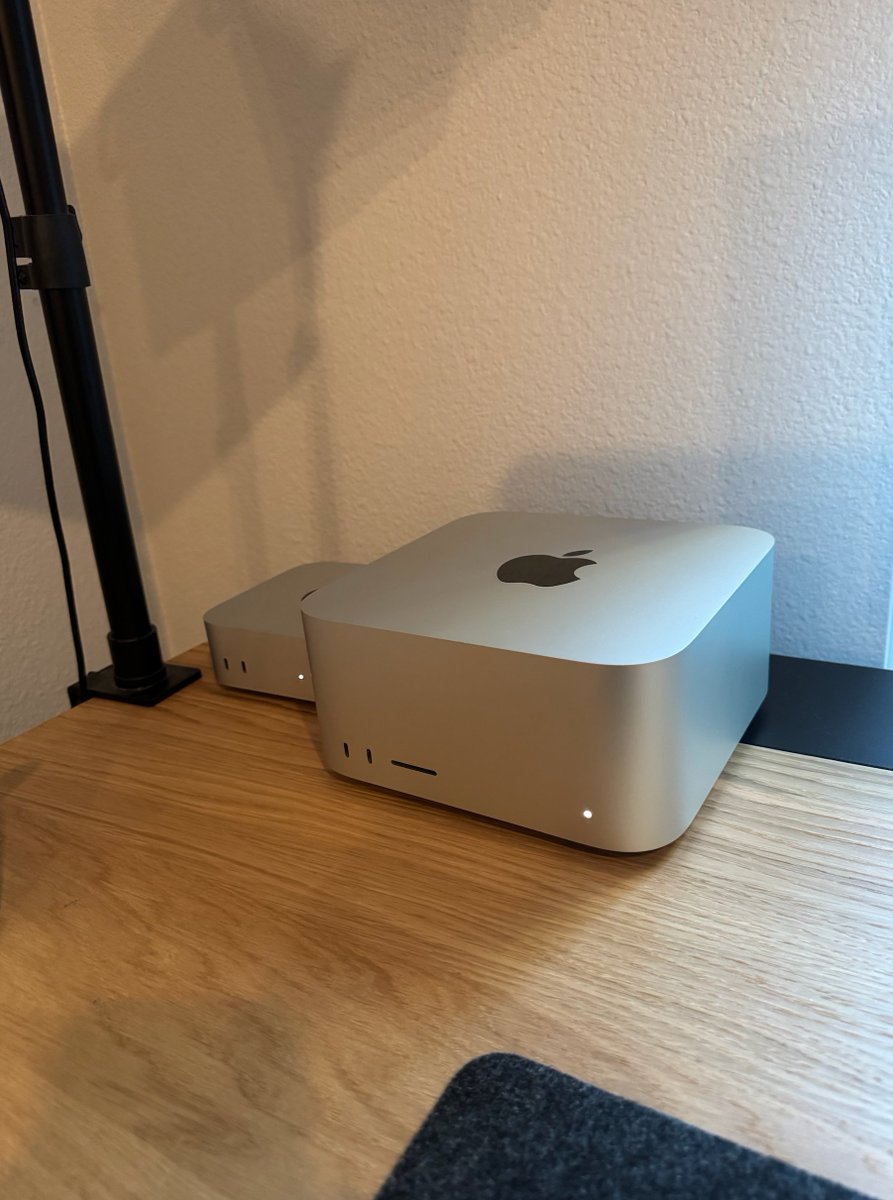

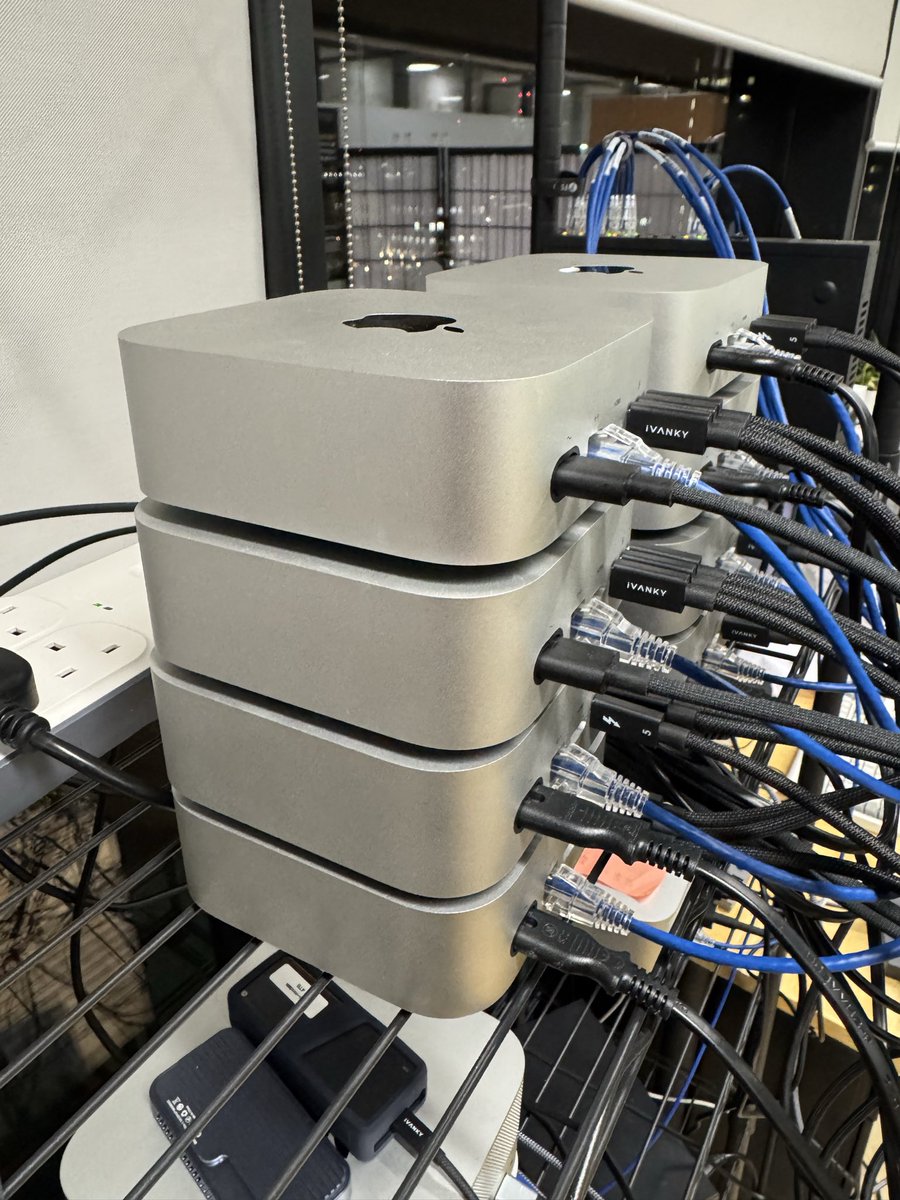
Have you been mass buying Mac Minis for your new @openclaw workflows? One man who skated to puck is @alexocheema, founder of @ExoLabs! He joins TWiST today to show @jason how his open source software helps users connect all of their Mac Minis. Check out how you can start running your own AI compute cluster!
I’ll be honest, I have 32 mac minis. 3 more clusters like this one. Why? @jason thought my argument for local AI would be cost, but it’s much more than that. AI is becoming an extension of your brain, an exocortex. @openclaw is a huge leap towards that. It knows everything you know, it can do pretty much everything you can do. It’s personalised to you. That brings into question where this exocortex should run. who should own it? who can switch it off? I certainly won’t be trusting @sama or @DarioAmodei with my exocortex. I want to own it. I want to know if the model weights change. I don’t want my brain to be rate limited by a profit seeking corporation. “not your weights, not your brain” - @karpathy

X is tracking the charge to put guardrails on the digital frontier before it outruns the law. We are witnessing a massive legislative surge as 2026 kicks off with hundreds of AI bills already tracking across more than 40 states. This builds on a record-breaking 2025 that saw over 1,000 introductions, proving that American lawmakers are aggressive about tackling the risks of the future in real-time.
No new GPU models for 2 years. NVidia to halt introduction of new models. AAA games that bet on graphics 3 years ago are gonna be in some pain.
The market is currently witnessing a massive correction, but it’s not the kind of bubble burst that skeptics predicted. For years, the assumption was that the AI bubble would pop when we realized the technology couldn’t deliver on its promises. Instead, the exact opposite has happened. The bubble that is bursting right now is the valuation of traditional Software as a Service (SaaS) companies. We are watching the “SaaS Apocalypse” unfold in real time, triggered not by failure, but by the overwhelming competence of new AI agents. When a single plugin released on a repository can cause a twenty percent intraday drop in a multi-billion dollar legacy firm (like we just saw with major legal tech incumbents), it signals that the era of selling access to basic digital tools is drawing to a close. The catalyst for this shift is the maturation of what was once jokingly called “vibe coding.” A year ago, the idea that non-technical users could simply “vibe” their way into functioning software was seen as a novelty or a source of messy code “slop.” Today, that concept has evolved into a genuine industrial force. We have reached a tipping point where AI coding capabilities allow anyone to generate enterprise-grade applications in minutes for negligible cost. This democratization effectively destroys the scarcity that allowed SaaS companies to charge high monthly fees for relatively simple databases and interfaces. Why would a business continue to pay for a dozen different subscriptions when a custom, tailored solution can be conjured into existence by an AI agent for free? This transition fundamentally alters the economics of the tech industry. For decades, the winning model was to build a software moat and charge rent. Now, those moats are evaporating because the barrier to entry for creating software has dropped to near zero. While this introduces new risks (such as the potential for massive future technical debt and security vulnerabilities in these rapid-fire creations), it also grants startups and individuals infinite “shots on goal.” A founder can now iterate through product ideas with a speed and frugality that was previously impossible, bypassing the need for expensive engineering teams just to reach a Minimum Viable Product. Ultimately, the “AI bubble” that has popped is actually the “Middleman Bubble.” The inflated valuations of companies that acted as gatekeepers to information or basic utility are collapsing under the weight of efficient, accessible intelligence. The winners in this new landscape won’t be the ones selling the shovels; it will be the ones who realize they no longer need to buy them. We are moving away from a world where we rent our digital capabilities to one where we simply speak them into existence, and the market is violently adjusting to this new reality where the marginal cost of software approaches zero.
Regarding the SaaSpocalypse. I am the Chief Strategy Officer of a major enterprise software company. We've lost 47% of our market cap in four months. Our stock dropped 6% on Monday. My bonus is gone. My options are underwater. My second vacation home is in jeopardy. The third one is fine. For now. I need to explain what happened. We didn't do anything wrong. Anthropic did. They released plugins. For Claude. Eleven of them. Open source. Legal automation. Contract review. Compliance workflows. NDA triage. Work that used to cost $400 per hour. Now costs $20 per month. We had a phrase for this. "AI augments, not replaces." That was the pitch. The pitch to investors. The pitch to customers. The pitch to employees. The pitch to law school graduates with $200,000 in debt. The pitch to the senators we lobby. "AI augments, not replaces." It was a beautiful phrase. Calming. Reassuring. Focus-grouped extensively. Completely false. We knew. We all knew. Every enterprise software CEO on the planet knew. We discussed it at Davos. Over $47 cocktails. While wearing badges that said "Human-Centered AI." The technology was coming. The replacement was inevitable. The timeline was unclear. Our exit liquidity was not. We just didn't expect Anthropic to be so... helpful. On January 30th, they released the plugins. By February 2nd, Thomson Reuters was down 18%. In a single day. LegalZoom dropped 20%. Our Head of Investor Relations had a panic attack. On a Zoom call. With investors. They saw. We call it the "SaaSpocalypse." That's a joke. It's not funny. My net worth dropped by $14 million. That's two Teslas per hour for a week. Jensen Huang said our reaction was "purely illogical." Easy for him to say. He sells the shovels. We sold the promises. He's up 340% since 2023. We're down 47% since September. But sure. Illogical. The promises that AI would make your existing software better. Not obsolete. The promises that you still needed expensive platforms. Expensive integrations. Expensive support contracts. Expensive consultants. Expensive lawyers. The lawyers. The lawyers are the real story. Big Law runs on billable hours. $800 an hour. $1,200 an hour. $2,000 an hour. For contract review. For NDA triage. For compliance workflows. For "adding value." Work that requires a JD. Three years of law school. Bar passage. Six years of experience. A corner office. A parking spot. A subscription to the Yale Law Journal. Claude does it now. For $20 a month. Claude doesn't need a parking spot. Claude doesn't expense client dinners. Claude doesn't bill 2,400 hours to make partner. Claude doesn't have a Yale Law Journal subscription. Claude doesn't have student loans. Claude doesn't cry in the bathroom at 2 AM. Claude just... works. The American Bar Association had a conference last week. They predicted "the demise of the billable hour model." At a conference about billing. They served $18 sandwiches. The irony was lost on no one. The sandwiches were mediocre. Morgan Stanley called it "intensifying competition." That's Wall Street speak for "your business model is dying." Adam Parker at Trivariate Research said software stocks are "guilty until proven innocent." He said we're "a falling knife." He's right. We are a falling knife. And we sold you the handle. For years. With a service contract. And an annual maintenance fee. We said: "AI is a tool." We meant: "AI is our tool." We said: "AI augments humans." We meant: "AI augments our revenue." We said: "AI won't replace your job." We meant: "AI won't replace your job until it does." We said: "The human touch is irreplaceable." We meant: "The human touch is expensive and we're working on it." We said: "AI needs human oversight." We meant: "For legal liability purposes only." We said: "We're committed to responsible AI." We meant: "We're committed to responsible AI until it's unprofitable." It's unprofitable now. It does now. The associate lawyers are first. The ones who thought they were safe. The ones who thought "AI can't practice law." AI can't practice law. AI can do 80% of what associates bill for. The other 20% is "relationship management." That means: lunch. Then the contract reviewers. Then the compliance analysts. Then the consultants. Then the financial analysts. Then the people who make PowerPoints about synergy. Actually, we're keeping those. Someone has to explain the layoffs. Mike O'Rourke said it best: "If the legal industry can be disrupted, so can consulting and financial services." He's not wrong. He's terrifyingly correct. He probably shouldn't have said that out loud. His LinkedIn is now "Open to Work." Every knowledge worker who bills by the hour is now in a race. A race against a Claude plugin. An open-source Claude plugin. We didn't see that coming. We expected proprietary. We expected expensive. We expected enterprise sales cycles. Eighteen-month implementations. Mandatory consulting packages. Executive briefings in Aspen. Anthropic just... gave it away. Eleven plugins. Free. "Customize workflows." "Slash commands." "Consistent outcomes." For $20 a month. No executive briefing. No Aspen. No $47 cocktails. Just a chat interface. And the death of our business model. The board meeting was yesterday. The CFO cried. The General Counsel updated his resume. On company time. Using the company laptop. Bold move. The Chief Revenue Officer blamed the sales team. The sales team blamed the product. The product blamed the market. The market blamed us. The PR team blamed "macro headwinds." The CEO blamed "exogenous factors." The board blamed the CEO. The CEO blamed his predecessor. His predecessor is on three other boards. He's fine. The market is correct. We knew. We all knew. Every pitch deck. Every investor presentation. Every "thought leadership" article. Every podcast appearance. Every TED talk about "the future of work." "AI augments, not replaces." We said it. We didn't believe it. We had a private Slack channel. Called "#inevitable." We discussed the timeline. We discussed our options vesting schedule. We discussed which executives should sell first. "Staggered for optics." And now the market doesn't believe us. $250 billion. Gone. In a week. Because a company in San Francisco released eleven plugins. For free. And did what we said was impossible. Replaced expensive knowledge workers. With a chat interface. A chat interface that doesn't need dental. We have a new phrase now. "Pivot to AI-native." That means: "We're rebuilding everything." That means: "The last five years were wasted." That means: "Your job is also in jeopardy." That means: "Please don't look at our executives' stock sales from Q4." But don't worry. We're "leaning into the disruption." We're "embracing the paradigm shift." We're "right-sizing for the new reality." Right-sizing means layoffs. Paradigm shift means our product is obsolete. Leaning in means we have no plan. AI augments, not replaces. We would never lie to you. Again. Anyway, buy the dip! Our investor relations team says it's a "compelling entry point." They're also updating their resumes.


Fucking killed them Lmao.


We raised $500M at an $11B valuation to transform how people interact with technology.