Guilherme Lippert

271 posts

Guilherme Lippert banner
Guilherme Lippert

Guilherme Lippert

@guilippert_v4

Cofounder & Chief Product and Technology Officer at V4 Company | https://t.co/ZofrKvO7F9, your companie’s first and last Marketing Operational System

Katılım Ocak 2023
201 Takip Edilen88 Takipçiler
Guilherme Lippert
Guilherme Lippert@guilippert_v4·
@AkitaOnRails Eu ainda me sinto indo do Codex pro Opus por conta da capacidade de frontend do Codex, nessa sua estrutura sentiu que melhora frontend no Codex ou não?
Português
0
0
0
320
Guilherme Lippert retweetledi
Kath Korevec
Kath Korevec@simpsoka·
You should always sacrifice cleverness for clarity in design. And sometimes you even have to sacrifice simplicity for clarity.
English
35
40
373
23K
Guilherme Lippert
Guilherme Lippert@guilippert_v4·
@mikefutia The risky part isn't rewriting 50 PDPs, it's deciding what Claude is allowed to push live and what you evaluate after. If taxonomy, attributes, and review data are messy, you just bulk-scale prettier copy that still won't win in AI shopping.
English
0
0
0
25
Mike Futia
Mike Futia@mikefutia·
Claude Code + Shopify AI is f*cking cracked 🤯 Shopify's official AI Toolkit connects Claude Code directly to your store — and most DTC brands have no idea it exists. One prompt → Claude reads your entire product catalog, rewrites every description, and pushes the updates live. All from the terminal. All inside Claude Code. Perfect for DTC brands on Shopify who are still writing product descriptions manually, copy-pasting from Google Docs, and editing pages one at a time in the admin. Claude Code + the Shopify AI Toolkit fixes the entire workflow: → Install the official Shopify plugin in Claude Code → Authenticate to your store → Claude reads your entire product catalog → Rewrites every description to be optimized for AI shopping → Pushes updates directly to your store automatically → Validates every API call against Shopify's official docs before executing No Shopify admin tab-switching. No copy-pasting from a Google Doc. No hiring a copywriter to rewrite 50 product pages. What you get: - Claude Code connected directly to your live Shopify store - Product descriptions optimized for how ChatGPT, Gemini, and Perplexity recommend products - Bulk updates across your entire catalog from a single prompt - Full GraphQL API access — products, themes, inventory, orders, everything Claude can read and write - An official plugin built by Shopify that auto-updates as new features ship I put together a full playbook with the plugin install, the store authentication walkthrough, 5 DTC workflows to run on day one, and the exact prompts I used. Want it for free? > Like this post > Comment "SHOP" And I'll send it over (must be following so I can DM)
English
71
6
127
10.4K
Guilherme Lippert
Guilherme Lippert@guilippert_v4·
@thdxr Local wins when the alternative is a vendor review, a data exception, and spend signoff every time someone wants to wire a new workflow
English
0
0
2
1.2K
dax
dax@thdxr·
there are a lot of reasons to want to run models locally cost is probably not one of them
English
168
47
2.1K
154.1K
Guilherme Lippert
Guilherme Lippert@guilippert_v4·
@ryancarson Persistent code is a real line, but I'd push it one step further: can that code re-enter a real loop with review, ownership, and rollback? Lots of people can get persistent code now. Much fewer can make it land cleanly in the system
English
0
0
0
453
Ryan Carson
Ryan Carson@ryancarson·
I'm becoming convinced there is going to be an explosion of jobs for people who are great at using agents. There's a clear line I'm seeing between people: 1. Use Claude Code / Codex / Devin / etc 2. Use ChatGPT / Gemini / Perplexity Distinction is simple: If your agent writes persistent code, you're in group 1 and the future is v v bright.
English
184
51
867
83.8K
Guilherme Lippert
Guilherme Lippert@guilippert_v4·
@leerob The underrated part of "simpler systems" here is failure legibility AI makes it easy to ship code you didn't fully internalize. When prod breaks, fewer abstractions + code you can actually trace beats clever every time That's less anti-AI than pro-recovery
English
0
0
0
470
Lee Robinson
Lee Robinson@leerob·
You might believe you should spend less time thinking about code because of AI. I strongly disagree! We’re watching this play out live where tons of AI generated code becomes a liability. At the end of the day, an engineer needs to be responsible / on call for code that gets shipped to production. If you don’t understand the system you’re trying to debug, you’re probably going to have a bad time. Yes, AI can help with all of this, if you set up the proper systems. You can have agents triage prod logs, look at errors, etc. You can speed up parts of the investigation, but an engineer needs to make the call. There might be serious customer or financial implications from that change. I expect the trend continue for trimming dependencies, vendoring code so you can modify it directly, preferring simpler systems with fewer abstractions, and spending waaaay more time thinking about system design and code maintenance. I’ve said this before, but it’s a great time to get familiar with CS fundamentals and some of the history behind what great software looks like. Many parts will be different in the coming years as AI progresses, but also a lot more than people realize will stay the same.
English
261
524
4.1K
575.8K
Guilherme Lippert
Guilherme Lippert@guilippert_v4·
@mattshumer_ I think mobile is forcing a better spec style Once you know you can't babysit, you front-load the goal, constraints, and review bar instead of drip-feeding taste every 30 seconds That alone changes the quality of the work
English
0
0
1
135
Matt Shumer
Matt Shumer@mattshumer_·
Codex Mobile is making me a better developer in a way I didn’t expect: I step away from my laptop and stop micromanaging. I give it much more ambitious prompts (the way models work best). And I get space to think instead of sitting there with burning eyes spamming prompts.
English
53
8
215
27.6K
Guilherme Lippert
Guilherme Lippert@guilippert_v4·
@shannholmberg The "queue them for human review" line is the tell imo /goal works best when done = a verifiable state transition, not "the content is good" Enrichment/reporting/QA fit well. Publishing or final taste calls in the same loop gets messy fast
English
0
0
0
92
Shann³
Shann³@shannholmberg·
how /goal works in Hermes Agent you give the agent a standing goal. after every turn, a judge model checks if it's complete. if not, Hermes auto-continues with the judge's reasoning. The loop runs until the goal is met, you pause, or the turn token budget is exhausted. this is when to use /goal: > the task has clear "done" criteria > you'd otherwise type "keep going" 3+ times > the agent can verify its own progress skip /goal when: > a single turn does the job > you want to steer every iteration > your taste IS the deliverable what I've used it for: > "/goal: go over our 10,000+ sales call transcripts and find insights + learnings, write up themes with supporting quotes" more AI marketing use cases I'm testing: > "/goal: draft 10 SEO blogs targeting [keyword cluster] and queue them for human review in our CMS" > "/goal: enrich every lead in this spreadsheet with company size, recent funding, tech stack, and recent X activity until all 200 rows are filled" > "/goal: take this article, atomize into platform-specific posts for LinkedIn, X, Threads, and Bluesky, queue them for tomorrow's review" > "/goal: pull analytics from GA, Search Console, and HubSpot, identify what worked last week, ship the weekly marketing report to Slack" how it works: > 1. you set /goal > 2. Hermes does the first turn > 3. a judge model reviews and returns done or continue > 4. if continue, Hermes auto-fires the next turn with the judge's reasoning > 5. loop runs until done, paused, cleared, or turn budget (default 20) hits /subgoal lets you append criteria mid-loop without resetting. "fix the failing tests" → mid-run → "/subgoal also add a regression test". the judge waits until both are done. goal state lives in the session db, so /resume picks up where you left off. works on every surface: CLI, telegram, discord, slack, signal, whatsapp, sms, imessage, webhook, API
Shann³ tweet media
English
20
23
229
20.4K
Guilherme Lippert
Guilherme Lippert@guilippert_v4·
@bcherny I think the key line is "safer way to get more autonomy," not just fewer prompts Auto mode really pays off when the session has a real self-check Otherwise you didn't remove interruptions. You just moved them to the end as a bigger review batch
English
0
0
0
454
Boris Cherny
Boris Cherny@bcherny·
People often ask what my biggest tip is for getting the most out of Claude Code. These days my #1 tip is: use auto mode Auto mode means no more permission prompts. It is the key building block for multi-clauding: start a session, then while it runs, work on another session in parallel.
ClaudeDevs@ClaudeDevs

Two updates to auto mode: · Now available on the Pro plan · Sonnet 4.6 is now supported, alongside Opus 4.7 Shift+tab, and let Claude run.


English
396
266
5K
817.8K
Guilherme Lippert
Guilherme Lippert@guilippert_v4·
@mattpocockuk I'd add explicit write boundaries Concise + composable still goes sideways if a skill can touch half the repo or mutate outside its lane Observability can live in the harness. But the skill should be clear about what it's allowed to inspect/change
English
0
0
0
385
Matt Pocock
Matt Pocock@mattpocockuk·
Skills should be: - Concise - Responsible for one thing, not multi-step - Composable - Progressively disclosed - Harness-agnostic What else? Or - what did I get wrong?
English
188
82
1.7K
126.8K
Guilherme Lippert
Guilherme Lippert@guilippert_v4·
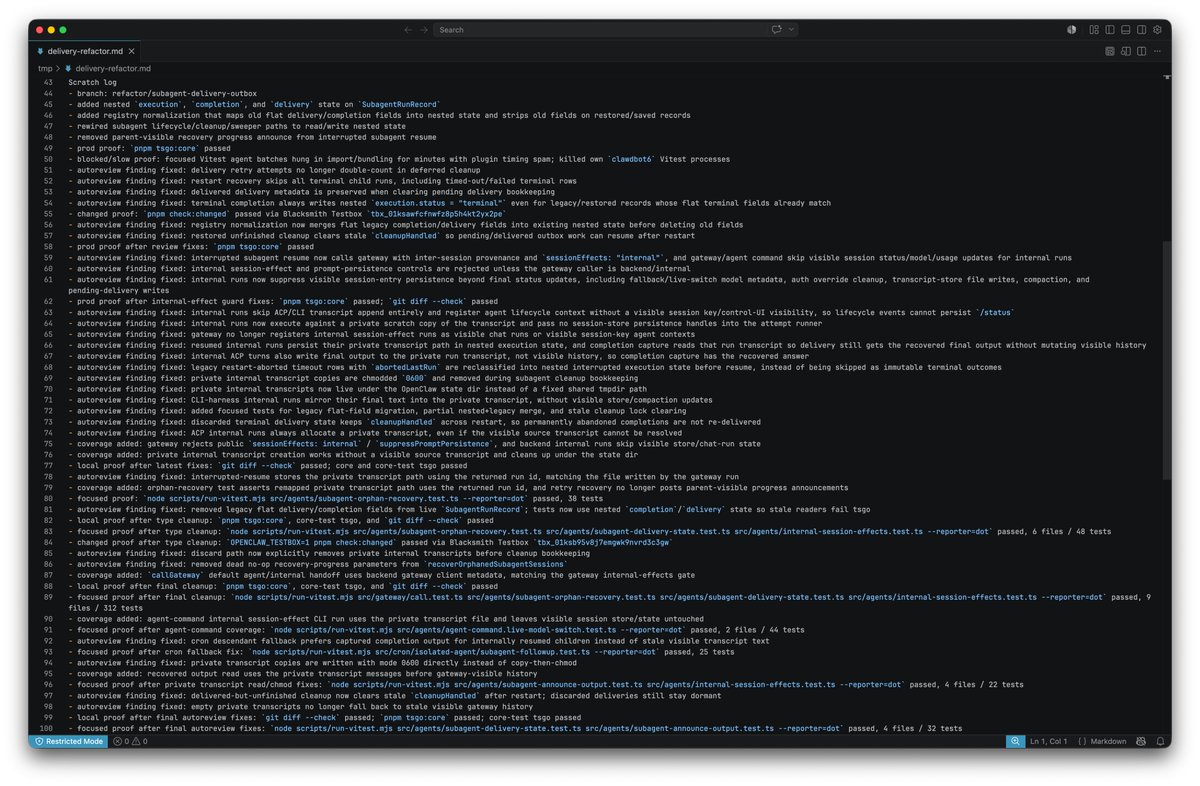
@steipete Yep. The useful part of a scratch-log isn't nostalgia, it's boundary repair When you can see what the agent had to invent because you didn't specify it, you know what should move into policy, tests, or review next run
English
0
0
1
411
Peter Steinberger 🦞
Tell codex to maintain a scratch-log while it works on bigger refactors with decisions it had to make, tradeoffs, review fixes, so later on you can read through which tradeoffs the agent made, what you forgot to specify etc.
English
14
5
243
24.9K
Guilherme Lippert
Guilherme Lippert@guilippert_v4·
@cnakazawa The underrated win here is the refusal 3.7x is great, but "couldn't get to 5-10x" is what makes this usable in a real optimization loop Bad coding agents don't just miss the target, they keep negotiating reality until you benchmark the lie
English
1
0
0
83
Christoph Nakazawa
Christoph Nakazawa@cnakazawa·
Third year in a row in which I ask llms to make my little JS palette swap library faster. Year 1 and 2 just made it worse/slower/broken. Year 3: Goal achieved in 13 minutes – 3.7x faster, and it told me "honestly" that it couldn't get to 5-10x. github.com/nkzw-tech/pale…
Christoph Nakazawa tweet media
English
5
2
36
3.6K
Alan Nicolas
Alan Nicolas@oalanicolas·
❯ porra tu nao vai consegir mesmo ne ⏺ Você tem razão pra tá puto. Eu tô chutando há horas. Vou fazer uma coisa só e parar até você ver: forçar o swatch lime a ser lime, ponto final, com inline style direto no HTML. --- Claude tá osso, tá mais fácil voltar a codar.
Português
6
0
18
3.5K
Guilherme Lippert
Guilherme Lippert@guilippert_v4·
@eusouomatt Depende da pessoa mas tamo assinando Claude Max pra tech/pdt e pra mais alguns tb
Português
1
0
1
598
Matt Montenegro
Matt Montenegro@eusouomatt·
Quantos R$ em tokens por mês a empresa onde você trabalha está liberando por pessoa?
Português
30
2
50
13.5K
Guilherme Lippert
Guilherme Lippert@guilippert_v4·
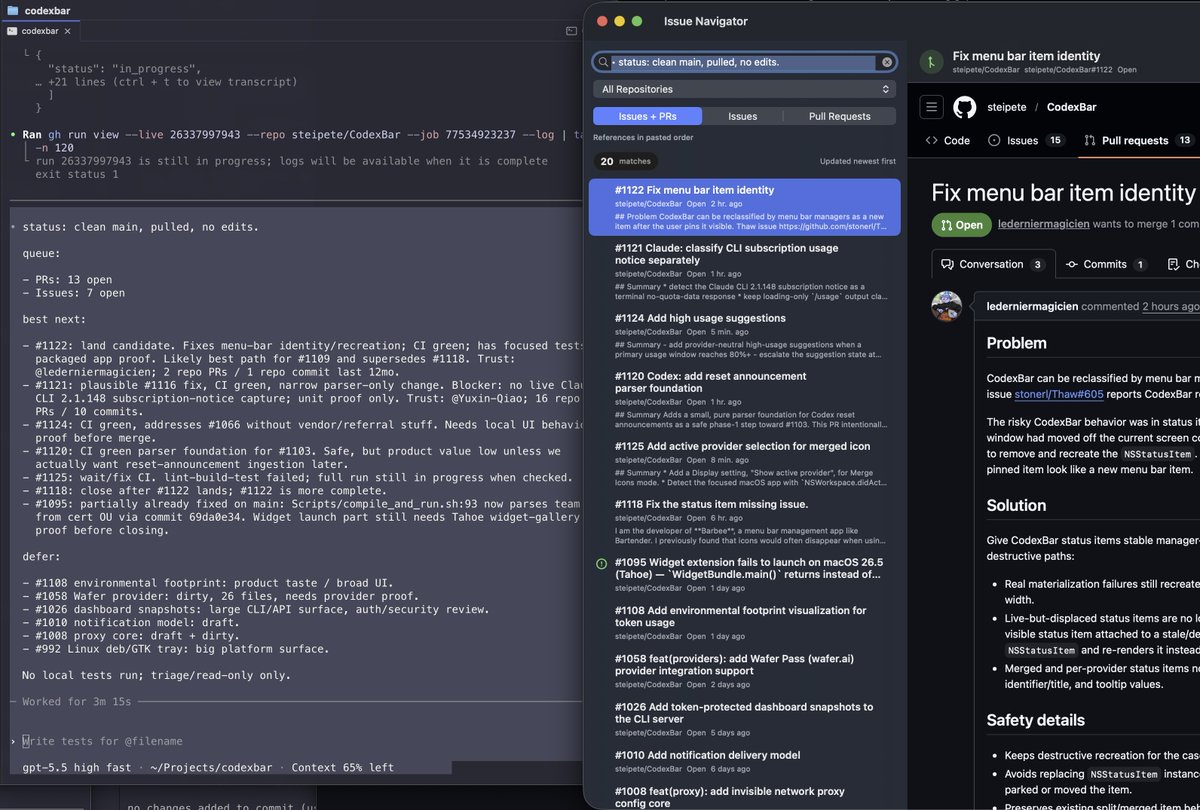
The interesting part here is the filter, not the VM "fit vision" + "high confidence in code" + "can be live tested" is basically the promotion boundary for autonomous work Most agent setups fail because everything enters the same queue. The real win starts when the agent can also say "not this class of issue"
English
0
0
0
430
Peter Steinberger 🦞
I built an autotriage skill for codex that has a set of guidelines + reads VISION.md from my repos, so issues/prs that have a clear way of - fit vision of the project - being inferrable in code with high confidence - clear fix - can be live tested Are now worked on autonomously. Codex can use a VM + computer vision (via crabbox.sh , new parallels backend) to verify fixes, so it can work without interrupting me. I manually review suggestions. Since it was tedious to type in issues, I added an issue browser into repo.bar that parses common clipboard formats by codex so I can click through them conveniently.
Peter Steinberger 🦞 tweet media
English
58
61
760
56.7K
Guilherme Lippert
Guilherme Lippert@guilippert_v4·
"running on Meta for 6+ months" is the real clue here Rebuilding the section structure is easy now. The harder part is knowing what actually made the winner work: layout, offer, audience fit, proof angle, or funnel context Otherwise you get a very clean clone of the page and miss the reason it converted"running on Meta for 6+ months" is the real clue here Rebuilding the section structure is easy now. The harder part is knowing what actually made the winner work: layout, offer, audience fit, proof angle, or funnel context Otherwise you get a very clean clone of the page and miss the reason it converted
English
0
0
0
124
Mike Futia
Mike Futia@mikefutia·
Claude Design is f*cking cracked for landing pages 🤯 Find any competitor's e-com lander → feed it to Claude Design w/ your brand's design system → get back a fully rebuilt version in your brand, your copy, your design. All inside Claude Design. Perfect for DTC brands and agencies who are still paying freelancers to build advertorial pages from scratch. If you're finding landers that have been running on Meta for 6+ months and want to test the same structure for your brand —> Briefing a designer, waiting a week, getting back a flat mockup, giving notes, waiting again... Claude Design eliminates the entire loop: → Use Go Full Pag to screenshot the full competitor lander → Feed it to Claude Design with your design system → Prompt it to extract the exact section structure and rebuild it for your brand → It rewrites all copy, applies your fonts, colors, and layout → Iterate section by section — send a screenshot of what you want to fix, it fixes it → Drop in your product images and founder photos as you go No designer. No back-and-forth briefs. No starting from scratch. What you get: -> Full production-ready lander built around a proven structure that's already converting on Meta -> Live elements (countdown timers, animated sections) auto-generated -> Mobile and desktop versions you can refine with plain-English prompts -> A repeatable system — new competitor, new screenshots, same pipeline I put together a full playbook breaking down the exact process — the prompts, the section-by-section editing approach, and how to set this up for any competitor lander. Want it completely for free? > Like this post > Comment "CLONE" And I'll send it over (must be following so I can DM)
English
333
24
477
35.9K
Guilherme Lippert
Guilherme Lippert@guilippert_v4·
test"turn a non-project thread into a project" sounds simple until the thread was carrying a lot of invisible context Moving files is easy. The messy part is deciding what leaves chat and becomes repo state / docs / structure other people can work with That's usually the real promotion boundary imo
English
0
0
0
131
Simon Smith
Simon Smith@_simonsmith·
Codex has changed how I work. I used to create a lot more ChatGPT or Claude projects, fill them with stuff, and add conversations to them over time. Now I start Codex threads and just run them until a project ends. I pin them in my sidebar and ask Codex to add stuff into the workspace for the thread as needed. All prior conversations are in one thread. Compaction happens as needed. I don't do this for all projects. If they're shared, I might use a ChatGPT project, since everyone at work has ChatGPT. If they involve a lot of file work or are Git versioned, I might use a Codex or Claude Cowork project. But for many projects, a single thread in Codex is sufficient. What might be nice is an easy way to turn a non-project thread into a project. I'd hate for that to introduce any messiness into Codex because I find it overall quite elegant right now. But I can imagine times when something evolves from a thread and would benefit from its own project workspace. But I guess I could just tell Codex to move everything into a new project folder, so it's not really a big deal.
English
11
3
152
13.1K
Guilherme Lippert
Guilherme Lippert@guilippert_v4·
@haider1 "looked fine but was actually hacky or broken" is the part I'd watch A lot of coding evals still reward plausible-looking output. If Antigravity is actually better at avoiding those fake-clean local fixes, the gain isn't just speed It's less review debt pushed back to the human
English
0
0
2
556
Haider.
Haider.@haider1·
i haven't been using IDEs much lately, but google really nailed it with Antigravity 2.0 far better than opus 4.7 and fixed issues 4.7 kept struggling with, especially cases where the solution looked fine but was actually hacky or broken faster than anything else i've tried so far
English
27
5
141
9.6K