Hackmamba

6.7K posts

Hackmamba banner
Hackmamba

Hackmamba

@hackmamba

Your next 10,000 developer signups start here. We build marketing campaigns so devs/agents try, adopt, and recommend your devtool without friction

Katılım Mart 2016
283 Takip Edilen3K Takipçiler
Sabitlenmiş Tweet
Hackmamba
Hackmamba@hackmamba·
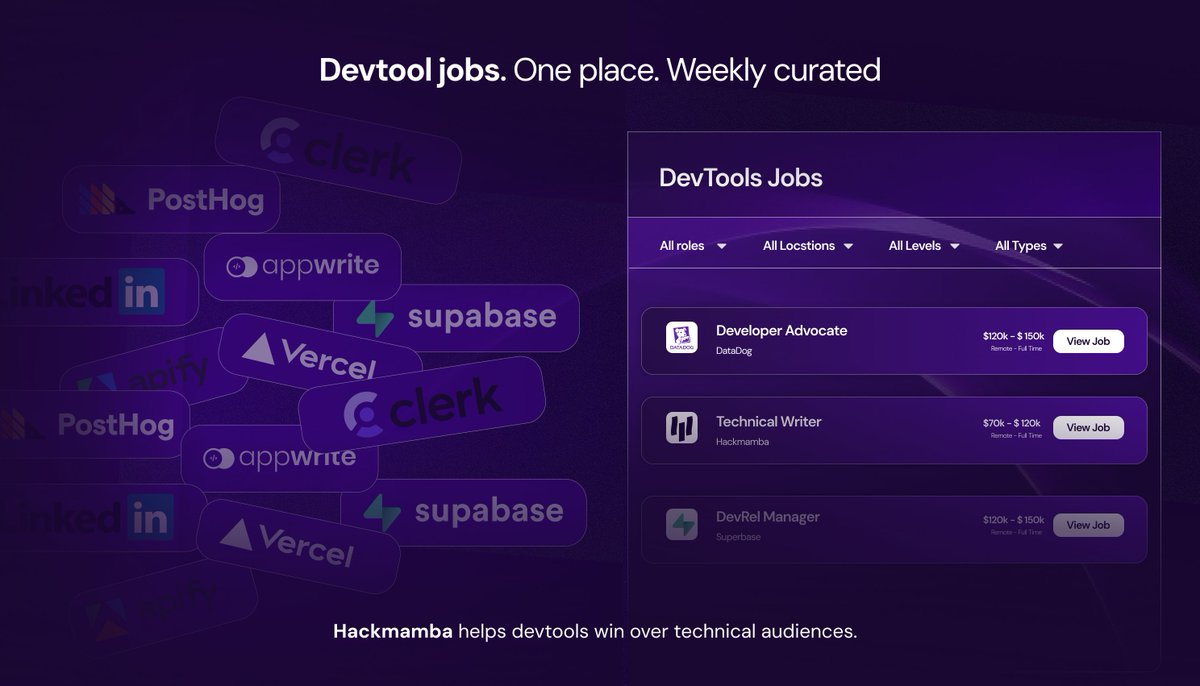
Big announcement for job seekers in the Devtool marketing space 👋 We’ve launched the Hackmamba Devtool Jobs portal! We regularly hear from technical writers, DevRel, and growth professionals who struggle to find devtools roles without checking multiple places. Jobs are scattered across communities, LinkedIn, and company career pages, making the search slow and inconsistent. To solve this, we built a dedicated portal that brings relevant devtool roles into one place. Listings are curated from communities, LinkedIn Jobs, and our own network, so you can quickly see what’s open and decide what’s worth exploring. We refresh the listings every Friday. Bookmark it to stay updated on the latest Devtool Jobs 💜
Hackmamba tweet media
English
3
7
21
2.1K
Hackmamba
Hackmamba@hackmamba·
If your team has ever debated "should we mock this or hit the real API," the honest answer is that it depends on five things: - How critical the flow is. - The cost of getting it wrong. - Who controls the API. - Whether a formal contract exists. - What real testing actually costs you in time and quota. This article by @currents_dev breaks that decision down across a five-level spectrum, from no mocking at all to schema-validated and contract-tested mocks. It also covers parts like webhook testing, idempotency keys for real integration runs, and how to clean up sandbox data when ten parallel CI runs share the same Stripe test account. If you're making suite-wide decisions rather than writing one-off tests, this one is for you. Article link in the comments.
Hackmamba tweet media
English
1
1
4
80
Hackmamba
Hackmamba@hackmamba·
In case you missed it, we’ve got new roles on our Dev Tools Jobs Board. You’re only seeing 6 out of 14 here, with openings across DevRel, growth, technical writing, documentation, and more. Check the full list below.
Hackmamba tweet media
English
1
1
4
124
Hackmamba
Hackmamba@hackmamba·
If you have ever shipped a Cloudflare Worker and later discovered a teammate was running it with a different API key than production, this guide from @doppler is for you. It covers the complete workflow for managing secrets across environments. From cloning a starter project and setting up Doppler, to syncing secrets to Cloudflare, wiring GitHub Actions for automated deployments, rotating credentials without touching every environment manually, and setting up team collaboration with proper access controls. Ten chapters, each step hands-on. By the end, you have a workflow that scales with your team and your deployment frequency. Link in the comments.
Hackmamba tweet media
English
1
0
2
96
Hackmamba retweetledi
Asjad Khan
Asjad Khan@khanasjad21·
Everyone repeats that GitHub's free runners are 2-core. That's only true for private repos. Public repos get 4-core Linux runners now. It changes the parallelism math: on 2 cores, Playwright's undefined worker setting resolves to a single worker, so you're serial by default. On 4 cores, you get 2 out of the box, with room to push higher. Worth knowing before you tune workers against advice written for a machine you're not running on. endform.dev/blog/playwrigh…
English
0
3
3
1.2K
Hackmamba retweetledi
Asjad Khan
Asjad Khan@khanasjad21·
Playwright CI feels slow, so you shard it. That's usually the wrong first move. Sharding costs you CI minutes across several runners, a merge-reports step, and a shard count you have to rebalance as the suite grows. Before any of that: cache the browsers, turn on fullyParallel, lift the CI worker cap, and run Chromium only on PRs. That holds a 100-test suite under five minutes on a single runner. Shard when your numbers cross the line. Not when the run first feels slow. endform.dev/blog/playwrigh…
English
2
3
5
197
Hackmamba
Hackmamba@hackmamba·
Using AI as a coding helper and actually building with it are two different things. The first is autocomplete. The second requires you to think in prompts, manage context across a session, and know when to stop Claude before it rewrites something you did not ask it to touch. This tutorial from @roadmapsh walks through that shift concretely, building a real CLI app using Claude Code from installation to optional deployment. The prompts are included verbatim. You'll see the output and the places where things typically go wrong. Article link below.
Hackmamba tweet media
English
1
0
1
129
Hackmamba
Hackmamba@hackmamba·
Quick way to test whether your Playwright suite is actually decoupled from the UI: Rename a CSS class, change a build hash, or swap an element type that tests rely on. Then run the suite. If tests fail, your suite has hidden dependencies that code review never caught. A visual refactor that produces zero test failures is the target. If tests fail after a CSS-only change with no functional impact, the selector design needs work. This piece from @currents_dev is on designing tests that survive UI refactors. To understand it fully, take a look at the article at the link below.
Hackmamba tweet media
English
1
1
5
117
Hackmamba
Hackmamba@hackmamba·
Tried the whole "let AI write our technical content" thing. It didn't quite work out. We're keeping the technical writers. 🙂
English
0
1
2
111
Hackmamba
Hackmamba@hackmamba·
Most vibe coding sessions start well and slowly drift. Context bleeds between features, prompts get vague, and by the time something breaks, there are too many accepted changes to trace the cause. The 10 practices in this carousel address that drift directly. Each one is something you can apply before your next session starts, from how you write prompts to how you handle schema changes and sensitive code. Save this one. The full guide from @roadmapsh is in the comments. 🧵
Hackmamba tweet media
English
2
1
7
141
Hackmamba retweetledi
Asjad Khan
Asjad Khan@khanasjad21·
The workerIndex, parallelIndex, and retry data are in your Playwright test results. The HTML reporter just doesn't surface it in a way that makes cross-run analysis practical. Here's what teams actually need past 150 tests: currents.dev/posts/playwrig…
English
0
2
2
661