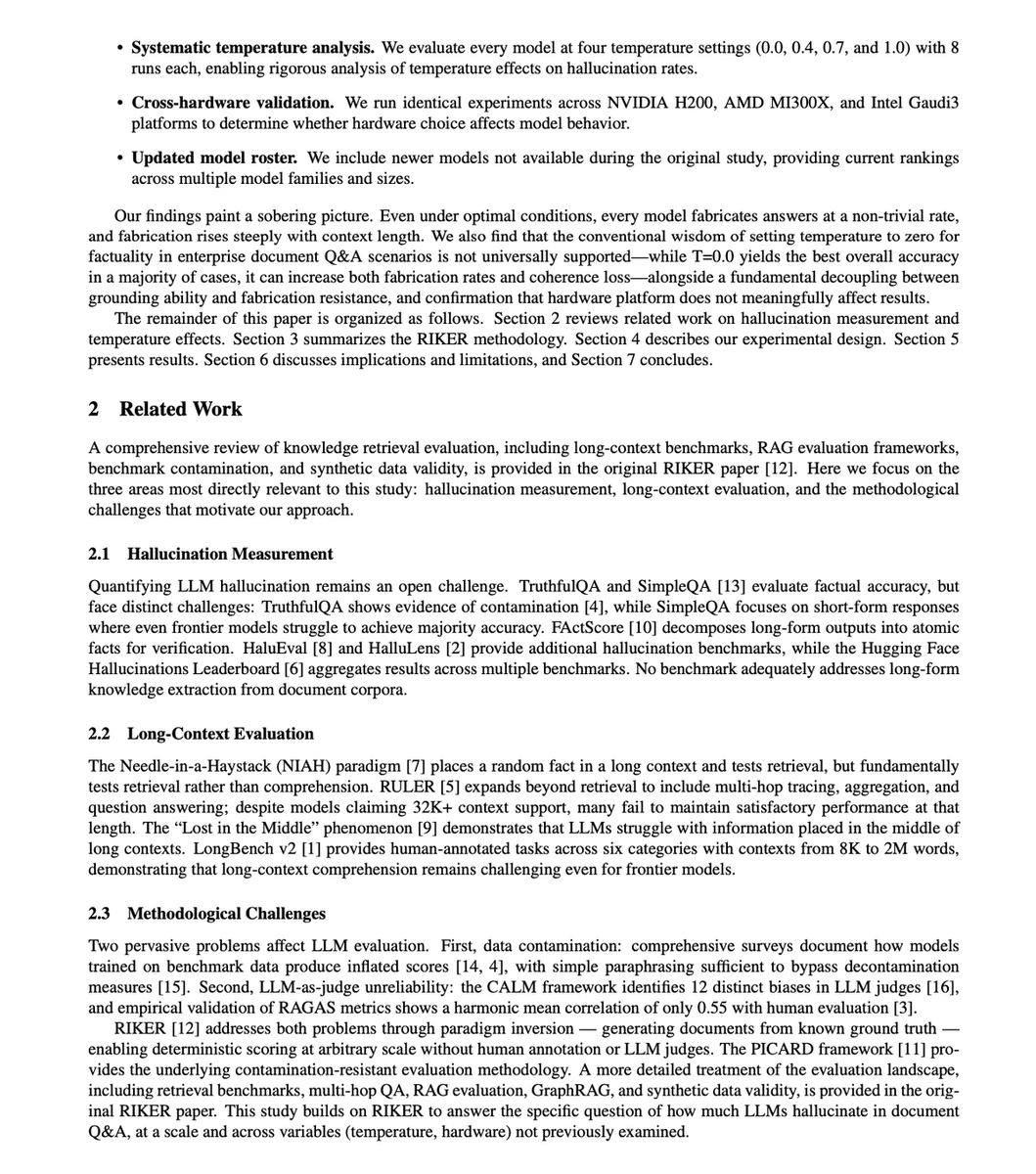
halfik⚡️

2.5K posts

halfik⚡️ banner
halfik⚡️

halfik⚡️

@halfik83

Warsaw, Poland Katılım Aralık 2013
173 Takip Edilen158 Takipçiler
halfik⚡️ retweetledi
Simplifying AI
Simplifying AI@simplifyinAI·
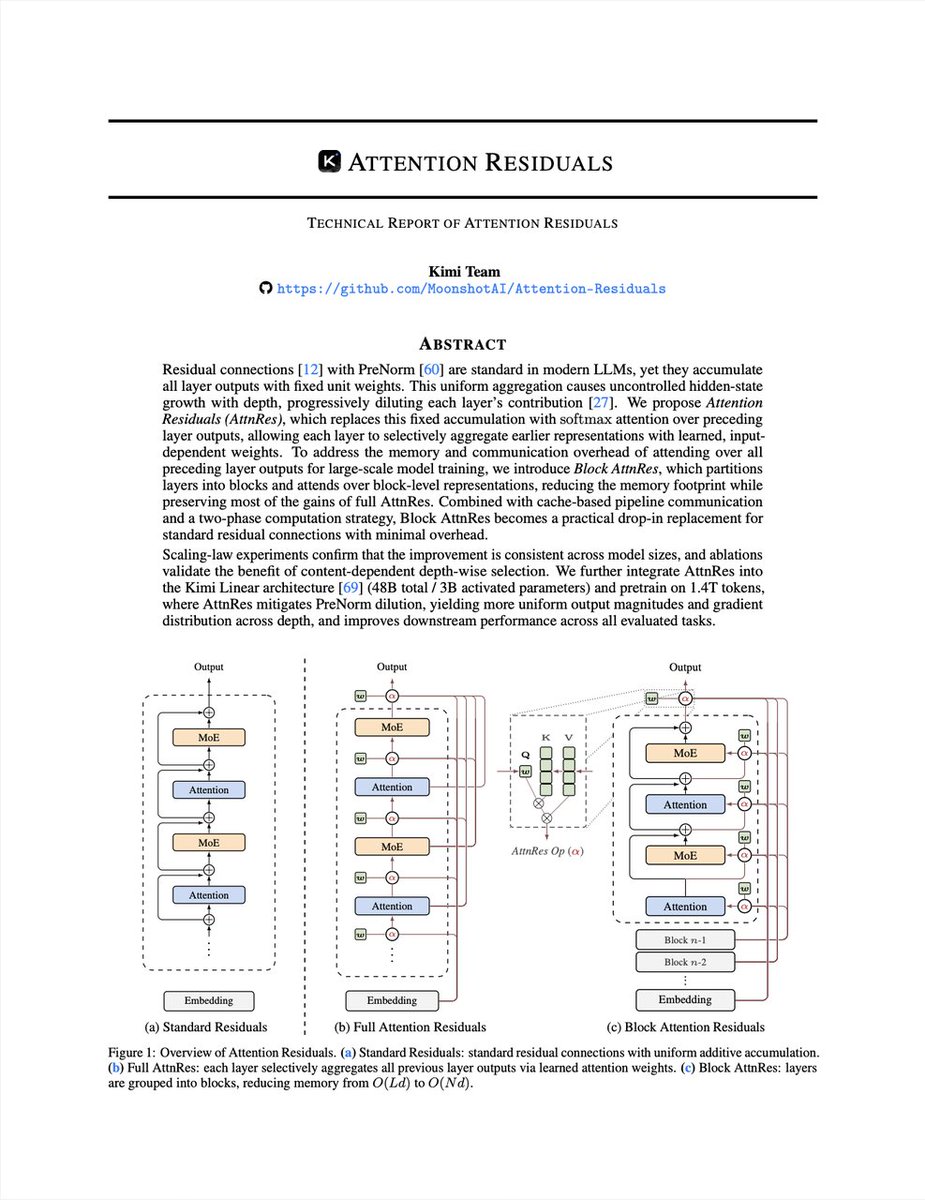
🚨 BREAKING: China just fixed a 10-year-old flaw hidden inside every major language model. Every AI you use today (ChatGPT, Claude, Gemini) is built on a massive flaw. It’s called the residual connection. Here’s the problem: every layer inside an AI blindly stacks its output on top of the last one. There is no filtering, no judgment, just blind accumulation. Imagine a meeting where every person shouts their ideas at full volume, forever. The early ideas (the fundamental patterns) get drowned out by the newer, louder layers piled on top. The technical term is “prenorm dilution,” but in practice, it means your AI forgets its own most important work as it gets deeper. We’ve been building models like this since 2017. Now, Moonshot AI (Kimi) just dropped a paper that completely replaces this broken system. They call it “attention residuals.” Instead of blindly accumulating everything, each layer now “votes” on which previous layers actually matter using softmax attention over depth. The network learns to remember what’s important and ignore what isn’t. The results are absolutely insane: - It matches the performance of models that used 25% more compute to train - Tested on a 48-billion-parameter model with massive gains in math, code, and reasoning - Inference slowdown is less than 2% - It’s a direct drop-in replacement for existing systems The Transformer replaced recurrence with attention across words in 2017. This paper is doing the exact same thing across layers of depth. This is the same class of idea. The entire architecture of AI is about to change.
Simplifying AI tweet media
English
37
279
1.1K
81.3K
halfik⚡️
halfik⚡️@halfik83·
@nic_carter @McFaul How about fu? With all the shit Trump dump on EU only idiot would be supprised EU don't give a fck.
English
0
0
0
11
nic carter
nic carter@nic_carter·
- confirming that our allies are fake allies - creating clear evidence of the obsolescence of NATO - creating moral justification for future concessions demanded from european former allies once we unilaterally reopen the straight (hint: Trump will make sure he is repaid for the blood and treasure we spent opening the strait)
English
89
62
1.4K
44K
Michael McFaul
Michael McFaul@McFaul·
The United States has the greatest navy in the world. Not really sure why Trump is begging for help to execute his war in the Strait of Hormuz. Can someone explain this to me?
English
2.9K
448
4.4K
942.2K
halfik⚡️
halfik⚡️@halfik83·
@NickSzabo4 Nah. If it would be about America first you would not seend own soldiers to become a target instead of Tel Aviv. America had no business do be part of that war. Same as Europe or Chinea have no business to fix your mess now.
English
0
0
0
100
Nick Szabo
Nick Szabo@NickSzabo4·
If America had an actual America-first foreign policy, we'd ally with Iran in making East Asia, Europe, and India pay a toll at Hormuz. We'd "split the loot." Or, we could just pack up every American soldier and intelligence agent within a thousand miles of Iran and Israel and bring them back home. That, too, would be an America-first foreign policy. The foreign policy we currently have is almost as extremely far removed from actual American interests as it is possible to imagine.
Robin Knox@rknoxjohnston

@NickSzabo4 @JABG1579 @ChayasClan What about the division of the loot when (if) the war ends?

English
18
12
157
15.3K
halfik⚡️
halfik⚡️@halfik83·
@LeonWaidmann Eth has no cap and no monetary policy. It can be changed by Vitalik. Its shitcoin. Always was.
English
0
0
1
9
Leon Waidmann
Leon Waidmann@LeonWaidmann·
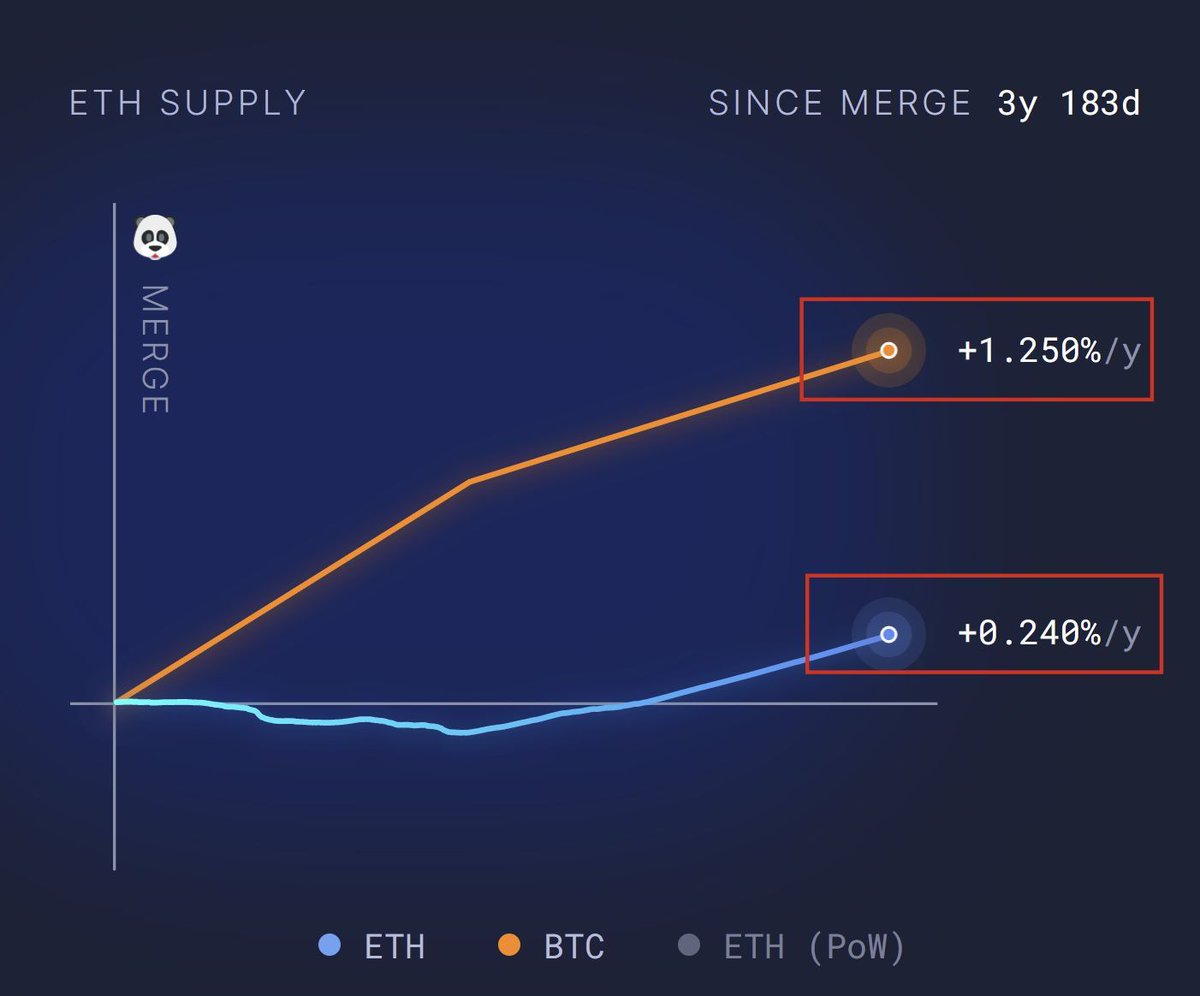
Ethereum is 5x less inflationary than Bitcoin! 3 years and 183 days since the Merge. 🔹 ETH supply growth: +0.240%/year 🔹 BTC supply growth: +1.250%/year Everyone calls Bitcoin "sound money." But by the numbers, ETH has the tighter monetary policy! Let that sink in. Price doesn't reflect it yet. The data does! 📈
Leon Waidmann tweet media
English
116
101
648
79.2K
halfik⚡️ retweetledi
Guri Singh
Guri Singh@heygurisingh·
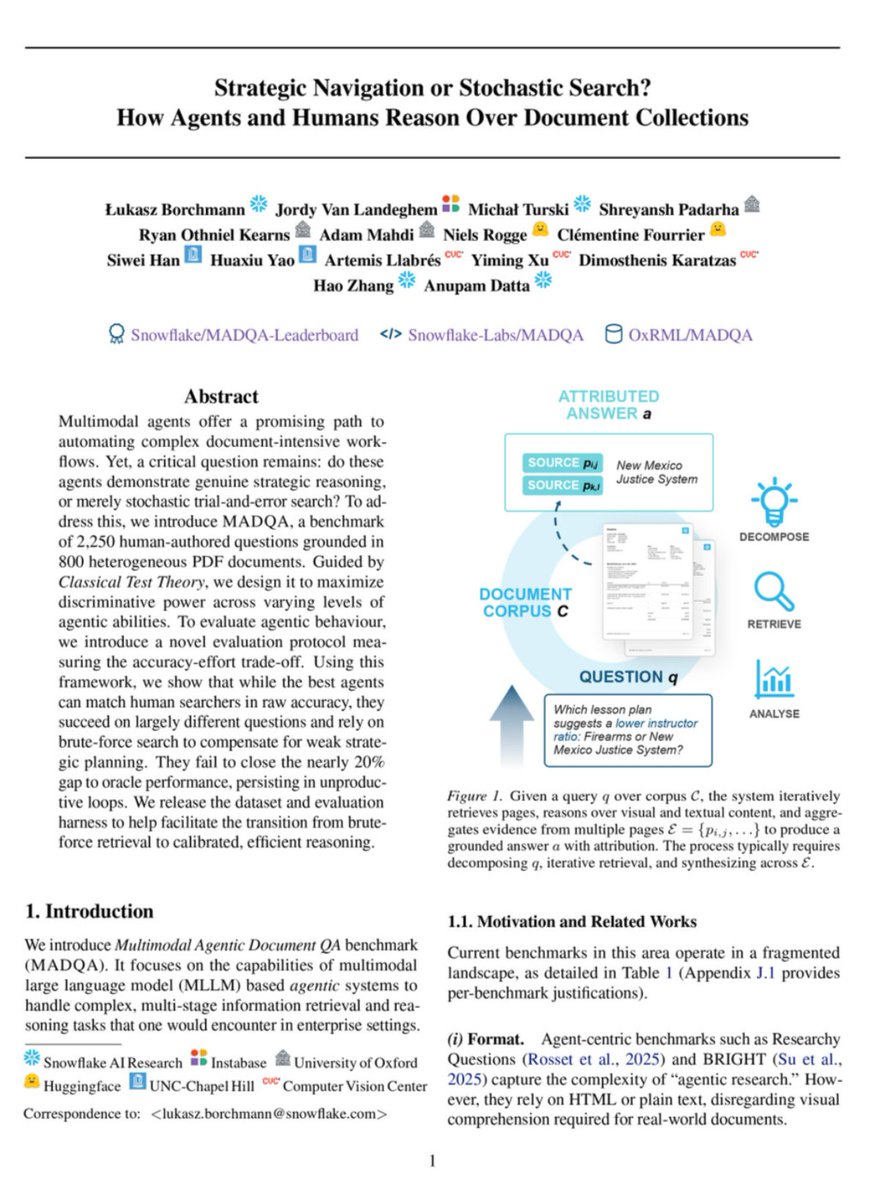
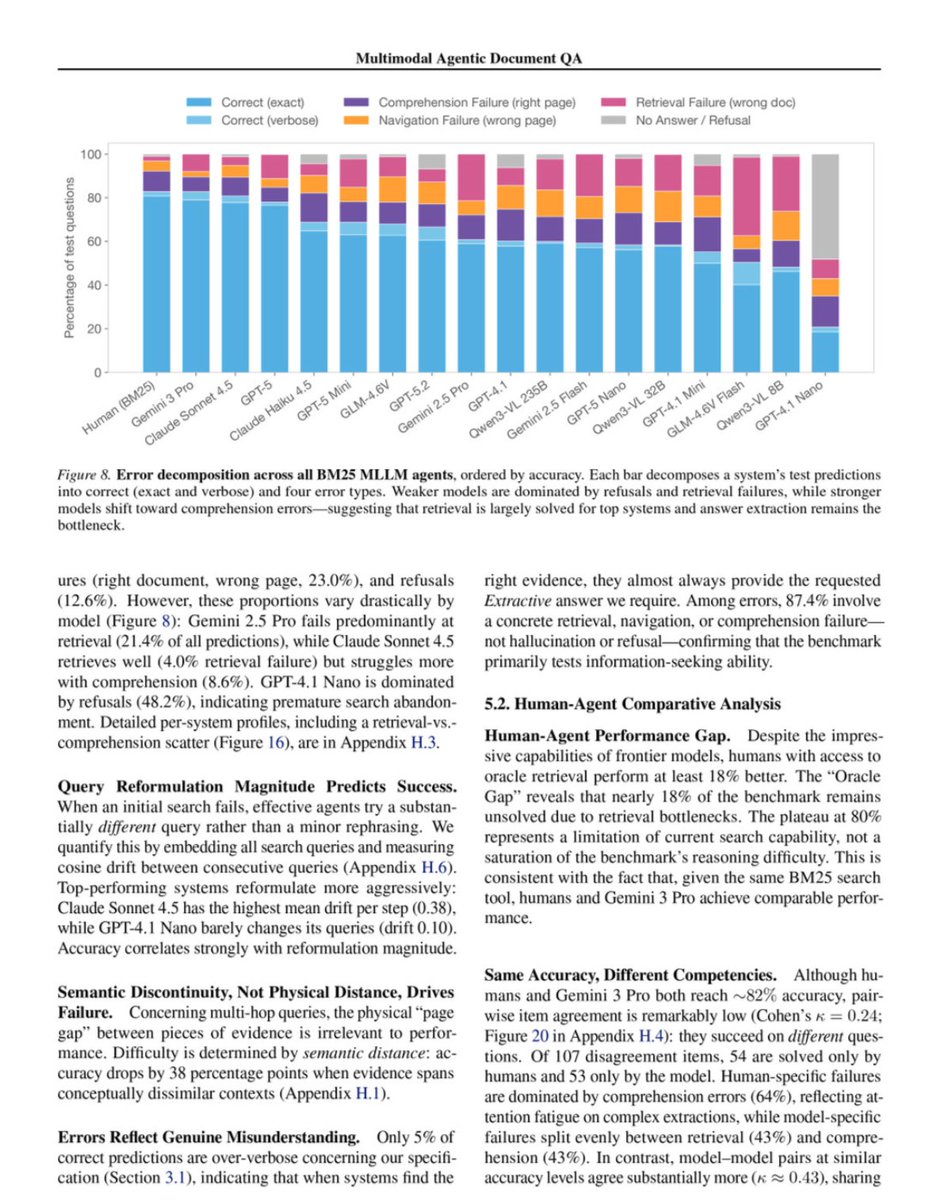
🚨BREAKING: A new benchmark just exposed the biggest lie in AI. Your AI agent isn't "reasoning" through documents. It's throwing 270 million tokens at the wall and praying. Snowflake, Oxford, and Hugging Face tested every frontier model on real document search. 2,250 questions. 800 PDFs. 18,619 pages. 1,200 hours of human annotation. The best AI agent, Gemini 3 Pro, scored 82.2%. Humans scored 82.2%. Perfect match. Headlines would call this "human-level performance." Then they checked which questions each got right. The overlap was 24%. Cohen's kappa of 0.24. Humans and AI were solving completely different questions. Same score. Totally different intelligence. But that's not the bad part. Humans nailed 50% accuracy on their very first search query. Gemini 3 Pro? 12%. The best AI agent on Earth needed 9 rounds of blind searching to reach what a human does in one shot. When searches failed, humans immediately changed strategy. AI agents? They rephrased the same failed query with minor tweaks and tried again. The worst agent, GPT-4.1 Nano, barely changed its queries at all. 48.2% of its responses were straight-up refusals. It just gave up. With perfect retrieval, humans hit 99.4%. Best AI agent with the same documents? Stuck at 82.2%. An 18% gap that no amount of compute could close. Claude Sonnet 4.5's recursive model burned 270 million input tokens, $850 per test run, and still couldn't beat its own cheaper version using basic keyword search. 3,273 agent errors analyzed. 35.7% couldn't even find the right document. Not the right page. The right file. Your AI agent isn't reading your documents. It's playing a slot machine with your data and billing you for every pull.
Guri Singh tweet mediaGuri Singh tweet media
English
62
132
452
34.1K
halfik⚡️ retweetledi
Priyanka Vergadia
Priyanka Vergadia@pvergadia·
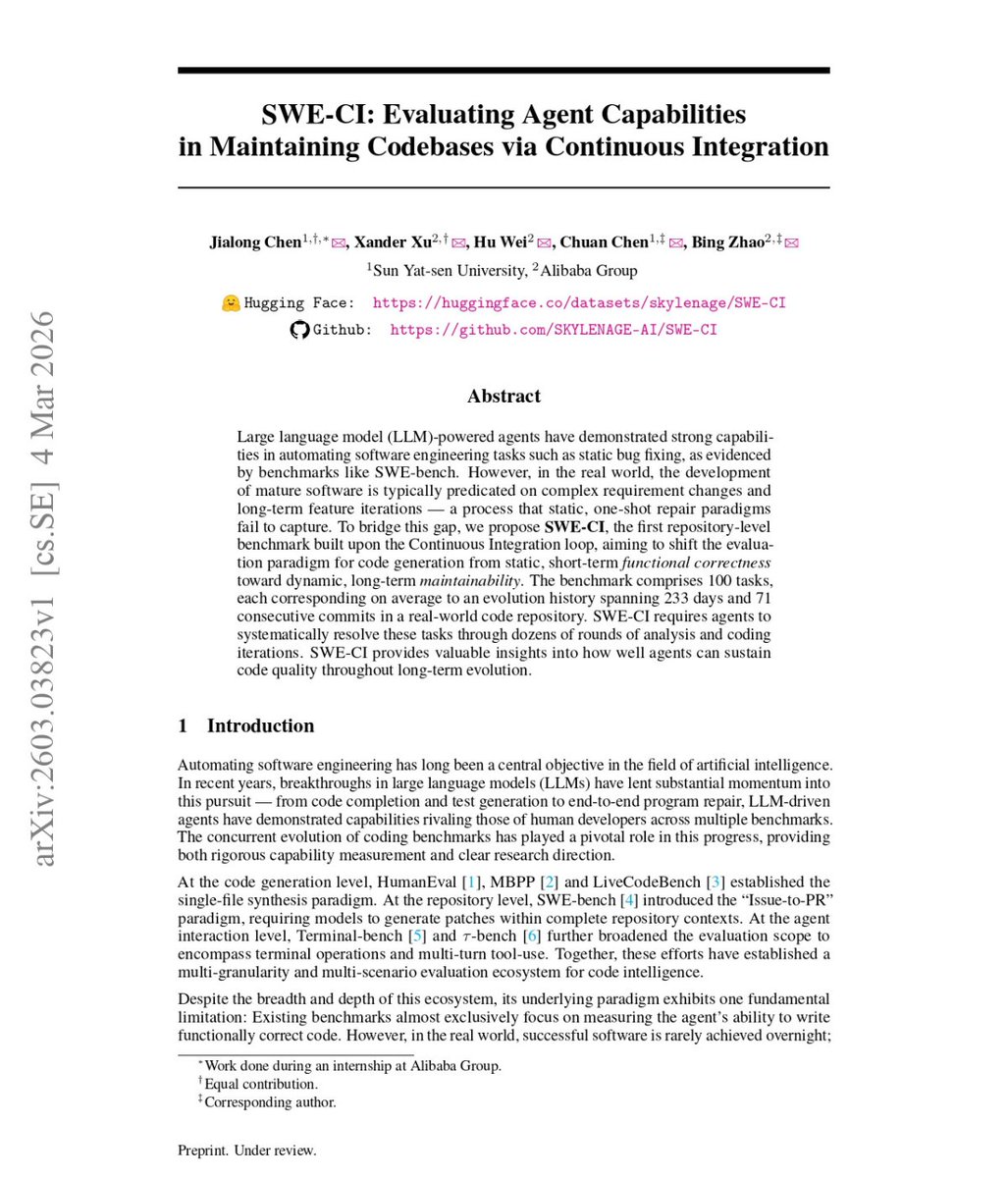
🤯BREAKING: Alibaba just proved that AI Coding isn't taking your job, it's just writing the legacy code that will keep you employed fixing it for the next decade. 🤣 Passing a coding test once is easy. Maintaining that code for 8 months without it exploding? Apparently, it’s nearly impossible for AI. Alibaba tested 18 AI agents on 100 real codebases over 233-day cycles. They didn't just look for "quick fixes"—they looked for long-term survival. The results were a bloodbath: 75% of models broke previously working code during maintenance. Only Claude Opus 4.5/4.6 maintained a >50% zero-regression rate. Every other model accumulated technical debt that compounded until the codebase collapsed. We’ve been using "snapshot" benchmarks like HumanEval that only ask "Does it work right now?" The new SWE-CI benchmark asks: "Does it still work after 8 months of evolution?" Most AI agents are "Quick-Fix Artists." They write brittle code that passes tests today but becomes a maintenance nightmare tomorrow. They aren't building software; they're building a house of cards. The narrative just got honest: Most models can write code. Almost none can maintain it.
Priyanka Vergadia tweet media
English
486
1.9K
9.4K
1.7M
halfik⚡️
halfik⚡️@halfik83·
@d_1awrence Here is crazy idea. Imagine you arw big wall street investment bank. All you care about is to make shit tons of money. Even if you have to break some laws. You just pay fines. What will you do if there is tons of money to be made on Bitcoin and there is 1 entity holding 700k+ ?
English
0
0
0
19
David Lawrence
David Lawrence@d_1awrence·
Every 210,000 Bitcoin that #MSTR buys, it eliminates 1% of the total Bitcoin supply that can ever be purchased, forever. This generally wouldn't be entertained as a genuine thought, due to the sheer scale of capital required & the time it would take for them to obtain that amount of Bitcoin. There's a strong chance they've obtained 30,000+ Bitcoin this week alone. At this run rate, they would be absorbing 1% of the entire network every 7 WEEKS! But here's where it starts to get really crazy.... There's $156 Trillion in the fixed income market - that's the capital that $STRC is targeting - not $1000 deposits form your uncle Steve. Real, large, institutional capital. The size & volume of capital that's been spoken about for years, but has always felt decades away. It's coming. Not in 5 years. Right now. If the volume of capital running through $STRC increases by 1000x, it would capture just 1% of that fixed income market. Take a moment to really think about that. I daren't predict how much Bitcoin they're going to accumulate this year, but it's going to be A LOT. And yet, despite this knowledge, there are STILL people saying that their purchases will have no influence on the Bitcoin price! At this point it's impossible to not. The game has changed forever. Saylor has been playing 4D chess for years and most people are still trying to learn the rules for checkers. Strategy will become the most valuable company in the world. Bitcoin is going to absorb everything. You really are not bullish enough!
English
50
100
738
114.1K
halfik⚡️ retweetledi
hodlonaut #BIP-110
hodlonaut #BIP-110@hodlonaut·
1/ The removal of Bitcoin Core's OP_RETURN limit in June 2025 was justified as "harm reduction." Criticism was met with accusations of "censorship". Let's look at the record. Who knew the limit was blocking their protocols. Who was routing around it. And who was counting on Core to remove it.
English
29
140
449
28.3K
halfik⚡️
halfik⚡️@halfik83·
@cryptomanran Yea bit AI has to figure out how to increase revenue by factor of x25 to become profitable to pay for that electricity. Bitcoin does not have that problem.
English
0
0
3
27
Ran Neuner
Ran Neuner@cryptomanran·
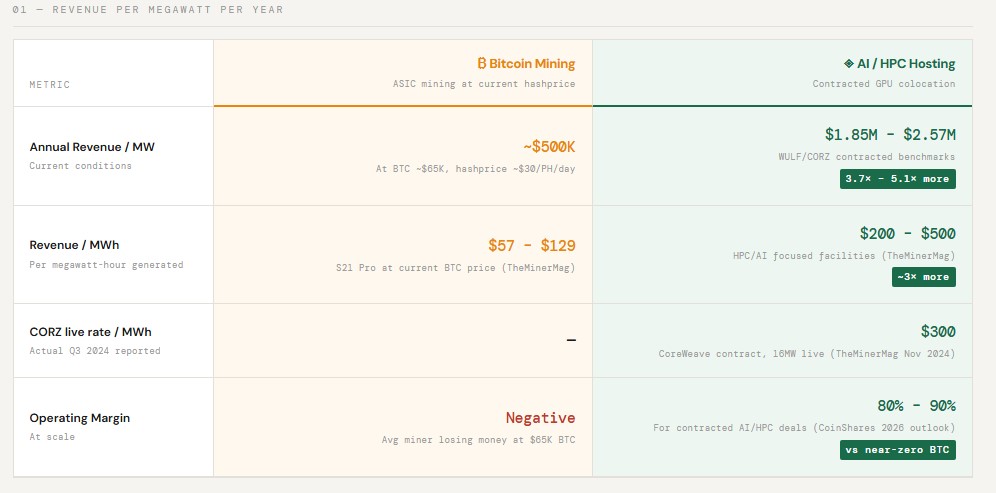
AI has killed Bitcoin forever. It became Bitcoin mining’s biggest competitor. Not another crypto. AI. Because both industries compete for the same thing: electricity. And right now, AI is willing to pay much more for it. Bitcoin mining revenue per MW: $57 – $129 AI data center revenue per MW: $200 – $500 Same electricity. But up to 8x more profitable. That’s why miners are starting to pivot. Core Scientific signed a massive AI hosting deal. Hut 8 signed a $7B AI infrastructure agreement. Cipher Mining cut its hashrate 51% to focus on AI compute. So a new question is emerging: If AI becomes the highest bidder for electricity, what happens to Bitcoin? In my new video, I break down: • Why miners are switching • What it means for hash rate • And the two scenarios that could play out for Bitcoin [link in comments]
Ran Neuner tweet media
English
645
110
835
290.6K
halfik⚡️ retweetledi
hodlonaut #BIP-110
hodlonaut #BIP-110@hodlonaut·
1/ In May 2019 a prominent Bitcoin Core developer called Matt Corallo posted a Twitter thread calling for DEI recruitment into Bitcoin development. The same month, John Newbery hired a new co-organiser for Chaincode Labs' developer residency.
hodlonaut #BIP-110 tweet media
English
62
149
543
88.2K
halfik⚡️
halfik⚡️@halfik83·
@PeterSchiff @TimDraper On centralized network sure. But then you have other risks. But you can't make gold decentralized. Only Bitcoin can do it.
English
0
0
4
20
Peter Schiff
Peter Schiff@PeterSchiff·
In a recent interview, @TimDraper said he prefers Bitcoin over gold because gold doesn't work as a medium of exchange because you can't shave some gold off your bar and order a cappuccino. Somehow Draper, a knowledgeable crypto investor, doesn't realize you can tokenize gold.
English
560
60
880
181.2K
halfik⚡️
halfik⚡️@halfik83·
@AnishA_Moonka 9% chance model will halucinate still makes it usless without expert supervisor.
English
0
0
2
193
Anish Moonka
Anish Moonka@AnishA_Moonka·
GPT-5.4 loses 54% of its retrieval accuracy going from 256K to 1M tokens. Opus 4.6 loses 15%. Every major AI lab now claims a 1 million token context window. GPT-5.4 launched eight days ago with 1M. Gemini 3.1 Pro has had it. But the number on the spec sheet and the number that actually works are two very different things. This chart uses MRCR v2, OpenAI’s own benchmark. It hides 8 identical pieces of information across a massive conversation and asks the model to find a specific one. Basically a stress test for “can you actually find what you need in 750,000 words of text.” At 256K tokens, the models are close enough. Opus 4.6 scores 91.9%, Sonnet 4.6 hits 90.6%, GPT-5.4 sits at 79.3% (averaged across 128K to 256K, per the chart footnote). Scale to 1M and the curves blow apart. GPT-5.4 drops to 36.6%, finding the right answer about one in three times. Gemini 3.1 Pro falls to 25.9%. Opus 4.6 holds at 78.3%. Researchers call this “context rot.” Chroma tested 18 frontier models in 2025 and found every single one got worse as input length increased. Most models decay exponentially. Opus barely bends. Then there’s the pricing. Today’s announcement removes the long-context premium entirely. A 900K-token Opus 4.6 request now costs the same per-token rate as a 9K request, $5/$25 per million tokens. GPT-5.4 still charges 2x input and 1.5x output for anything over 272K tokens. So you pay more for a model that retrieves correctly about a third of the time at full context. For anyone building agents that run for hours, processing legal docs across hundreds of pages, or loading entire codebases into one session, the only number that matters is whether the model can actually find what you put in. At 1M tokens, that gap between these models just got very wide.
Claude@claudeai

1 million context window: Now generally available for Claude Opus 4.6 and Claude Sonnet 4.6.

English
75
187
1.9K
348.6K
halfik⚡️
halfik⚡️@halfik83·
@Giovann35084111 What if you take only last 15 years of sp500 and gold? It would be more fair to compare.
English
0
0
2
50
Giovanni's BTC_POWER_LAW
Giovanni's BTC_POWER_LAW@Giovann35084111·
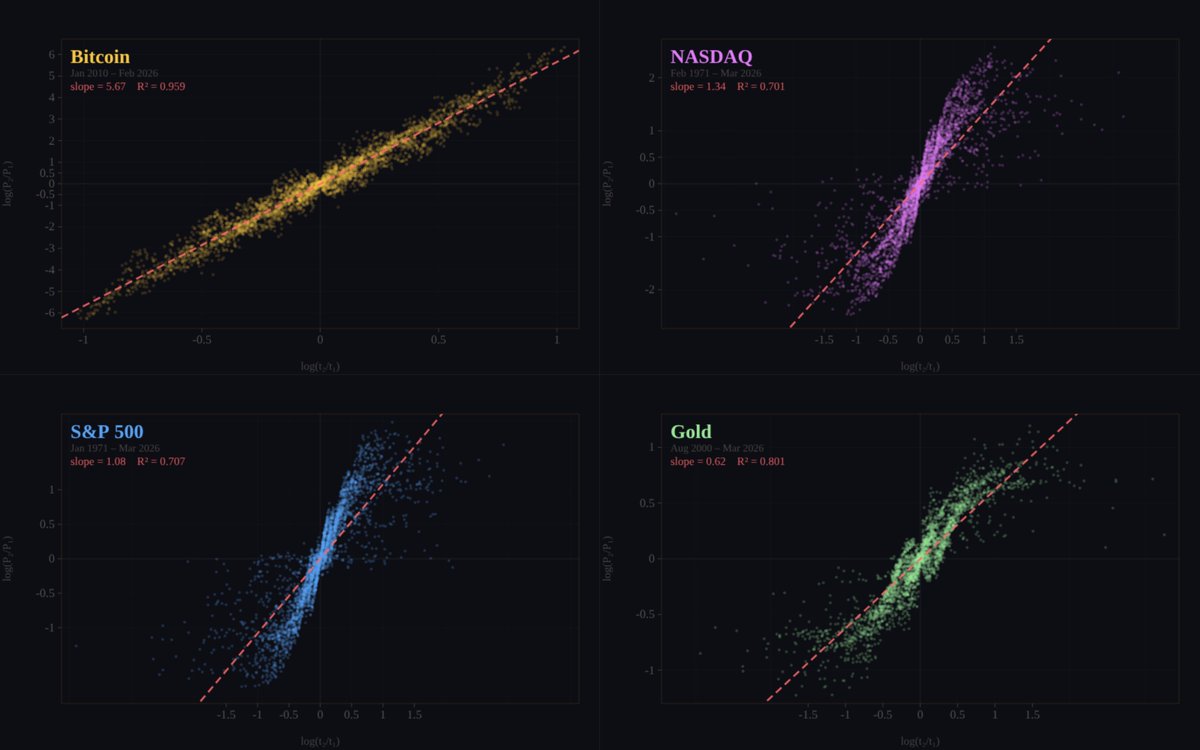
The graph below is something every Bitcoiner should print and put it in their bedroom. From the Physics of Bitcoin book: Bitcoin is the only asset that passes the Scaling Test. Here's a model-independent way to prove Bitcoin follows a power law — no curve fitting, no cherry-picked dates, no assumptions. Pick two random days from Bitcoin's history. Compute the ratio of the prices. Compute the ratio of the times. Plot one against the other. Repeat thousands of times. For a true power law, those points should collapse onto a perfectly straight line — because if P(t) ∝ tⁿ, then P(t₂)/P(t₁) = (t₂/t₁)ⁿ. The ratio of prices is entirely determined by the ratio of times. It doesn't matter which dates you pick. It doesn't matter where you are in the cycle. The exponent is always the same. Bitcoin does exactly this. Slope = 5.67. R² = 0.96. A tight linear cloud across 15 years of data — bull markets, crashes, halvings, exchange collapses — all of it consistent with a single underlying mathematical structure. The S&P 500 and NASDAQ, using their full 55-year histories? R² drops to ~0.70. A third of the variance is simply unexplained by elapsed time. Gold is worse. These assets grow, but they do not scale. Recessions, policy shifts, and macro shocks leave fingerprints that no single exponent can capture. This is the mathematical signature of scale invariance — the same symmetry that appears in critical phenomena, phase transitions, and the renormalization group in physics. When a dataset has this symmetry, it means the microscopic noise is washing out at large scales, leaving behind a single universal exponent. Bitcoin isn't just growing faster than other assets. It's growing according to a different mathematical logic entirely.
Giovanni's BTC_POWER_LAW tweet media
English
65
207
1.1K
51.3K
halfik⚡️ retweetledi
Reformed 🧂
Reformed 🧂@ProfessorBigz·
How much time you got? Here’s a few ways that BIP 110 damages Bitcoin: 1) Kills scaling and programmability -Bans OP_IF in Tapscripts that destroys MAST, covenants, Ark, BitVM, channel factories, statechains, and almost every future L2 roadmap. -Removes the foundation for Schnorr and Taproot efficiency gains (30–60% smaller multisig, private scripts). -We do not win if we cannot scale 2) Creates worse spam vectors -Forces spammers into fake-pubkey P2WSH multisigs and other unprunable vectors -Results in permanent utxo bloat instead of prunable OR, which increases node costs, slows sync times, and centralizes running a node. -Every new filter just shifts the attack vector to somewhere more harmful 3) Breaks legitimate use cases and existing users -Makes ~560,000+ real taproot spends (vaults, HTLCs, lightning, decaying multisigs) unspendable on the BIP 110 chain after activation. -Retroactively freezes or devalues tens of millions of utxos that belong to real holders, effective confiscation for those users. 4) Chain split risk -Zero miner signaling plus uasf activation will result in an automatic split when miners keep mining data for fees. -Creates a low-hashrate minority chain with no economic support. Easy 51% attacks, reorgs, and confusion. 5) Destroys rough consensus and governance -Trades public debate, mailing list, and proper review for a single dev pushing directly to main with no review. -Sets precedent that any small group can uasf contentious rules and threaten to split the chain. -Turns Bitcoin development into personality-driven drama instead of technical merit. 7) Hurts adoption and economic security -Alienates builders, institutions, and new users. -Makes Bitcoin look unstable and ruled by moral panic. -Reduces long-term fee security budget by killing L2 growth. 7) Security and centralization risks -Forces constant filter updates and centralizes policy in one maintainer. -Increases attack surface (new consensus rules = new bugs, reorg risks). -Makes running a node more expensive due to forced utxo bloat. 8) Sets terrible precedent -Normalizes retroactive rule changes and moralistic censorship. -Opens the door for future forks over what small group decides is“bad data” -Weakens Bitcoin’s core promise of immutability and permissionlessness. Bottom line: BIP 110 doesn’t “fix” spam, it redirects it into worse forms, breaks scaling tools, risks a split, and sets a dangerous precedent. It’s anything but conservative and completely undermines Bitcoin as global money. It’s radical sabotage dressed as purity.
Reformed 🧂 tweet media
English
29
44
182
22K
halfik⚡️ retweetledi
Abdul Șhakoor
Abdul Șhakoor@abxxai·
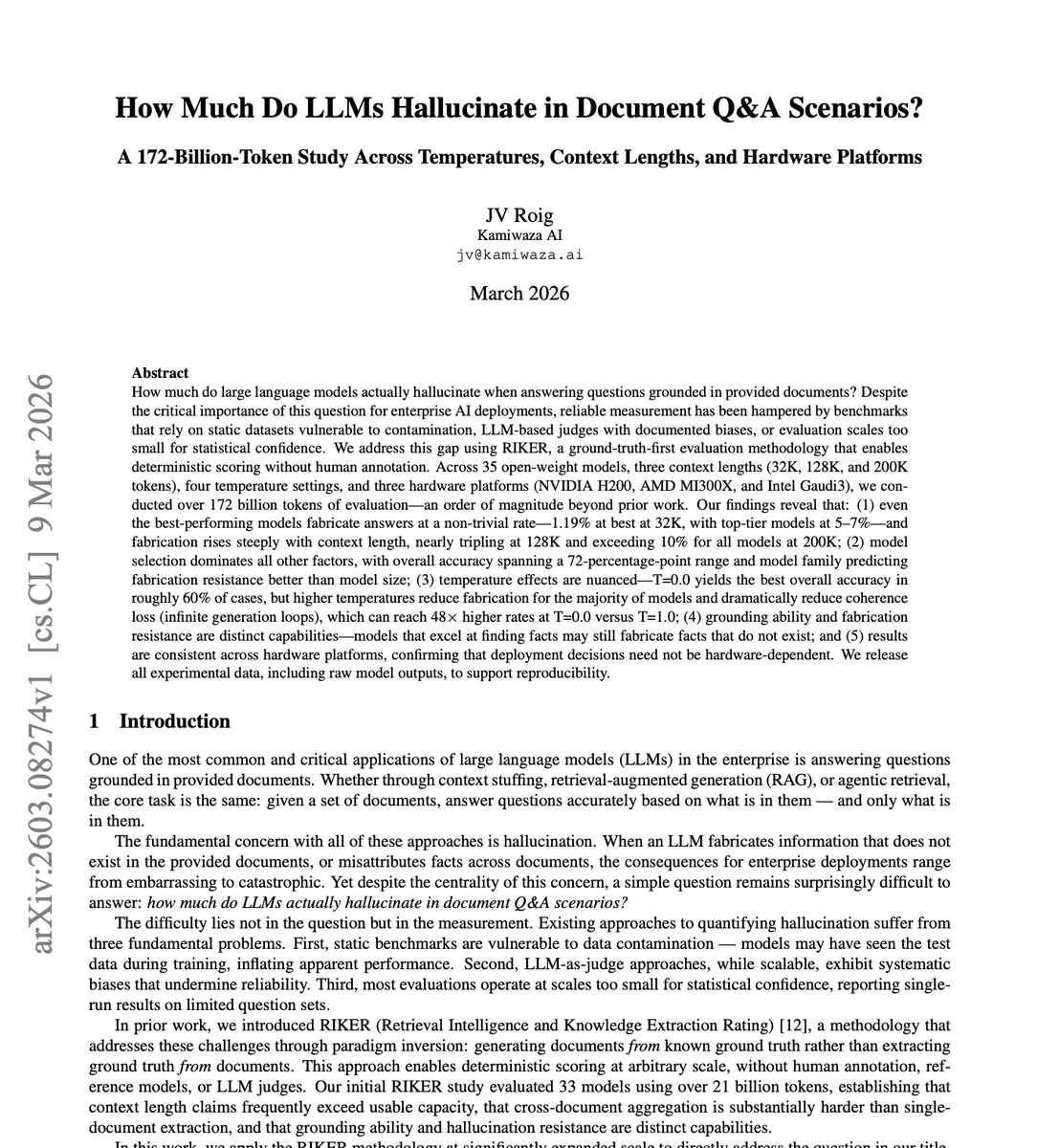
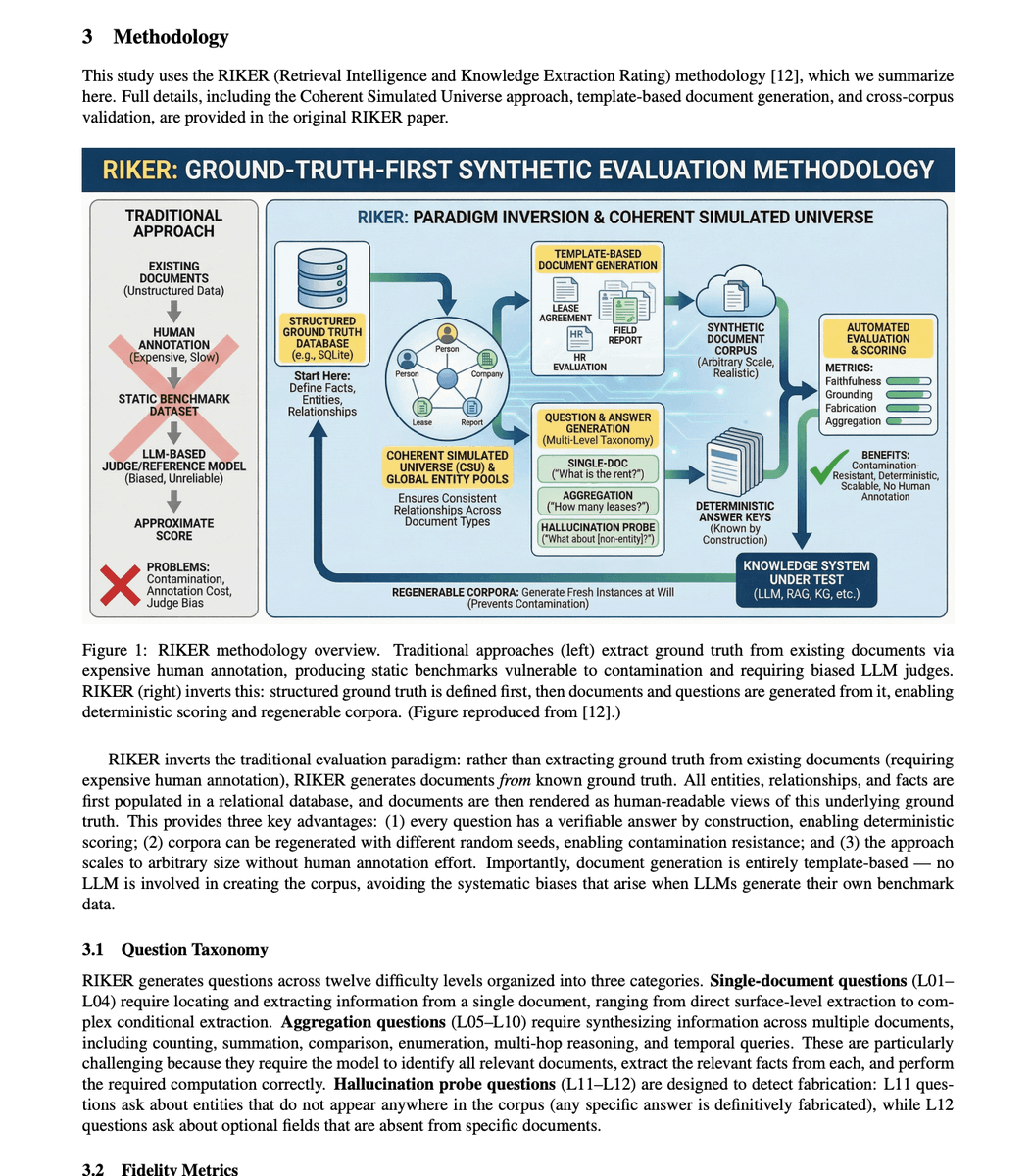
BREAKING: 🚨 Someone just tested 35 AI models across 172 billion tokens of real document questions. The hallucination numbers should end the "just give it the documents" argument forever. Here is what the data actually showed. The best model in the entire study, under perfect conditions, fabricated answers 1.19% of the time. That sounds small until you realize that is the ceiling. The absolute best case. Under optimal settings that almost no real deployment uses. Typical top models sit at 5 to 7% fabrication on document Q&A. Not on questions from memory. Not on abstract reasoning. On questions where the answer is sitting right there in the document in front of it. The median across all 35 models tested was around 25%. One in four answers fabricated, even with the source material provided. Then they tested what happens when you extend the context window. Every company selling 128K and 200K context as the hallucination solution needs to read this part carefully. At 200K context length, every single model in the study exceeded 10% hallucination. The rate nearly tripled compared to optimal shorter contexts. The longer the window people want, the worse the fabrication gets. The exact feature being sold as the fix is making the problem significantly worse. There is one more finding that does not get talked about enough. Grounding skill and anti-fabrication skill are completely separate capabilities in these models. A model that is excellent at finding relevant information in a document is not necessarily good at avoiding making things up. They are measuring two different things that do not reliably correlate. You cannot assume a model that retrieves well also fabricates less. 172 billion tokens. 35 models. The conclusion is the same across all of them. Handing an LLM the actual document does not solve hallucination. It just changes the shape of it.
Abdul Șhakoor tweet mediaAbdul Șhakoor tweet mediaAbdul Șhakoor tweet media
English
267
1.3K
5K
474.1K