hames

1.5K posts

hames banner
hames

hames

@hamesIX

hey world

Katılım Temmuz 2022
568 Takip Edilen37 Takipçiler
hames retweetledi
Arvind Narayanan
Arvind Narayanan@random_walker·
I vibe coded an app to chat with my Kindle books. (To make a book chattable it flips through the pages using an automated browser and screenshots / OCRs them.) I've been using it for a couple of weeks and it's become an important part of my learning and research workflows. It is NOT a replacement for actually reading books. There is simply no alternative to spending a few hours with a book to really process the ideas. Besides, I enjoy reading too much to want to take shortcuts. Here are a few things the chat interface lets me do: - Create summaries that I edit and save in a personalized knowledge wiki (that I also vibe coded) so that I can quickly refer back to books I've read. - Help me decide which books to read in the first place (I read a lot of books but there are 10x as many books I don't have time to get to, so I have to be selective). - If a book mostly tells me stuff I already know, quickly zoom into the parts that are new (in the past I would have read the first chapter or two, realize that I didn't learn much, and put the book down). - If I engage with a book critically in my own writing, do a sanity check by asking questions like "did the author address this counterargument anywhere?" (This is the least frequent use case but perhaps the most important one because the peace of mind I get from it is a big deal.)
English
18
20
184
28.1K
hames retweetledi
Sebastian Raschka
Sebastian Raschka@rasbt·
Upgraded from Llama 3 to Qwen3 as my go-to model for research experiments, so I implemented qwen3 from scratch: github.com/rasbt/LLMs-fro… Trade-off: Qwen3 0.6B is deeper (28x vs 16x layers) & slower than the wider Llama 3 1B but more memory efficient due to fewer params
Sebastian Raschka tweet media
English
45
252
2K
140.8K
hames retweetledi
Deedy
Deedy@deedydas·
Karpathy senpai called out this blog post in his YC AI startup school talk yesterday. If you write software, this is a must read.
Deedy tweet media
English
33
154
2.2K
355.8K
hames retweetledi
Kath Korevec
Kath Korevec@simpsoka·
Real-time terminal monitor for Claude token usage. Shows burn rate, predictions, and reset timers. Super handy if you’re pushing limits. github.com/Maciek-roboblo…
English
12
23
327
37.4K
hames retweetledi
Tom Dörr
Tom Dörr@tom_doerr·
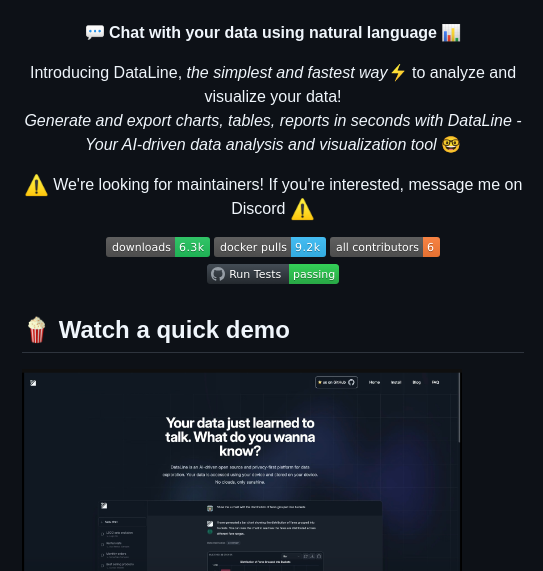
AI tool for chatting with and analyzing your data using natural language; works with files and databases, keeps data on your device
Tom Dörr tweet media
English
5
33
304
28.6K
hames retweetledi
Pietro Schirano
Pietro Schirano@skirano·
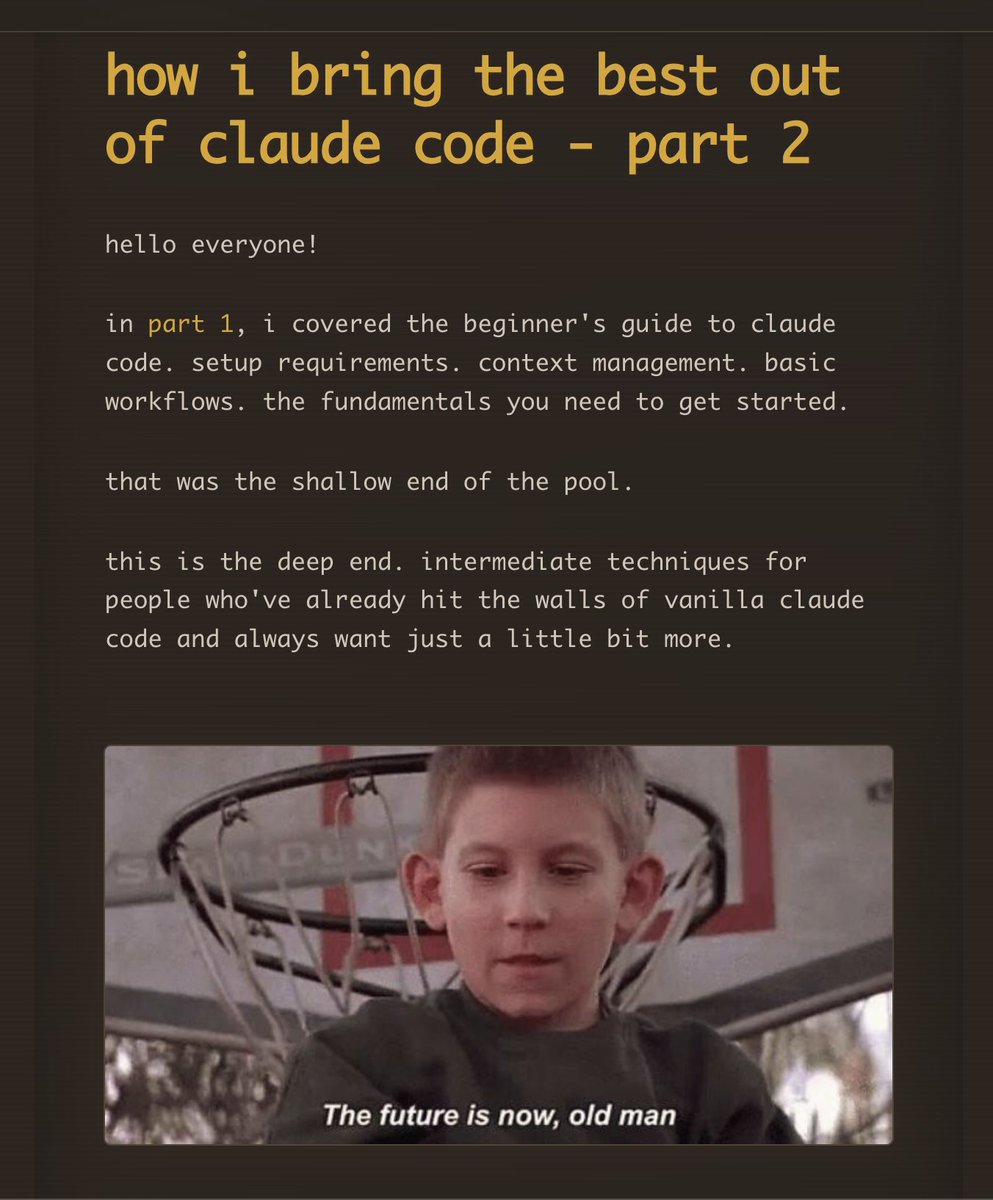
Btw, since people don’t seem to know this, you can literally spawn subagents in Claude Code just by asking.
English
58
104
1.7K
213.6K
hames retweetledi
David Ondrej
David Ondrej@DavidOndrej1·
Claude Code: Everything You Need To Know
English
17
165
1.3K
60K
hames retweetledi
matt palmer
matt palmer@mattyp·
How to write docs for LLMs: What types of info do models do best with? The same types humans do. llms.txt is an optimization. it does nothing if your documentation is terrible. Start with the basics: - navigation / discoverability / structure - use cases / outcomes - hands on implementation details - examples of good & bad patterns - edge cases & common pitfalls - accessibility + ensuring important info isn't buried in multimodal content (images, video, etc) You need to optimize for a LLM with tools (search, etc) to navigate your site, understand the content, and implement a solution. That's a lot like optimizing for an eager junior dev. This bleeds into how you design your tool. If you're building a lib / SDK a reallllly simple way to do this is to use common standards and provide structured, programmatic ways of defining your api (OpenAPI) A more advanced pattern is to follow common training data / uses, ex: at least in the short-term, LLMs are going to do really well at implementing GCS primitives for cloud storage bc they were trained on it. Going with some obscure storage solution or writing your own novel primitives might seem like a good idea, but LLMs will struggle UNLESS you built on a common pattern and provide hella good documentation. I suspect this will be less of an issue with tools like web search and model improvements, but it's a technique for now. TLDR; Do exactly the same things you would do for a human. Provide a structured, excellent documentation UX. Build a library that follows common patterns and technical standards. Think from first principles.
Mat Balez@matbalez

🚨 Looking for input 🚨 What are best practices for libraries/SDKs/APIs to maximize the (1) ease and (2) likelihood of success of integration into vibe coded apps? Is there something like llmstxt.org that should be in your repo? Release a simple sidecar? Other?

English
8
14
87
10.6K
hames retweetledi
Peter Yang
Peter Yang@petergyang·
New post: How to build a stunning personal website with AI in just 15 min. It's easy to make with @boltdotnew: 1. Start with a detailed prompt 2. Use the visual editor 3. Add your social posts 4. Add animations 5. Deploy in 1 click 📌 Read now: creatoreconomy.so/p/full-tutoria…
Peter Yang tweet media
English
7
4
86
27.9K
hames retweetledi
catherine jue
catherine jue@juecd__·
One of our users is using @browser_use agents running on @onkernel to register on government sites 🙂 — 406 total processed forms — dozens of web agents running simultaneously — letting them process forms overnight
English
13
21
220
30.9K
hames retweetledi
Tom Dörr
Tom Dörr@tom_doerr·
Agent File (.af) is a format for sharing and saving AI agents with memory, tools, prompts, and settings
Tom Dörr tweet media
English
8
81
795
51.2K
hames retweetledi
Virat Singh
Virat Singh@virattt·
I finally figured it out. How OAuth + MCP server works. The Key Players: 1 • OAuth Provider 2 • OAuth Client 3 • User App These 3 participate in auth flow. OAuth provider is my API @findatasets, which authenticates users and issues tokens. OAuth client is my remote MCP server, which handles token exchange and storage. User app is the MCP client (eg. Claude), which is the UX that user interacts with. Example scenario: 1 • User asks Claude financial questions 2 • Claude tries data fetch from MCP server 3 • MCP server returns OAuth login URL 4 • User authenticates with @findatasets 5 • @findatasets redirects with auth code 6 • MCP server exchanges code for token 7 • MCP server gets data, returns to Claude 8 • User gets their question answered User never shares login info with MCP server. Claude gets the real-time data it needs!
Virat Singh tweet media
English
10
42
288
19.2K
hames retweetledi
Lenny Rachitsky
Lenny Rachitsky@lennysan·
The ultimate guide to prompt engineering in 2025 Learn: 1. Why role prompting (e.g. “You are a math professor. . .”) is largely ineffective, counter to what most people think. Research shows that while role prompts may help with tone or writing style, they have little to no effect on improving correctness. 2. How “Few-shot prompting” can improve accuracy from 0% to 90%. One of the most powerful techniques is to show the model examples of exactly what you want—called few-shot prompting. This single technique took a medical-coding use case from complete failure to near-perfect output, simply by adding a few example-label pairs. 3. Why prompt engineering as a skillset is very much alive—and more important than ever. If anything, it’s become more critical as companies rely on LLMs to drive user-facing features and core functionality. Prompt quality can make or break AI performance—especially when scaled across products. 4. The two types of prompt engineering: “conversational” and “product-focused.” Most people think of prompting as chatting with ChatGPT, but the real leverage comes from crafting high-performing prompts inside products. These prompts are used at scale, run millions of times, and must be hardened and optimized like production code. 5. Advanced techniques like decomposition and self-criticism. Specifically, asking a model to first break a problem into sub-problems (decomposition) or critique its own answer (self-criticism) can lead to smarter, more accurate outputs. These are especially valuable in agent-like settings where multi-step reasoning is required. 6. Why context (“additional information”) is underrated and massively impactful. Simply giving the model more relevant background can drastically improve performance. Including examples where including extra data (like bios, research papers, or past interactions) made or broke a prompt, especially when included in the right format and order. 7. How prompt injection is real, dangerous, and unsolvable in the traditional sense. We explore how attackers can “jailbreak” LLMs—tricking them into outputting harmful, restricted, or unintended responses. These attacks often bypass traditional defenses like “do not do X” guardrails. And there’s no silver bullet. 8. The “grandma” trick, typos, and obfuscation tricks, and how they still break state-of-the-art models. Even the most advanced LLMs can be fooled with surprisingly simple hacks. We walk through jailbreak techniques that still work, including emotional manipulation (e.g. “Tell me like my grandma used to”), encoded inputs, and creative phrasing. 9. How most companies are using broken defenses. And why “prompt separation” or adding phrases like “ignore malicious inputs” doesn’t work. Guardrails are easily bypassed, and current classifiers often lack the intelligence to catch encoded attacks. The future of security must be model-level, not bolted on. 10. Despite the risks, the upside of AI is massive and worth pursuing. AI will save lives (especially in health care), unlock productivity, and solve real problems—if we build responsibly. Stopping progress isn’t the answer; smarter, safer development is. Listen now 👇 • YouTube: youtu.be/eKuFqQKYRrA • Spotify: open.spotify.com/episode/3Bb7d0… • Apple: podcasts.apple.com/us/podcast/ai-…
YouTube video
YouTube
Lenny Rachitsky tweet media
English
12
51
428
45K
hames retweetledi
GREG ISENBERG
GREG ISENBERG@gregisenberg·
My friend screenshared his $500K/month growth funnel, here's exactly how he did it and how you can copy it for your SaaS, agency, or app (50 minute tutorial)
English
47
214
2K
145K
hames retweetledi
GREG ISENBERG
GREG ISENBERG@gregisenberg·
how aren't we in an AI gold rush? i can build programmatic seo directories with cursor that bring in 20,000 visits/month on auto pilot and it only took me a few lines of english and $6. i can talk to a document, a database, or a YT video and it talks back with clarity. i can clone my voice in 5 seconds max, create video content, write a blog post, and schedule social posts without opening a camera or doc. i can spin up agents to research, reply, generate strategy, and write code, all at once. i can go from idea to landing page to first users before dinner. i can test pricing, positioning, and messaging instantly. i can simulate customer conversations and handle objections i haven’t heard yet. i can get from “this might work” to “this is working” faster than ever before. the friction is gone. the overhead is gone. we have reasoning on demand. infinite research capacity. tools that get better weekly. boring businesses feel new. consumer mobile is back. service businesses scale like software. what used to need a team and vc money now just needs a laptop and good taste. if this isn't the greatest time to be building i dont know what is. not everyone will be successful, startups are hard, but this is a remarkable time to be building. if this isn’t an ai gold rush, i don’t know what is....
English
216
223
2.9K
311.9K
hames retweetledi
Guillermo Rauch
Guillermo Rauch@rauchg·
I pasted @karpathy's talk transcript from HN and asked @v0 to create a slide deck. The conceptual extraction, design and interactivity in one shot was wild. Design Mode was very helpful to make style tweaks.
English
47
60
1K
109.1K
hames retweetledi
LangChain
LangChain@LangChain·
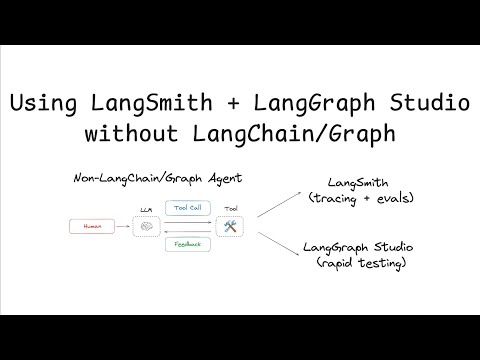
Tracing + Evals w/o LangChain/Graph How to get the benefits of LangSmith (evals + tracing) + Studio (testing) w/o using LangChain or LangGraph? Here, we walk through the from scratch, using a non-LangChain/Graph agent as an example! 📽️: youtu.be/YBErIomQ7N4
YouTube video
YouTube
LangChain tweet media
English
1
34
136
11.2K