hampelman.algo

13K posts

hampelman.algo banner
hampelman.algo

hampelman.algo

@hampelman_data

civ.algo, @mori_algo, mempool sonifier, governance tracking no-coder that codes, github: knonode 🎲☕🌷 ⩕ node runner 🖥️❤️ carbon based

Algoland Katılım Eylül 2021
1.1K Takip Edilen1.6K Takipçiler
Sabitlenmiş Tweet
hampelman.algo
hampelman.algo@hampelman_data·
⠙⠕ ⠝⠕⠞ ⠙⠊⠎⠞⠥⠗⠃ ⠓⠁⠍⠏⠑⠇⠍⠁⠝ ⠊⠎ ⠺⠕⠗⠅⠊⠝⠛
4
0
6
1.4K
lute.algo
lute.algo@LuteWallet·
A big thanks to all the xGovs who supported the grant for Lute to become an open-source project! There is a link to the repo in the nav bar on lute.app We look forward to your suggestions and contributions!
lute.algo tweet media
English
12
7
58
643
hampelman.algo retweetledi
NFDomains.algo
NFDomains.algo@NFDomains·
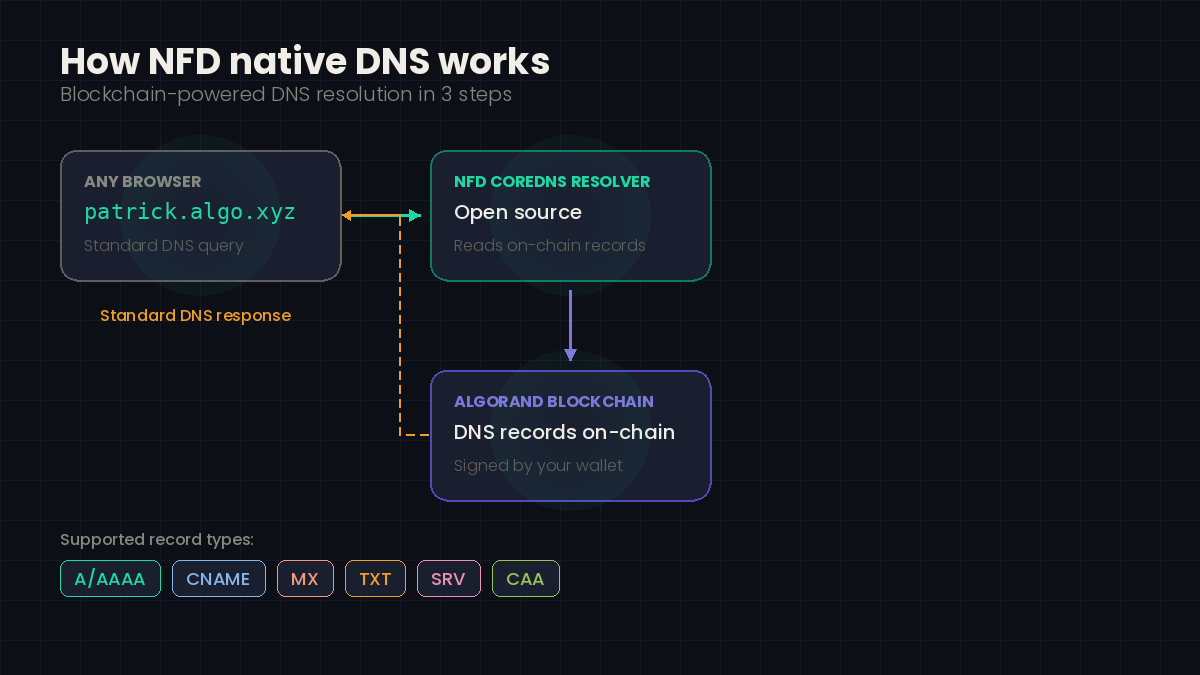
🧵 2/ The majority of blockchain naming systems gives you a name that only works inside their ecosystem. NFDs give you a name that works everywhere DNS works... which is everywhere. Resolves automatically to your profile, use simple HTTP redirects if you want, or add custom RRs. All exposed immediately.
English
1
2
16
436
hampelman.algo retweetledi
NFDomains.algo
NFDomains.algo@NFDomains·
Your blockchain name just became a real domain. V3+ NFDs now have native DNS. Your yourname.algo resolves as yourname.algo.xyz, from any browser, any email client, any DNS-aware app on the planet. No plugins. No gateways. Just DNS. 🧵👇
NFDomains.algo tweet media
English
5
52
131
4.9K
hampelman.algo
hampelman.algo@hampelman_data·
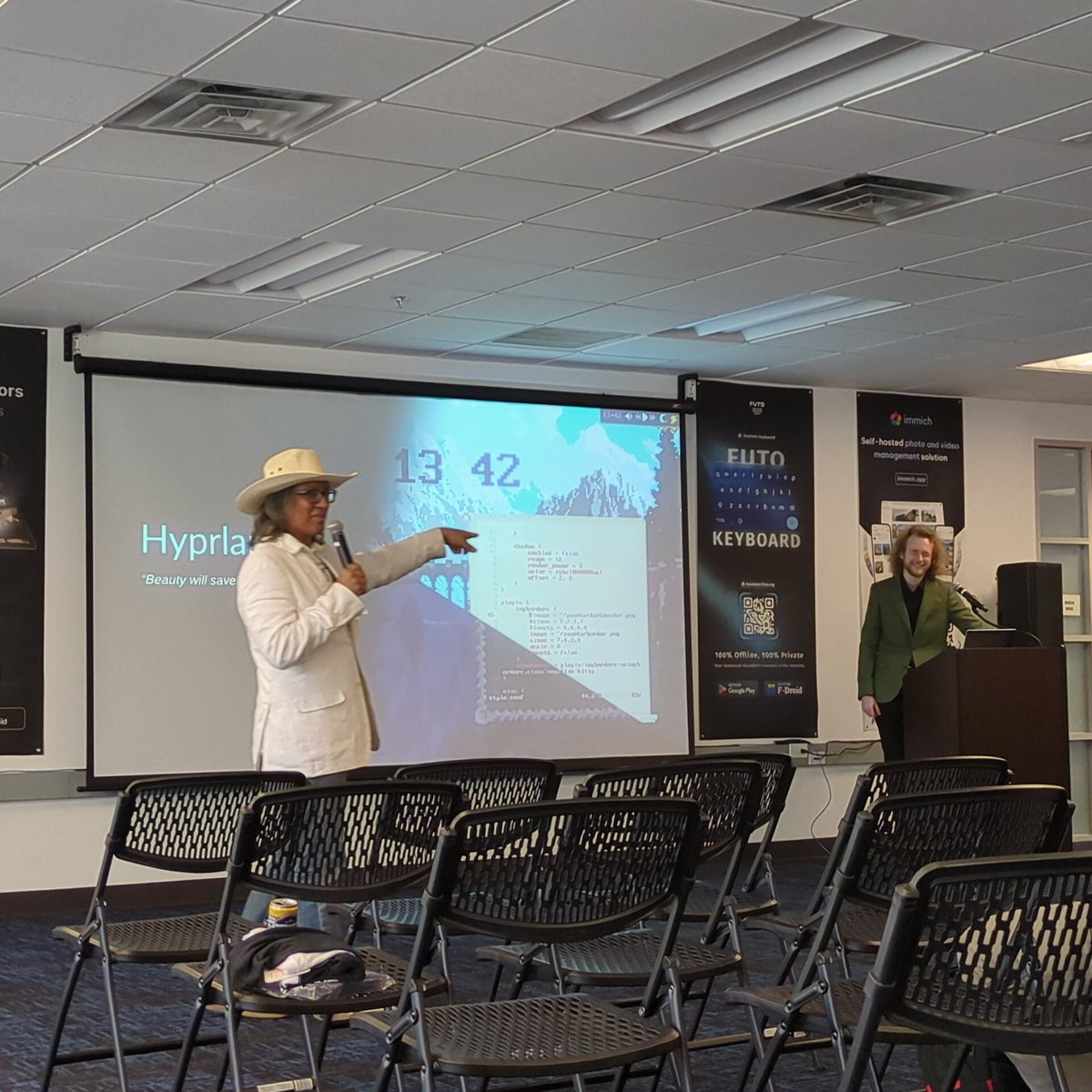
@vaxryy just make a claude archlua skill to ship with and all critics will silence
English
0
0
0
558
Governor Hat
Governor Hat@GovernorHat·
Did I get any wrong?
English
3
0
21
348
hampelman.algo
hampelman.algo@hampelman_data·
vibes while claude is working
English
0
0
3
61
vaxry
vaxry@vaxryy·
@_trapexit dats me!! :D hope you liked it
English
6
0
132
4.1K
hampelman.algo
hampelman.algo@hampelman_data·
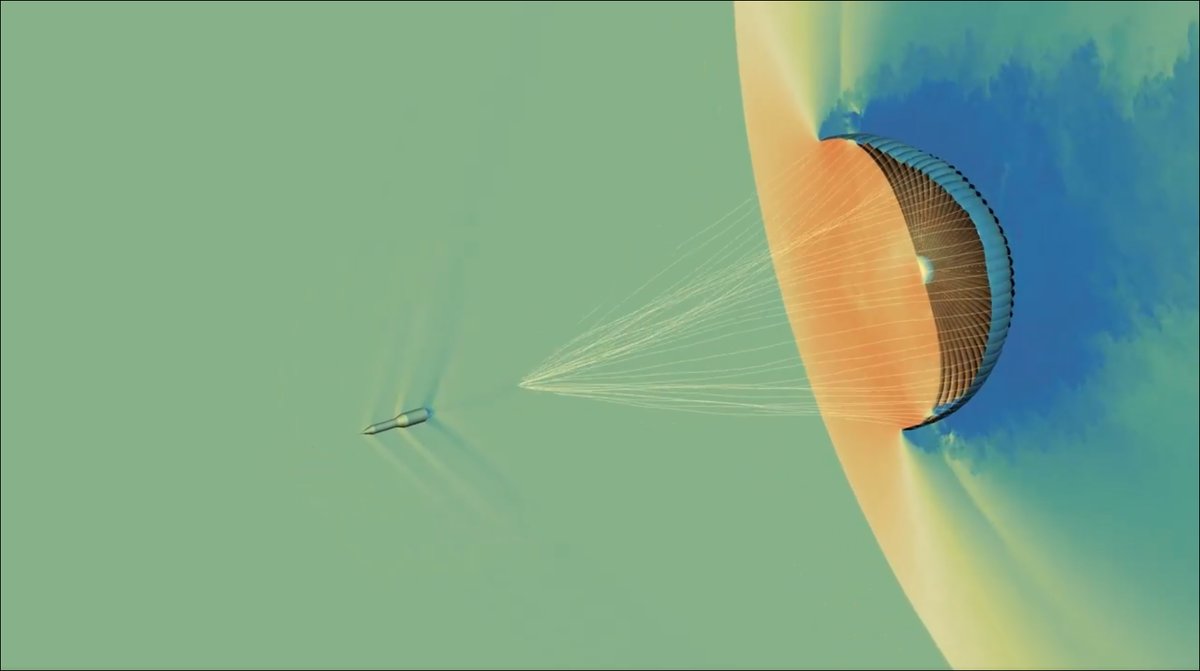
working on a taxonomy for the game assets. instead of a tree, it will utilize tags, so assets can share properties across db tables. each tag will have a weigth, manually curated or rarity based or a combination. big implications, since here, one can abandon moral intuitions civalgo 💀 30K assets and climbing
hampelman.algo tweet media
English
0
0
9
207
hampelman.algo
hampelman.algo@hampelman_data·
@AlgoFamily I wonder how art history books would look if impressionism originated in west Texas instead of Paris, France
English
1
0
2
49
MJ.algo 🇺🇸
MJ.algo 🇺🇸@AlgoFamily·
Share something you saw that was beautiful today.
MJ.algo 🇺🇸 tweet media
English
7
0
26
1.1K
hampelman.algo
hampelman.algo@hampelman_data·
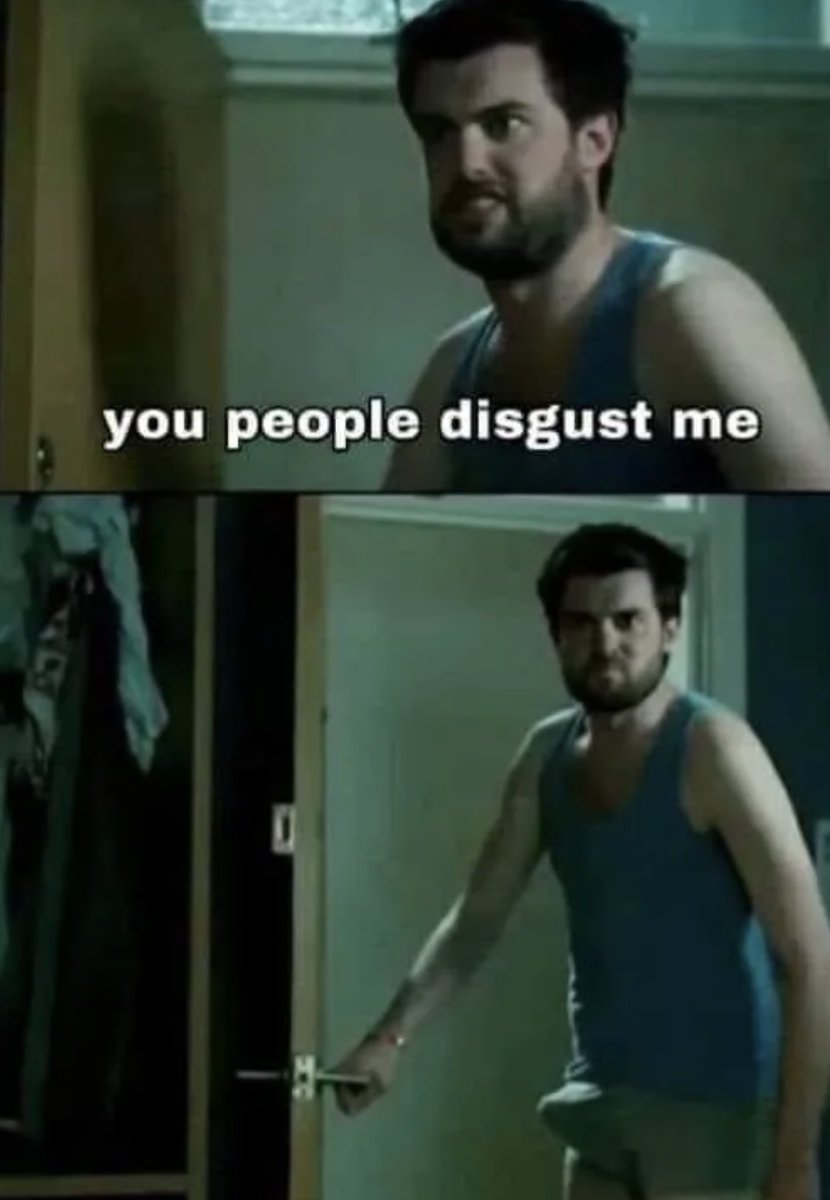
no regrets are watching
hampelman.algo tweet media
English
0
0
2
42
hampelman.algo retweetledi
lute.algo
lute.algo@LuteWallet·
What wallet… • will work if WalletConnect is down? • lets you connect to your own node in case public node services are not reachable? • uses on-chain storage (instead of a proprietary backend service) to facilitate multi-sig distribution? Lute. Please support Lute in xGov!
English
6
37
107
3.6K
U.S. Graphics Company
U.S. Graphics Company@usgraphics·
My contrarian view is that the symbolic version of a map is better than 3D version for navigation. Not everything needs to be a literal and accurate representation of the thing. At some point, the details become irrelevant for the task at hand (navigation). An arrow is IMO indisputably more effective that a literal 3D model of the car for fast cognition. For exploration of a city and looking at landmarks, may be cool to fly over a 3D map on your couch; but for navigational purposes (the usage as shown in the quoted tweet), so much of this is nuissance when you have a second to glance at the navigation screen. Literal representation is appealing on the first order. But if you think about what the vision system has to do to distill relevant information, it's a red herring. Even things like exits and ramps, we can symbolically show them and it'd be superior than having to cognate 3D renderings of it from a totally different perspective than what you're seeing out the window. I am not saying it is impossible, I am saying that it takes longer for the vision system to process. I also think 3D version and a symbolic UI are not different in degree, but in type. One cannot replace the other, at best they're useful for different goals. For 3D maps, navigation isn't one of them. Navigation is a task that demands high performance UI.
Google@Google

The Maps driving experience is also evolving with Immersive Navigation, featuring clearer visuals and intuitive guidance. You’ll be able to see the buildings, overpasses and terrain around you in a vivid 3D view, made possible with help from Gemini models. You’ll also be able to: 👀 See more of your route to prepare for what’s next. 🤔 Understand tradeoffs for alternate routes to pick what works best for you. 🛣️ Arrive easily with helpful details like parking and entrance information. Immersive Navigation starts rolling out today across the U.S. and will expand in coming months to eligible iOS and Android devices, CarPlay, Android Auto and cars with Google built-in.


English
55
34
649
47.9K
hampelman.algo retweetledi
Mullvad.net
Mullvad.net@mullvadnet·
Mass surveillance and censorship are escalating in many countries right now. There is a global attack on secure encrypted communication. Often, authorities, politicians, and tech companies work together to push for new laws. One example: when Ashton Kutcher (yes, the actor), through his tech company Thorn, tried to introduce total surveillance of all EU citizens through undemocratic and corrupt methods. First, Ashton Kutcher convinced the EU Commission that they could scan everything on an EU citizen’s phone or computer (messages, photos, emails, phone calls, all of it) for child sexual abuse material without, at the same time, looking at the content of other types of communication. And then? And then EU Commissioner Ylva Johansson presented the legislative proposal called Chat Control, which aimed to scan everything on all EU citizens' phones and computers (including conversations in end-to-end-encrypted messaging services). The message from the Commission was: we will only search for child sexual abuse material (CSAM). And then? And then experts from all over the world explained to her that the kind of scanning she was talking about (as Ylva described it: a drug-sniffing dog that can detect illegal content in a message without reading the message) simply cannot be done safely, and that Chat Control would mean the end of privacy and pose a security threat to all Europeans. Ylva responded with: “what about the children?” And then? And then it was revealed that Thorn, the organization founded by Ashton Kutcher and which had been lobbying for Chat Control from the beginning, was selling the kind of scanning technology that could be used for Chat Control – despite being registered as a charity organization in the EU’s lobbying registry. And then? And then it was revealed that Thorn, together with the EU Commission, had also started and funded “children’s rights organizations” that had supported the proposal. What appeared publicly to be charitable organizations were in fact lobby groups. And then? And then it was revealed that Europol wanted unlimited access and wanted to use the scanning for more than just child abuse crimes, saying that all data – also unfiltered and innocent material – should be stored because it “could at some point be useful to law enforcement”. And then? And then it was revealed that employees at Europol had joined Thorn, to lobby their old colleagues. And then? And then politicians in Brussels wanted to exempt themselves from the scanning. And then? And then the European Parliament, in an almost historic consensus, voted against the proposal and called Chat Control nothing but mass surveillance. As one of the members of the parliament said: “The Commission wasn’t focusing on protecting children but wanted mass surveillance.” And then? And then The Council of the EU (law proposals must go through both the Parliament and the Council), after three years of negotiation, finally reached a common position on Chat Control. The requirement for mandatory scanning (including end-to-end encrypted messaging services) was removed, which is a major victory, but several problematic elements remain in the Council's position. For instance, the Council wants to demand ID Control to use messaging services (including end-to-end encrypted). And then? And then, in 2026 the final negotiations began, between the European Commission, the European Parliament, and the Council of the EU. At the same time, the European Commission is working on a Plan B, through the initiative Going Dark/ProtectEU, where they once again try to force total surveillance (this time organized crime is the excuse) on the citizens of the EU. And then? youtube.com/watch?v=fPzvUW…
YouTube video
YouTube
English
62
643
2.1K
124.6K
hampelman.algo
hampelman.algo@hampelman_data·
@FlintDibble you can't generalize to simply "AI", what model, what harness did you use? what are we comparing? otoh, there's few if any archaeology models on hugging face. it is a matter of training a model for archaeological needs, and only "you" can do it. you meaning archaeologists
English
0
0
1
67
Flint Dibble 🍖🏺
Flint Dibble 🍖🏺@FlintDibble·
But it's not true. In my field (archaeology), even with the latest models I see rampant hallucinations. AI gets the general picture decent, but when you ask it on specifics, it invents references, randomly combines unrelated details, and just plain gets stuff wrong 1/4
Michael Inzlicht@minzlicht

Ask a colleague why they refuse to use AI. They say it uses up all that water. You point out the water use is far smaller than some would have them believe. Then it's the hallucinations. You mention accuracy has improved dramatically. Then, finally: the process is the point. The struggle. The craft. The deeply human act of sitting with uncertainty. They're not reasoning. They're rationalizing their gut intuitions. My amazing student @vicoldemburgo, with Éloïse Côté, Reem Ayad, @yorl, Jason Plaks and I have a new preprint that explores this more thoroughly, called "The Moralization of Artificial Intelligence". We started by asking how moralized AI has become in public discourse. Analyzing 69,890 news headlines from 2018 to 2024, we found that AI was moralized at levels comparable to GMOs and vaccines, technologies whose moral opposition has been studied for decades. It ranked above both. The sharpest spike came within weeks of ChatGPT's launch in late 2022. When we surveyed representative samples of Americans, a majority of AI opponents said their views wouldn't change even if AI proved safe and beneficial. That's consequence insensitivity, the hallmark of moral conviction, not practical calculation. Across art, chatbots, legal tools, and romantic companions, AI moralization loaded onto a single latent factor. A global moral stance, dressed up in whatever practical language is available. The behavioral data make this concrete: a one standard deviation increase in moralization scores predicted a 42% drop in actual AI usage, even when it would have benefited that person personally. The conviction preceded the behavior by up to 573 days. The next time someone gives you three different reasons to oppose AI, each one dissolving under mild scrutiny, you're probably not watching someone think. You're watching someone feel. Preprint avaulable here: osf.io/preprints/psya…

English
40
77
1.1K
77K
hampelman.algo
hampelman.algo@hampelman_data·
@trq212 ok, how about /ngl /iykyk /wtf /brb /ccp /otoh /ftw?
Indonesia
0
0
0
13
Thariq
Thariq@trq212·
We just added /btw to Claude Code! Use it to have side chain conversations while Claude is working.
English
1.2K
1.6K
26K
2.7M