Harsh Singh

2.8K posts

Harsh Singh

Harsh Singh

@harsh_language

designer

🌏 Duniya Katılım Kasım 2017
1.6K Takip Edilen679 Takipçiler
Satya
Satya@heysatya_·
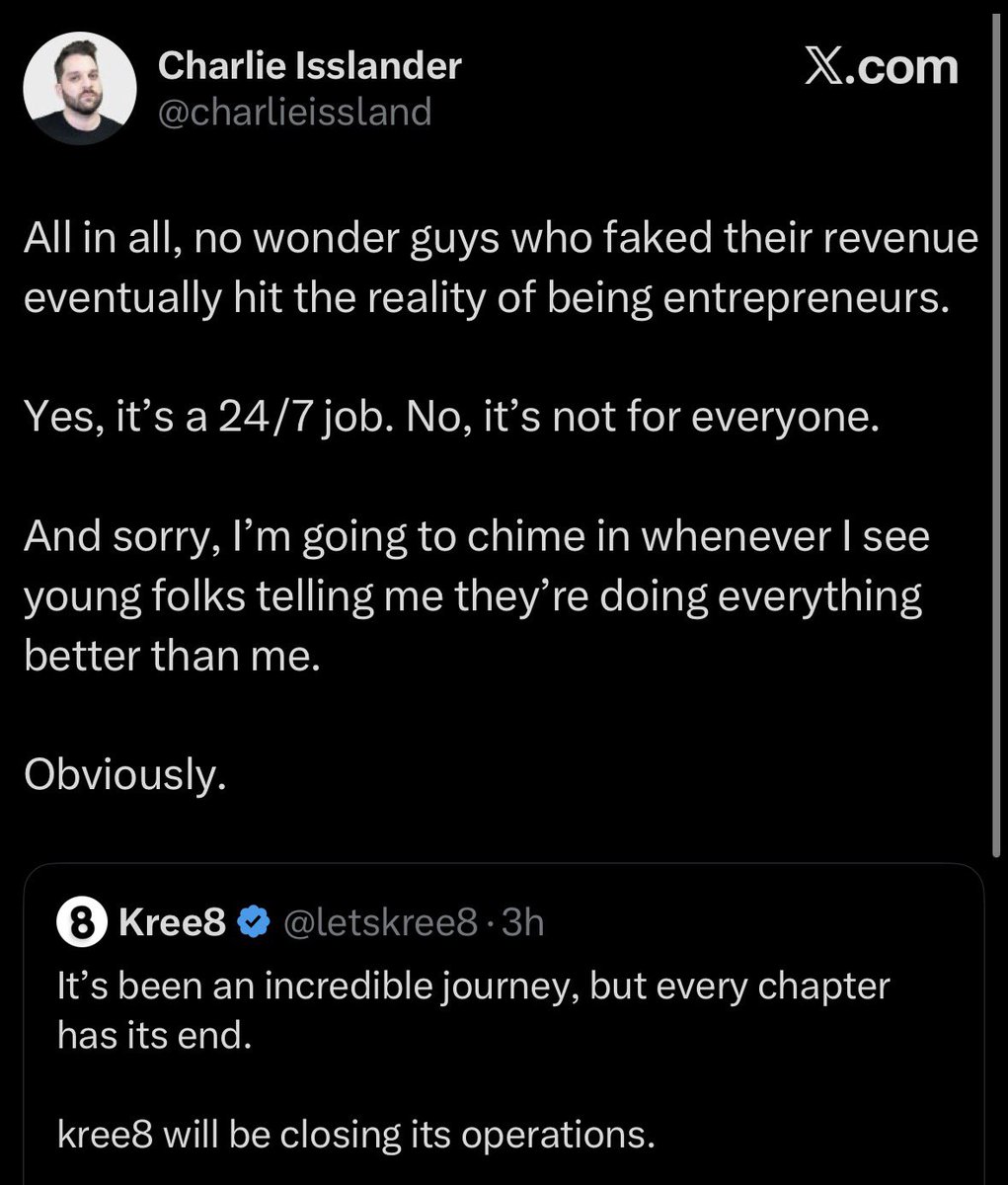
lmao, what’s up with the ego of this man. 1. He’s accusing me for faking our revenue. 2. He didn’t even msged me to verify the fact. 3. He’s senior to me in age as well as in design experience. Don’t know why he behaves like this to someone so younger than him. If you have problem dm me, I’ll show you each and every proof an tbh our real revenue is $501,303 accurate /-
Satya tweet media
English
35
2
128
26.8K
Soumyadip
Soumyadip@soumyadipdzign·
@heysatya_ Why do you consider him as Sr. Designer...! Barely I have seen his work lol
English
3
0
1
1.5K
Harsh Singh retweetledi
Karri Saarinen
Karri Saarinen@karrisaarinen·
I think we have lost some sense of judgment and moderation when it comes to product building currently. The moment you turn something into a universally celebrated metric, whether that is token burn, prototype count, or percentage of agent-written code, you start losing sight of what actually matters. I have felt the same way for a long time about overusing data and A/B testing to build products. The moment you reduce product quality or productivity to a metric, you stop shipping value and start shipping numbers. A lot of what people are doing with AI makes directional sense. The missing piece is counterbalance: 1. AI should help engineers build better products. Leaderboards and adoption metrics can be useful as directional signals. They do not tell you what is being built, whether it is good, or whether it should exist at all. 2. Users do not care what percentage of your code was written by agents. They care about the outcome. Faster output is useful. Like usually, faster doesn't seem to add to quality, clarity, or stability of products. Power to build should not become an excuse to lower quality bars. 3. LLM-generated prototypes can feel like late-night whiteboarding sessions. They look exciting in the moment and feel productive very quickly. Then a few days later you realize the idea was shallow, distracting, or simply wrong. The same trap shows up in jumping straight to code and solutions more broadly. You may just be building the wrong thing more efficiently. Prototyping has its place. So do clear thinking, good design, and a real understanding of the user’s problem. In terms of activities or momentum, the main quest and the side quest can both feel productive but only one actually moves the mission forward. 4. Adding more to products is still dangerous as ever even if time or effort to add it has gone down. Every addition creates complexity, maintenance cost, and user confusion. New features should be pushed back unless they clearly show it should exist and how it improves the product. 5. Not everything needs to be an agent shaped. A simple scheduled task does not need a full LLM sandbox. Making something agentic because it feels current or impressive does not make it right-sized, correct, or effective. The core ideas are: - even if you can, maybe you should not. - more power we have to build should not reduce our need to think, it should increase it.
dax@thdxr

sent this to the team today everything great comes from being able to delay gratification for as long as possible and it feels like we're collectively losing our ability to do that


English
30
126
1.1K
147.6K
Rachel Wilson
Rachel Wilson@Rach4Patriarchy·
Dude, you guys took my post all wrong. I was saying Zack ratioed the assholes who were trying to smear him. I was not saying I ratioed him, dummies. Wth 🤦🏼‍♀️
English
16
2
262
4.9K
Rachel Wilson
Rachel Wilson@Rach4Patriarchy·
This was a glorious ratio 🫡
Zack@Asmongold

@RationalDis I'm evil because I don't want my taxes allocated to Africans over Americans Are you retarded?

English
12
17
1.3K
58.7K
Harsh Singh retweetledi
van Schneider
van Schneider@vanschneider·
I think the reason why current UIs are still lacking in the AI creation field is because they’re all done by engineers and tech designers. They’re uninspiring, standard and predictable. They’re designed to fit into an existing engineering flow. A new technology usually becomes really interesting once The Artist embraces it and molds it to a point where it fits their worldview, and then the engineering is forced to make it work, rather than the engineer designing tools for the artist. That’s why artists prefer tools for expression and freedom where as the (design) engineer builds tools for mainly for efficiency. Currently we’re in the phase of demos and repurposed UIs that match existing workflows, the artist has not yet embraced the medium. But that’s just a matter of time at this point.
English
45
15
328
21.2K
Harsh Singh retweetledi
Atul Khola 💊
Atul Khola 💊@pixelandpump·
maybe you were never meant to be extraordinary. 🧵01/11
English
7
6
316
225.8K
Harsh Singh
Harsh Singh@harsh_language·
@hobdaydesign With that specific design and no other context: definitely text alignment.
English
0
0
0
100
Harsh Singh
Harsh Singh@harsh_language·
@gregisenberg Nah dude I have every intention of checking them. Trust me.
English
0
0
0
13
GREG ISENBERG
GREG ISENBERG@gregisenberg·
people just bookmark stuff on X with zero real intention of every checking those said bookmarks
English
937
43
1.9K
144.2K
Harsh Singh
Harsh Singh@harsh_language·
@rahulbhadoriya @Naina_2728 Yeah but how is irctc or any of these sites good for the use case you’re designing for? Being a hot mess is not a good design in any scenario, is it?
English
0
0
1
12
Rahul Singh Bhadoriya
Rahul Singh Bhadoriya@rahulbhadoriiya·
@Naina_2728 I know, I know But there’s a Design system which is designed for the most basic computers, phone and internet. Also we have the bias ki what is normal, the base for us is totally different when you think in these limitations I had a post about same, or tab I got to know
English
3
0
23
2K
Naina
Naina@Naina_2728·
we need a national design studio for india tbh
Naina tweet mediaNaina tweet media
English
135
48
1.5K
232.6K
Oykun
Oykun@oykun·
building ai powered design products to sell to designers that replace designers so designers can use them to replace designers so there are fewer designers because designers bought tools that replace designers sold to designers by designers to remove designers from the future of design designers funding the tools that design without designers until there are no designers left except the ones selling tools to replace designers to designers makes sense right?
English
10
4
29
1.4K
Shashi (シャシ)
Shashi (シャシ)@shashpicious_·
figma has the cleanest possible input any code gen tool could ever need components, tokens, variants, patterns, full design systems everything is already structured its all inside figma and designers are still having to figure out n number of ways to take all this information into tools like cursor and claude through MCPs... figma literally has everything it takes to become a visual first code gen tool and stay relevant in the market but guess what lol instead they are busy dropping features like "emojis in stamp"
English
23
14
265
18.5K
Jared Palmer
Jared Palmer@jaredpalmer·
@Swizec Price's law: square root of a population do half the work. square root(28m) = ~5,196
Jared Palmer tweet media
English
17
20
491
35.6K
Jared Palmer
Jared Palmer@jaredpalmer·
I have come to believe that there are actually only ~5000 truly elite software engineers in the world and they do the vast majority of the work
English
318
170
5K
827.3K
Kailash
Kailash@kail_designs·
@PixelJanitor Who did your design system? This is one of the cleanest UI ive seen
English
2
0
1
584
Derek Briggs
Derek Briggs@PixelJanitor·
Order fulfillment overview flow exploration
Derek Briggs tweet media
English
41
7
441
37.8K
Ali Grids
Ali Grids@AliGrids·
Perfection in every switch. Pick one!👇 Dark⚫️, Light⚪️ or Gold🟡 vid: @guerriero_se
English
26
15
504
19.5K
Harsh Singh retweetledi
van Schneider
van Schneider@vanschneider·
The problem is that Mark is right. Nobody cares anymore. And this perfectly explains every single decline in quality across every industry in recent years. Our experiences, our designs, our products, our food, absolutely everything. Nobody cares anymore. How did this happen? Simply put: The average person doesn't care. In fact, they never did. However, Designers and Companies used to care more back in the day. Many of them acted as moral agents. They told people "Look, I understand you don't care, but if I show you a better way, you may start to care". Care used to be a competitive advantage. That's why most old legendary Designers had strong convictions. They'd focus on quality no matter what, because they deeply cared. Most people/consumers only start to care if you show them how caring works. They don't do it by default. But over time, broadly speaking, Designers and Companies started to not care anymore. And if you match enough average people who don't care with Designers/Companies who don't care, you'll get careless experiences, careless food and careless products — But the irony is, everyone's kinda happy, because no one knows what a different world would look like. And as long as carelessness is profitable, companies will continue to focus on the minimum care they can get away with.
Mark Gurman@markgurman

Apple has 2 billion users now. 99.9% of them do not care about the icons.

English
106
437
3.3K
276.4K
Harsh Singh retweetledi
Ryo Lu
Ryo Lu@ryolu_·
@vanschneider some people only think some people do some people think while doing
English
6
3
142
7.7K
Harsh Singh retweetledi
Alex
Alex@alexgilev·
Ok, hear me out... In StarCraft, players interface has 3 modes: watching the minimap, managing build queues, and controlling units. Why not use this analogy for agentic interfaces? 1) User monitors what's happening (activity, calls, status) 2) User orchestrates the strategy (agents, campaigns, playbooks) 3) User delegates the resources (integrations, libraries, permissions) In Agentic UI, the navigation is built on intent but not features. You don't hunt for "Settings" or "Dashboard." You think "I need to check what's running" or "I need to set up a new campaign" and land exactly where they need to be. Zero friction. w/ @AgenticUi
Alex tweet media
English
40
21
559
36.4K
Harsh Singh retweetledi
Aakash Gupta
Aakash Gupta@aakashgupta·
Linear’s CEO just described the biggest shift in product team structure since Agile. For decades, product work meant: PM defines requirements → designers create specs → engineers translate to code. The middle step, translation, absorbed 70% of the time and created most of the friction. Karri is saying that step is collapsing. AI agents don’t need handoff documents or sprint planning rituals. They need structured context about what matters, what constraints apply, and what success looks like. This inverts the leverage points. The person who captures customer intent clearly now has more impact than the person who translates it into implementation. And the person reviewing agent output becomes the quality bottleneck. Linear built their entire product around this bet: structured entities with clear ownership, context attached to work items, feedback connected directly to issues. It turns out the same system that helps humans coordinate also helps agents know what to do. The teams figuring this out first will have a structural advantage. Everyone else will still be writing Jira tickets that read like riddles.
Karri Saarinen@karrisaarinen

x.com/i/article/2007…

English
77
255
3.1K
766.1K