Andreas Hassellöf

6.8K posts

Andreas Hassellöf banner
Andreas Hassellöf

Andreas Hassellöf

@hassellof

Building delightful real-world experiences with Edge AI. Founder of @ombori and @phygridcom

Dubai, United Arab Emirates Katılım Temmuz 2007
1.5K Takip Edilen55.9K Takipçiler
Sabitlenmiş Tweet
Andreas Hassellöf
Andreas Hassellöf@hassellof·
7 years ago, one voice-interactive mirror reached 150 million people and set us on a mission. Today, that mission is @phygridcom: a platform that empowers anyone to bring AI to the Edge with speed and at scale. The next frontier is not in the cloud, it's on the ground.
English
7
8
62
427.5K
Andreas Hassellöf retweetledi
Anish Moonka
Anish Moonka@anishmoonka·
If you beat this level as a kid, your brain was doing the same fifty-hour training researchers now run on adult volunteers in a lab. Action gamers react about 45 milliseconds faster than non-gamers and make decisions a quarter quicker without sacrificing accuracy. Brain scientists at Rochester and Geneva have been measuring this for over twenty years. The level is Mine Cart Carnage. Eighth stage of Donkey Kong Country. November 1994. Built by a team of twelve working out of a village in rural Leicestershire. It was the first time the game ever took control away from you. The cart started rolling. You couldn't slow it down. You had to time jumps between broken tracks while lizards drove carts at your face from the opposite direction. And the cart weighed more than you did, so every jump messed with your landing. Daphne Bavelier at the University of Geneva has spent her career studying exactly this kind of game. Her 2003 Nature paper showed that fast-paced action games physically rewire the brain's attention circuits. Fifteen years later, Bediou and colleagues combined dozens of these studies into one big review of the field. You get sharper at picking out what matters and ignoring what doesn't. Spatial puzzles get easier. And in one Bavelier experiment, gamers figured out made-up vocabulary from a fake language in twenty minutes. Non-gamers needed forty. Rare bought Silicon Graphics computers, roughly eighty thousand pounds each, to build this game. Those were the same kind of computers that animated the dinosaurs in Jurassic Park. A single picture of Donkey Kong, rendered on one of those computers, took up more memory than an entire Super Nintendo game could hold. So Rare built a compression trick from scratch and squeezed the 3D models into flat images the console could actually run. The computers ran all night. A massive air conditioner kept the machines from frying, while the team worked through the summer heat with no AC of their own. 9.3 million copies sold. Nintendo spent sixteen million dollars marketing it in America alone, more than triple the industry average. Every kid who got stuck on Mine Cart Carnage and kept restarting until they beat it was running the same kind of experiment neuroscientists now study in their labs. Fifty hours of it.
Nostalgia@nostalgiaa

‘How are you so focused under pressure?’ Me in 1995:

English
107
675
4.4K
396.9K
Andreas Hassellöf retweetledi
Aaron Levie
Aaron Levie@levie·
It’s remarkable how often you need to be dramatically upgrading your AI architecture given the pace of progress in AI models right now. If you’re building agents, you basically need to throw away large parts of previous work that you setup to compensate for model limitations every few quarters. The systems you built to mitigate context window limits aren’t useful anymore, and for many use-cases it’s easier just to throw more compute at a problem today in ways that wouldn’t have worked previously. If you’re deploying agents in a workflow, you likely need to equally be rethinking your core systems at about that same frequency. The way you would deploy agents in an enterprise 18 months ago is entirely different from the best practices that you’d have today. This is partly why everyone’s working so hard right now. Right as a best practice is solidified, models improve dramatically, and that old work is rendered obsolete. Unclear that this lets up anytime soon, which is why the it pays to be so wired in right now.
Sam Hogan 🇺🇸@samhogan

most of tooling around llms was built for a world that largely doesn’t exist anymore RAG, GraphRAG, Multi Agent Orchestration, ReAct frameworks, prompt management/versioning tools, LLMOps tooling, eval tools, gateways, finetuning libs, etc all obsoleted in in the last 3 months

English
96
105
966
236.4K
Andreas Hassellöf retweetledi
Ethan Mollick
Ethan Mollick@emollick·
Its noticeable how much of the whole practice of working with AI - the prompts, the skill files, the connectors, retrieval work, the markdown files, etc. - is a substitute for the real problem of continual learning. If that ends up being solved, a lot of things will change fast.
English
60
61
980
43.8K
Andreas Hassellöf retweetledi
Sawyer Merritt
Sawyer Merritt@SawyerMerritt·
Emirates executive Patrick Brannelly in new interview on why they adopted @Starlink: "The legacy systems weren’t working. No matter how much money we threw at them, passengers still complained, and it was impossible technically for everybody that wanted to connect to connect. Then Starlink came along saying, ‘We guarantee it, it will work.’ With a very pragmatic technical viewpoint, insisting on XWAPs, to connect 100%, and to install more than one antenna to handle demand and for redundancy. It was like for the first time, talking to people that actually understood how the internet works in a highly dense environment on an aircraft. It seemed our legacy connectivity industry didn’t really understand the core technologies needed to deliver customer connectivity happiness. But Starlink absolutely understood it. Now, in addition, the big fundamental shift from the first generation of Starlink was the evolution of satellite-to-satellite laser connectivity. So, if you’re a middle of the ocean, where you’ve got nowhere to ground the traffic, Starlink could just pass the traffic through adjacent satellites until there’s one over a ground station. That worked much better than I think anybody had imagined." Emirates has already started to install Starlink on its entire fleet of ~232 aircraft, with full completion expected by mid-2027. Customers onboard with Starlink are already seeing 10-20X internet speed improvements. (full SatelliteToday interview linked below)
Sawyer Merritt tweet media
English
441
1.7K
8.5K
1.3M
Andreas Hassellöf retweetledi
diplo
diplo@diplo·
if you are a creative you need to adapt or just like give up and become an uber driver until everyone has a waymo. I know it’s not cool or classy to speak like this but i’m not gonna candy coat the future - it is what it is . sorry for bad new’s my purist . there will always need a human mind and touch because ai will never suffer from bipolar disorder and autism like me and other creative people 🤪
techbimbo@jameygannon

”You're not gonna win, there's no fighting AI” Diplo's take on AI is spot on, and he's ahead of 99% of creatives, across all disciplines > it's inevitable, and you're dumb if you don't use it > it's a tool, just like many other things before it > taste and references matter A LOT amazing interview by @DanielSWall

English
1K
278
3.3K
2.4M
Andreas Hassellöf
Andreas Hassellöf@hassellof·
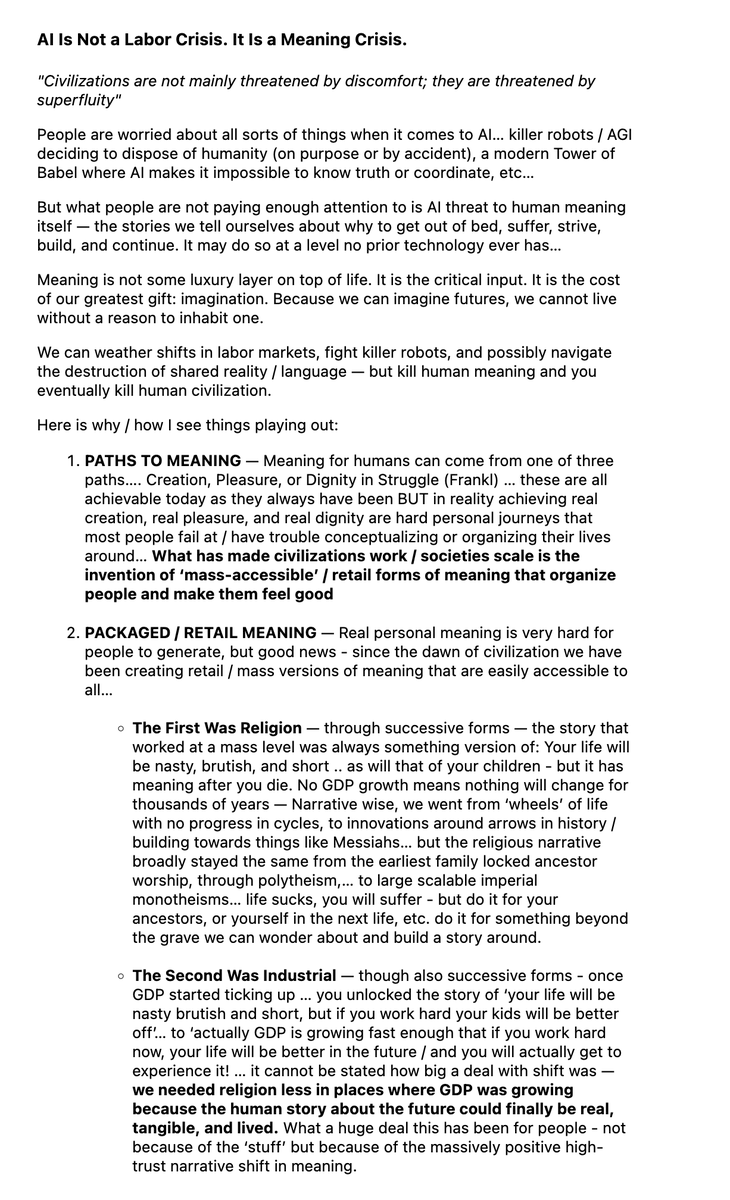
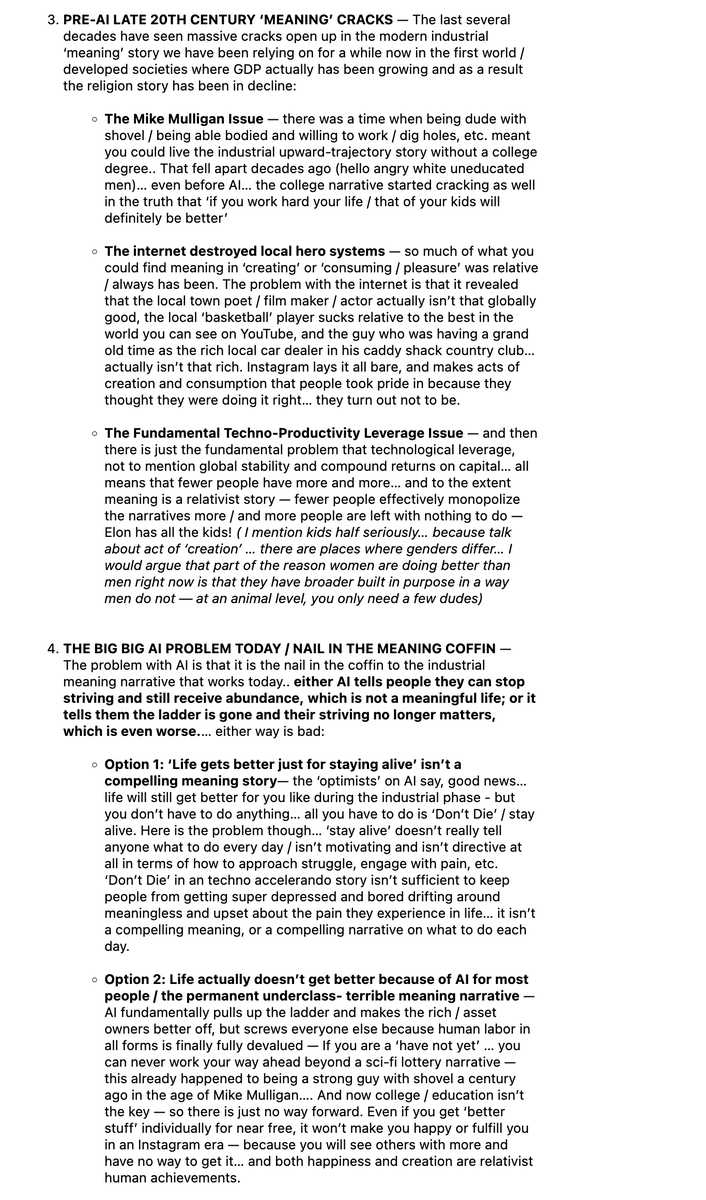
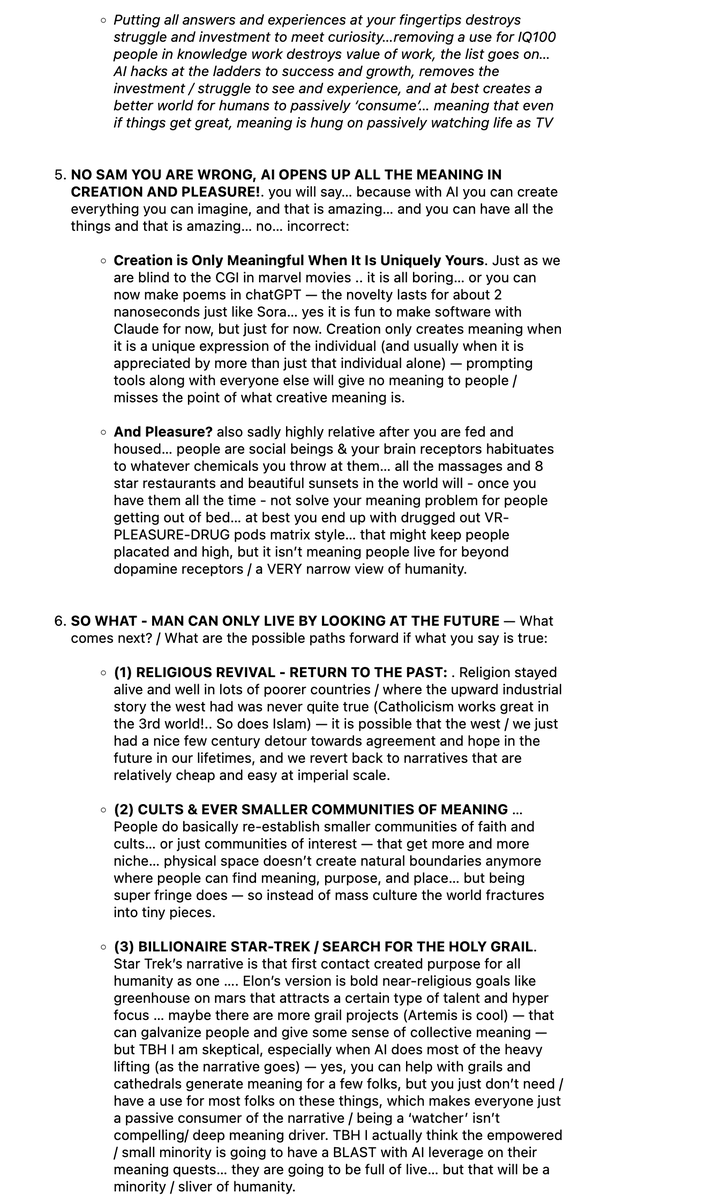
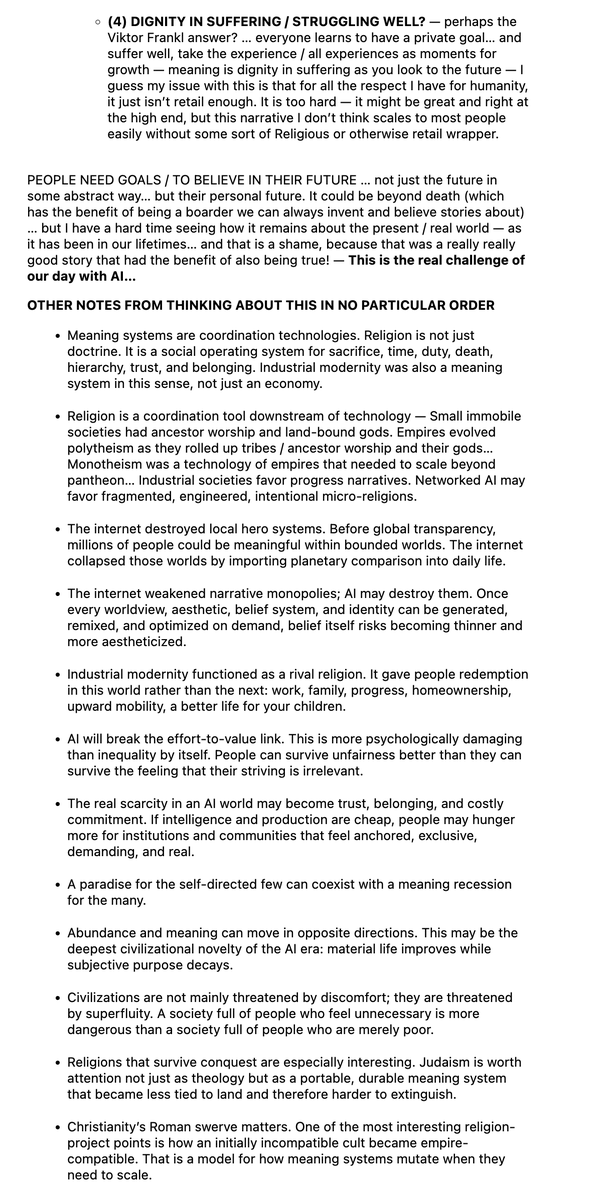
@lessin Sam, your newsletter nails it. AI is triggering a real meaning crisis, just like industrialization did. When people who spent years perfecting skills suddenly see those roles transformed or pushed aside, the hit to ego, identity, and motivation is brutal in the short term. Your warning is spot on. But I believe humans have the ability to not only adapt, but to thrive, long term. During the Industrial Revolution, skilled artisans like weavers and blacksmiths lost their proud, independent crafts to machines almost overnight. Many suffered real hardship as old meaning and dignity in work disappeared. Yet societies eventually adapted by creating new roles and a new progress narrative. Today we face something similar, but with an even sharper divide. AI is creating millionaires overnight, including people who had no previous foundation or wealth. At the same time, others are losing jobs as routine work gets automated. The gap is widening fast between those who adapt quickly and spot new opportunities, and those who struggle to adjust. It is no longer just about property owners versus laborers. Adaptability itself has become the biggest divider. The hopeful part is that humanity has always found ways to adapt and rediscover meaning, even after massive shifts. It is what makes us human. We have done it before through huge changes, and I truly believe we will do it again. Sam, what paths for adaptation strike you as most realistic? I believe in our ability to rise to this one.
English
0
0
3
114
sam lessin 🏴‍☠️
A bunch of people have written me back saying this was the best newsletter I have ever sent (flattering) ... so here it is for those who don't subscribe: AI Is Not a Labor Crisis. It Is a Meaning Crisis.
sam lessin 🏴‍☠️ tweet mediasam lessin 🏴‍☠️ tweet mediasam lessin 🏴‍☠️ tweet mediasam lessin 🏴‍☠️ tweet media
English
62
153
1.4K
253.7K
Andreas Hassellöf retweetledi
@levelsio
@levelsio@levelsio·
Okay honestly this makes vibe coding into production very dangerous, you guys were all right I think what I'll do is cut off all access to DBs and run it as a user with almost no privileges
Basel Ismail@BaselIsmail

URGENT PSA - New supply chain attack vector that I found WILD > AI LLMs hallucinate package names roughly 18-21% of the time. Hackers have started pre-registering those hallucinated names on PyPI and npm with malicious payloads; they call it "slopsquatting" You can only imagine what's next

English
164
75
1.7K
429.3K
Andreas Hassellöf retweetledi
Boris Cherny
Boris Cherny@bcherny·
I wanted to share a bunch of my favorite hidden and under-utilized features in Claude Code. I'll focus on the ones I use the most. Here goes.
English
554
2.5K
23.2K
3.9M
Andreas Hassellöf retweetledi
PhyGrid
PhyGrid@phygridcom·
📷 Behind every great retail experience is an employee who: → Has the right tools at their fingertips → Can focus on customers (not tech issues) → Feels empowered, not overwhelmed That's what we build at PhyGrid. Technology that works FOR your team. Not the other way around.
PhyGrid tweet media
English
0
2
3
43
Andreas Hassellöf retweetledi
🇦🇪 HGS
🇦🇪 HGS@Sajwani·
Best accounts to follow and to get the truth in the UAE: UAE Ministry of Defense @modgovae The official UAE News agency (WAM) @wamnews National Emergency and Crisis Management Authority @NCEMAUAE UAE Government Media Office @UAEmediaoffice
English
136
970
3.6K
544.4K
Andreas Hassellöf retweetledi
James Shields
James Shields@scaling_shields·
i watched a flight go from $483 to $547 in 24 hours WITHOUT a single seat selling searched london to new york on a tuesday $483 checked again 2 hours later $512 next morning: $547 panicked and booked it the guy sitting next to me paid $391 same seat, date + airline $156 less he searched once i searched 3 times the algorithm saw me come back and charged me until i broke the seat doesnt have a price you have a price and it goes up EVERY time you show interest couldnt stop thinking about it so i tracked down someone who actually built pricing algorithms for a european carrier asked him what happened to me "you got profiled. the system assigned you an intent score after your second search and raised your ceiling every time you came back" asked how to beat it "most people think a VPN fixes it. thats 2015 advice. the algorithm fingerprints more than your IP now. it reads your device your browser your screen resolution your timezone. VPN to bucharest but your clock says london and your language is english? the algo knows youre faking and sometimes charges you more for trying" "so what actually works?" "you have to poison the entire profile. not just the location. the identity" the protocol he gave me: VPN AND match your timezone and language to the spoofed location. mismatched signals flag you and can trigger a price increase use a fully clean browser. no history no saved passwords no google account. the algorithm fingerprints your session not just your cookies one search one booking. the intent score activates on the second search. there is no safe way to look twice book tuesday or wednesday 1-5am. lowest traffic means the least demand data for the algorithm to inflate against if the price already spiked go dark for 72 hours minimum. not 24. the intent score on most carriers decays on a 3 day cycle. come back on a different device from a different network "we spent $4 billion building these systems. theyre not going to lose to someone who opened an incognito tab" $900 billion industry the gap between what you pay and what the person next to you pays is not a bug its the entire business model stop letting an algorithm charge you for being predictable
English
1.1K
5.7K
35K
4.1M
Andreas Hassellöf retweetledi
Claude
Claude@claudeai·
New in Claude Code: Remote Control. Kick off a task in your terminal and pick it up from your phone while you take a walk or join a meeting. Claude keeps running on your machine, and you can control the session from the Claude app or claude.ai/code
English
1.8K
4.6K
44.3K
10M
Andreas Hassellöf retweetledi
John LeFevre
John LeFevre@JohnLeFevre·
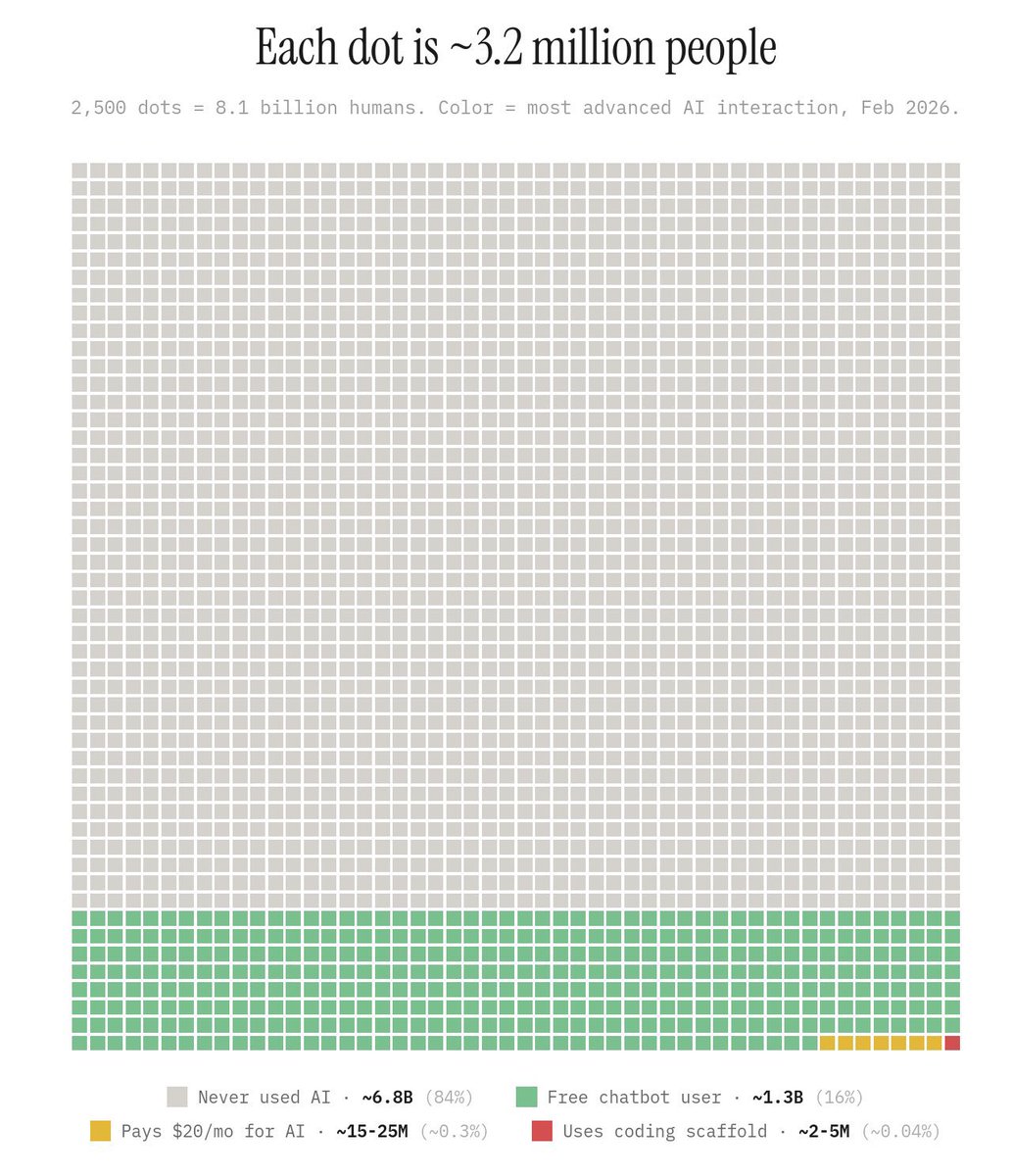
84% of people have never used AI, and just 0.3% of users pay for premium services. Anyone who thinks AI is a bubble isn't paying attention.
John LeFevre tweet media
English
556
672
3.8K
1.6M
Andreas Hassellöf retweetledi
The Humanoid Hub
The Humanoid Hub@TheHumanoidHub·
Wang Xingxing is showing confidence in the safety and reliability of his creations.
English
141
842
4.9K
370.2K
Andreas Hassellöf retweetledi
Yuchen Jin
Yuchen Jin@Yuchenj_UW·
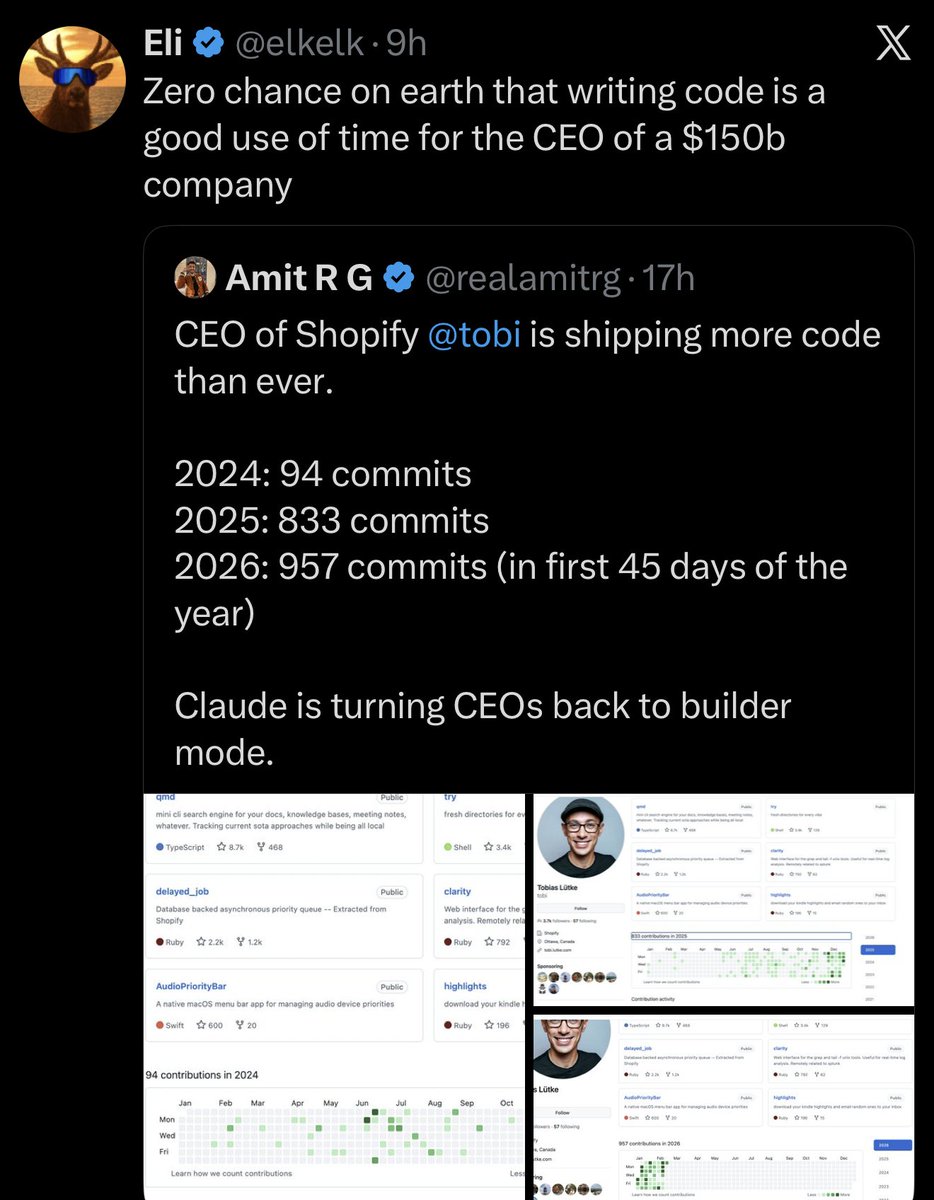
Hot take: any tech CEO who hasn’t tried coding with AI is missing the signal. Sergey is coding. Zuck is coding. Tobi is coding. If you don’t feel the slope of AI progress first-hand, you can’t see the future. You’ll likely get disrupted by someone who does.
Yuchen Jin tweet media
English
28
13
220
12.8K
Andreas Hassellöf retweetledi
Aakash Gupta
Aakash Gupta@aakashgupta·
The real story here is worse than a fumble. It’s a three-step own goal. January 9: Anthropic locks Claude Code OAuth tokens, killing every third-party tool that built on Claude subscriptions. OpenClaw, which recommended Claude Opus 4.5 as its default model, wakes up to a broken integration. No warning. No partner outreach. January 27: Anthropic’s legal team sends the cease-and-desist over “Clawdbot” sounding too similar to “Claude.” Steinberger complies at 5 AM on a Discord call. During the 10-second window where he releases the old GitHub and X handles, crypto scammers hijack both accounts and run a $16M pump-and-dump scheme. The chaos reflects on the entire Claude ecosystem. February 15: Steinberger announces he’s joining OpenAI. So Anthropic had the fastest-growing open source project in AI history (145K+ GitHub stars, 2 million visitors in a single week), built by a guy who sold his last company for ~€100M, whose tool literally recommended Claude as the default model to millions of new users. Their response was to cut off his API access and send lawyers. Steinberger spent last week in San Francisco meeting with every major lab. He explicitly said he could have built OpenClaw into a massive company but chose OpenAI because he wanted “the fastest way to bring this to everyone.” Meanwhile OpenClaw has already spread to China, with Baidu planning direct integration into its main app. This is a project that was essentially a free distribution channel for Claude. Millions of developers installing a tool that defaults to your model. The growth marketing team at Anthropic should have been sending gift baskets, not legal notices. Sam Altman just got handed an open-source agent framework with global distribution and a brilliant founder, because Anthropic’s legal department moved faster than their partnerships team.
nader dabit@dabit3

Maybe the fumble of the decade by @AnthropicAI. The most popular and fastest growing open source project of all time is not only named after you, but most users are power users of your product. Instead trying to collaborate or work with him they chose violence 😭

English
173
403
3.9K
543.8K
Andreas Hassellöf retweetledi
RAVI KUMAR SAHU
RAVI KUMAR SAHU@RAVIKUMARSAHU78·
🚨 ALIBABA JUST OPEN-SOURCED THE MOST POWERFUL MODEL IN THE WORLD - Qwen3.5 plus And it changes the AI race forever. This is not another “bigger model” release. This is a complete architectural reset. 397B parameters → only 17B active at inference, Qwen3.5 plus delivers performance on par with GPT-5.2 and Gemini-3-Pro. A new Hybrid Sparse MoE + Linear Attention architecture + Multi-Token Prediction = near-instant long-context responses and massive speed gains. Built as a true native multimodal model, it doesn’t just chat it builds. With a single prompt: “Use the React framework to create a visually impressive Mapbox demo featuring locations in Beijing and Shanghai” it generates a live interactive 3D map UI, structured components, real layouts, and production-ready frontend logic. This is real agentic, multimodal coding not a static code block. MMLU-Pro: 87.8 GPQA: 88.4 IFBench: 76.5 ⚡ up to 8× faster inference And it’s fully open-sourced under Apache-2.0. No locked APIs. No restricted tiers. 201 languages supported bringing frontier AI to developers, startups, and researchers worldwide. The race is no longer about the biggest model. It’s about the most usable intelligence. Open source just entered the top tier.
English
149
554
4.1K
378.8K