Hattie Chung

443 posts

Hattie Chung

Hattie Chung

@hattaca

asst prof @YaleMed | tissue homeostasis and aging | systems biology & ML | @hattaca.bsky.social

New Haven, CT Katılım Mart 2009
1.1K Takip Edilen2.5K Takipçiler
Hattie Chung retweetledi
Isha Jain
Isha Jain@ishahjain·
A century ago, “vitamin hunters” discovered micronutrients. Today, vitamins are taken adhoc. We revisited this with modern genetics: CRISPR screens -> new NAXD disease mouse -> over 40× lifespan increase w/ vitamin B3. Huge credit to Ankur & Skyler! tinyurl.com/32k74629 🧵👇
English
11
43
190
21.5K
Hattie Chung retweetledi
The New York Times
The New York Times@nytimes·
Breaking News: Yale will waive tuition for new undergraduate students whose families have annual incomes below $200,000. nyti.ms/45vJY8L
English
155
766
4.3K
531.2K
Hattie Chung retweetledi
Sam Rodriques
Sam Rodriques@SGRodriques·
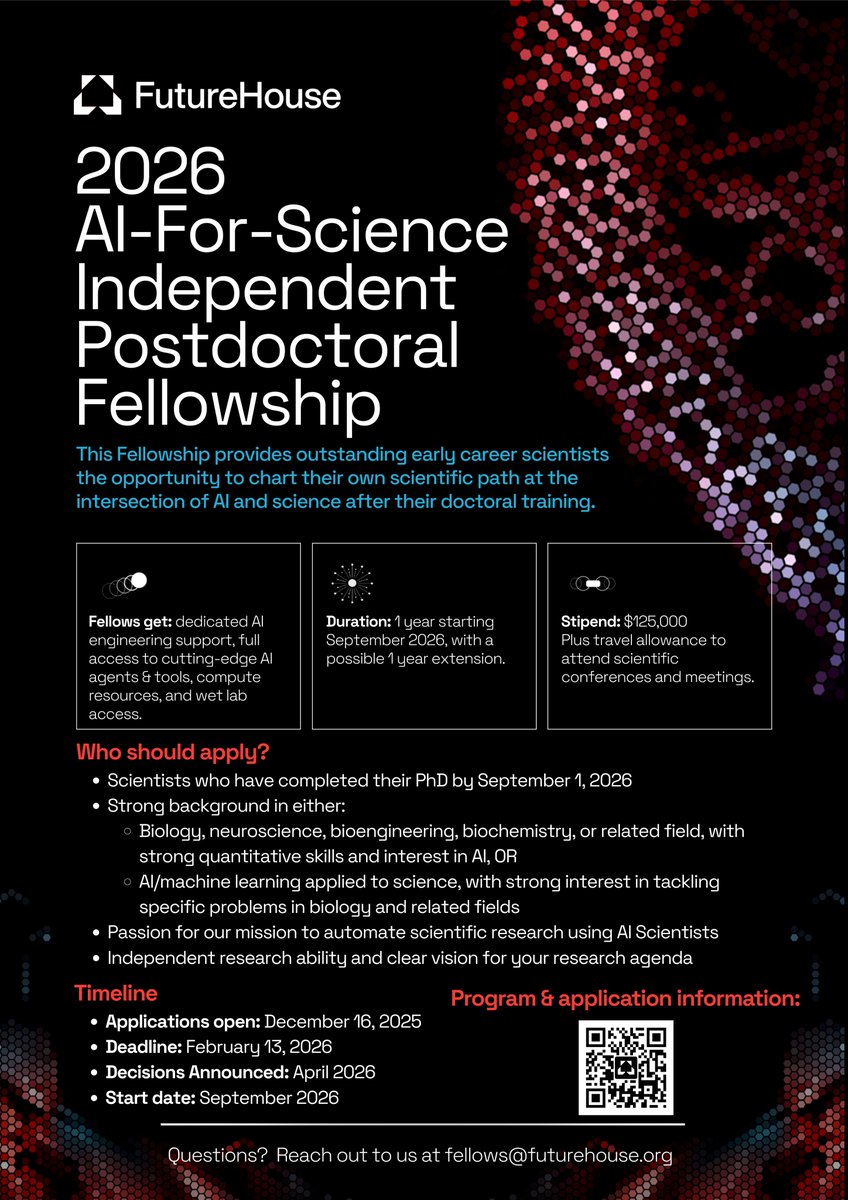
We are opening applications for our 2026 cohort of FutureHouse AI-for-Science Independent Postdoctoral Fellows! Apply our AI tools to specific problems in biology and biochemistry, in collaboration with world-leading academic labs: --$125,000 annual stipend. --Access to all tools developed by FutureHouse and Edison Scientific at scale, including Kosmos and several as-of-yet unreleased agents, with under-the-hood access to them to specialize them for your workflows. --Receive dedicated software engineering support. --1 year with possible 1 year extension. Even more exceptional co-advisors than last year. Deadline for applications is February 13th, 2026. Link in next post.
Sam Rodriques tweet media
English
17
161
674
61.6K
Hattie Chung retweetledi
Sanju Sinha
Sanju Sinha@Sanjusinha7·
When and how do different tissue physical structures deteriorate during aging (structural aging)? What molecular changes occur in tissues during periods of major changes? Are there tissue-specific periods of accelerated structural aging? Which organs age early vs. late? Is there cross-organ coordination in structural aging? And, finally, how lifestyle, diseases and genetics impact these organ-specific trajectories? While important, these questions haven’t been answered yet because we lack structural and molecular data from normal aging tissues at scale. We present a framework taking the first stab at scale at these questions using high resolution histology images and omics (+more) from 25,000 post-mortem tissues (public data: GTex). We reason that structure determines function and learning how tissue structure changes with age can help us understand the process of aging in different tissues - a central question with yet little understanding. An example is to visualize these two ovaries histology: young vs. old ovary- young ovaries cortex is intact, with follicles, no fibrosis - basis of its function (partially). First, we extract tissue structure from these organs using their high-res histology images using a pre-trained digpath foundation model (UNI) and asked how much they change with age (Structural Aging Rate)? As an example, the ovary has two peaks around the late 30s and then around 55. First aligns with accelerated follicle loss and second is just after post-menopause. This shows that change in morphology of the ovary captures its functional milestones during aging with no training. Bonus Puzzle: Does anyone know how these two functional milestones of ovary were originally found in the last century? What if we repeat the same analysis on bulk-omics, transcriptomics and methylation, from the same samples? Can they capture this bimodal functional decline? No. (read the paper of our explanation) Can molecular clocks trained on chronological age track this? No. They assume aging is linear. Note: Unlike molecular clocks trained on chronological age, PathStAR learns with no age labels. We simply ask: When and how does tissue morphology change most rapidly during life?
Sanju Sinha tweet mediaSanju Sinha tweet mediaSanju Sinha tweet mediaSanju Sinha tweet media
English
2
15
56
11.2K
Siyuan (Steven) Wang
Siyuan (Steven) Wang@SStevenWang·
Our RAEFISH spatial transcriptomics technology is now published in Cell @CellCellPress! RAEFISH enables sequencing-free whole genome spatial transcriptomics at single molecule resolution. This work represents the first time that transcripts from more than 23,000 genes were directly probed and imaged in situ with any technology, and the first time numerous different gRNAs were directly probed and distinguished by imaging in a high-content CRISPR screen. The challenge: Recent breakthroughs in spatial transcriptomic technologies, from us and others, have greatly improved our ability to profile cell types, states, cellular interactions, and the underlying gene programs within the native tissue contexts. However, these technologies have limitations. Methods based on 2D-array-capture/tagging and ex situ sequencing offer genome-scale coverage, but lack the resolution needed to accurately study fine spatial organization. In contrast, image-based methods that rely on highly multiplexed fluorescence in situ hybridization or in situ sequencing provide single-molecule resolution and resolve fine spatial organization, but require pre-selecting a limited set of target genes (typically hundreds to a few thousand genes), which limits discovery and sometimes leads to only validations of prior knowledge due to the pre-selected targets being well studied in the context. The solution: RAEFISH, our lab's new flagship image-based spatial transcriptomics technology, simultaneously enables single-molecule spatial resolution and whole-genome level coverage of long and short, endogenous and engineered RNA species in cell cultures and intact tissues. The results: 🔥 We performed RAEFISH targeting 23,312 human genes in cell cultures, and demonstrated hypothesis-free discovery of cell cycle associated genes and subcellular localization patterns of transcripts, including nearly the entire protein coding transcriptome and additional long noncoding RNAs. 🔥 We performed RAEFISH targeting 21,955 mouse genes in mouse liver, placenta, and lymph node tissues. Our analyses on immediately neighboring cells uncovered intriguing cell-cell interactions and previously unknown gene expression programs underlying the interactions, such as those between cholangiocytes and immune cells. 🔥 Finally, we further developed RAEFISH to directly read out guide RNAs (gRNAs), demonstrating Perturb-RAEFISH in an image-based high-content CRISPR screen. The capacity of Perturb-RAEFISH to directly read out gRNAs addresses a crucial limitation of previous techniques that read out a barcode/identifier sequence paired with each gRNA species, as the pairing can be shuffled due to RNA recombination intrinsic to lentivirus used in such screens, which limits screen sensitivity and accuracy. In summary, RAEFISH provides the biomedical research community with a generalizable research tool, which will bring more spatial and mechanistic insights across health and disease. This work was co-led by my postdocs Drs. @ChengYubao, Shengyuan Dang, and Yuan Zhang, and was supported by the @NIH, @genome_gov, @sennetresearch, and @psscra. I would like to thank our co-authors, funding agencies, editor, reviewers, and my whole lab @YaleGenetics @YaleCellBio @YaleCancer @YaleMed @Yale. Link to paper: cell.com/cell/fulltext/…
Siyuan (Steven) Wang tweet media
English
17
118
418
45K
Hattie Chung retweetledi
LeifLudwig
LeifLudwig@LeifLudwig·
🚨 New preprints from our lab! First, we introduce Cryo-mtscATAC-seq, led by Maren (@ms-maren.bsky.social), enabling high-throughput clonal tracing from frozen human samples by isolating nuclei with their mitochondria (“CryoCells”). 👉 biorxiv.org/content/10.110…
English
2
4
30
2.9K
Hattie Chung retweetledi
Pradeep Natarajan
Pradeep Natarajan@pnatarajanmd·
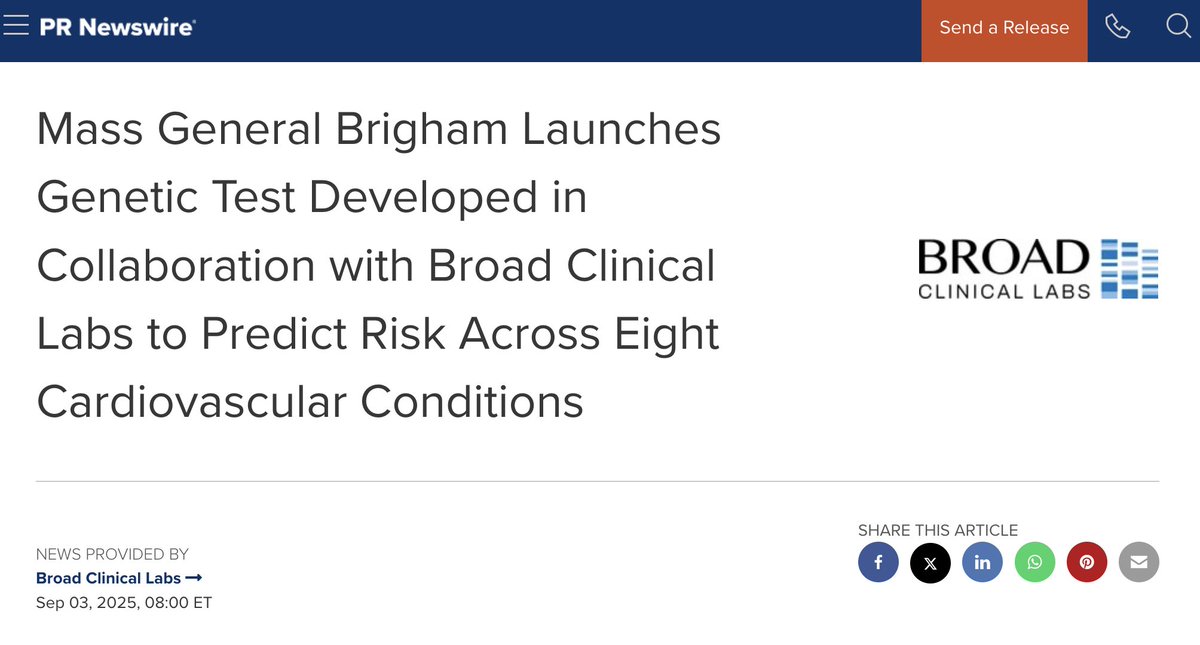
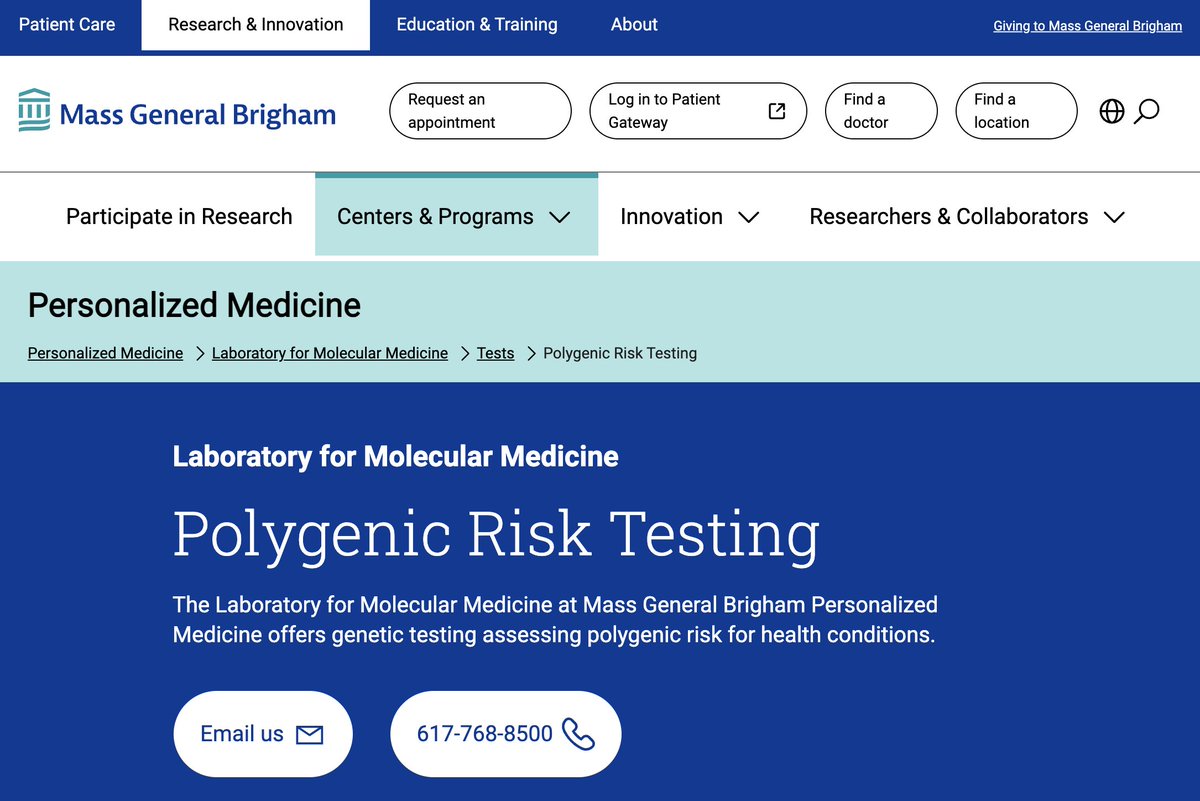
Building on the legacy of many, I'm incredibly excited that we have successfully translated our polygenic risk scores into a validated clinical assay @MassGenBrigham @broadinstitute, orderable by any clinician in the US today. 🧬To order: massgeneralbrigham.org/en/research-an… 🧬Announcement: prnewswire.com/news-releases/… The CVD PRS panel is already expanding, and panels in other disease areas are in development. Single sequencing for multiple disease areas. Methods: cell.com/cell-genomics/… @CellGenomics nature.com/articles/s4146… @NatureComms [1/4]
Pradeep Natarajan tweet mediaPradeep Natarajan tweet mediaPradeep Natarajan tweet media
English
19
90
333
78.8K
Hattie Chung retweetledi
Melanie Weber
Melanie Weber@mweber_PU·
Single-cell data can reveal hierarchical patterns in organismic development but popular embedding approaches often distort them. We introduce Contrastive Poincaré Maps, a self-supervised hyperbolic encoder that preserves hierarchies, scales efficiently, and uncovers developmental lineages across diverse datasets. Led by @nithyabhasker. Preprint here: bit.ly/4211hMY
Melanie Weber tweet media
English
0
19
71
15.9K
Hattie Chung
Hattie Chung@hattaca·
Our lab at @YaleMed seeks #postdocs with in vivo expertise to pioneer research at the intersection of tissue remodeling & aging. Work with us to uncover immunological & vascular drivers of ovarian aging, applying single-cell, spatial omics, and ML!
Hattie Chung tweet media
English
7
59
187
22K