Knik

228 posts

Knik

Knik

@hemingblade

Katılım Şubat 2017
31 Takip Edilen3 Takipçiler
hmph
hmph@hmph29759351·
@hemingblade @G_melo_ding @hjc4869 L3 is not counted for the core arch. L3 varies wildly between different models of the same core arch gen. More L3 also keeps more data closer to the core, saving expensive memory fetches.
English
1
0
0
33
hmph
hmph@hmph29759351·
Beyond just @hjc4869 's testing, here's more evidence that 18A perf/watt just isn't much better than what Intel already had on ARL-H's N3B... LNC and CGC, similar cores, similar Fmax, similar freq/power curves. tieba.baidu.com/p/10565365278?…
hmph tweet media
English
3
0
0
395
Knik
Knik@hemingblade·
@hmph29759351 @G_melo_ding @hjc4869 You are comparing P core efficiency, what's the difference it make whether having E cores or not? And E cores doesn't really having efficiency advantage, only LPE cores have.
English
1
0
0
23
hmph
hmph@hmph29759351·
@hemingblade @G_melo_ding @hjc4869 I literally just listed how they also changed the L3 cluster capacity too. Plus you have an additional mid cluster to help effec. vs just booting stuff to the P-cores. And battery life has also been very OEM dependent across generations, and even in the same generation.
English
3
0
0
37
Knik
Knik@hemingblade·
@Arronwei3n They are under the same regulations, how did other comments believes they aren't?
English
0
0
0
130
opdroid1234
opdroid1234@opdroid1234·
@PatrickMoorhead Ah the Panther Lake X1 Carbon is out - ThinkPad X1 Carbon Gen 14 Aura Edition (its 14 inch though)
English
1
0
1
360
Patrick Moorhead
Patrick Moorhead@PatrickMoorhead·
I still haven't tested a Panther Lake system to see what the big deal is. I need max battery life, don't care about the best display (14"+), light to travel with, need at least 64GB (128GB preferred) memory to vibe code. Camera can't suck for CNBC/YF/Pod appearances. Recommendations?
English
12
0
24
9.2K
Knik
Knik@hemingblade·
@IntelProMUltra Don't think EMIB is complicated, it's their first advanced packaging product, and it won't attract external customers is it is complicated.
English
1
0
0
80
Intel Pro Max Ultra
Intel Pro Max Ultra@IntelProMUltra·
1. It’s a no brainer that EMIB-T’s 90% yield is not high enough compared to TSMC CoWoS. Because it provides larger reticle size, it’s more complex and difficult to make. 2. Until 2H27, Intel still got at least 1 year to improve the yield to 98% to be ready for Google TPU Humifish’s mass production. 3. TSMC seems unlikely to win back the orders. Of course, Google wants a bigger reticle size solution, and currently only Intel is capable to provide that!
郭明錤|Ming-Chi Kuo@mingchikuo

Some quick thoughts on Intel's EMIB-T packaging for the new 2H27 Google TPU (Humufish). Based on my industry checks: 【How to read EMIB-T's 90% yield?】 1. Given Intel's track record running EMIB in mass production, hitting 90% technology validation yield on EMIB-T (still under development) is a very positive but reasonable data point. 2. Intel benchmarks EMIB production/assembly yield against FCBGA. Industry FCBGA yield today is generally above 98%. 3. On yield, getting from 90% to 98% is harder than getting from project kickoff to 90%. And technology validation yield ≠ final production yield, especially with some Humufish specs still unfinalized. So long-term, I'm positive on Intel's advanced packaging story. Near to mid-term, I'm staying cautious on how they get there. 【From 90% to 98%. Looks like just a few points. Does Google care? Absolutely】 1. Google recently asked TSMC how much it could save by placing wafer orders for Humufish's main compute die (designed in-house by Google) directly, rather than routing them through MediaTek. 2. Google and MediaTek have run a semi-COT model since day one (8t). MediaTek's mark-up sits mostly on the parts it designs itself, so whether Google places the wafer orders for main compute die directly isn't a key swing factor for MediaTek's earnings trajectory. 3. But Google even probing whether it can squeeze out the pass-through mark-up on wafer orders tells you something: Google has shifted from easygoing buyer to hard-nosed on cost. The reason is simple: to take on Nvidia head-on, cost is Google's edge, which makes EMIB-T production yield Google's problem to solve. For context, TSMC's yield target on 5.5-reticle CoWoS in 2026 also starts at 98%. 【TSMC's position】 1. My understanding is TSMC is still working out how much advanced-node capacity to allocate to Humufish in 2H27, for two reasons: (1) it still wants the back-end packaging orders, though looks unlikely for now, and that's by design on Google's part; and (2) it's still gauging actual back-end output from EMIB-T, to avoid misallocating scarce advanced-node capacity. 2. Humufish's effective back-end output hinges on both EMIB-T and substrates, and both need to be tracked together. 3. On the Humufish semi-COT model, TSMC also prefers MediaTek to place the wafer orders for the main compute die. Beyond the close working relationship, the key point is MediaTek is TSMC's third-largest advanced-node customer in 2025. If TPU orders shift, MediaTek's scale makes it a natural buffer for TSMC to rebalance its wafer allocation mix.

English
7
9
105
15.3K
hmph
hmph@hmph29759351·
@hemingblade @G_melo_ding @hjc4869 LNL and PTL do not use the same uncore. Beyond just mem latency improvements, PTL gives the P-cores a larger L3 cluster and more L2 per core to boot.
English
1
0
0
83
hmph
hmph@hmph29759351·
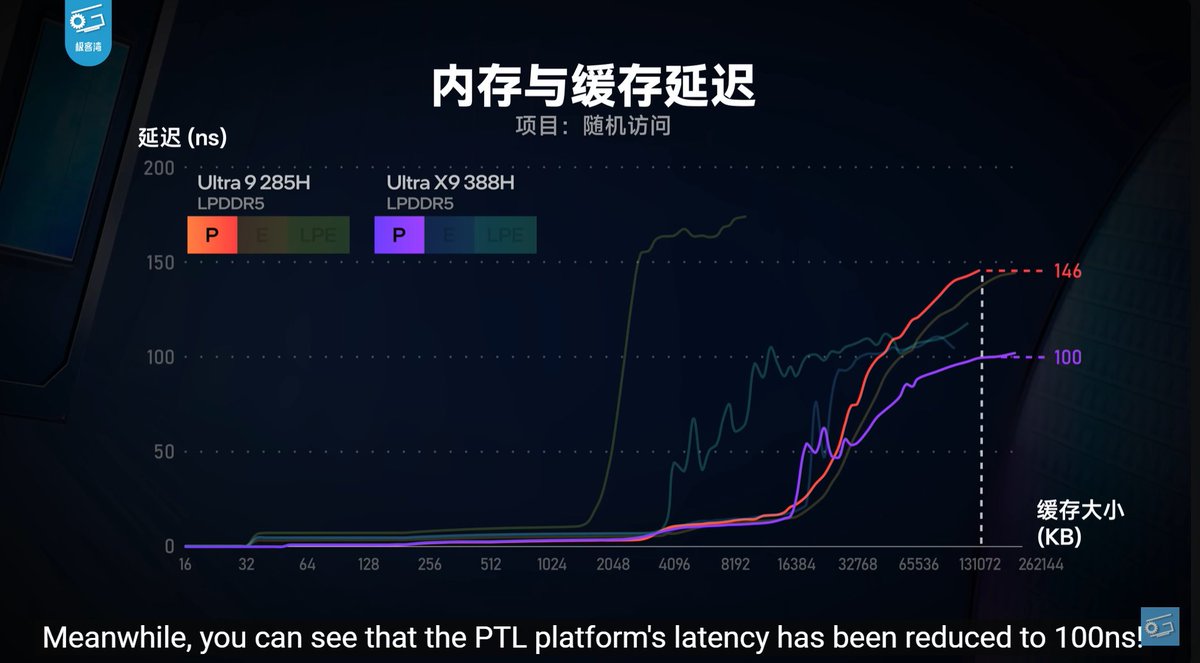
@hemingblade @G_melo_ding @hjc4869 Check out the image I posted under my above reply. Perf/watt does not equal freq/watt. PTL has noticeably higher IPC than LNL/ARL, mostly due to uncore improvements. The improvement in mem latency is insane esp over ARL.
hmph tweet media
English
3
0
0
108
Knik
Knik@hemingblade·
@hmph29759351 @G_melo_ding @hjc4869 On one or two cases maybe, not on majority of cases, their used the same uncore. Also how did you win perf/w curve but failing on every single spot on that curve?
English
1
0
0
54
hmph
hmph@hmph29759351·
@hemingblade @G_melo_ding @hjc4869 Battery life is impacted by a ton of other factors other than single core perf/watt curve. iGPU, other parts of the uncore, but also how much power you limit the cores to when you turn on battery mode. And also, PTL does have a better perf/watt curve, but not better freq/power
English
2
0
0
66
Knik
Knik@hemingblade·
@hmph29759351 @G_melo_ding @hjc4869 Not only in CB, other tests also follows the same trend. Besides basically all ptl models win over lnl in battery test, how do you achieve that with worse efficiency?
English
1
0
0
50
hmph
hmph@hmph29759351·
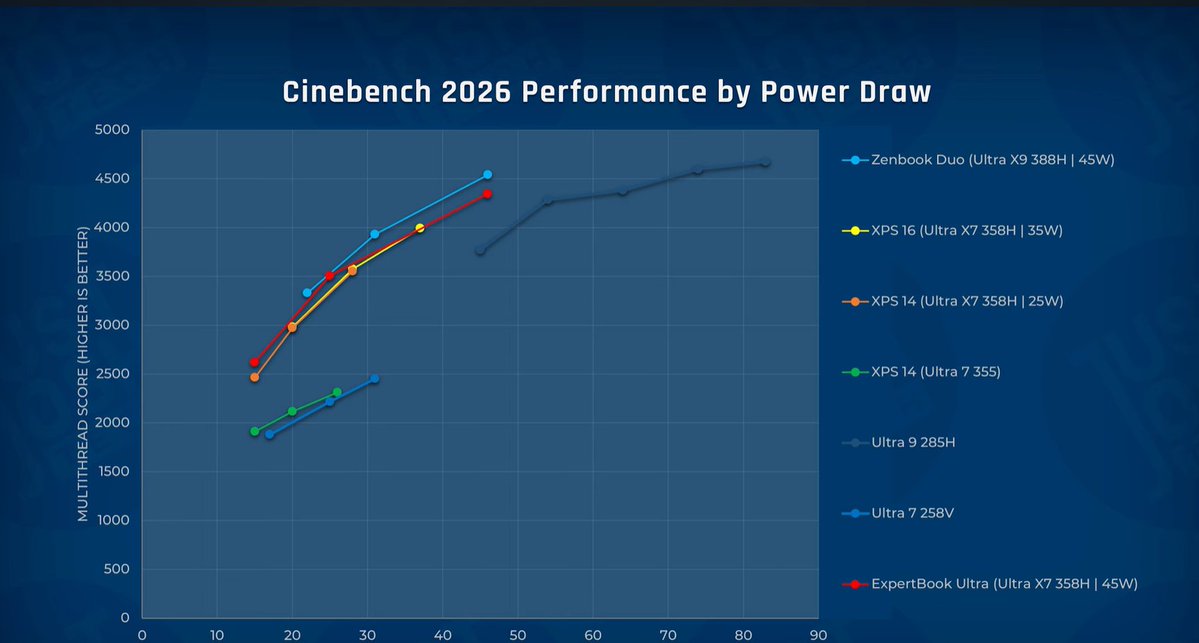
@hemingblade @G_melo_ding @hjc4869 They perform pretty much the same lol Keep in mind though, that PTL sees a large IPC uplift in cinebench 2026 vs LNL (not related to process, but uncore), and I'm pretty sure LNL also reports DRAM power in package power, while PTL does not.
hmph tweet media
English
1
0
0
100
Knik
Knik@hemingblade·
@G_melo_ding @hmph29759351 @hjc4869 Why there are still so many haters claiming 18A has worse efficiency, when low end PTH4+4 easily beats lnl in almost all the tests?
English
1
0
0
77
Knik
Knik@hemingblade·
@JohnTinsman Simply not true, especially for AI workloads, you are reading serious outdated resources.
English
0
0
1
33
John Tinsman
John Tinsman@JohnTinsman·
$AMD Verse $INTC: The CPUs and Foundries In one of my last posts, I argued the AMD should be doing better than Intel YTD as I believe AMD makes a much better CPU chip for agentic AI than $INTC. 1) AMD CPUs offer higher core/thread density. 2) AMD's EPYC shows 1.1–1.9x gains over comparable Intel Xeon in relevant workloads 3) Market momentum: Surging demand for AMD's EPYC in agentic AI (hyperscalers, enterprises) show customers prefer AMD as the company continues to gain market share in CPUs 4) AMD's chips are significantly more energy efficient, and this matters a ton when you run them at scale at full capacity. Now many of my commenters said it was all about the Foundry. However, I do not believe having $TSM make the CPUs for AMD is a weakness, rather a strength. TSM has an enormously profitable foundry business and is building hundreds of billions worth of manufacturing capacity in the United States. Meanwhile, Intel's foundry business loses tens of billions, showing it is deeply uncompetitive on a world stage. Commentors though Intel having their own foundry business would mean they would be able to ramp up output much faster than AMD, but I believe it actually means the opposite, it could hamstring their output and allow AMD to steal even more market share.
John Tinsman tweet media
English
12
4
73
13.3K
Knik
Knik@hemingblade·
@zyl19911 But didn't M3 will be discontinued by that time?
English
3
0
0
288
Caplume Research
Caplume Research@caplume_R·
Only Apple and Intel used N3B iirc. So Jeff is probably referring to Apple M3
Jeff Pu@sssjeffpu

#Intel Thanks for referencing our research. We believe the company’s front end 18A yield is also doing well, which is consistent with mgmt’s comments. As said in our earlier note, we expect the company to have started trial/testing for external customers based on 18A for a customer’s 2023’s chip which was on N3B.

English
2
3
44
7.8K
Knik
Knik@hemingblade·
@Alex_Intel_ Basically all of the taiwan companies did that 🤣, that's why they need all these taiwanese people just to operate, also the reason why these people will eventually run off.
English
0
0
3
184
Alex
Alex@Alex_Intel_·
Little nugget from this Reddit post, which has a lot of info on the dysfunction at TSMC Arizona (took 2 years to ramp 5nm) N3 AZ, could be a slow ramp. Keep in mind, N2 in Arizona is supposed to ramp 1 year after TSMC toxicity is a drag, not an asset (including Taiwan fabs)
Alex tweet media
A2THEZ@awakenowzone

Anyone that works in Fabs or knows someone who works there knows that $TSM work culture is not healthy. Which really means talent would rather be somewhere else if that somewhere else provides them a good stable opportunity…..Queue Intel! A change is happening gradually and I bet many TSM talent will soon make the move to $INTC reddit.com/r/Semiconducto…


English
4
5
38
7.3K
Mojo
Mojo@Mojo_flyin·
$AMD biggest issue is unlike $INTC they are completely at the mercy of $TSM for their data center products. They cannot flex supply as easily and structurally their cost framework keeps rising as $TSM costs keep increasing. I've spoken about this some time ago.
Wall St Engine@wallstengine

Northland Downgrades $AMD to Market Perform, PT $260 Analyst comments: "We initiated coverage of AMD 11 years ago with an Outperform rating, and people thought we were clueless. At the time, AMD was catching up to Intel, and Intel was falling behind TSMC. Now Intel is catching up to AMD, and TSMC is partnering with NVDA in AI infrastructure and PCs. We think this limits AMD’s gross margin expansion, and R&D spending will likely remain elevated. While AMD is a phenomenal company, the CY27 consensus is likely too high. Downgrading to Market Perform. We expect AMD to beat and raise estimates when it reports next week, but the results will likely not be as robust as Intel's. While AMD will benefit from price increases, we believe AMD needs to continue spending heavily on R&D to catch up with NVDA. AMD’s non-GAAP gross margin is currently in the mid-50% range, whereas INTC is high 30% to low 40%. Intel is becoming more competitive, and while INTC likely has a higher cost structure, AMD’s price premium relative to Intel’s is likely to decline. AMD is a fabless company and dependent on TSMC. NVDA is TSMC’s largest customer and is likely to receive favorable allocation amid very tight supply. Moreover, NVDA uses the supply chain as a competitive weapon, buying up capacity ahead of its competitors and constraining their growth. Our conclusion is that AMD results and outlook are going to be good, just not as good as INTC's last week. We believe the CY27 consensus needs to come down, as we expect AI infrastructure spending to decline in CY27. We believe that capex/cash flow of the hyperscalers is maxed out, and as OpenAI and Anthropic go public this year, they will demonstrate greater financial discipline. They are already moving away from unlimited free usage toward strict usage caps, token-volume-based pricing, and higher-tier subscriptions. We think this slows AI demand growth. At the same time, construction delays are affecting data center facilities." Analyst: Gus Richard

English
14
1
86
14.6K
Knik
Knik@hemingblade·
@awakenowzone That's also part of the reason they're so reluctant to move to US, they know their taiwan trained engineers will defect to other US companies almost inevitably.
English
1
0
6
493
A2THEZ
A2THEZ@awakenowzone·
Anyone that works in Fabs or knows someone who works there knows that $TSM work culture is not healthy. Which really means talent would rather be somewhere else if that somewhere else provides them a good stable opportunity…..Queue Intel! A change is happening gradually and I bet many TSM talent will soon make the move to $INTC reddit.com/r/Semiconducto…
A2THEZ tweet media
English
7
3
60
14.8K
Knik
Knik@hemingblade·
@treasureh8nter @Mojo_flyin Only by 2%🤣, what's the difference? Also Boardcom only have accelerators, so they don't have all these CPUs fighting for that same wafers.
English
1
0
1
31
Ally
Ally@treasureh8nter·
@Mojo_flyin And yet for $NVDA $AVGO $AAPL it’s no issue whatsoever 😅
English
2
0
9
550
Knik
Knik@hemingblade·
@limegpt @The_AI_Investor They haven't reach his goal yet, there's still 1 or 2 quarters ahead. 18A's yield is basically on track all this time, it didn't simply getting improved a lot overnight like you think.
English
0
0
0
29
Lime
Lime@limegpt·
@The_AI_Investor They both did work. Pat took the risk, Lip-Bu righted the ship. There was a story about when Lip-Bu first joined Intel, he saw that 18A yields were piss poor. First thing he did was call up all his friends and came up with a plan to get yields to industry standard… and he did
English
5
0
33
1.5K
The AI Investor
The AI Investor@The_AI_Investor·
So Pat Gelsinger did all the hardwork and Lip-Bu Tan got all the credit ?
English
34
4
189
22.2K