
David Murakami

963 posts

David Murakami banner
David Murakami

David Murakami

@hirothreading

🇦🇺🇯🇵 Macroeconomist at BoE 🏦 Opinions my own 📚 @ U.Milan+Pavia PhD👨🏻‍🎓UWA, Keio, @OxfordEconDept alumnus

Milano, Lombardia Katılım Mart 2013
459 Takip Edilen350 Takipçiler
Sabitlenmiş Tweet
David Murakami
David Murakami@hirothreading·
I set up a new website to host my working papers, notes, and teaching material. E.g., here are my notes on postgrad macroeconomics: hirothreading.github.io/macro-postgrad/ Please feel free to use and share — but do be on the lookout for typos! I’ll have to do a major typo fix at some point…
English
0
1
15
1.9K
David Murakami retweetledi
Jesús Fernández-Villaverde
Jesús Fernández-Villaverde@JesusFerna7026·
Smartphones are not the explanation for the recent decline in fertility. Instead, they are an accelerator of deeper forces already at work. Let’s start with the facts. Fertility is falling almost everywhere: in rich, middle-income, and poor countries; in secular and religious countries; and in countries with high and low levels of gender equality. The decline accelerated around 2014. So, no country-specific explanation will work unless you are willing to believe that 200 distinct country-specific explanations arrived at roughly the same time. Smartphones look like the obvious candidate: the first iPhone was released in 2007, and global adoption has been astonishingly fast. Economists understand the first major decline in fertility in advanced economies, from 6 or 7 children per woman throughout most of human history to about 1.8, that occurred between the early 1800s and roughly 1970, well before smartphones. The main drivers were a sharp fall in child mortality (effective fertility was rarely above 3 and often close to 2) and the shift from a low-skill, rural agrarian economy to a high-skill, urban industrial one. We have quantitative models that fit these facts well. Country-specific factors mattered too, of course. Proximity to low-fertility neighbors accelerated Hungary’s decline, while fragmented landowning structures accelerated France’s. But these were second-order mechanisms. This is also why most economists long considered Paul Ehrlich’s doom scenarios implausible. We forecast that fertility in middle- and low-income economies would follow the same path as in the rich, probably faster, because reductions in child mortality reached India or Africa at lower income levels (medical technology is nearly universal, and most gains come from handwashing and cheap antibiotics, not Mayo Clinic-level care). Much of what we see in Africa or parts of Latin America today is still that old story. But in the 1980s, a new pattern appeared. Japan and Italy fell below 1.8, the level we had thought was the new floor. By 1990, Japan was at 1.54 and Italy at 1.36. This second fertility decline began in Japan and Italy earlier than elsewhere, driven by country-specific factors, but the underlying dynamics were widespread: secularization, an education arms race, expensive housing, the dissolution of old social networks, and the shift to a service economy in which women’s bargaining power within the household is higher. The U.S. lagged because secularization came later, suburban housing remained relatively cheap, and African American fertility was still high. U.S. demographic patterns are exceptional and skew how academics (most of whom are in the U.S.) and the New York Times see the world. My best guess is that, without smartphones, Italy’s 2025 fertility rate would be about 1.24 rather than 1.14. I doubt anyone will document an effect larger than 0.1-0.2. Italy was at 1.19 in 1995, not far from today’s 1.14. The TFR is cyclical due to tempo effects, so I do not read too much into the rise between 1995 and 2007 or the decline from 1.27 in 2019 to 1.14 today. The direct effect of smartphones is not zero, but it is not, by itself, that large. Where social media, in general, and smartphones, in particular, matter is in the diffusion of social norms. What would have taken 25 years now happens in 10. Social media are not the cause of fertility decline; modernity is. But they are a very fast accelerator. That is why social media are a major part of the story behind Guatemala (yes, Guatemala) going from 3.8 children per woman in 2005 to 1.9 in 2025. Without them, Guatemala would also have reached 1.9, just 20 years later. Modernity, in its current form, is incompatible with replacement-level fertility. By modernity, I do not mean capitalism: fertility fell earlier and faster in socialist economies than in market economies. Socialist Hungary fell below replacement in 1960, and socialist Czechoslovakia in 1966 (both experienced small, short-lived baby booms in the mid-1970s). By modernity, I mean a society organized around rational, large-scale systems and formalized knowledge. Countries will not converge to the same fertility rate. East Asia is likely stuck near 1, possibly below, given its unbalanced gender norms and toxic education systems. Latin America faces the same gender problem plus weak growth prospects, so I expect something around 1.2. Northern Europe has more egalitarian family structures and might hold near 1.5. The very religious societies are probably the only ones that will sustain 1.8. All of this could change with AI or changes in population composition. We will see. But on the current evidence, deep sub-replacement fertility is the “new new normal.” Unless we reorganize our societies, better learn to handle it as best we can.
Jesús Fernández-Villaverde tweet media
English
220
913
3.7K
885.8K
David Murakami
David Murakami@hirothreading·
Milwaukee was great — lots of fun and a great conference! Chicago is absolutely awesome 🙌
English
0
0
1
31
David Murakami retweetledi
Runling Wu
Runling Wu@RunlingWu·
(6/6) Interested in joining our workshop or presenting your research? Don't hesitate to get in touch with labor.public@gmail.com. We welcome job market candidates and researchers working on micro and macro perspectives of labor markets!
English
0
3
21
5.3K
David Murakami
David Murakami@hirothreading·
Happy to be in Milwaukee for the 2026 Spring Midwest Macro Meetings, presenting joint work with @mkomatsu_econ and @ShchapovEcon! Looking forward to seeing old friends and meeting new ones too!
English
0
1
5
153
David Murakami retweetledi
Paris School of Economics
📢 Call for Papers | PSE Macro Days 2026 Submissions are open for the 2026 edition of the PSE Macro Days (September 17-18) 📧 To submit, please send a pdf of your paper at macro@psemail.eu ⏰ Deadline: May 30 Decisions will be made by June 10 parisschoolofeconomics.eu/en/news/call-f…
English
1
20
59
11.6K
David Murakami
David Murakami@hirothreading·
Such a relief seeing this published! Would not have been possible without my coauthors Ivan and Yifan, amazing supervisors, and our editor Thomas Lubik and the two referees!
NHH Department of Economics@NHHEcon

"Restoring Existence and Uniqueness at the Effective Lower Bound with Simple Fiscal Policy" - new publication by @YifanZh97714961 (@NHHEcon & @NHHnor), @hirothreading and @ShchapovEcon in Journal of Economic Dynamics and Control: sciencedirect.com/science/articl…

English
0
0
4
201
David Murakami retweetledi
David Van Dijcke
David Van Dijcke@packlesshepherd·
Big update on @CoarseDotInk: you can now run reviews at ~zero marginal cost through your AI subscriptions! Just drop your paper into coarse.ink, click "Review with my subscription" and follow the instructions See coarse.ink/setup --> "Use my subscription"
David Van Dijcke tweet media
English
12
45
355
34.8K
David Murakami retweetledi
Pontus Rendahl
Pontus Rendahl@pontus_rendahl·
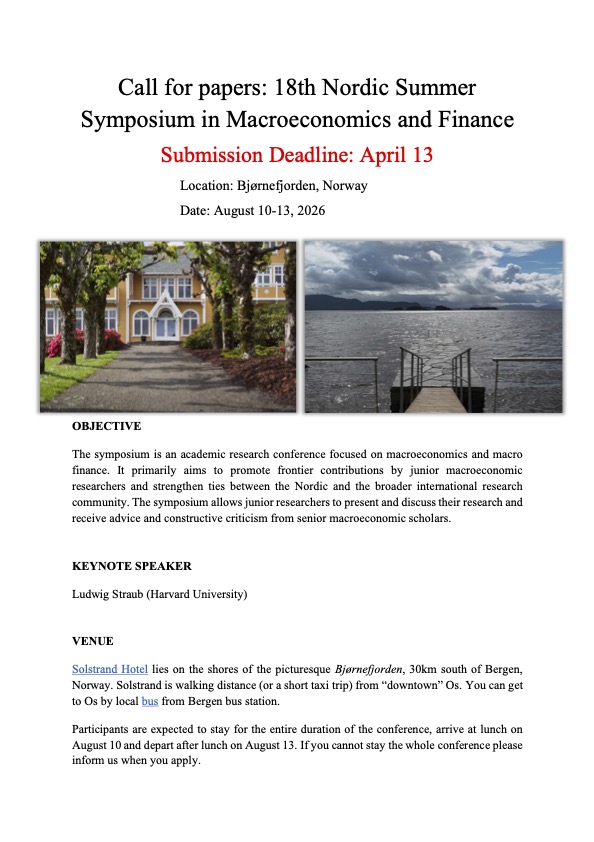
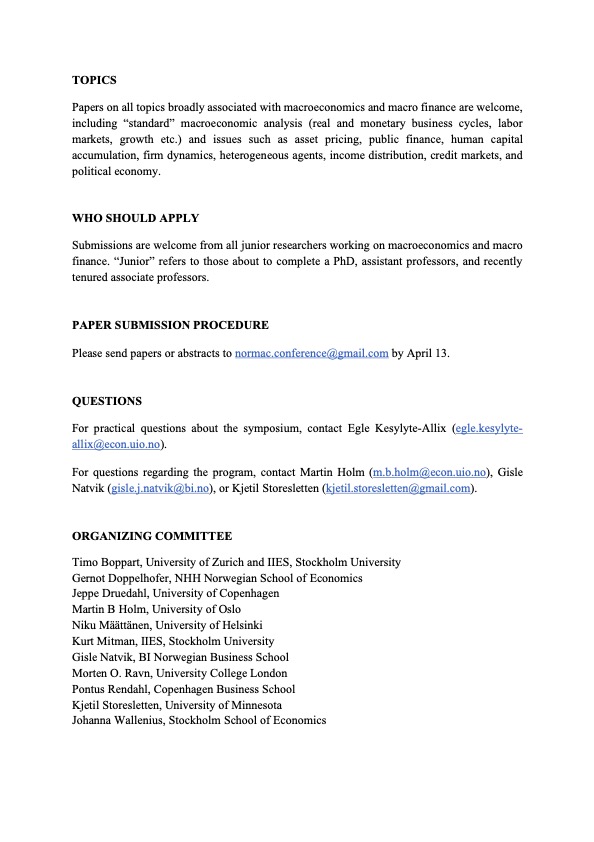
My favourite macro conference of the year just announced its call for papers! It's mainly intended for "juniors" (=PhD students, Assistant and recently Associate profs). Tight deadline, so apply before April 13. RT if you think someone else might be interested.
Pontus Rendahl tweet mediaPontus Rendahl tweet media
English
2
42
128
17.7K
David Murakami retweetledi
Ambrogio Cesa-Bianchi
Ambrogio Cesa-Bianchi@AmbrogioCB·
🚨 Last few days to submit to our annual flagship research event !! The conference will span topics in international trade, macro, and finance. Submit your papers here: bankofengland.co.uk/events/2026/ma… In addition to academic sessions, the conference will also feature: 🎤 Keynote: @helene_rey (LBS) 👥 Policy panel: @GitaGopinath (Harvard), Philip Lane (ECB), and Nathan Lane (LSE) 🔥 Fireside chat: Governor Andrew Bailey with @martinwolf_ (FT)
English
1
13
49
6.6K
David Murakami retweetledi
NBER
NBER@nberpubs·
Open call for applications, Fiscal and Monetary Policy Boot Camp for Doctoral Students. Boot Camp to be held in Cambridge, MA on May 7–8, 2026. Submit applications by 11:59pm EDT on February 4, 2026. More information: nber.org/calls-papers-a…
NBER tweet media
English
0
9
70
19.4K
David Murakami
David Murakami@hirothreading·
unibocconi.it/en/programs/ph… Very happy to see this Workshop continue on to its FOURTH YEAR! This year, the Workshop will be held at Bocconi and we are accepting applicants internationally! Deadline for paper subs: 28 Feb
English
0
11
36
4.1K
David Murakami retweetledi
Matthias Meier
Matthias Meier@MatthiasMeier1·
📢Call for Papers 𝐂𝐨𝐧𝐟𝐞𝐫𝐞𝐧𝐜𝐞 𝐨𝐧 𝐍𝐞𝐰 𝐂𝐡𝐚𝐥𝐥𝐞𝐧𝐠𝐞𝐬 𝐢𝐧 𝐌𝐨𝐧𝐞𝐭𝐚𝐫𝐲 𝐄𝐜𝐨𝐧𝐨𝐦𝐢𝐜𝐬 📝Mannheim, August 28-29 🚨Fantastic keynotes: Jordi Galí @CREIResearch and Guido Lorenzoni @ChicagoBooth 📅Deadline: March 31 My great co-organizer: @KlausAdam
Matthias Meier tweet media
English
1
32
118
14K
David Murakami retweetledi
Banco de España Research
Banco de España Research@bde_Research·
Banco de España organizes the 1st Workshop on Financial Intermediation on 7 May 2026. Each accepted paper will have a discussant and Prof. Rajkamal Iyer will deliver a keynote speech. Deadline for submission: 2 February 2026. Call for papers: bde.es/f/webbe/INF/Me… #bdeResearch
Banco de España Research tweet media
English
0
8
21
6.8K