Marcin Cieslik

696 posts

Marcin Cieslik

Marcin Cieslik

@i000

Ann Arbor Katılım Haziran 2008
2.7K Takip Edilen372 Takipçiler
Marcin Cieslik
Marcin Cieslik@i000·
@anshulkundaje @PracheeAC @WalentekLab To me this discussion is just on which side of the Gartner hype cycle one is more comformtable at. Those who ride the upswing are more risk tolerant and need more capital so benefit from hype. Those in the wake benefit from rigor as they compete on deliverables not visions.
English
0
0
2
23
Prachee Avasthi
Prachee Avasthi@PracheeAC·
Absolutely love this. No matter how anyone’s win-loss accounting is going in this period, I think any transformative change (this era or any other) requires the hyperbullish. Not speaking about this specific exchange or people but IMO, the fraction of skepticism that accelerates progress is a drop in the ocean of knee jerk skepticism that’s empty point scoring. It’s the easiest thing in the world to shit on everything and look smart when hard things most people can’t imagine and won’t believe until they already exist turn out to be hard. Or if they simply overcame all odds and came to be but didn’t nail the landing. When enough of the right people have a clear enough view of the impossible and the skills to make it a reality, sure…it’s kind of an act of shared delusion. But it’s anything but mindless.
andy jones@andy_l_jones

@sebkrier You've had a couple of takes recently that take issue with > the hyperbullish faith-based hype-y takes and I'm a little askance about this. While hyperbullishness is aesthetically displeasing, I think it's pretty substantially outperformed thoughtful skepticism these past five years? Like when I think of folks who were thoughtfully skeptical about AI in 2021 (a tell: refusing to call it AI), vs. the folks who bought in hard - it's the bought-in-hard crew that have had the greater success. And I think you could reasonably say 'you are generalizing from winning a lottery', but - it's been a couple of lotteries now. LLMs, RL, CoT, scaling, agents, coding, are all topics with correlated takes where there's been thoughtful skeptics but I think? broadly? the mindless zealots have won out. You can go further back as well. An expansive framing is that the last 30 years of technological development has more readily rewarded the blindly optimistic than the carefully skeptical, and to my mind this explains a fair chunk of US-West-Coast outperformance versus the East Coast, the UK and the EU. tl;dr I suspect thoughtful skepticism - which rewards folks in most other domains of life and times in history - is a maladapted strategy for this period


English
1
0
2
4.6K
Marcin Cieslik
Marcin Cieslik@i000·
@jrkelly The difference is that from the very start (i.e. 1973 Asilomar) biotech remains a regulated industry. There are also harsher limits to scaling biology (reaction kinetics, cell size, indeterminism); these are real barriers which, IMHO, clamp biotech to a comparatively small niche.
English
0
0
1
78
Jason Kelly
Jason Kelly@jrkelly·
computers made compute much cheaper than slide rules. that then let compute enter many new markets. my belief is that biotechnology is even more general purpose than computer -- it works with atoms after all which is much more of the economy than bits. the issue is the cost of compiling and debugging genetic programs (i.e. lab work) is insanely high -- thus limiting it to only a small number of applications (largely pharmaceuticals).
English
1
0
2
136
Jason Kelly
Jason Kelly@jrkelly·
Autonomous labs will paradoxically increase the number and value of jobs for scientists, not decrease them!! Curious if folks agree - I laid out my thinking here👇
English
32
32
264
59.3K
Marcin Cieslik
Marcin Cieslik@i000·
@jrkelly I understood your IBM metaphor to be on productivity gains not cost savings. But I find it a bit loose, computers didn't just make compute cheaper, they resulted in the creation of completely new goods and services. A new IT economy; what would be the new lab-automation economy?
English
1
0
0
118
Jason Kelly
Jason Kelly@jrkelly·
@i000 Way less lab space + equipment needed which is a huge cost in research.
English
1
0
2
269
Marcin Cieslik
Marcin Cieslik@i000·
@anshulkundaje I am not saying it is an excuse. But it is a finite system. Increasing salaries without increasing budgets will: 1) decrease the total # of scientists, 2) increase the competition for funding - to maintain lab sizes, and 3)in my opinion overall favor big labs. Maybe its all good.
English
1
0
1
68
Anshul Kundaje
Anshul Kundaje@anshulkundaje·
@i000 Either way, this is not an excuse for paying folks unliveable salaries. I started paying PDs quite a bit higher than the minimum from the very early days. It's doable if u just make it a constraint.
English
2
0
0
450
Anshul Kundaje
Anshul Kundaje@anshulkundaje·
💯. This is not impossible to do. If u are a new PI, just make a conscious decision to pay postdocs livable salaries depending on cost of living & expertise. The NIH minimum is terrible for big cities & even the University minimums are not sufficient. 1/
Gokul Rajan@gokulrajan_

I have an opinion here: science is absolutely not just another job; science is passion *but* maybe pay your trainees like it is "just another job"? Because passion can't pay their bills.

English
6
5
65
18.2K
Marcin Cieslik
Marcin Cieslik@i000·
@anshulkundaje Perhaps not necessarily, but the ones I know do. I also say this from personal experience doing a post-doc in such a lab.
English
1
0
0
64
Anshul Kundaje
Anshul Kundaje@anshulkundaje·
@i000 This is actually not true. Wealthy labs don't necessarily pay more. They often have larger workforce cuz they have more funding. They don't pay folks higher salaries. Also this is why I said new PIs. Most are at a somewhat more leveled playing field.
English
2
0
0
409
Marcin Cieslik
Marcin Cieslik@i000·
@jrkelly @gama_search What is a fair price depends on the efficiency on the industry. Given its aging and ailing population US would be silly not to import safe/effective drugs from efficient economies + allow medicare/aid to fully negotiate prices to have the same levarage on pharma as other nations.
English
0
0
1
84
Jason Kelly
Jason Kelly@jrkelly·
Happy to have other counties than US pay fair price for drugs. That would 3x the market and create enough abundance that these issues would go away. Until then the US consumer is paying 70% of the profits for worldwide drug market — US would be silly not to leverage that for strategic reasons.
English
2
0
25
1.6K
Silvi Rouskin
Silvi Rouskin@silvirouskin·
Took a few iterations but nano banana got what I wanted !
Silvi Rouskin tweet media
English
9
7
101
7.8K
Marcin Cieslik
Marcin Cieslik@i000·
@BoWang87 I find your argument of reasoning vs narrating really insightful. Too often we hear about the promise of AI to discover biological knowledge, as opposed to generating hypotheses. The impact of AI will have to be on how biology is practiced, not generating a de-novo Bio GrokPedia.
English
0
0
3
180
Bo Wang
Bo Wang@BoWang87·
Everyone’s hyped about “AI for Science.” in 2025! At the end of the year, please allow me to share my unease and optimism, specifically about AI & biology. After spending another year deep in biological foundation models, healthcare AI, and drug discovery, here are 3 lessons I learned in 2025. 1. Biology is not “just another modality.” The biggest misconception I still see: “Biology is text + images + graphs. Just scale transformers.” No. Biology is causal, hierarchical, stochastic, and incomplete in ways that language and vision are not. Tokens don’t correspond cleanly to reality. Labels are sparse, biased, and often wrong. Ground truth is conditional, context-dependent, and sometimes unknowable. We’ve made real progress—single-cell, imaging, genomics, EHRs are finally being modeled jointly—but the hard truth is this: Most biological signals are not supervised problems waiting for better loss functions. They are intervention-driven problems. They demand perturbations, counterfactuals, and mechanisms, beyond just prediction. Scaling obviously helps. But without causal structure, scaling mostly gives you sharper correlations. 2025 reinforced my belief that biological foundation models must be built around perturbation, uncertainty, and actionability, not just representation learning. 2. Benchmarks are holding biology back more than compute is. Let’s be honest: Benchmarking in AI & biology is still broken. Everyone reports SOTA. Everyone picks a different dataset slice. Everyone tunes for a different metric. Everyone avoids prospective validation. We’ve imported the worst habits of ML benchmarking into a domain where stakes are much higher. In biology and healthcare, a 1% gain that doesn’t transfer is worse than useless—it’s misleading. What’s missing isn’t more benchmarks. It’s hard benchmarks: •Prospective, not retrospective •Perturbation-based, not static •Multi-site, not single-lab •Failure-aware, not leaderboard-optimized If your model only works on the dataset that created it, it’s not a foundation model—it’s a dataset artifact. In 2026, we need fewer flashy plots and more humility, rigor, and negative results. 3. “Reasoning” in biology is not chain-of-thought. There’s a growing tendency to directly apply the word reasoning onto biological LLMs. Let’s be careful. Biological reasoning isn’t verbal fluency, longer context windows, or prettier explanations. Those are surface-level improvements. Real reasoning in biology shows up elsewhere: in forming hypotheses, deciding which experiments to run, updating beliefs when perturbations fail, and constantly trading off cost, risk, and uncertainty. A model that explains a pathway beautifully but can’t decide which experiment to run next is not reasoning, it’s narrating. 2025 convinced me that the future lies in agentic biological AI: systems that couple foundation models with experimentation, simulation, and decision-making loops. Closing thought: AI & biology is not lagging behind AI for code or language. It’s just playing a harder game. The constraints are real. The data is messy. The feedback loops are slow. The consequences matter. If 2025 clarified anything for me, it’s this: We won’t make progress by treating biology like text. We’ll make progress by building AI that behaves more like a scientist : skeptical, iterative, and willing to be wrong. Onward to 2026.
Bo Wang tweet media
English
54
166
742
66.5K
Marcin Cieslik
Marcin Cieslik@i000·
@deAlmeida_BP @instadeepai Taken at face value these data are at odds with published literature which showed that long contexts are needed to model interactions between promoters and regulatory elements to model 'integrated' outputs. Do you have any ideas how this works?
English
0
0
0
20
Bernardo Almeida
Bernardo Almeida@deAlmeida_BP·
@i000 @instadeepai That’s a very good catch. To be fair we did not check it in detail since it was an outlier example. But we will take a look to make sure there is nothing wrong with those results, and try to understand them.
English
2
0
0
92
Bernardo Almeida
Bernardo Almeida@deAlmeida_BP·
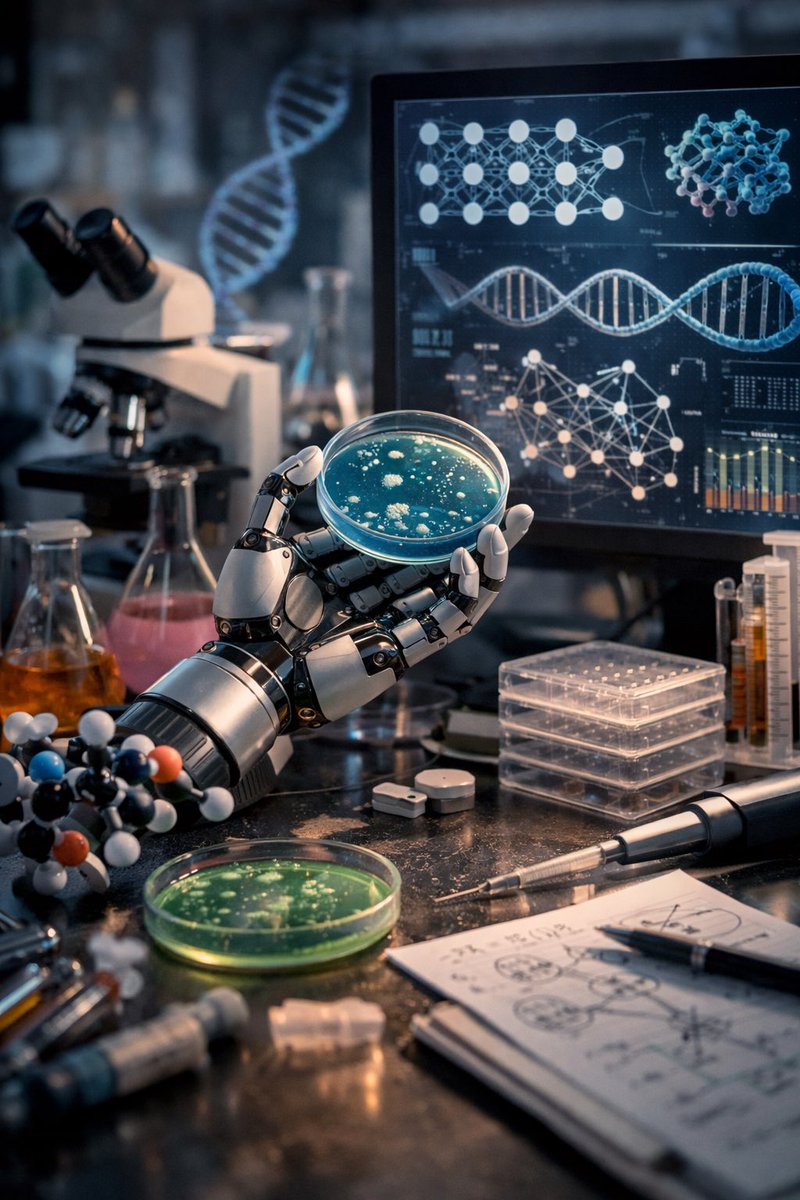
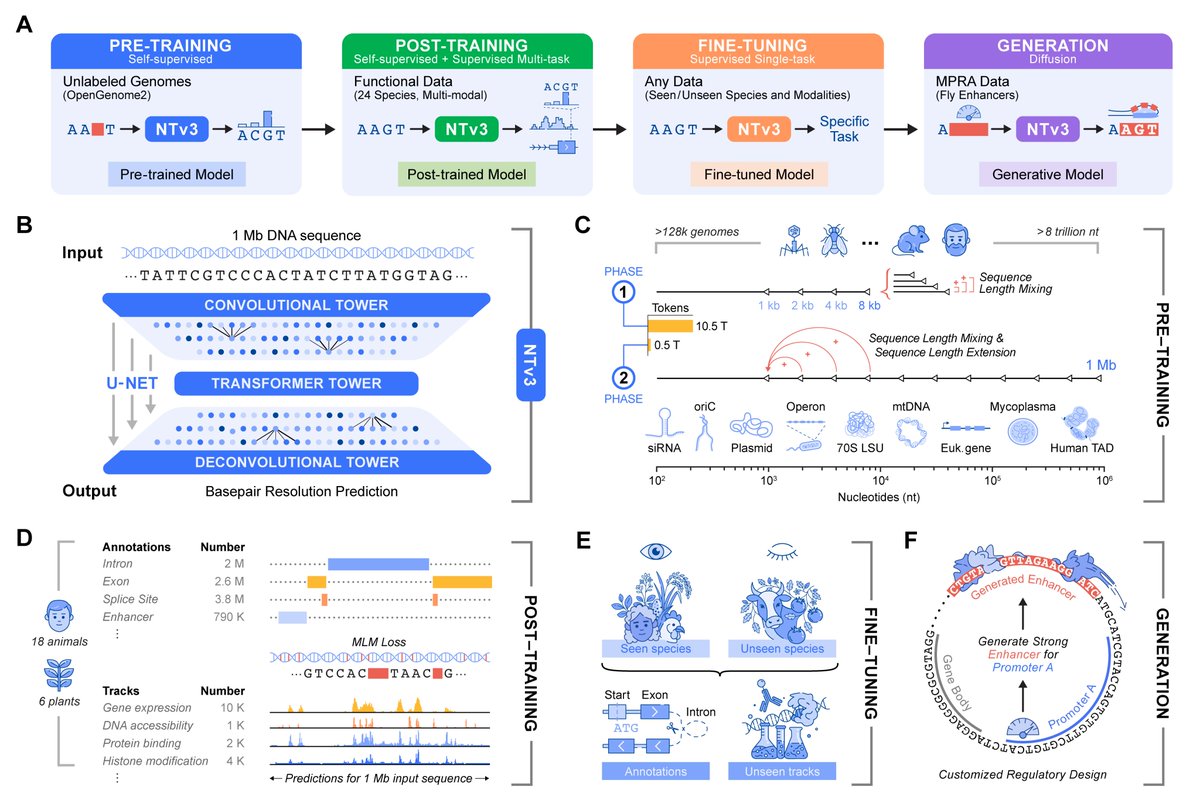
🚀 Introducing Nucleotide Transformer v3 (NTv3) Today, we are very excited to share our latest foundation model for biology - Nucleotide Transformer v3 (NTv3). NTv3 is @instadeepai new multi-species genomics foundation model, designed for 1 Mb, single-nucleotide-resolution prediction, and for bridging representation learning, sequence-to-function modeling, and generative regulatory design within a single framework 🧬 This work was developed in close collaboration with @AlexanderStark8 , @volokuleshov , and @pkoo562 , and reflects several years of joint effort at the intersection of machine learning and regulatory genomics.
Bernardo Almeida tweet media
English
10
108
497
56.6K
Marcin Cieslik
Marcin Cieslik@i000·
@deAlmeida_BP @instadeepai Thanks! Figs 3G and A.9C are intriguing. They suggest that long context >8kb offers almost no benefit for NTv3 on predicting functional tracks. But how is this possible e.g. for RNA-seq where a 8kb window will rarely cover the promoter. /1
English
0
0
0
16
Marcin Cieslik
Marcin Cieslik@i000·
@msikic @anshulkundaje AIxbio follows the same trajectory as systems biology. sysbio failed to deliver on its grand promise, yet ultimately became an essential part of how biology is done. Same for AIxBio it will both fail miserably and transform fundamentally.
English
0
0
2
112
Mile Sikic
Mile Sikic@msikic·
I agree with @anshulkundaje. Biology is definitely a frontier where AI helps a little so far. It helps with writing and learning. However, the language of biology is not the language we speak, and we cannot find answers in language itself. We need an additional level of new experiments and data. We still need what humans still do best - continuous learning (I love using em dashes :)) and other things we are good at, but do not think of them. The essay below is very worth reading. One thing we desperately need is a new philosophy. With or out the help of AI, we need it. Politics too
Anshul Kundaje@anshulkundaje

This is very well written. I'm probably in the minority but since I work in the ML for bio/genomics/genetics space, I don't feel like we are anywhere remotely close to AI completely taking over.

English
2
4
73
12.6K
Marcin Cieslik
Marcin Cieslik@i000·
@owl_posting I once met some pharma project managers getting hammered in the middle of the week in a suburban dive bar in Hershey Pennsylvania. Big WTF. They must worked for auxolith. ;)
English
0
0
2
415
owl
owl@owl_posting·
i watched Bugonia (2025) last night and never before have i ever seen such an apt representation of what it is like to work in an executive position at a large pharmaceutical company
English
3
1
61
6.5K
Marcin Cieslik
Marcin Cieslik@i000·
@owl_posting @ronalfa @NOETIK_ai I will definitely read those! It seems fair to speculate that spatial FM, being a much better fit for DL, will be of higher value then squeezing ranked gene names into transformer architectures. Perhaps especially when fine-tune for discovery from small sample sizes. But overall?
English
1
0
2
87
owl
owl@owl_posting·
thank you for the comments @i000! one note: even if you believe that a FM doesnt give you the ability to interrogate biology any better than simpler approaches, i think there’s still an awful lot of value in the insane flexibility that good latent representations offer you. each of the three case studies were derived from the same base model, which is pretty extraordinary to me! but! this all said, i do have conviction that these models have some deep insight into in-vivo biology that i really could not imagine being acquired any other way. i dont want to vaguepost *too* much, but there’s a few extremely surprising, internal results (that we haven’t written anything up on yet) that have made me much more of a believer than i was perhaps 6 months ago we have plans to release articles over these in the next few months :)
English
1
0
0
55
Ron Alfa
Ron Alfa@Ronalfa·
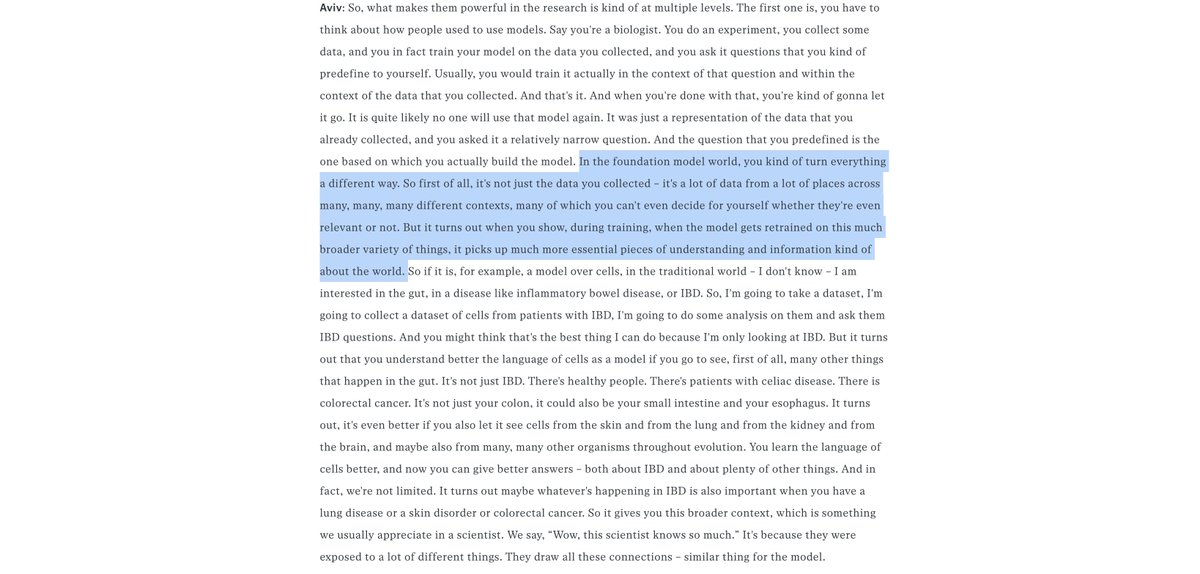
Aviv Regev discusses power of foundation models and agents in biology. Very nice overview of thesis behind FMs we're building at @NOETIK_ai.
Ron Alfa tweet media
English
4
6
51
4K
Marcin Cieslik
Marcin Cieslik@i000·
@ronalfa @NOETIK_ai @owl_posting You have shown that a FM can make plausible predictions - this is nice, hypothesis generation is important, and I am with you on the importance of looking at human tissues for biomarkers. But it is a far cry from the claims above.
English
1
0
1
82
Marcin Cieslik
Marcin Cieslik@i000·
@ronalfa @NOETIK_ai @owl_posting Sure, I checked it out. Do you refer to the STK11/KRAS study? It seems like nice set of results, but it does not show that the FM was: necessary and improved over baselines. It shows no exp. validation for "Target A". Has no comparison to supervised approaches.
English
1
0
1
69
Marcin Cieslik
Marcin Cieslik@i000·
@adamfeuerstein @ScottAdamsSays Such a bad take. Lack of evidence is not evidence of absence. Response rates are highly variable including Pluvicto. Whether either drug does anything for him is anyone's guess.
English
0
0
7
416
Adam Feuerstein ✡️
Adam Feuerstein ✡️@adamfeuerstein·
Pluvicto - proven to benefit prostate cancer patients. Anktiva - no data, no proof it does anything at all for proststr cancer patients. @ScottAdamsSays is taking both drugs. Pluvicto is helping him. Anktiva is not.
jay plemons@jayplemons

Scott Adams health update: Yesterday he completed the second phase (shots 3 and 4) of @drpatrick’s BioShield protocol, designed to significantly boost natural immunity against cancer recurrence, while continuing his complementary Pluvicto treatments that actively target and destroy existing tumors. Neither being a cure, but together potentially pushing the cancer back substantially. Please continue to pray for @ScottAdamsSays 🙏

English
33
3
59
37.3K