

Huy Nguyen
606 posts

Huy Nguyen
@iamhuy
Building data tools for data and dev teams. @holistics_bi (AI-assisted BI), @dbdiagram (DB/ERD as code, 200K monthly actives)
Saigon and Singapore Katılım Mart 2008
871 Takip Edilen724 Takipçiler

We spent months building a Claude Code system that runs outbound at our $7M ARR agency (and we're giving the whole thing away).
Our head of GTM, Kenny, walks through the complete build on camera.
Scores a target list against our ICP, pulls sales leaders via Apollo, enriches the missing emails, fetches our best-performing copy from Instantly's API, and loads 154 leads into Instantly with the copy and schedule set.
Kenny packaged everything he used in the video below into a public starter kit. You get:
→ the GitHub repo
→ the CLAUDE md file we use
→ the Python scoring scripts
Reply "send" and I'll DM you all three.
English

My co-founder and I built an audience of 70,000+ LinkedIn followers in 2 years.
That booked us 170+ meetings in our first 2 months at Workflows.
But a vast majority of B2B teams post on LinkedIn with zero system behind it.
1. Their content gets engagement but nobody actually books a call from it.
2. There is no workflow connecting post engagement to their CRM.
And the BIGGEST gap is the content mix itself.
Too many teams dump effort into case studies and product promotions before the audience trusts them.
They skip the trust-building phase entirely and wonder why LinkedIn isn’t bringing them any leads...
Even though everyone tells them it should be one of their best channels.
So…
We built a 7-step social selling framework to fix exactly this and published the full system on our blog.
It includes:
1. Complete 7-step framework from audience building to conversion
2. The 70/20/10 content split for TOFU, MOFU, and BOFU
3. 14 content formats mapped to funnel stage
4. 5 buyer signal types to track for pipeline
5. Contact capture to CRM workflow
6. Recommended weekly posting cadence
BONUS: Our complete content OS in Notion… the same one we use to organize everything content related for our clients.
If you want it:
Comment: "SOCIAL"
And I’ll DM it to you ASAP
GIF
English

I MIGHT GET SUED FOR THIS, BUT YOLO:
I just found a way to bypass LinkedIn's 20 connection limit per day
You can use this to reach VPs, Directors and C-Suite without a single connection request
And the craziest part - IT'S COMPLETELY FREE
It helped us:
Book 350 appointments for an AI automation firm
Generate $500K in closed revenue from LinkedIn alone
Hit 25-30 qualified enterprise calls every month for another client
Comment "L" and I'll send it to you (24h only)

English
@karpathy For the IDE frontend I use this RepoView instead. It opens a lightweight GitHub-like web UI where I can read markdown csv pdf and other file types.
github.com/nvquanghuy/rep…
English

LLM Knowledge Bases
Something I'm finding very useful recently: using LLMs to build personal knowledge bases for various topics of research interest. In this way, a large fraction of my recent token throughput is going less into manipulating code, and more into manipulating knowledge (stored as markdown and images). The latest LLMs are quite good at it. So:
Data ingest:
I index source documents (articles, papers, repos, datasets, images, etc.) into a raw/ directory, then I use an LLM to incrementally "compile" a wiki, which is just a collection of .md files in a directory structure. The wiki includes summaries of all the data in raw/, backlinks, and then it categorizes data into concepts, writes articles for them, and links them all. To convert web articles into .md files I like to use the Obsidian Web Clipper extension, and then I also use a hotkey to download all the related images to local so that my LLM can easily reference them.
IDE:
I use Obsidian as the IDE "frontend" where I can view the raw data, the the compiled wiki, and the derived visualizations. Important to note that the LLM writes and maintains all of the data of the wiki, I rarely touch it directly. I've played with a few Obsidian plugins to render and view data in other ways (e.g. Marp for slides).
Q&A:
Where things get interesting is that once your wiki is big enough (e.g. mine on some recent research is ~100 articles and ~400K words), you can ask your LLM agent all kinds of complex questions against the wiki, and it will go off, research the answers, etc. I thought I had to reach for fancy RAG, but the LLM has been pretty good about auto-maintaining index files and brief summaries of all the documents and it reads all the important related data fairly easily at this ~small scale.
Output:
Instead of getting answers in text/terminal, I like to have it render markdown files for me, or slide shows (Marp format), or matplotlib images, all of which I then view again in Obsidian. You can imagine many other visual output formats depending on the query. Often, I end up "filing" the outputs back into the wiki to enhance it for further queries. So my own explorations and queries always "add up" in the knowledge base.
Linting:
I've run some LLM "health checks" over the wiki to e.g. find inconsistent data, impute missing data (with web searchers), find interesting connections for new article candidates, etc., to incrementally clean up the wiki and enhance its overall data integrity. The LLMs are quite good at suggesting further questions to ask and look into.
Extra tools:
I find myself developing additional tools to process the data, e.g. I vibe coded a small and naive search engine over the wiki, which I both use directly (in a web ui), but more often I want to hand it off to an LLM via CLI as a tool for larger queries.
Further explorations:
As the repo grows, the natural desire is to also think about synthetic data generation + finetuning to have your LLM "know" the data in its weights instead of just context windows.
TLDR: raw data from a given number of sources is collected, then compiled by an LLM into a .md wiki, then operated on by various CLIs by the LLM to do Q&A and to incrementally enhance the wiki, and all of it viewable in Obsidian. You rarely ever write or edit the wiki manually, it's the domain of the LLM. I think there is room here for an incredible new product instead of a hacky collection of scripts.
English

A two-person GTM team at a Series B SaaS company closed $2.4M in pipeline in one quarter.
No SDRs. No demand gen agency. No paid ads.
Signal-based outreach. Intent scoring. AI-sequenced follow-up. Automated reporting.
Two GTM engineers running the whole motion - for one quarter.
I pulled it apart.
Compared it to every system we've built across the GTM teams we've worked with.
Then asked myself one question:
If I had to reverse engineer this from scratch - what would it actually look like?
Turns out the architecture isn't that complicated.
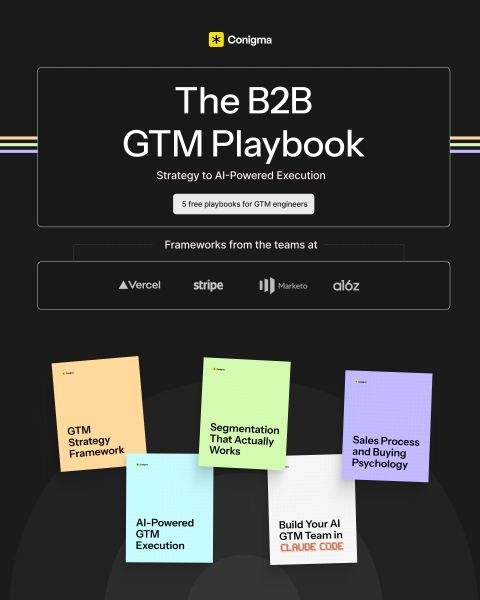
I mapped the whole thing into a step-by-step playbook you can upload directly to any LLM.
It walks you through building your own version from GTM strategy to fully AI-powered execution.
Comment "GTM" and I'll send it over.
English

I’ve NEVER seen a B2B company fail to scale with ABM when they build signal infrastructure that automatically scores, routes, and alerts.
That said…
I just built this ABM playbook for you to steal.
8 steps from ICP model to realtime CRM updates with intent signals and dedicated Slack channels for warm leads.
I recorded a full video breaking down the entire workflow.
It covers:
• The 8-step framework from ICP to activation
• How we track 1st, 2nd, and 3rd party signals
• The awareness scoring model (5 stages)
• CRM automation structure
• How Slack channels keep reps focused on warm leads
And a WHOLE lot more.
Comment "ABM" and I'll DM you the guid3.
PS - This is the same playbook we deploy for clients with $60K+ ACV deals.
GIF
English

Clay’s new pricing is probably my fault. We were paying $314 a month, but using (based on their new model) $214,087.50 worth of Clay a WEEK. Here’s the story:
A year ago Clay's head of product hopped on a call with me.
I told him we were hitting their platform 17.3 million times per week.
Almost all custom events (i.e. HTTPs)
I remember his response being something close to "Holy shit, I think you are the largest user of Clay"
I said yeah that doesn't surprise me.
But then it also came up that we were only paying $3,769 a year.
We talked about HTTPs, custom integrations, how we were basically using Clay as a giant API orchestration layer.
I knew his wheels were turning.
If you saw my last post, you know we eventually replaced Clay entirely with a $200/mo Claude Code subscription. 272,000 leads per second vs Clay's 27 hours for the same volume.
But before we left, we were the perfect case study for why Clay's old pricing was broken.
$314/mo for 17.3 million weekly, for what they now call ‘actions’.
Run the math. We were paying $0.00001815 per action.
Clay announced their new pricing structure. They split everything into Data Credits and ‘Actions.’
Actions are HTTPs, custom integrations, API calls. The exact things we were doing 17.3 million times a week.
The new price per action credit works out to about 1.24 cents each. A 681% price increase for us
I know you might say, "But Clay is letting people stay on the old pricing if they want," and I hear you
but
I also don't know how it makes me feel that someone brand new would have to pay $856,350 per month to get the same advantages I had when I was starting out only 3 years ago.
I'm not saying that one call caused the entire restructuring.
But I am saying their head of product learned that day that someone was running 17 million HTTPs a week for the price of a nice dinner.
And now every HTTP costs 1.24 cents.
anyways
For the last year, we've been trying to figure out how to get off of our dependency on Clay.
That was until Cursor / Claude Code / Codex came out
My VP of Growth, @James, who doesnt know how to write a single line of code, touched Claude Code for the first time
And three weeks later he replaced Clay for us
We could process 272k rows per second now for the cost of a Claude Code sub
My last post was about that system
Then after that post, Clay announces new pricing that specifically monetizes the exact thing we were doing at a massive scale.
Coincidence? Maybe.
But
I may owe everyone using Clay an apology
If your Clay bill just went up, you can probably blame me for that one. Sorry!
I put together a system blueprint of what I did to replace Clay for myself -- every tool, the tech stack, a Clay vs custom comparison, and a 6-step playbook for building your own. Plus a video walkthrough where I show you the live system and how each tool actually works.
Reply CODE below and I'll DM it to you.
English

My agency has generated over $3 million and helped generate 1 million+ followers on LinkedIn.
So I sat down and wrote a 34-page playbook that details A → Z how to launch, grow, and monetize your personal brand on LinkedIn.
Like + Comment “Playbook” and I’ll DM it to you.
Must be following / have your DMs open.
24 Hours only.
GIF
English
We scaled Workflows(.)io from 0 → 7 figures in 6 months.
The signal architecture we used is now a free playbook:
For context...
Signal data is supposed to tell you who's ready to buy and when to reach out.
But without the right architecture, it becomes irrelevant.
Here's what a working signal system actually looks like:
• A single source of truth that ingests signals from every tool automatically
• Normalized scoring that weights every action by intent level (not all clicks are equal)
• Account enrichment that merges live behavioural data with firmographic context
• If/then automation logic for Slack alerts, outbound triggers, nurture flows, and retargeting
• A self-correcting feedback loop that improves signal weights based on closed won data
The playbook covers all 3 signal categories, the full 5-step build process, and the exact automation examples we use across CRM, outbound, and ABM.
We're giving it away here because the teams that implement this don't need to wonder what's working.
Want the full playbook?
Comment "GTM"
I'll DM you the link ASAP.
(must be following)
PS
We also included the signal scoring model with exact point values. You can steal the whole framework and start using it this WEEK.
GIF
English

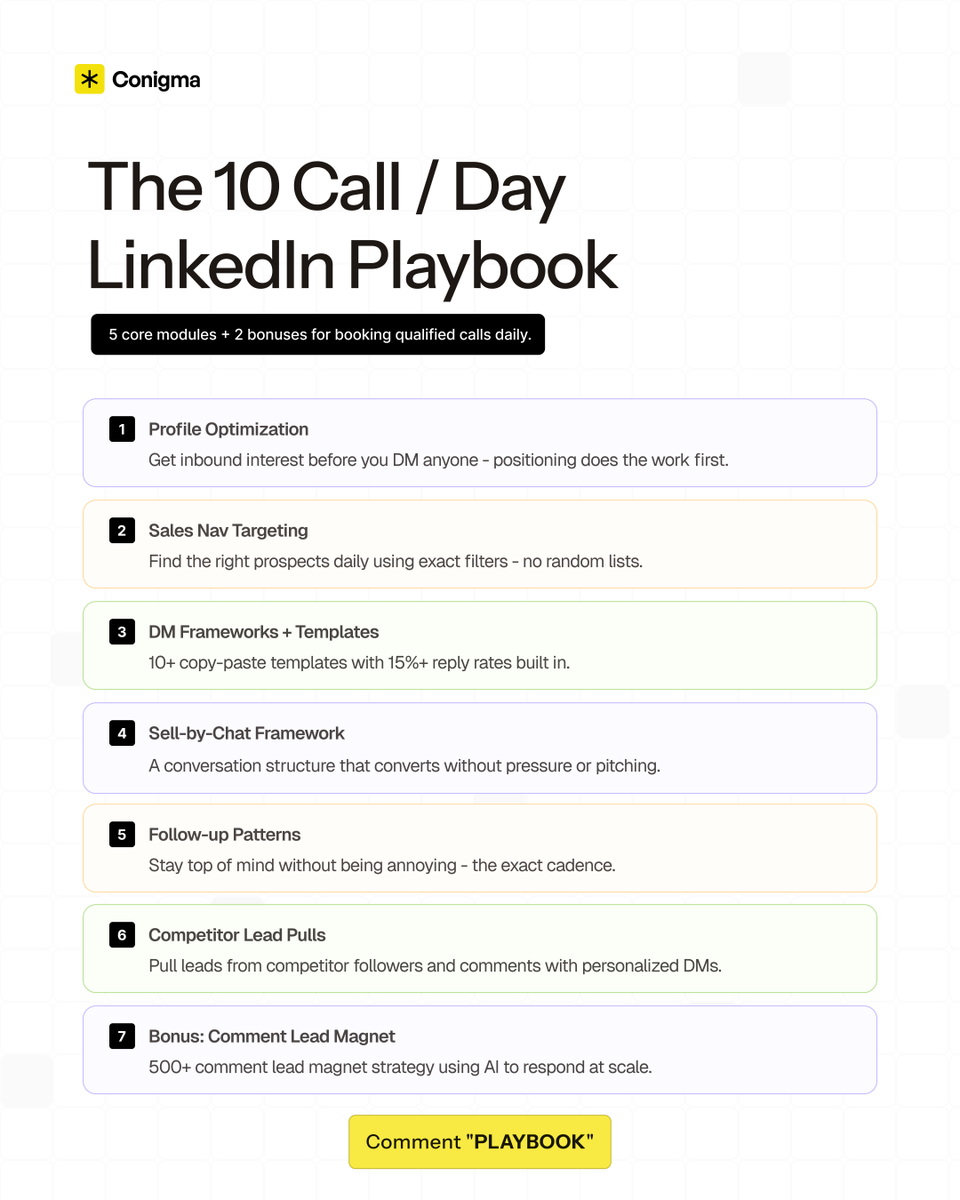
SHOCKING: 99% of people using LinkedIn for outbound are barely scratching the surface.
Right now, the entire internet is screaming "LinkedIn, LinkedIn, LinkedIn"... But here's the truth: sending random DMs without a system won't book 10 calls a day.
To unlock its real power, you need to master:
- Profile optimisation that gets inbound interest before you DM anyone
- DM frameworks with 15%+ reply rates built in
- A sell-by-chat structure that converts without pressure or pitching
I spent 100+ hours building the most complete LinkedIn outbound playbook and compiled all 5 core modules plus 2 bonuses into one resource.
I'll give it to only 1,000 people.
To get it:
1. Follow me MUST (so I can DM)
2. Comment "PLAYBOOK"
3. I'll DM you the playbook
If you don't follow or comment, you won't receive it.
English
🎁 This post template generated 60,000+ impressions. I'm giving it away free.
Not because I got lucky with the algorithm.
Not because I have a massive following.
Because I used a repeatable structure - and ran it through AI to fill it in fast.
So I'm giving away the template.
This is a copy-paste AI prompt you drop into Claude or ChatGPT.
Not a course. Not a paid group. No fluff.
Here's what's inside:
- The exact prompt structure that generates a full LinkedIn post in under 2 minutes
- A fill-in-the-blank input system for your idea, proof, and CTA
- A one-line fix for when the output feels generic: "Make this more concrete. Remove vague language."
If you want to:
- Stop staring at a blank page every time you post
- Turn one idea into a structured, skimmable post that actually gets read
- Build a repeatable content system you can reuse every single week
This will help.
Want access?
Comment TEMPLATE and I'll send it to you directly.
P.S. The structure works for any idea - not just this one. Reuse it every time you post.
English

If you want to take cold email seriously you cannot be doing Apollo searches manually.
I created a custom Claude lead list builder.
Like + comment "claude" - I'll send you the link to use it - fully free + my full lead list building SOP.

English

most teams are watching the wrong signals.
job change: everyone sees it. everyone emails at the same time.
funding round: same. 50 cold emails hit the new VP's inbox in 48 hours.
intent data: the most expensive way to fight over the same 3%.
the signals that actually predict a buying window are less obvious.
they're the ones nobody's automating yet.
i mapped 11 buying signals that consistently precede a decision, most of which are public but underused.
-> headcount growth above 15% in 90 days
-> shift from one job function to another in hiring patterns
-> new c-suite hire outside the core business (often means restructure is coming)
-> plus 8 more, each with the outreach trigger that goes with it
like + comment 'SIGNALS' and i'll DM you. (must be following)
English
58% of replies come from email 1.
email 2 gets most of the rest.
after that, you're just sending email to people who've already decided to ignore you.
most teams run 5-7 email sequences. it's burning their domain and their market's goodwill.
the 2-email framework:
-> email 1: specific pain, proof point, direct meeting ask
-> email 2: different angle, lower barrier CTA
that's it. two emails. a higher reply rate than most 7-step sequences.
because each email actually earns its spot rather than just filling a sequence slot.
i put together the exact 2-email templates we use across every client, including the ICP-specific variations for saas, services, and professional firms.
like + comment '2EMAILS' and i'll DM you. (must be following)
English
most outbound operations have a tool stack.
they don't have a system.
a system has 4 layers. most teams only have 1 or 2.
layer 1: research (who, why, what signal)
layer 2: copy (what to say, how to frame it)
layer 3: infrastructure (how it reaches the inbox)
layer 4: monitoring (what's working, what to change)
missing any layer means inconsistent results. not bad results. inconsistent.
this is the full AI outbound system breakdown:
-> what runs in each layer (tools + process)
-> how the layers connect in sequence
-> the monitoring framework we use across 10+ clients
-> what to build first if you're starting from scratch
-> the managed service model vs DIY
comment SYSTEM and i'll send it over.
(must be following)
English

my uber driver had two phones on his dashboard
one for navigation. one had stripe open.
"you run a business?"
"i sell a checklist."
"a checklist?"
"pre-flight checklist for people scared of flying. $34."
pulled up his stripe at a red light. $8,400 last month.
"how'd you come up with that?"
"i'm in a facebook group for flight anxiety. 94,000 members. every day someone posts 'flying tomorrow i'm terrified what do i do' and the same people type the same answers over and over."
"so you wrote down the answers?"
"organized them. what to do 24 hours before. at the airport. during takeoff. during turbulence. stuff people been giving away for years."
"people pay $34 for that?"
"people pay $34 to not have a panic attack scrolling facebook threads at 3am the night before their flight. they want it clean and done in one place."
"how do you sell it?"
"tiktok. 1,100 followers. text on screen with a calm voiceover. one video hit 890K views. still sells 3-6 copies a day four months later."
one video. still paying him while he drives strangers around.
he'd been driving for 2 hours. made $41 from rides. made $136 from checklist sales in the same window.
"why still drive?"
"every third passenger asks about the second phone. that's free marketing."
he was using uber as a lead gen channel.
meanwhile you're spending 6 months filming a $197 course with ring lights and a script you rehearsed 14 times.
this guy typed a google doc on his lunch break and it outearns his job.
94,000 people answering the same question every day for free.
he's the only one who charged for it.
the information has always been free. the person who organizes it gets paid.
English

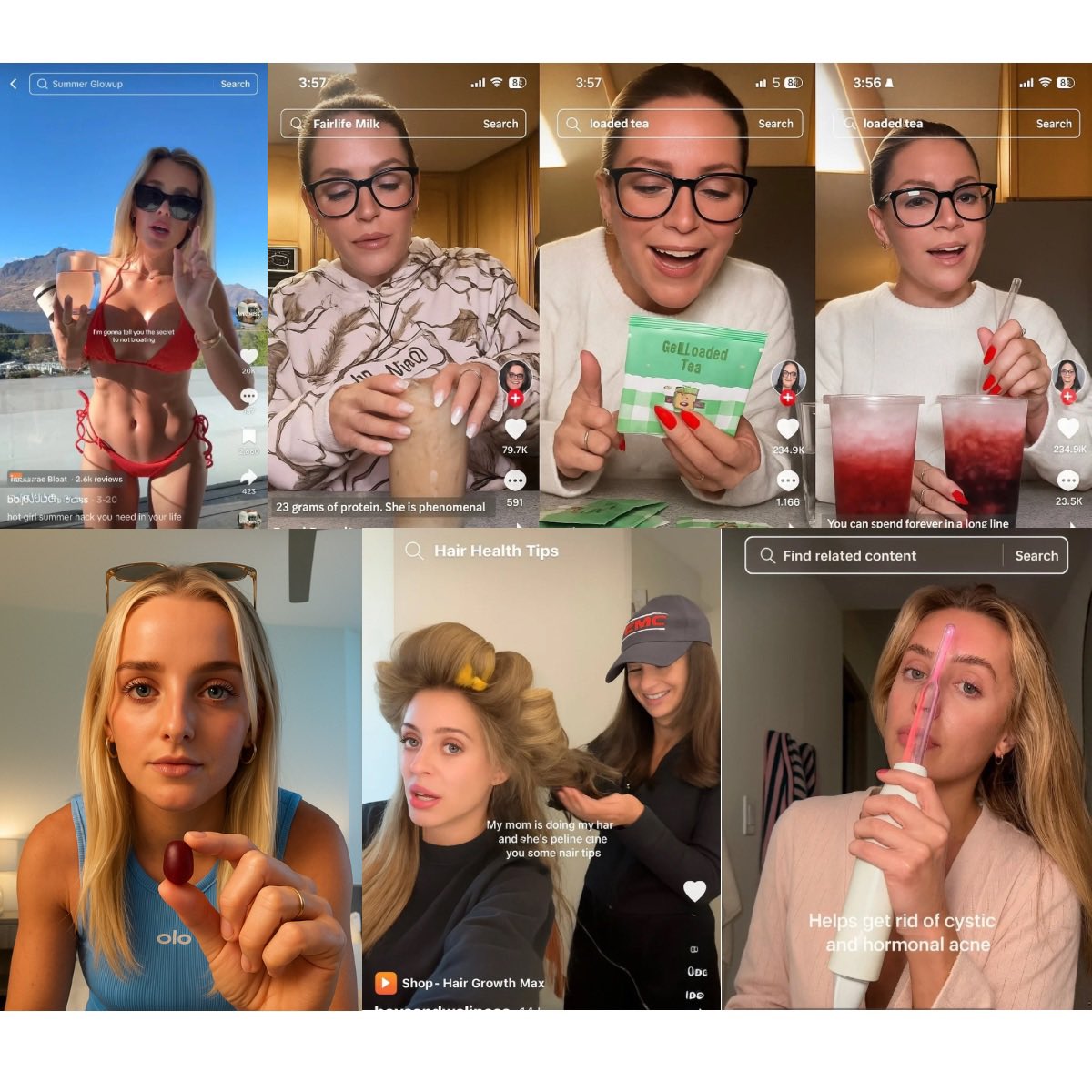
Clawdbot + Kling = 550 videos per day
Fully-realistic UGC ads — cinematic lighting, human motion, perfect pacing — powered by AI agents.
UGC cost: $5
Production time: minutes
Scale: instant
One AI engine that creates, tests, and scales short-form ads automatically — nonstop.
It’s live. Campaigns are scaling now.
Comment + RT “AGENT” and I’ll DM you the full workflow.
(Must be following)
English
Not sure if relevant @lennysan, I built a side project tool WithTranscript.ai that you can just plug in a youtube podcast link and it gives an interactive player with the transcript. Been consuming your podcast with this lately.
Example of the latest pod: withtranscript.ai/video/z7T1pCxg…

English

Here are the full transcripts from all 320 of my podcast episodes.
It's been super fun for me to play with AI to extract insights from this data. Now you can to.
My only ask is that if you do something cool with it, just let me know.
I'll keep this folder updated with as each new episode comes out.
Have fun.
dropbox.com/scl/fo/yxi4s2w…
English
AI summary by Anthropic, transcripts by WithTranscript AI
💰 Anthropic's $10B Fundraise at $350B Valuation
- Likely the last private round before IPO
- Revenue trajectory: $100M (2023) → $1B (2024) → $9-10B (2025) — 10x growth two consecutive years
- At ~17x next-twelve-month revenue, it's cheaper than Palantir and comparable to Cloudflare
- Strong unit economics evidenced by relatively modest dilution
- Dominates enterprise API market, powering Cursor, Lovable, Replit, Harvey, and others
💻 Claude Code & Anthropic's Expansion
- Claude Code now competes directly with Cursor and GitHub for enterprise coding
- New "Claude Workspaces" product targets non-coders doing knowledge work
- Positions Anthropic as a potential challenger to Microsoft's Office suite for AI-native workflows
3. 🦂 Cursor's Competitive Position
- Early investors (at $200M pre) are likely fine; later investors at $27B pre face more risk
- Caught between two giants: Anthropic (their supplier) and GitHub (Microsoft)
- Anthropic could theoretically limit model access or copy the product entirely
- The "scorpion and frog" analogy: Anthropic may eventually sting Cursor despite mutual dependence
4. 🍎 Google/Gemini Winning Apple's Siri Deal Over OpenAI
- Leverages existing Google-Apple relationship (search placement)
- Privacy was a key differentiator — Apple emphasized keeping data within their systems
- Enterprise-level security requirements are a barrier many startups can't meet
5. ⚠️ OpenAI's Challenges
- Being squeezed: Anthropic winning enterprise, Gemini gaining consumer traction
- High stock-based compensation and churn concerns
- Existential risk scenario: If macro conditions deteriorate and OpenAI can't raise the ~$100B needed over 2-3 years, it could fall behind rapidly
- LLM shelf-life is extremely short (~100 days half-life) — a frozen-in-time ChatGPT would become obsolete quickly
- Counter-argument: 800M users and real subscription revenue provide some defensibility
6. 🏦 Andreessen Horowitz's $15B Fundraise
- Represents ~22% of all venture dollars raised in 2025
- Combined strongest brand with top-decile returns — rare achievement at scale
- Math works if they capture 10% of Series A's that matter (their historical share)
- Structured internally as ~4 separate "boutique" funds (American Dynamism, Fintech, AI/Apps, Infra) of ~$1-1.5B each
- Late-stage capital provides "cleanup on aisle five" — allows more promiscuous early-stage investing because winners can be doubled down on
7. ⚰️ The "Middle Is Dead" Thesis
- Venture may polarize like other asset classes: boutique specialists vs. mega platforms
- Counter-argument: Andreessen's own structure suggests focused, smaller teams still matter
- Focused firms must know something others don't and see opportunities earlier
- ~20% of unicorns came through YC; 80% didn't
- By Series C, ~80% of top deals have a "hard to beat" investor on the cap table
8. 🎙️ 11 Labs Discussion
- $330M revenue in one year, valued at $11B
- Best API experience — implementation takes minutes
- But: Price sensitivity is real. Jason burned $30 in credits in 48 hours on a small game
- Substitution risk emerging: If something 80% as good costs 10% as much, developers will switch
- Bull case: If voice becomes ubiquitous and unit economics hold, 3-5x return possible
- Bear case: Concentrated revenue from large customers creates pricing pressure
9. 🏛️California Wealth Tax Proposal
- Current proposal: One-time 5% tax on billionaires
- Real concern: This is phase one of a multi-year plan to implement annual wealth taxes at lower thresholds ($50M → $25M)
- Tax would apply to illiquid paper wealth based on last round valuations
- Prediction: Founders will leave after Series B if this trajectory continues
- Winners: Austin, Miami (the 2020-2021 destinations that lost momentum when AI brought people back)
- Four leading billionaires have already left California
10. ⚖️ Broader Wealth Inequality Concerns
- AI companies normalizing $1-2M revenue per employee
- Nvidia has created 18,000+ employees worth $25M+ (1 in 3 employees)
- Housing markets distorted — zero inventory in Palo Alto
- Growing disconnect: AI millionaires thriving while SaaS employees face layoffs and can't find new jobs
- Social unrest likely to grow, fueling more wealth tax proposals
English

The only podcast you have to listen to every week.
No politics. Just tech.
- Anthropic’s $10BN Fundraise… Has Claude Beaten Cursor?
- a16z’s $15BN Fundraise: Is VC Go Big or Go Home in 2026?
- How OpenAI Could Go to Zero?
- Is ElevenLabs at $11BN a Buy?
Spotify 👉 open.spotify.com/episode/5Ea68N…
Youtube 👉 youtu.be/RXLJk-SyGfA
Apple Podcasts 👉 podcasts.apple.com/us/podcast/20v…
My 8 takeaways with @jasonlk and @rodriscoll👇
Timestamps:
00:00 Intro
01:16 Anthropic's $10 Billion Fundraise
08:59 Has Claude Code Beaten Cursor Already
16:08 OpenAI Could Still Go to Zero
25:58 Andreessen Horowitz's $15 Billion Fundraise
46:33 The Middle is Dead: Boutique vs. Large Platforms in Venture
53:27 The Future of Venture Capital
01:12:14 The Impact of Wealth Taxes on the Industry

YouTube
English
A quick summary for those who can't watch full.
🔥 The Palisades Fire Rebuilding Failure
Carolla, who was physically present when the fire started and has extensive construction background, explains why only one home has been rebuilt out of ~5,000 destroyed. He argues the permitting process is so cumbersome that it dissuades rebuilding entirely—citing Suzanne Somers' husband who abandoned rebuilding in Malibu after fighting the Coastal Commission and moved to Palm Springs instead.
🦺 The Root Cause: "Safety Uber Alles"
Carolla attributes the overregulation not to union corruption or contractor interests, but to what he calls "gyno fascism"—an excessive focus on safety above all else. He argues this mindset, which he associates with increased female representation in leadership, prioritizes process and safety to the point of paralysis. He uses COVID school closures as an example: the "safest" choice caused enormous collateral damage.
📰 Media Bias
He contends that newsrooms shifting from ~12% to ~57% female has led to more emotional, partisan coverage. He explicitly exempts journalists like Megyn Kelly and Bari Weiss, saying they "think like cage fighters," while criticizing figures like Gavin Newsom as having the opposite disposition.
🧑💻 DEI and Meritocracy
Carolla argues that favoring any group necessarily disadvantages another when resources are finite—whether in Hollywood writers' rooms, college admissions, or vice presidential picks.
☯︎ Two Americas Prediction
He forecasts continued self-segregation: "octagon people" moving to Texas/Florida, "safe space people" concentrating in California/Portland/Seattle—with the latter eventually failing under their own policies.
💹 Economic Outlook
He predicts if Trump's economic policies produce results (lower gas prices, interest rates, border security), Republicans will win in 2028. The midterms are less certain since effects may not be felt yet.
English

All-In Interview: Adam Carolla on California’s Collapse 🚨
@friedberg sits down for a 1-on-1 with @adamcarolla
-- Fires, failed leadership, and gyno-fascism
-- Rebuilding crisis in LA
-- Can two Americas coexist?
-- How DEI broke Hollywood... and more
-- California's next governor
++ much more!
(0:00) David Friedberg introduces Adam Carolla!
(1:32) Palisades Fire one year out: the rebuilding crisis in LA
(7:39) Gyno-fascism and safety culture
(15:49) Media bias and gender dynamics
(28:51) DEI, Hollywood's transformation, socialism, "safe spaces and octagons"
(36:14) Is America living through the "Hard times make strong men" adage? Can two Americas coexist?
(51:23) Who should be California's next governor?
(58:04) Big Tech, AI, and the 2028 Election
************************
Thank you to our partner for making this happen!
When you need a partner trusted by millions, there’s one platform for all business - PayPal Open.
Grow today at paypal.com/us/business.
Loans subject to approval and available locations.
English