
Sabitlenmiş Tweet
Enrique Ide
79 posts


Enrique Ide
@ide_enrique
Assistant Professor of Economics - IESE Business School
Barcelona Katılım Temmuz 2022
196 Takip Edilen348 Takipçiler

Enrique Ide retweetledi
Looking forward to the @nberpubs Organizational Economics Working Group tomorrow.
Amazing line up of presenters and discussants, follow the sessions live on YouTube.
Raffaella Sadun@raffasadun
The program of the next NBER Organizational Economics Working group is up! The conference will take place on April 9/10 in Cambridge and will be live streamed on Youtube. nber.org/conferences/or…
English
Enrique Ide retweetledi
I am below 6h every night since January. Is general anxiety and overwork from AI use reducing sleep?
A deeply scientific study:
Are you sleeping less post Claude Code/Codex adoption?
English
Enrique Ide retweetledi

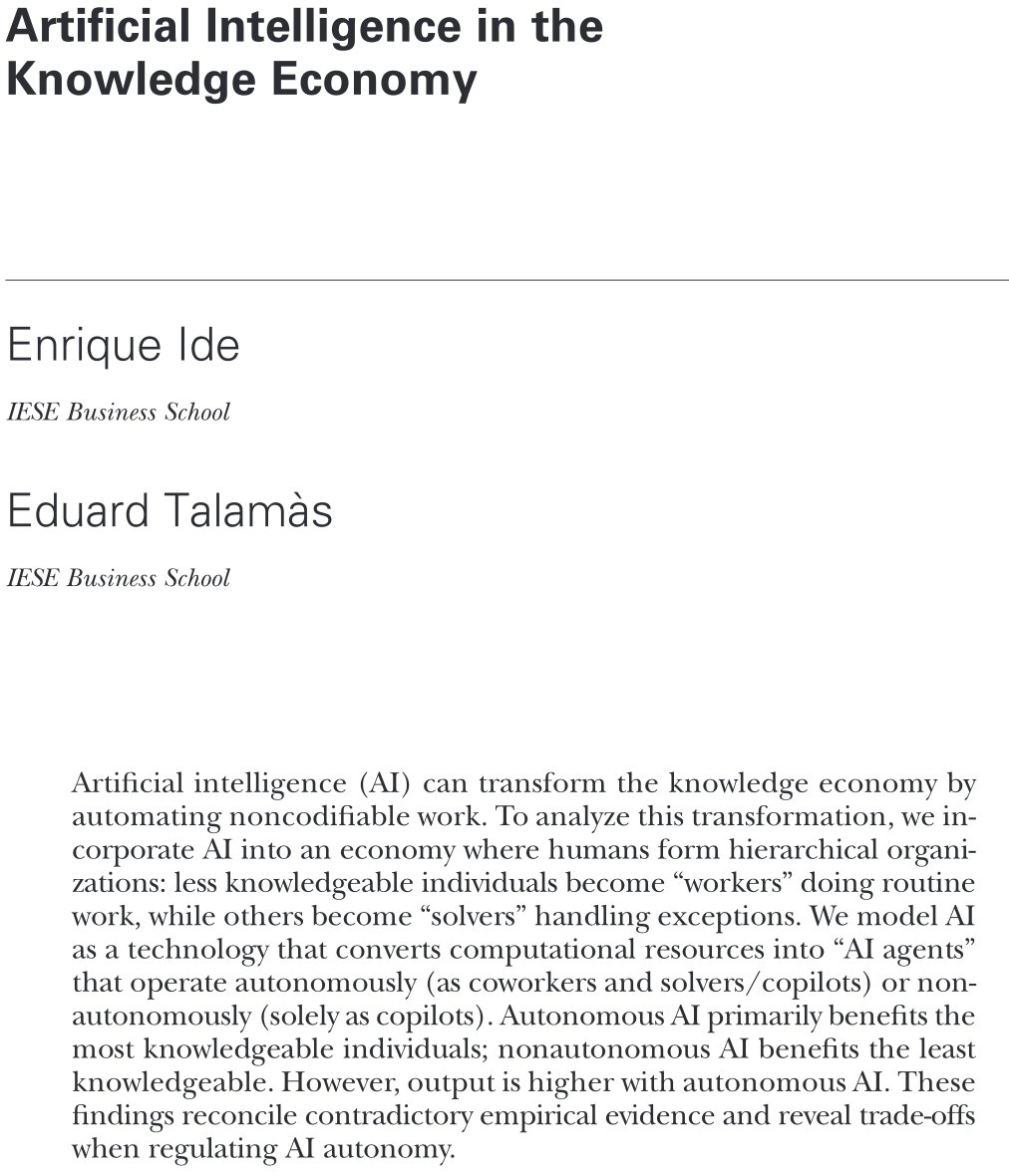
This is one of the points @ide_enrique and I make in this paper: The fact that digital brains can be scaled makes them fundamentally different. They will transform organizations.
Dwarkesh Patel@dwarkesh_sp
The list of all the problems in mathematics that Terence Tao *could* solve is absolutely enormous. The problem is we can't make copies of him, dump millions of dollars of inference compute into each copy, and have them each tackle a different Millennium Prize Problem for a hundred subjective years. But we can do that with AI. So in that way, we may be underrating how significant it will be when we have AIs that are not superintelligent but rather simply as good as the best humans today. It’s actually an extremely powerful property of AI that by just running copies in parallel, you can immediately fill in the waterline of accomplishments that are feasible with a given level of capabilities.
English
Enrique Ide retweetledi

Garicano @lugaricano’s Hierarchies model (2000) is a very interesting and important model in Organizational Economics. Let me explain it👇
Let π ∈ [0, ♾️) be the type of problem a firm faces.
We order them by frequency, with a probability distribution F with strictly decreasing density f, which means
▶️low π = common problems
▶️high π = rare problems
Workers choose what to learn (at cost c) and can ask other workers (at cost h).
They first try to solve the problem themselves. If [0, π̄₀] is the knowledge set of a worker, then
if π ≤ π̄₀ → problem solved
if π > π̄₀ → the problem is passed to someone more knowledgeable
So the probability of a problem being passed up is Pr(passed up) = 1 − F(π̄₀).
This extends to multiple hierarchical layers with different knowledge sets, each handling progressively rarer problems.
Optimal choice for the firm: handle common problems yourself, send rare ones up ⇒ hierarchy.
Source: Garicano, L. (2000). Hierarchies and the Organization of Knowledge in Production. Journal of Political Economy, 108(5), 874–904. doi.org/10.1086/317671


English
Enrique Ide retweetledi

🚨 “Job Transformation, Specialization, and the Labor Market Effects of AI” - new paper with @lukasfmann
💡 AI transforms what tasks we do at work. Our paper shows how, as a result, individuals' wages may rise or fall depending on their skill set.
🧰 We build a framework to quantify the effects of job transformation on wages, and characterize winners & losers in a genAI automation scenario from 3 perspectives.
👉Exposure: Moderate occupational exposure benefits incumbents, on average, while high exposure harms them; but: within any exposed occupation there are both losers and winners.
👉Skills: Value of social and manual-technical skills ⬆️, analytical/information-processing skills ⬇️.
👉Distribution: Low-wage workers gain relatively more than high-wage workers.
🧵 Summary thread & link to paper 👇

English
Enrique Ide retweetledi
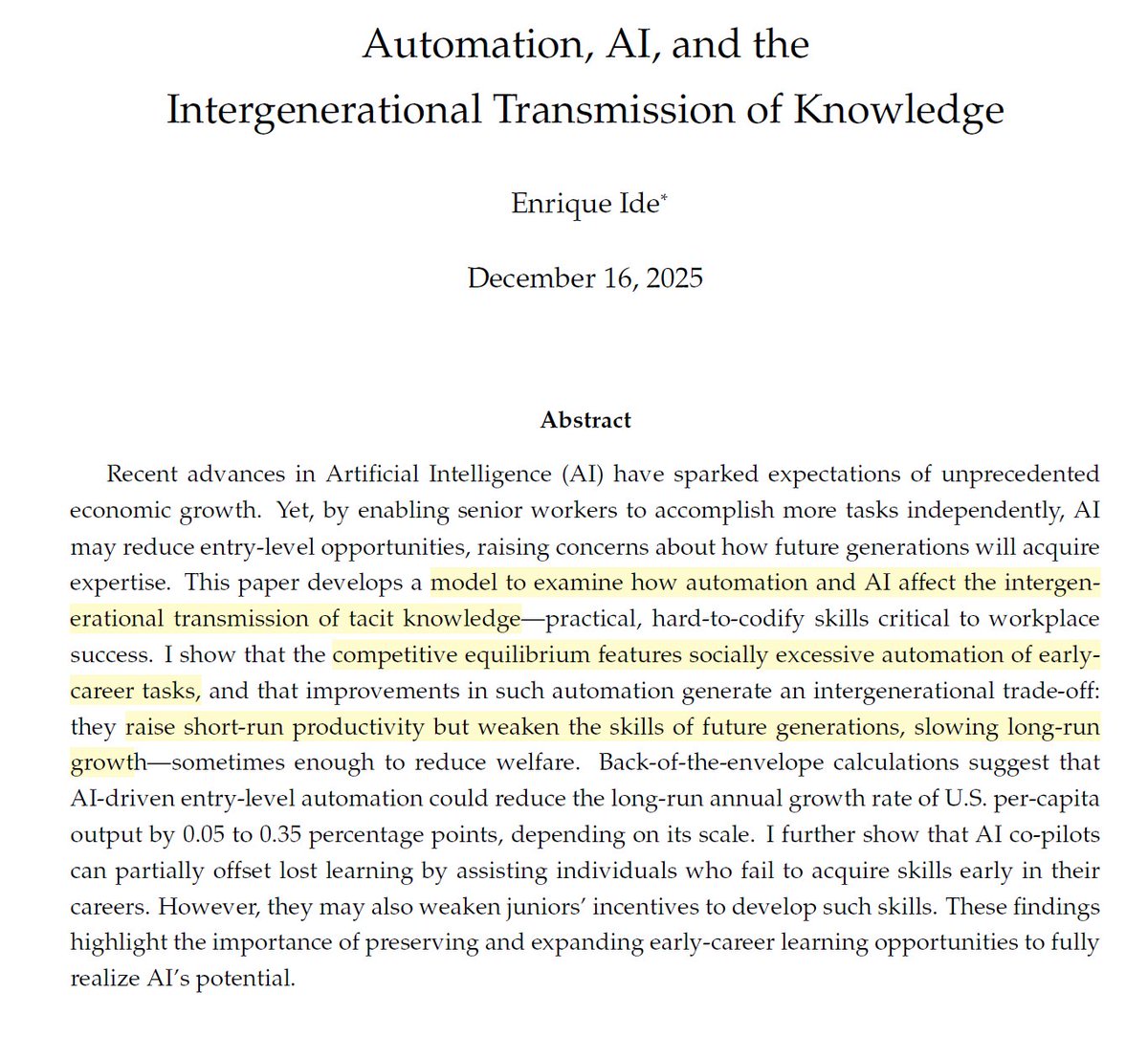
@ide_enrique has a really exciting paper Automation, AI, and the Intergenerational Transmission of Knowledge on this theme.
He develops a model in which equilibrium automation of early-career work can be excessive, because experts cannot be fully compensated for the tacit knowledge they transfer to novices.
By eroding the skills of future cohorts, this mechanism limits long-run growth.
Emily Galvin-Almanza@GalvinAlmanza
I don't get how people are planning to sidestep the very basic problem that if you don't have junior hires right now, you won't have experienced people 5 or 10 years later.
English
Enrique Ide retweetledi
Famously (there is a beautiful Works in Progress piece on this) in 2016, Geoffrey Hinton told an audience in Toronto that medical schools should stop training radiologists, since AI would soon outperform them at reading scans. Ten years later, there are more radiologists than ever, and they earn more than they did then.
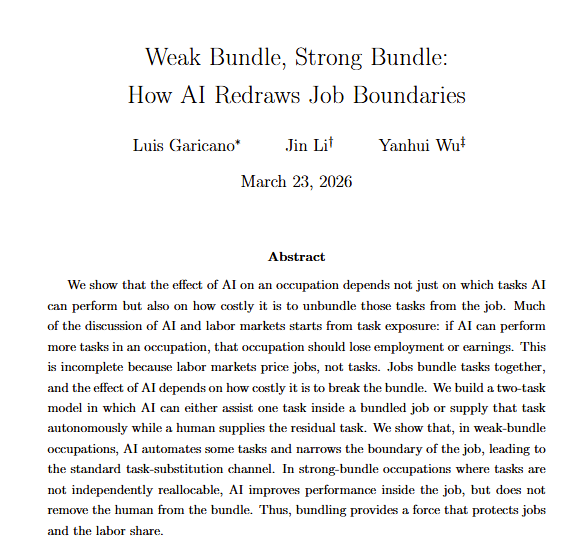
Hinton was right about the task, but he was wrong (so far!) on the future of the radiology profession. Times have never been better for them. The gap between those two claims, the difference between tasks and jobs, is the subject of a paper I have written with Jin Li and Yanhui Wu, and that we release today: "Weak Bundle, Strong Bundle: How AI Redraws Job Boundaries." (Very relatedly we are also finishing the first draft of our book "Messy Jobs" on AI and Jobs!! You will be the first to hear).
We start from the observation that the growing literature on AI and labor markets measures the AI shock by task exposure: people count how many tasks AI can perform in a given occupation AI can perform, and infer that more exposure means more displacement. Eloundou et al. published a paper in Science in 2024 that started this literature, and many follow the same logic. The inference they make is that the more exposed tasks, the worse the outcomes.
This is incomplete, because labor markets price jobs, not tasks. A radiologist does not just sell image classification, but does many other jobs: triages cases, communicates with other physicians, trains residents, makes the difficult decisions, and signs a diagnosis. The market buys a bundled service. The question AI poses is not whether it can do one task inside the bundle. The question is whether that task can be pulled out.
Thread (1/3)
dropbox.com/scl/fo/689u1g7…
English
Enrique Ide retweetledi
Someone has created a gmail account using my first and last name (raffaellasadun@gmail.com) without my consent.
If you receive an email from this gmail account please know that it is not me, and please alert me. This is an impersonator using my name to ask for money.
English
Enrique Ide retweetledi

🚨 Calling scholars & practitioners based in Latin America: @ILASColumbia’s Edward Larocque Tinker Visiting Professorship (2027–28) is now open.
✅ 1 semester at Columbia + stipend, office space, housing support, airfare, RA support
📚 Teach/co-teach 1 course + 2 public lectures
⏳ Apply by March 20, 2026
🔗 ilas.columbia.edu/content/edward…
English
Enrique Ide retweetledi
Fantastic post on AI's impact on productivity. In recent @JPolEcon paper building on foundational work by
@lugaricano and @HansbergRossi, @ide_enrique and I propose another reason that may explain the disparity in findings about who wins and loses from AI.
Alex Imas@alexolegimas
New post: What is the impact of AI on productivity? I review all of the studies and data that I can find and try to provide a synthesis. There’s a lot of disagreement on what we know about the productivity impact. Part of the reason for this is the disconnect between the micro and macro evidence. The micro studies overwhelmingly find positive productivity benefits (except for one notable exception), but these productivity benefits are yet to show up in the macro data. There is also a disconnect on who benefits most: micro (mostly) finds low-skill/less-experienced workers see higher returns, the (limited) macro evidence is more mixed but leans toward higher wage/higher ed people seeing more of the benefits. I discuss potential reasons for the micro-macro gap in the post and 🧵 below. Importantly, this is a living post. I will update it continuously as new data comes in. If you see something I'm missing, please let me know and I will add it. For regular updates, please consider subscribing to the substack. Here is the link: aleximas.substack.com/p/what-is-the-…
English
Enrique Ide retweetledi
Barcelona in June is beautiful. If there is a cool workshop on AI at the same time, even better. Consider submitting your best work on the economy at the other side of AGI.
Eduard Talamàs@EduardTalamas
🚨🚨 Call for Papers 🚨🚨 Economics of Transformative AI Workshop at the BSE Summer Forum 2026 👉 June 17, 2026 | Barcelona 👉 Keynote: @lugaricano 👉 Confirmed speakers: Kevin Bryan (@Afinetheorem) and @LindseyRRaymond 👉 Deadline: February 28, 2026
English
Fantastic review of the latest AI labor research by Danielle Li at the AEA meetings.
She covers everything from micro-evidence (@shakked_noy, @orgRem, @erikbryn) to broader generalizations, including work by @davidautor, @ProfNeilT, & my own work w/ @EduardTalamas at @JPolEcon (building on @lugaricano).
Missed it? Full talk below 👇

English
Enrique Ide retweetledi
People looking for research ideas: think this through/nice place to do some empirical work!
Ide and @EduardTalamas ((JPE 2025) did some of the necessary theory work, though with the same communication cost between agent and supervisor as between humans (seems may be lower!).
Kevin A. Bryan@Afinetheorem
@boazbaraktcs Hah! I wonder whether our standard org econ results on optimal span of control (e.g., how many employees per manager) are different in AI world? @lugaricano's QJE on this is my mental model, but would have to think of the optimal setup here.
English
Enrique Ide retweetledi

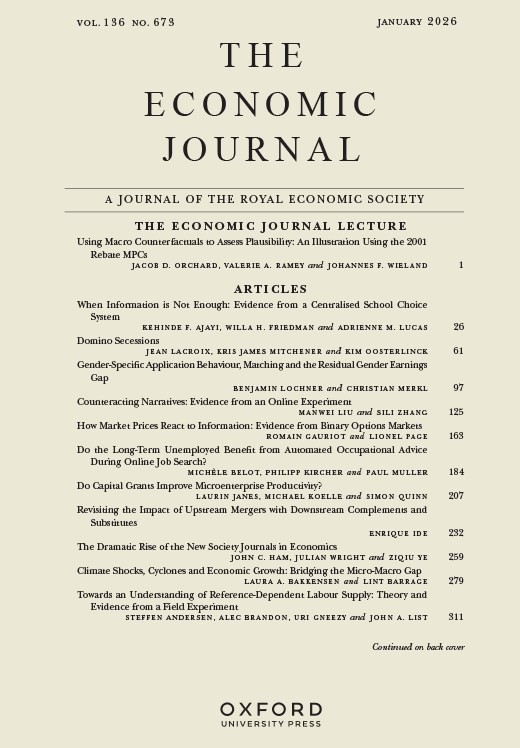
🆕Hot off the press!
The January 2026 issue featuring Editor’s Choice ‘When Information is Not Enough: Evidence from a Centralised School Choice System’ by Kehinde F Ajayi, @willafriedman, @ProfALucas @RoyalEconSoc @OxfordJournals #econtwitter
👉bit.ly/4ql3cGD
English
Enrique Ide retweetledi

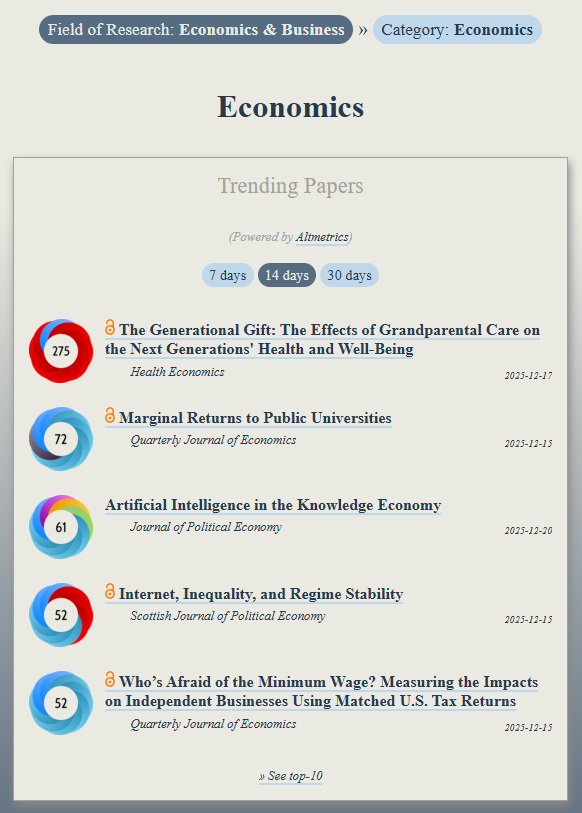
Trending in #Economics:
ooir.org/index.php?fiel…
1) Grandparental Care (@HECJournalTweet)
2) Marginal Returns to Public Universities (@QJEHarvard)
3) AI & Knowledge Economy (@JPolEcon)
4) Internet, Inequality & Regime Stability (@sjpeatses)
5) Who’s Afraid of Minimum Wage?
English
Enrique Ide retweetledi

New CEPR Discussion Paper - DP20940
Automation, AI, and the Intergenerational Transmission of Knowledge
Enrique Ide @iesebschool
ow.ly/PbJn50XKMuS
#CEPR_LE #CEPR_MG #CEPR_OE #EconTwitter
English
Enrique Ide retweetledi
Dear All, just out: I did a long podcast conversation on the economics of AI with @EpochAIResearch. We discussed its impact on labour markets, recent evidence of complementarities and substitution, training and careers, macro/growth/interest rates, on AI regulation and Europe and much more. I hope you enjoy it. I cited recent research (list next) among others by (list below): @erikbryn @Danielle__Li @LindseyRRaymond @spjaffe @BharatKChandar @RuyuChen @LichtingerGuy @ide_enrique @EduardTalamas @a_auclert @HannesMalmberg1 @ludwigstraub @Ph_Aghion @DAcemogluMIT @baselinescene.
Epoch AI@EpochAIResearch
Will AI drive Europe towards a “high interest rates, no growth” future? How will automation impact entry-level workers and the structure of firms? What role does Europe play as the US and China continue to push AI progress? On this episode of Epoch After Hours, @lugaricano joins Epoch AI researchers @ansonwhho and @APotlogea to discuss these questions. -- Timestamps -- 0:00:00 – Will AI trigger explosive growth? 0:06:26 – Short-run macroeconomic effects 0:11:29 – The decline of junior jobs 0:20:21 – The missing training ladder 0:39:31 – Europe’s AI regulation problem 0:52:46 – Who captures AI value? 01:08:17 – AI, interest rates & fiscal future
English

Live today from Cambridge, MA!
Org. Econ. @nberpubs Working Group
(program and livestream below).
Organized by @raffasadun and @andreapratnyc
Papers by @joshgans, @I_Am_NickBloom, and @erikbryn (among many others)
I’ll also be talking about my latest paper:
Automation, AI, and the Intergenerational Transmission of Knowledge

English