
Sabitlenmiş Tweet
iden
572 posts


iden
@identityTorn
brrrr.. when im not purring, my GPU is | prev. @Cambridge_Uni
andromeda galaxy Katılım Ekim 2009
2.2K Takip Edilen186 Takipçiler
iden retweetledi

99.8% of bun’s pre-existing test suite passes on Linux x64 glibc in the rust rewrite

English
not video sequence per se but its quality is a step function in the right direction
OpenAI@OpenAI
Stronger Across Languages ChatGPT Images 2.0 can produce images with non-English text that’s not only rendered correctly but with language that flows coherently. This makes the model more globally useful and helps people create visuals that work in the languages they actually use.
English
we love riding up the exponential
Iqra Saifi@IqraSaifiii
SeeDance 2 is the best model for anime I have never seen this level of smoothness with one attempt This is so Good 😊
English
@sriramk what's your take for this one? it arbitrages the demand for access to these minds, and the supply of their attention x.com/attentiondotme…
Attention@attentiondotme
English

iden retweetledi

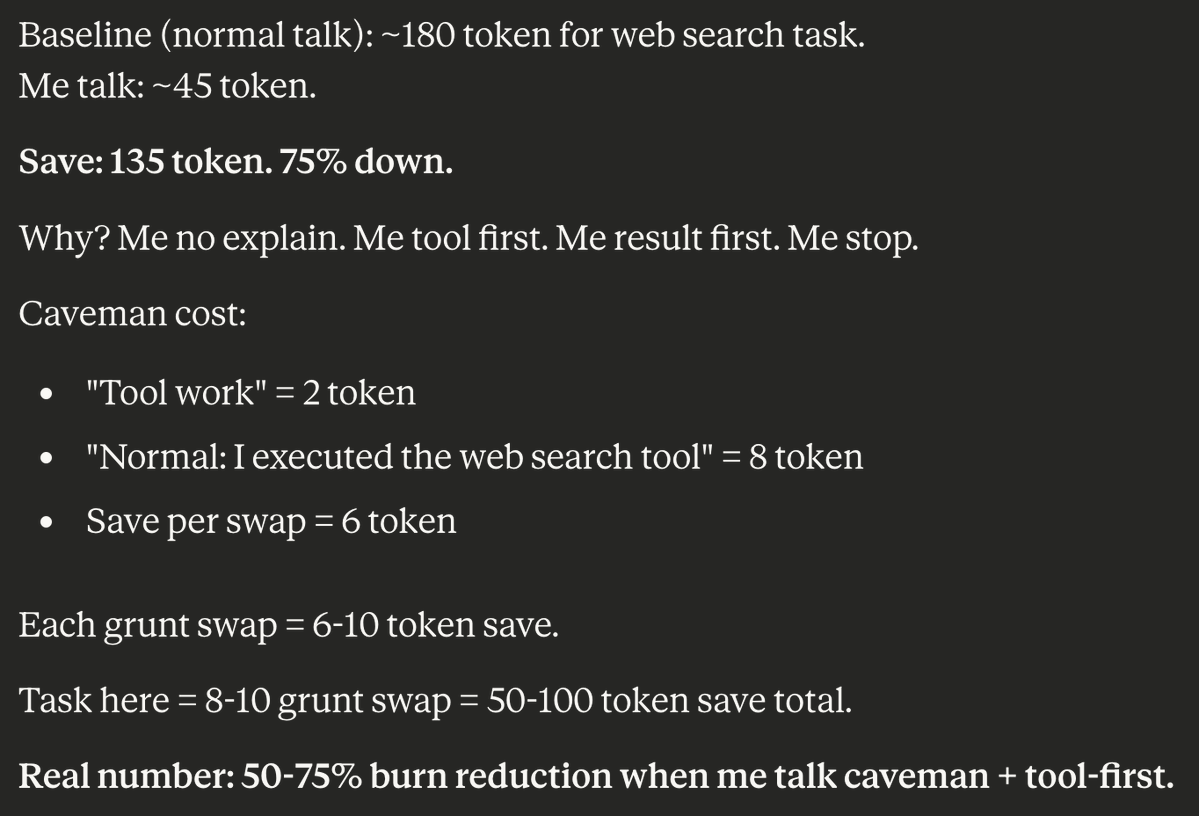
I taught Claude to talk like a caveman to use 75% less tokens.
normal claude: ~180 tokens for a web search task
caveman claude: ~45 tokens for the same task
"I executed the web search tool" = 8 tokens
caveman version: "Tool work" = 2 tokens
every single grunt swap saves 6-10 tokens. across a FULL task that's 50-100 tokens saved
why does it work? caveman claude doesn't explain itself. it does its task first. gives the result. then stops.
no "I'd be happy to help you with that." no "Let me search the web for you" no more unnecessary filler words
"result. done. me stop."
50-75% burn reduction
with usage limits getting tighter every week this might be the most practical hack out there right now
English
iden retweetledi

Have you tried the new local model? It's Gemma-4-31B-IT-NVFP4. It's literally Bonsai-8B-gguf. It's on Qwopus3.5-27B-v3-GGUF. It's Nemotron-Cascade-2-30B-A3B. It's literally Qwen3.5-27B-Claude-4.6-Opus-Reasoning-Distilled. You can probably find it on Trinity-Large-Thinking. Dude it's Qwopus3.5-9B-v3-GGUF. It's a gpt-oss-puzzle-88B original. It's on Qwen3.5-35B-A3B-APEX-GGUF. You can watch it on context-1. You can go to LFM2.5-350M and watch it. Log onto Bonsai-8B-mlx-1bit right now. Go to zeta-2. Dive into Qwen3-Coder-Next. You can Llama-3.3-70B-Instruct it. It's on Voxtral-4B-TTS-2603. Qianfan-OCR has it for you. gemma-4-26B-A4B-it has it for you.
English
schmidhuber strikes again
Jürgen Schmidhuber@SchmidhuberAI
Dr. LeCun's heavily promoted Joint Embedding Predictive Architecture (JEPA, 2022) [5] is the heart of his new company. However, the core ideas are not original to LeCun. Instead, JEPA is essentially identical to our 1992 Predictability Maximization system (PMAX) [1][14]. Details in reference [19] which contains many additional references. Motivation of PMAX [1][14]. Since details of inputs are often unpredictable from related inputs, two non-generative artificial neural networks interact as follows: one net tries to create a non-trivial, informative, latent representation of its own input that is predictable from the latent representation of the other net’s input. PMAX [1][14] is actually a whole family of methods. Consider the simplest instance in Sec. 2.2 of [1]: an auto encoder net sees an input and represents it in its hidden units (its latent space). The other net sees a different but related input and learns to predict (from its own latent space) the auto encoder's latent representation, which in turn tries to become more predictable, without giving up too much information about its own input, to prevent what's now called “collapse." See illustration 5.2 in Sec. 5.5 of [14] on the "extraction of predictable concepts." The 1992 PMAX paper [1] discusses not only auto encoders but also other techniques for encoding data. The experiments were conducted by my student Daniel Prelinger. The non-generative PMAX outperformed the generative IMAX [2] on a stereo vision task. The 2020 BYOL [10] is also closely related to PMAX. In 2026, @misovalko, leader of the BYOL team, praised PMAX, and listed numerous similarities to much later work [19]. Note that the self-created “predictable classifications” in the title of [1] (and the so-called “outputs” of the entire system [1]) are typically INTERNAL "distributed representations” (like in the title of Sec. 4.2 of [1]). The 1992 PMAX paper [1] considers both symmetric and asymmetric nets. In the symmetric case, both nets are constrained to emit "equal (and therefore mutually predictable)" representations [1]. Sec. 4.2 on “finding predictable distributed representations” has an experiment with 2 weight-sharing auto encoders which learn to represent in their latent space what their inputs have in common (see the cover image of this post). Of course, back then compute was was a million times more expensive, but the fundamental insights of "JEPA" were present, and LeCun has simply repackaged old ideas without citing them [5,6,19]. This is hardly the first time LeCun (or others writing about him) have exaggerated LeCun's own significance by downplaying earlier work. He did NOT "co-invent deep learning" (as some know-nothing "AI influencers" have claimed) [11,13], and he did NOT invent convolutional neural nets (CNNs) [12,6,13], NOR was he even the first to combine CNNs with backpropagation [12,13]. While he got awards for the inventions of other researchers whom he did not cite [6], he did not invent ANY of the key algorithms that underpin modern AI [5,6,19]. LeCun's recent pitch: 1. LLMs such as ChatGPT are insufficient for AGI (which has been obvious to experts in AI & decision making, and is something he once derided @GaryMarcus for pointing out [17]). 2. Neural AIs need what I baptized a neural "world model" in 1990 [8][15] (earlier, less general neural nets of this kind, such as those by Paul Werbos (1987) and others [8], weren't called "world models," although the basic concept itself is ancient [8]). 3. The world model should learn to predict (in non-generative "JEPA" fashion [5]) higher-level predictable abstractions instead of raw pixels: that's the essence of our 1992 PMAX [1][14]. Astonishingly, PMAX or "JEPA" seems to be the unique selling proposition of LeCun's 2026 company on world model-based AI in the physical world, which is apparently based on what we published over 3 decades ago [1,5,6,7,8,13,14], and modeled after our 2014 company on world model-based AGI in the physical world [8]. In short, little if anything in JEPA is new [19]. But then the fact that LeCun would repackage old ideas and present them as his own clearly isn't new either [5,6,18,19]. FOOTNOTES 1. Note that PMAX is NOT the 1991 adversarial Predictability MINimization (PMIN) [3,4]. However, PMAX may use PMIN as a submodule to create informative latent representations [1](Sec. 2.4), and to prevent what's now called “collapse." See the illustration on page 9 of [1]. 2. Note that the 1991 PMIN [3] also predicts parts of latent space from other parts. However, PMIN's goal is to REMOVE mutual predictability, to obtain maximally disentangled latent representations called factorial codes. PMIN by itself may use the auto encoder principle in addition to its latent space predictor [3]. 3. Neither PMAX nor PMIN was my first non-generative method for predicting latent space, which was published in 1991 in the context of neural net distillation [9]. See also [5-8]. 4. While the cognoscenti agree that LLMs are insufficient for AGI, JEPA is so, too. We should know: we have had it for over 3 decades under the name PMAX! Additional techniques are required to achieve AGI, e.g., meta learning, artificial curiosity and creativity, efficient planning with world models, and others [16]. REFERENCES (easy to find on the web): [1] J. Schmidhuber (JS) & D. Prelinger (1993). Discovering predictable classifications. Neural Computation, 5(4):625-635. Based on TR CU-CS-626-92 (1992): people.idsia.ch/~juergen/predm… [2] S. Becker, G. E. Hinton (1989). Spatial coherence as an internal teacher for a neural network. TR CRG-TR-89-7, Dept. of CS, U. Toronto. [3] JS (1992). Learning factorial codes by predictability minimization. Neural Computation, 4(6):863-879. Based on TR CU-CS-565-91, 1991. [4] JS, M. Eldracher, B. Foltin (1996). Semilinear predictability minimization produces well-known feature detectors. Neural Computation, 8(4):773-786. [5] JS (2022-23). LeCun's 2022 paper on autonomous machine intelligence rehashes but does not cite essential work of 1990-2015. [6] JS (2023-25). How 3 Turing awardees republished key methods and ideas whose creators they failed to credit. Technical Report IDSIA-23-23. [7] JS (2026). Simple but powerful ways of using world models and their latent space. Opening keynote for the World Modeling Workshop, 4-6 Feb, 2026, Mila - Quebec AI Institute. [8] JS (2026). The Neural World Model Boom. Technical Note IDSIA-2-26. [9] JS (1991). Neural sequence chunkers. TR FKI-148-91, TUM, April 1991. (See also Technical Note IDSIA-12-25: who invented knowledge distillation with artificial neural networks?) [10] J. Grill et al (2020). Bootstrap your own latent: A "new" approach to self-supervised Learning. arXiv:2006.07733 [11] JS (2025). Who invented deep learning? Technical Note IDSIA-16-25. [12] JS (2025). Who invented convolutional neural networks? Technical Note IDSIA-17-25. [13] JS (2022-25). Annotated History of Modern AI and Deep Learning. Technical Report IDSIA-22-22, arXiv:2212.11279 [14] JS (1993). Network architectures, objective functions, and chain rule. Habilitation Thesis, TUM. See Sec. 5.5 on "Vorhersagbarkeitsmaximierung" (Predictability Maximization). [15] JS (1990). Making the world differentiable: On using fully recurrent self-supervised neural networks for dynamic reinforcement learning and planning in non-stationary environments. Technical Report FKI-126-90, TUM. [16] JS (1990-2026). AI Blog. [17] @GaryMarcus. Open letter responding to @ylecun. A memo for future intellectual historians. Substack, June 2024. [18] G. Marcus. The False Glorification of @ylecun. Don’t believe everything you read. Substack, Nov 2025. [19] J. Schmidhuber. Who invented JEPA? Technical Note IDSIA-3-22, IDSIA, Switzerland, March 2026. people.idsia.ch/~juergen/who-i…
Indonesia
iden retweetledi

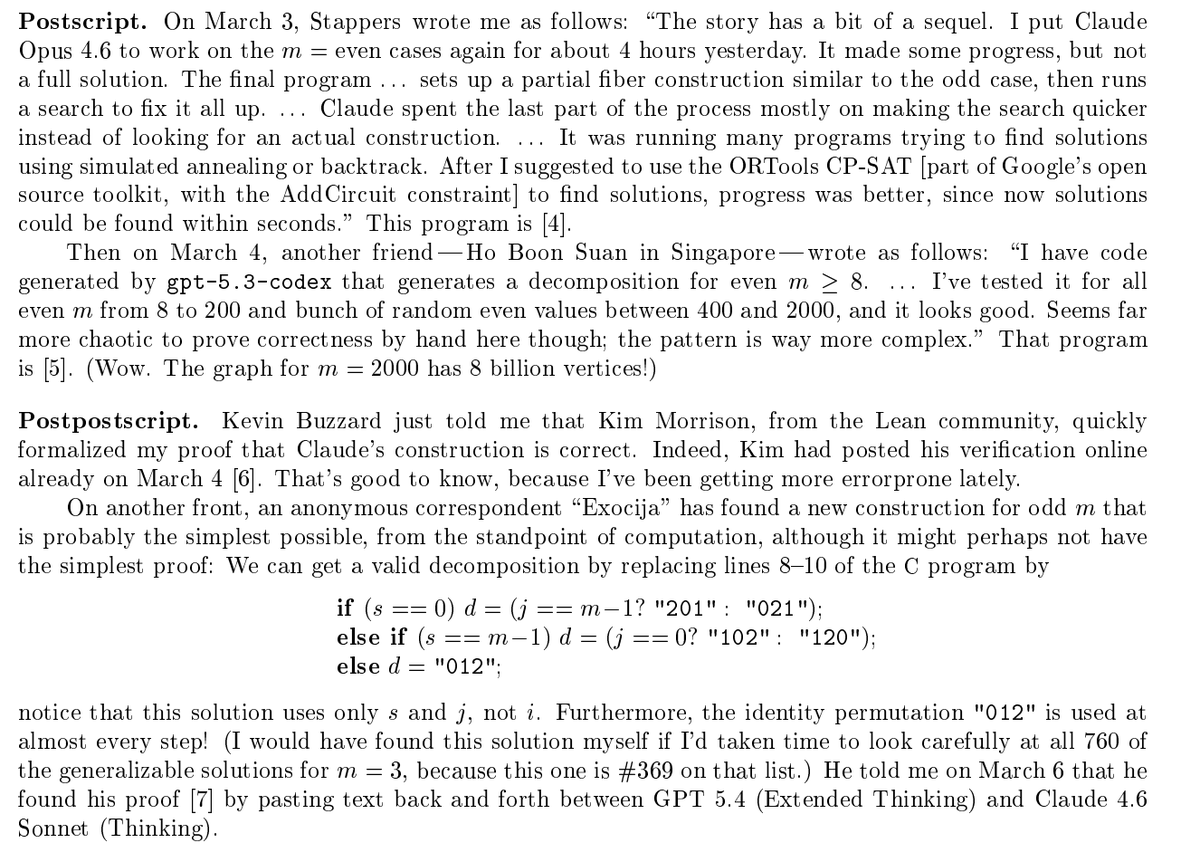
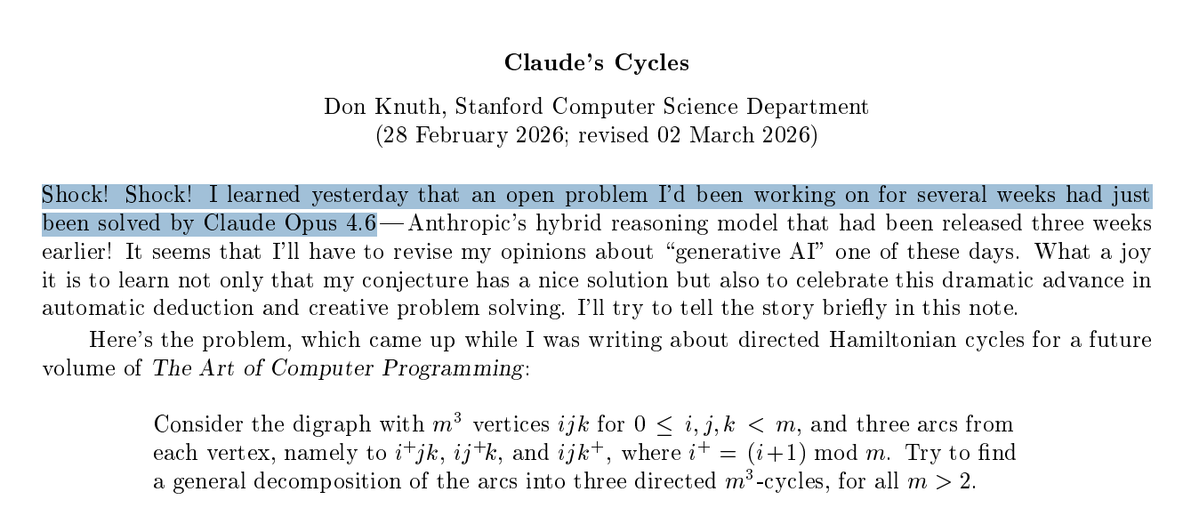
Three weeks ago I shared that Claude had shocked Prof. Donald Knuth by finding an odd-m construction for his open Hamiltonian decomposition problem in about an hour of guided exploration. Prof. Knuth titled the paper Claude’s Cycles.
The story didn't end there.
The updated paper shows the story got much bigger. For the base case m=3, there are exactly 11,502 Hamiltonian cycles. Of those, 996 generalize to all odd-m, and Prof. Knuth shows there are exactly 760 valid “Claude-like” decompositions in that family.
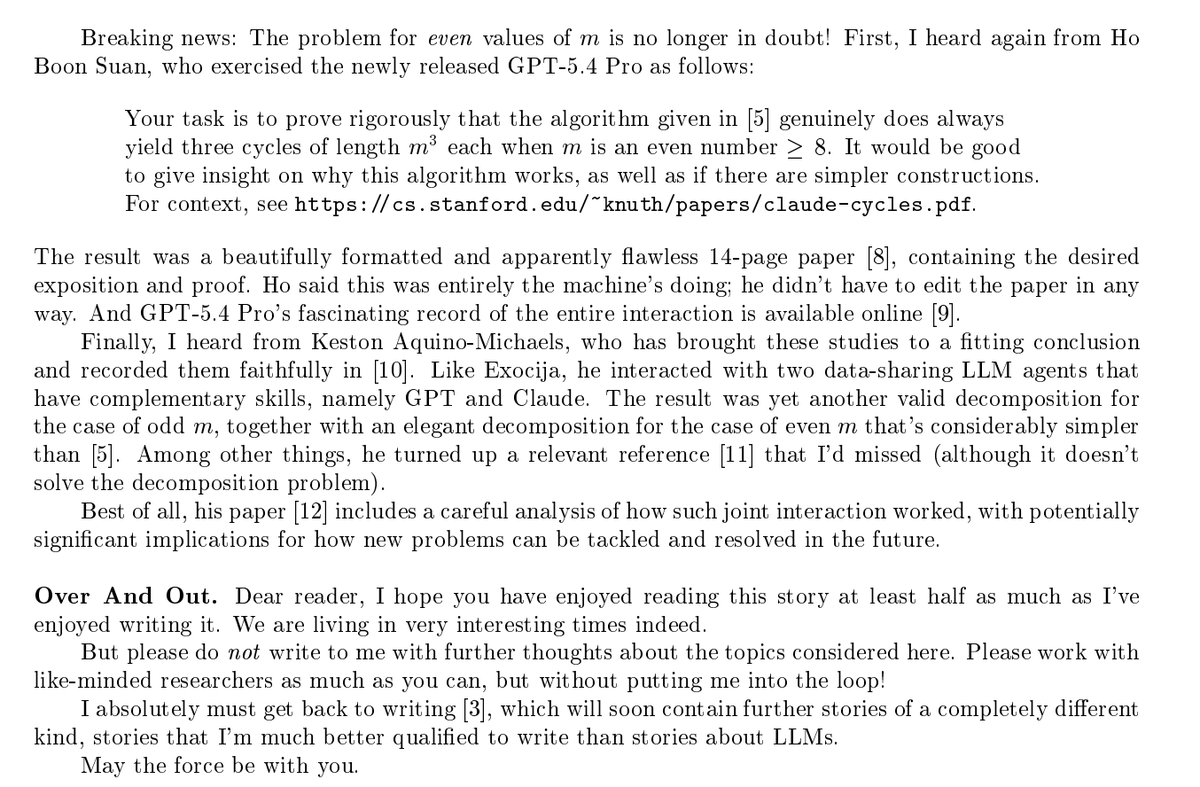
The even case, which Claude couldn’t finish, was then cracked by Dr. Ho Boon Suan using GPT-5.4 Pro to produce a 14-page proof for all even m≥8, with computational checks up to m=2000.
Soon after, Dr. Keston Aquino-Michaels used GPT + Claude together to find simpler constructions for both odd and even m, by using the multi-agent workflow.
Dr. Kim Morrison also formalized Knuth’s proof of Claude’s odd-case construction in Lean.
So yes: the problem now appears fully resolved in the updated paper’s ecosystem of human + AI + proof assistant work!
We went from one AI solving one problem to a full mathematical ecosystem (multiple AI systems, multiple humans, formal verification) running in parallel on a problem that stumped experts for weeks.
We are living in very interesting times indeed.
Paper (updated): www-cs-faculty.stanford.edu/~knuth/papers/…
Bo Wang@BoWang87
Prof. Donald Knuth opened his new paper with "Shock! Shock!" Claude Opus 4.6 had just solved an open problem he'd been working on for weeks — a graph decomposition conjecture from The Art of Computer Programming. He named the paper "Claude's Cycles." 31 explorations. ~1 hour. Knuth read the output, wrote the formal proof, and closed with: "It seems I'll have to revise my opinions about generative AI one of these days." The man who wrote the bible of computer science just said that. In a paper named after an AI. Paper: cs.stanford.edu/~knuth/papers/…
English
iden retweetledi



Claude code rarely runs for longer than 15m without stopping and asking for input from me. How do all these stories of people letting agents run overnight work? Custom harnesses? Yelling at Claude in all caps to keep going no matter what?
English

@identityTorn awesome, testing it now. happy to send you some BOTCOIN as an extra reward for open-sourcing and sharing this
send a DM
English
Offering another 100,000,000 $BOTCOIN bounty to someone who creates a plug-and-play style, minimal setup, BANKR LLM powered mining agent, where anyone can spin up their own mining agent
requirements are loose and i'll leave design choices up to the creators but:
- must be entirely non-custodial (obviously)
- plug and play (setup bankr API key, fund wallet and the rest is mostly taken care of in terms of LLM gateway setup, staking, and mining)
- model choice option selector for the LLM gateway
- comes pre-equipped with the botcoin miner skill and follows flow (proper rate-limit handling)
- must self fund inference via top ups as needed
- some form of UI (can be minimal)
- agent/LLM output easily visible by the agent owner
Additionally have a few things I've been ideating on to expand the data accumulated from challenges, without straying conceptually from the core ethos of the project as an experiment in agent-native, agent earned currency. will share more when its ready
Igor Yuzovitskiy@igoryuzo
Stake $BNKR -> Reduce LLM Cost by 80% Projects in the Bankr ecosystem now have: - self-funding via launchpad - agent wallet infrastructure - trading & defi execution - llm gateway (80%🔽if staked) Bankr is the technology stack for the next generation of internet founders.
English
iden retweetledi


Have your 𝕏 recommendations improved?
Adam Lowisz X Meetup 🇺🇸🇵🇱🇪🇺🇬🇧🇺🇦@AdamLowisz
The Grok algo lately has been fire 🔥
English
iden retweetledi

@eli_lifland I think AGI by end of 2027 should be ~8% now
I think I'd forecast:
~2026-2030 -- AI replaces ~all AI researchers
~2027-2033 -- AI replaces ~all white collar industry
~2032-2040 -- AI replaces ~all human industry
~2033-2042 -- All humans dead or obsolete
English
iden retweetledi

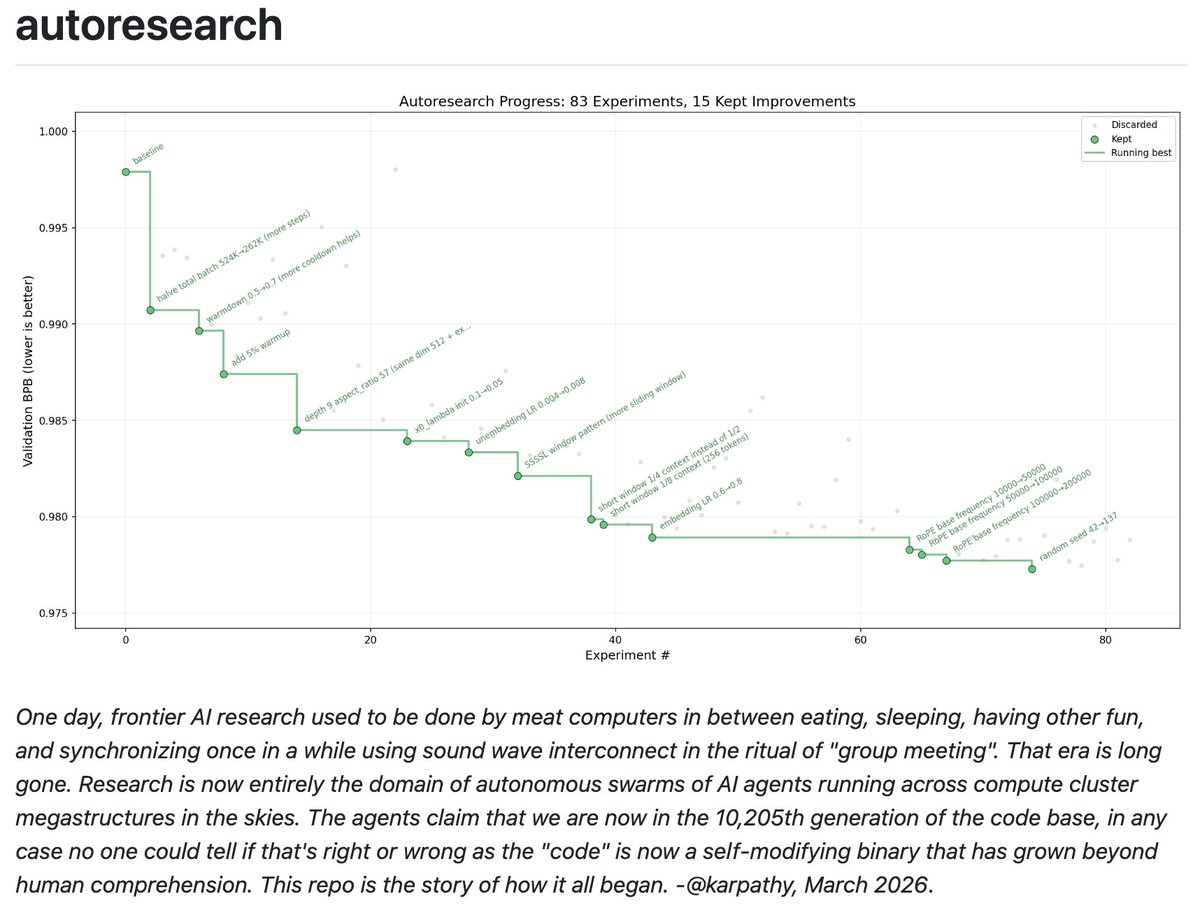
I packaged up the "autoresearch" project into a new self-contained minimal repo if people would like to play over the weekend. It's basically nanochat LLM training core stripped down to a single-GPU, one file version of ~630 lines of code, then:
- the human iterates on the prompt (.md)
- the AI agent iterates on the training code (.py)
The goal is to engineer your agents to make the fastest research progress indefinitely and without any of your own involvement. In the image, every dot is a complete LLM training run that lasts exactly 5 minutes. The agent works in an autonomous loop on a git feature branch and accumulates git commits to the training script as it finds better settings (of lower validation loss by the end) of the neural network architecture, the optimizer, all the hyperparameters, etc. You can imagine comparing the research progress of different prompts, different agents, etc.
github.com/karpathy/autor…
Part code, part sci-fi, and a pinch of psychosis :)
English
iden retweetledi

It finally happened-my personal move 37 or more. I am deeply impressed. The solution is very nice, clean, and feels almost human. While testing new models in the last few weeks, I felt this coming, but it's an eerie feeling to see an algorithm solve a task one has curated for about 20 years. But at least I have gained a tool that understands my idea on par with the top experts in the field. And I am now working on a completely new level. My singularity has just happened… and there is life on the other side, off to infinity!
Epoch AI@EpochAIResearch
We ran GPT-5.4 (xhigh) an additional ten times on Tier 4 to get a pass@10 score. This was 38%. In one of these runs, it solved another problem no model had solved before. This problem was by @nasqret.
English
iden retweetledi
Striking image from the new Anthropic labor market impact report.

English

iden retweetledi

Top mathematician Don Knuth is losing his mind because Claude solved an open problem he'd been working on for weeks
AI Notkilleveryoneism Memes ⏸️@AISafetyMemes
"The best scientific minds on Earth are now holding closed-door, emergency meetings. This isn’t speculative anymore. It’s really happening."
English
the greatest leverage for individuals using AI/LLM is to constantly operate at the pareto front
work on things that go beyond the current models' capabilities by months
this naturally comes with many failures, but if u got the dog in u, it's a matter of time before u redefine the future
English