elscorcho

4.9K posts

elscorcho banner
elscorcho

elscorcho

@ilscorcho

life is not a journey

Katılım Ocak 2021
294 Takip Edilen179 Takipçiler
elscorcho retweetledi
John Ryan
John Ryan@beaglebrigade·
$EOSE Latest Q1 2026 13F's institutional filings are a good indicator of sentiment following the Q4 2025 nuke by management. The reporting deadline was yesterday (May 15). Rubrik Capital bailed (6.5M shares) but the majors remain net buyers. Quant funds jumped in to take advantage of mean reversion.
John Ryan tweet mediaJohn Ryan tweet mediaJohn Ryan tweet media
English
0
4
26
3.5K
elscorcho retweetledi
max 🔋
max 🔋@max138497066263·
All upcoming catalysts for $EOSE for 2026. The stock could hit ATH of $32 by EOY subject to good execution.
max 🔋 tweet media
English
3
4
47
2.5K
elscorcho retweetledi
Rosanna Prestia, MBA
Rosanna Prestia, MBA@RosannaInvests·
The $EOSE story nobody is telling: Q4 2025 13F filings show institutions piling in despite controversy: 🔹 BlackRock: +5.0M shares (+27%) = $57M 🔹 Driehaus Capital: +7.7M shares (+117%) = $88M 🔹 Susquehanna: +5.8M shares (+767%) = $67M 🔹 Two Sigma Investments: +3.8M shares (+238%) = $43M 🔹 Two Sigma Advisers: +3.2M shares (NEW) = $37M 🔹 Vanguard: +3.1M shares (+20%) = $35M 200+ institutions adding vs 156 reducing. 35% short interest. Smart money loading. Frontier Power USA scaling. $EOSE
English
3
15
97
6K
elscorcho retweetledi
Gary Wentworth 🔋
Gary Wentworth 🔋@Cluster_6·
$EOSE Very important to be promoting this. I wish they would get out on X more often.
Gary Wentworth 🔋 tweet media
English
11
9
88
5K
elscorcho retweetledi
Shadow Intel
Shadow Intel@TheShadowIntelX·
Joe Rogan recently discussed a study where 1,062 people took nattokinase for a year. Ultrasound results showed their arterial plaque actually shrank by 36%. This enzyme stops new blockages AND helps reverse the ones you already have. Let's look at the data and dosing: (1/12)
English
31
393
2.3K
299.8K
Murray Hill Guy
Murray Hill Guy@MurrayHillGuy1·
Friend is in an absolute pickle rn… He’s been on like 7+ dates with this girl, really likes her, everything’s going great. Then last night for whatever reason (never ask this question) he asked her body count. 70+. Now he wants to end it immediately. She’s 27, he’s 30. Is this valid or is he being soft?
English
3.6K
42
2.9K
648.1K
elscorcho retweetledi
DonDraper
DonDraper@DonDraperDude·
According to GuruFocus, $EOSE has a GF Value of $17.08 indicating the stock is currently undervalued by approximately 52.9% This substantial margin of safety suggests that investors may have an opportunity to acquire shares at a discount relative to their intrinsic value.
DonDraper tweet media
English
2
15
97
6.2K
elscorcho
elscorcho@ilscorcho·
@JordanSolace @x_times_1 @0marginalreturn Reasons for no orders: 2023 - need DOE loan 2024 - need $( thanks Cerberus) then need SOTA line and then containers 2025 - need stackability 2026 - need bankabilty It’s been a heck of a ride
English
2
0
1
132
JordanSolace
JordanSolace@JordanSolace·
Never said capacity wasn’t a constraint. It still is… L2 coming online addresses that But.. capacity without bankable project finance means you’re manufacturing hardware that can’t get deployed at scale. You need both. Two constraints being addressed at the same time… doesn’t sound like drift to me… sounds like the thesis is maturing Bing bong
English
2
0
13
395
elscorcho retweetledi
JordanSolace
JordanSolace@JordanSolace·
$EOSE Q1 quick reflection… Everyone wants to know where the order is…   Wrong question. Reframe. Eos just solved the reason big orders weren't converting in the first place.   The #1 barrier to LDES isn't technology. It isn't demand.   It's one question nobody could answer:   What happens to our loan if the batt stops working in year 8?   Before yesterday ..nobody could answer it.   So the loan didn't happen. Project didn't get built. Pipeline didn't convert.   To understand why Frontier Power USA is vital.. you need to understand how these projects get financed.   Think about this Illustration…   Frontier builds a $50M battery storage project. Puts in $15M of their own equity. Borrows $35M from an infra fund or pension. Utility pays $12M a yr for 15 yrs That contracted revenue pays back the loan.   The lender gets paid from the cash flows. Not from Eos's balance sheet.   Infra funds and pensions WANT to lend against contracted infrastructure cash flows. 🔑   Here's why:   They need steady predictable returns over 15-20 years to match their long-term obligations to retirees.   A 5.5%+ locked in return secured against a real physical asset with investment-grade offtakers (THE PROJECT) is exactly what they need.   They have billions ready to deploy.   They just needed one thing answered first.   What if the batteries fail in year 8?   If batteries fail .. revenue drops.. loan can't be repaid … lender loses money.   Banks don't lend against questions they can't answer.   This single unanswerable question has kept billions of infra capital on the sidelines.   Enter the room Ariel Green   Lloyd's of London. Rated AA- $1.5B framework… 15 yr NON-CANCELLABLE coverage..Sized at the project level.   Their job is simple:   If Z3 batteries underperform in year 8.. the Ariel Green insurance structure is designed to preserve project cash flows for the lender 🔑 Watch what just happened.   Before TPI: Lender asks: What if batteries fail in year 8? Answer- We don't know Result- No loan. Project dies.   After TPI: Lender asks: What if batteries fail in year 8? Answer: Lloyd's of London can pay the claim Result: Investment grade loan. Project gets built.   One substitution. Dynamic changes.   This is NOT a performance bond.   Performance bonds cover the project getting built…   They expire at completion. The TPI covers something completely different:   Will the batteries keep working for 15yrs   That's the question that killed LDES project finance. That's the question Ariel Green is addressing   Now let's talk about the capital stack   200 MWh Z3 system. $50M total cost   Layer 1 Equity: $15M Frontier Power USA (Cerberus + Eos) Layer 2. TPI wrap: $1.5B framework -Ariel Green / Lloyd's AA- Layer 3- Senior debt: $35M - Infrastructure fund at 5.5%   Every layer serves a purpose. Every layer is now filled.   Here's how the cash flows every single year:   Utility pays: $12M Operating costs: -$4M (includes Ariel Green premium + Eos O&M) Debt service to infra fund: -$3.4M Infra fund gets their 5.5% locked in. Every year. For 15 years.   What's left for equity: 3-4M With a small buffer probably between the infra fund and equity (escrow) but think bigger picture.   On $15M invested.   The power of leverage is unlocked by the TPI   And here's what happens if the batteries DO underperform in year 8:   Revenue drops $3M below projection.   Frontier files a claim with Ariel Green. Ariel Green pays $3M or xyz$ Revenue restored to $12M   The infra fund is not getting *as* impacted by the underperformance. That's insurance backed credit. That's why lenders will now show up for LDES. Why did ariel green write this? DawnOS The st. Dev around RTE = insuranble risk
English
16
9
85
7.6K
elscorcho retweetledi
Carnivore Aurelius ©🥩 ☀️🦙
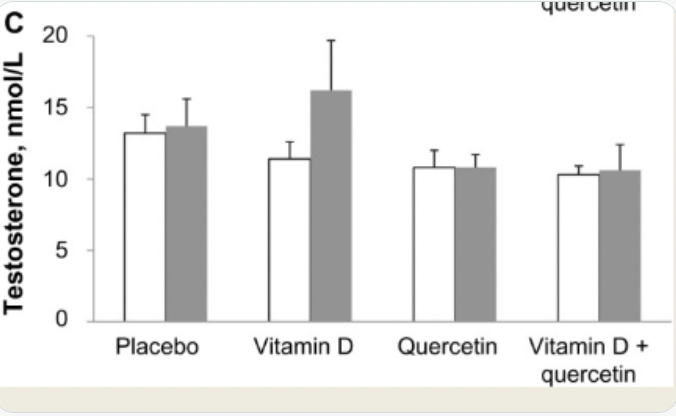
wow, just 4000 IU of vitamin D increased testosterone 40% in this study you dont need TRT you just need to get in the sun
Carnivore Aurelius ©🥩 ☀️🦙 tweet media
English
41
128
2.5K
419.6K
elscorcho retweetledi
Gary Wentworth 🔋
Gary Wentworth 🔋@Cluster_6·
$EOSE Lots of bears throwing around the words “massive dilution” today wrt the RO that will raise the cash required for Eos to participate in the Frontier venture, without actually attempting to model the mechanics of the proposed rights offering. As a very rough illustrative example only let’s assume that Eos needs to raise ~$150M for its Frontier participation, since that is literally what management told us. The first major question is: what is the actual participation base? The answer is likely not as simple as “common shares outstanding,” because the company has a very large number of preferred shares, warrants, converts and other potential common-equivalent securities outstanding. But the answer is also likely not as simple as fully diluted shares either, as it seems unlikely that Cerberus would directly participate in the RO given that it is already separately contributing capital to Frontier. Importantly, Cerberus anti-dilution adjustments likely do not come into play here, as long as the subscription price remains above $5.99. For purposes of this simplified illustration, I am assuming the RO pricing remains above the relevant adjustment thresholds and therefore does not trigger additional Cerberus adjustment mechanics. Using the Q1 2026 diluted share count as a rough framework, and then removing the major identifiable Cerberus-linked preferred and warrant equivalents, the effective participation base may be closer to ~385M shares than the ~545M diluted share count investors may initially assume. If that assumption is directionally correct, then the shareholder base collectively is effectively being asked to contribute: $150M ÷ 385M shares ≈ $0.39 per eligible share. Or roughly ~$390 per 1,000 shares owned. Assuming the offering is priced at a 20% discount to the prevailing stock price at launch, the pricing mechanics could look something like this: - Weak pricing environment: Stock trading at $7.50; Subscription price = $6.00; ~65 new shares purchased; ~$390 participation cost - Neutral pricing environment: Stock trading at $10; Subscription price = $8.00; ~49 new shares purchased; ~$390 participation cost - Strong pricing environment: Stock trading at $13; Subscription price = $10.40; ~38 new shares purchased; ~$390 participation cost The important point is that the company is raising a fixed amount of capital from a fixed ownership base. Lower stock price means more shares issued at lower prices. Higher stock price means fewer shares issued at higher prices. Warning! That does NOT mean the deal is simple. It is not. This is for illustrative purposes only, but it should be something reasonably close to this. The actual economics will depend on final subscription pricing, warrant coverage ratio, participation rates, oversubscription mechanics, treatment of preferred shares/warrants/converts, anti-dilution carveouts or waivers, future warrant exercises, and ultimately whether Frontier itself creates substantial long-term value. But based purely on the initial mechanics, the structure appears more nuanced than the “shareholder wipeout” narrative currently circulating.
English
2
4
32
3.2K
elscorcho retweetledi
🔋William Grassman🔋
🔋William Grassman🔋@GrassmanWilliam·
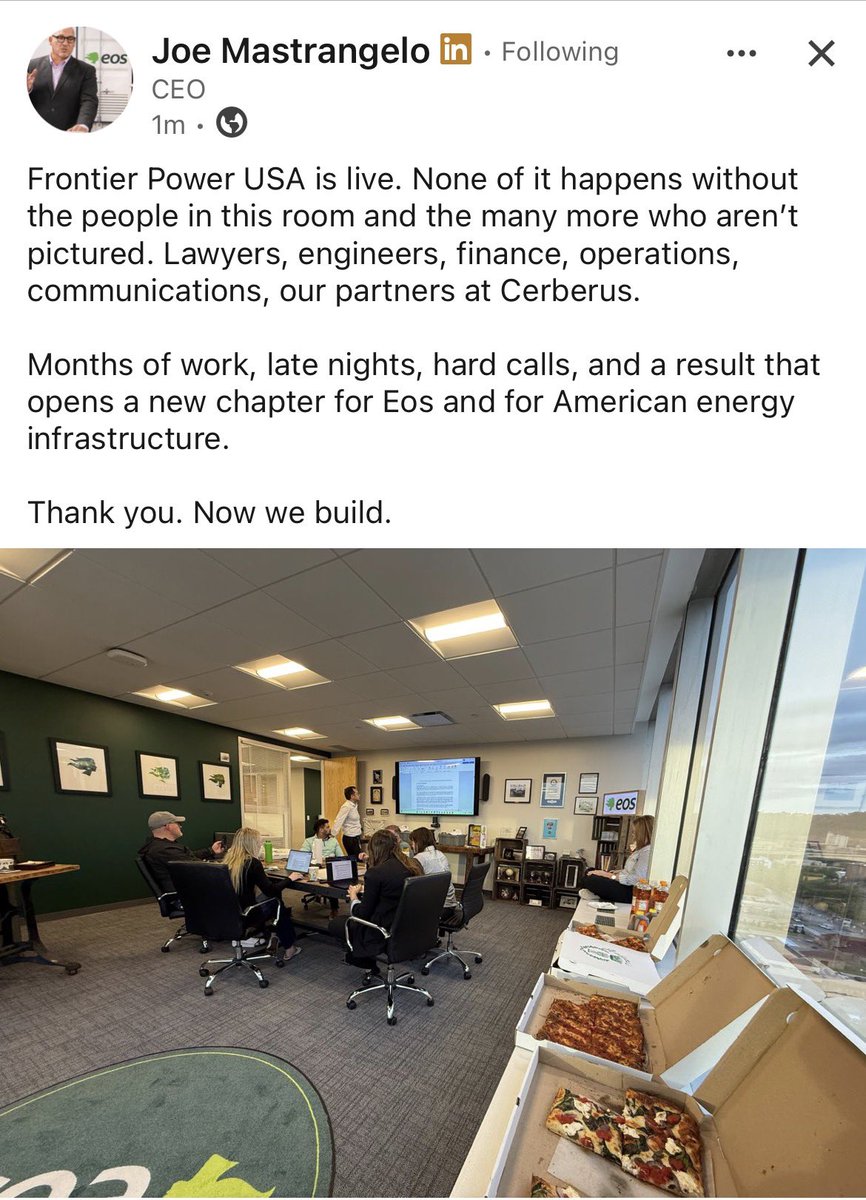
$EOSE FRONTIER IS LIVE!!! And there’s pizza 🍕 IYKYK 😉
🔋William Grassman🔋 tweet media
English
12
11
159
10.3K
elscorcho retweetledi
Gary Wentworth 🔋
Gary Wentworth 🔋@Cluster_6·
Great write-up by @xEBITDA - definitely worth the read. What I appreciate most about this write-up is that it does not pretend the bear case doesn’t exist. In fact, I’d strongly suggest starting with the appendix first. The risks and challenges outlined there are real and are largely the same issues serious investors have been debating for the last year: manufacturing execution, scale-up risk, margin trajectory, financing structure, dilution, backlog conversion, and whether EOS can transition from a promising technology platform into a reliable industrial company. Where many of us clearly differ from the bears is not in identifying those risks, but in how we assess the trajectory, and the probability that EOS can overcome them. That path depends on EOS continuing to improve simultaneously across manufacturing consistency, Line 2 execution, backlog conversion, unit economics, project financing, and large-scale bankability. The Frontier structure is particularly important in that context because it directly targets one of the largest barriers to deployment: financing and bankability. None of this guarantees success. But serious investing is usually about identifying whether a company is moving from “theory” toward “proof.” That is the transition EOS is attempting to make right now. The strongest response to a serious bear case is not to deny the risks, but to argue that the market may be mispricing the probability of successful transition. The key is separating “difficult” from “unlikely.” The bear case on EOS is fundamentally built around six core concerns: manufacturing execution risk, negative unit economics and margin structure, capital intensity and dilution, commercial conversion risk, technology and field-performance uncertainty, and competitive positioning versus lithium-ion incumbents. The bullish counterargument is not that these risks are imaginary. It is that the company now appears materially further along the industrialization curve than many critics acknowledge. Here is what I think about the risks. Manufacturing execution is still the central debate. Bears argue EOS has never demonstrated stable, repeatable, high-throughput production at scale and therefore should not be valued as though scale is inevitable. That criticism is fair. But the evidence now matters more than the narrative. Revenue grew from essentially immaterial levels in 2024 to over $114 million in FY2025, with Q4 revenue alone exceeding the first three quarters combined. Q1 2026 then delivered another $57 million quarter while management cited record battery output, shipments, and bipolar manufacturing performance. The question is no longer whether EOS can produce batteries commercially at all. The question is whether it can industrialize consistently enough for margins and throughput to compound. The margin debate is similar. Bears correctly point out that gross margins remain deeply negative and that EOS still loses substantial money on every quarter of production. That remains true. But the trajectory has clearly improved. Management repeatedly highlighted sequential gross margin improvements tied to automation, manufacturing efficiencies, and higher output. The bull thesis does not require current profitability. It requires confidence that automated manufacturing infrastructure begins to absorb overhead as throughput rises and defect/rework rates decline. If manufacturing stabilizes, the margin structure could change rapidly because EOS is still early on the utilization curve. Capital structure criticism is also legitimate. EOS has relied heavily on external financing and shareholders have experienced major dilution. But this argument increasingly shifts from “survival risk” toward “capital allocation and return-on-capital risk.” The balance sheet today is radically different than it was prior to the DOE facility and late-2025 financing transactions. The company ended FY2025 with over $600 million in cash and explicitly stated that substantial doubt regarding going concern no longer existed. The debate is no longer whether EOS survives the next year. It is whether the capital raised ultimately produces an economically viable manufacturing platform. Commercial skepticism also deserves nuance. Bears often argue the pipeline is promotional and that backlog may not convert reliably into revenue. That risk is real in project-based infrastructure businesses. But commercial demand itself is becoming extremely difficult to dismiss as the need for safe, dispatchable long-duration storage is now undeniable across the power market. EOS reported a $24.3 billion pipeline and a backlog measured in multiple GWh. More importantly, the duration mix appears to be shifting toward longer-duration applications where EOS believes its chemistry competes more favorably. Joe specifically highlighted that 55% of the pipeline is now 8+ hour duration. That matters because EOS does not need to beat lithium-ion everywhere. It needs to win where duration, safety, domestic sourcing, and cycling characteristics become increasingly valuable. The technology debate is probably the hardest area for outside investors to evaluate because field data disclosure remains limited. Bears question whether EOS has sufficiently proven long-term reliability, serviceability, and field economics at commercial scale. That concern is reasonable. However, the company now references over 6 GWh of discharged energy on EOS technology and highlighted DawnOS improvements tied to operational performance and round-trip efficiency. The bullish interpretation is that EOS is still climbing the learning curve rather than discovering fatal flaws in the chemistry. The Frontier structure may ultimately become one of the more important responses to the bear case because it directly addresses bankability and deployment friction. Historically, EOS faced a difficult cycle: customers wanted proof of large-scale deployment before financing projects, while deployments themselves required financing confidence. Frontier attempts to break that cycle by combining manufacturing access, institutional capital, and technology performance insurance into a single structure. Whether it succeeds remains uncertain, but strategically it is targeting one of the company’s largest gating factors, rather than simply raising more capital and hoping demand converts organically. The real divide between bulls and bears is probably this: bears see EOS as a company perpetually promising scale but never fully reaching industrial maturity, while bulls increasingly see EOS as a company finally beginning to cross the boundary between technology demonstration and true industrial execution.
Mr. Tinker@xEBITDA

x.com/i/article/2054…

English
1
3
45
2.4K
elscorcho retweetledi
Reasonably Approximating 🇺🇸 🇺🇦 🔋 🅰️
@Zerosumgame33 Bloom Energy uses a similar infrastructure finance vehicle (Brookfield is their Cerberus). They don't do simple equipment sales to hyperscalers. Their vehicle funds, owns, and operates on site power systems under long term agreements. So did GE for turbines.
English
6
4
75
14.3K
elscorcho retweetledi
Wall St Engine
Wall St Engine@wallstengine·
$EOSE Q1’26 EARNINGS HIGHLIGHTS 🔹 Revenue: $57M (Est $56.4M) 🟢 🔹 EPS: $0.12 (Est $(0.22)) 🟢 FY26 Guide: 🔹 Revenue: $300M-$400M (Est $303.7M) 🟢
English
2
20
186
25.8K
elscorcho retweetledi
Gary Wentworth 🔋
Gary Wentworth 🔋@Cluster_6·
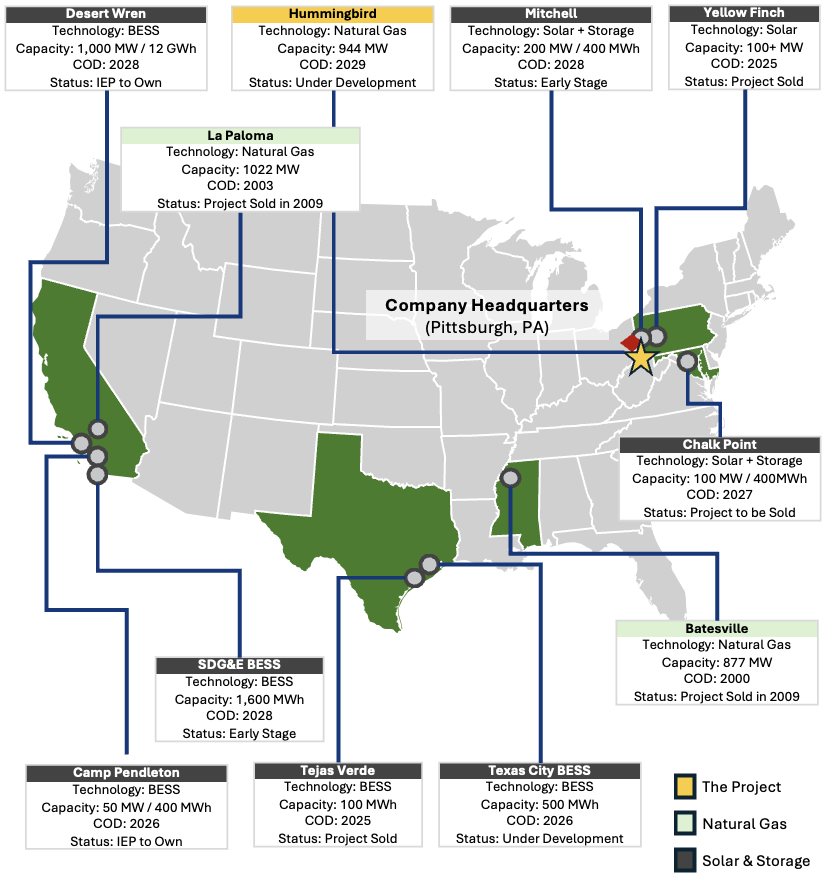
$EOSE The most consequential slide in the entire deck, IMO. This slide needs stay in the deck until EOS reaches escape velocity, at least. Thank you @JoeMastrangelo8
Gary Wentworth 🔋 tweet media
English
2
8
83
4.4K