Sabitlenmiş Tweet
Mark William
30.4K posts

Mark William
@immarkwilliam
Building Brands | $100M+ in Meta ads revenue for clients @Axiscale | ABT - Always Be Testing! | Utopia | HH
Grow Your Personal Brand ➡️ Katılım Mart 2016
1K Takip Edilen35.1K Takipçiler

Product is very very important.
But someone's out there selling a product worse than yours.
For a higher price. To a higher value audience. At a higher scale.
Because sometimes the difference isn't the formula or the quality of the product. But how the the product is positioned in the market.
Who it's for
What problem it solves
Why it matters right now
Etc.
You can spend years perfecting a formula and still lose to someone who spent weeks figuring out who it's really for.
There's more to the picture than this of course. Just zooming in on one topic/variable. But it already gives you a lot to think about.
English

The best creative strategists I know never judge an idea in isolation.
They ask lots of questions before making assumptions.
They look at data before creating hypotheses.
What's the brief? What's the audience? What's the one thing?
The "idea" comes in last.
Because a bad idea in the wrong context is just a misplaced idea.
And a great idea with no strategic foundation is just aesthetics (for the lack of better words)
Overall, the idea isn't really the work. The thinking behind it is.
So judge the thinking. The idea will follow.
English

AI doesn't replace thinking.
It reveals whether you were thinking at all.
But this is the thing nobody wants to say out loud.
When AI gives you something generic, the instinct is to blame the tool. The model is bad. The output is shallow. It doesn't understand nuance.
I mean, sometimes that can be true.
But mostly it's because of you.
"but Mark..."
The quality of what comes out is almost entirely a function of how much thinking you did before you even start typing.
Let's say you're doing creatives. If you come in with great context (e.g. a clear hypothesis, specific audience, defined tension, customer insights, etc.) then the output is useful.
But if you come in with a vague brief - "make this better", "give me ideas for X" - you get nothing you couldn't have Googled.
Every bad AI output is just a mirror of the input you give it.
It's showing you exactly how unclear your brief was. Most of us just aren't used to having that reflected back so fast.
Think harder.
English

Earlier this week I told you I've been ignoring 10 DMs/wk from agency owners under $100K/mo for years.
What I didn't tell you is I've actually been working on a solution for them for months.
A previous client of mine and his partner came to me a while back.
They were already building something for agency owners under $100K/mo and wanted me in on it.
I told them I'd been thinking about doing the same thing for years but never had the right partners to actually do it.
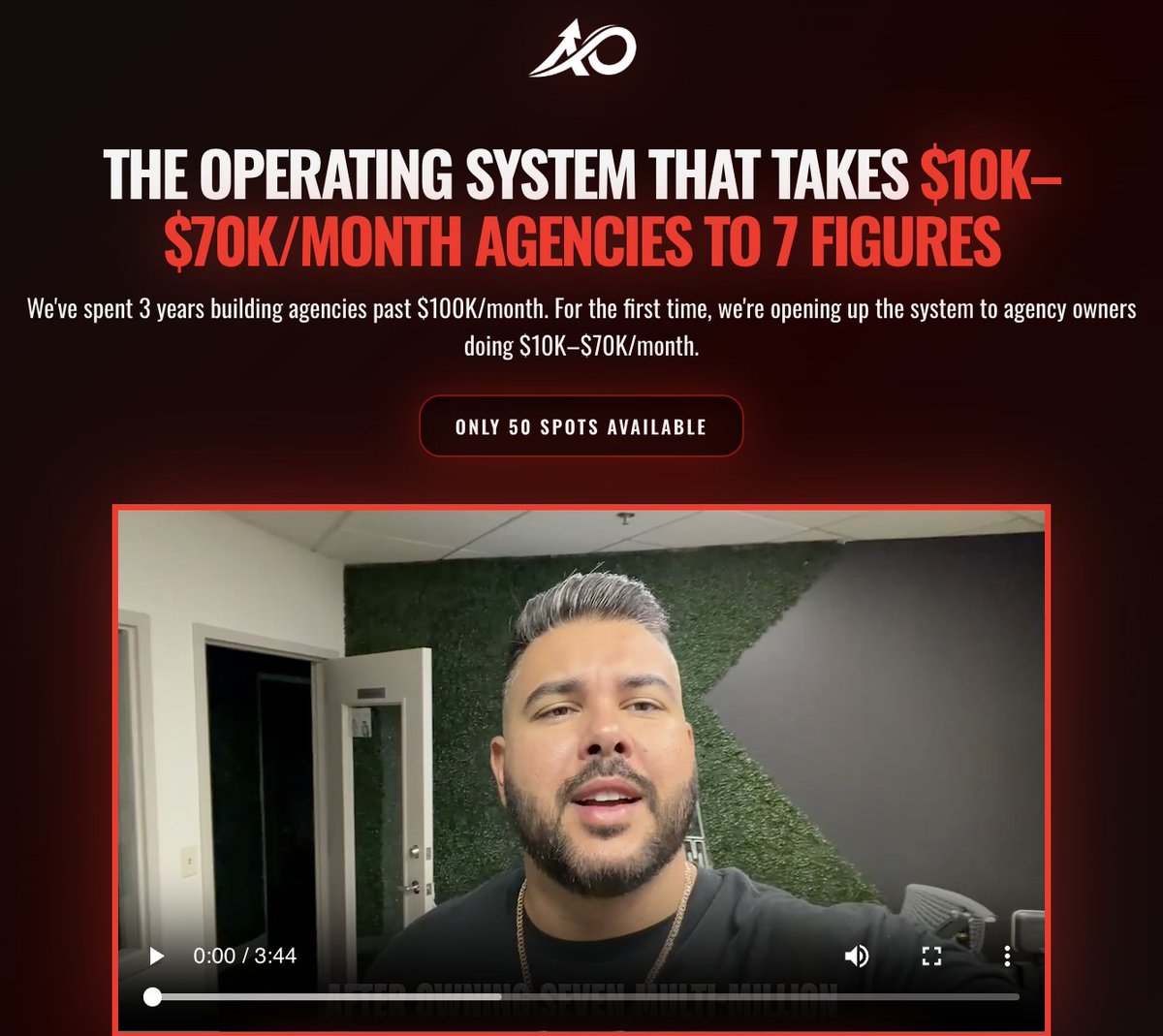
So we teamed up to create Agency Operators.
• 4 months of curriculum built by operators actually running agencies right now.
• Weekly group calls with 4 killers in the agency space covering ops, sales, client results, and more. I'm in once a month for open Q&A.
• An AI trained on all my content that pulls up exactly what I'd tell you about your specific business 24/7. You literally get access to my brain without paying me $5k/hr to consult.
• A constraint tracker that identifies exactly where your agency is bleeding, so you stop chasing shiny objects and fix what's actually broken.
This isn’t anything like Agency Founders.
Agency Operators is the room I've never had for everyone else.
50 spots only. After that you get put on a waitlist.
If you're between $10K-$70K/mo and stuck, this is the room you want to be in.
Doors close May 15. More details below.

English

Good tracking isn't for measurement.
It's for clarity and making decisions on the goal you set for it.
But without a framework for what matters, more data just creates more arguments.
You don't track to prove something worked.
You track to find out if your hypothesis was right.
Define what winning looks like before the work goes live.
Or you'll just keep negotiating with reality instead of learning from it.
English
Mark William retweetledi

Every ad has to have a reason for its creation
Why this big idea? Why this angle? Why this hook? Why this story? Why this format?
What's the actual hypothesis?
Most of the work here is in the tracking, analyzing, and thinking
Doing many back-and-forths with AI, providing as much context as possible, and making sure I have the answers to the questions above
then doing even more thinking
English

@immarkwilliam building a brand > running a service biz for 5 years in terms of learnings?
damn I wanna start a brand too
English

Went quiet on here for a while because I was busy building (still am)
You've known me as the Meta ads guy for the last 8 years.
But I started an ecom brand in the PH last year together with 2 really strong operators and marketers
Built our team to 70+, did things we've never done before, building brands our way
So the game's very different now
I'm not just focusing on ads anymore. Truly learned more in 1 year than the 5 before combined
English

this cowork agent knows which ads will print money 😱
here's the system that knows what meta doesn't:
step 1: pull the raw data
→ pulls @Meta ads, GA4 + your source of truth (ie @hubspot, @Calendly or a csv)
→ assumes broken UTMs, disconnected tools, no data eng
step 2: map ads by angle
→ agent re-groups every ad by MESSAGE family (teardown, save-time, founder-led, etc.)
→ your best message is usually scattered across 3 campaigns + 2 audiences. meta can't see that.
→ now you can answer the only thing that matters: which angle is producing $
step 3: score buyers not clicks
→ not CTR. not CPL. not ROAS.
→ bookings. signups. revenue. whatever moves YOUR business.
→ 4 questions every day: what's real, what's fake, what's leaking, what's underfed
step 4: the 4 outcome truths
→ REAL WINNER: strong clicks + strong buyers = scale
→ FAKE WINNER: strong clicks + garbage buyers = cut. no hesitation.
→ LEAK: good ad + broken page = rebuild page
→ UNDERFED: quiet crusher at 9% of budget = feed it
step 5: find what's breaking
→ tells you exactly where it breaks: ad, page, or follow-through
→ last week it caught a founder-psychology ad landing on a generic SaaS page converting 34% below account average
→ not "something's off." but specific. actionable.
step 6: 1 minute brief
→ 60 seconds brief. lands in cowork/telegram
→ every rec ships with a confidence tag. low data = no rec
step 7: memory that compounds
→ week 1 finds the obvious fake winners
→ week 4 it pre-flags curiosity hooks before they become the next fake winner
→ every cycle is smarter than the last
input: meta account + GA4 + one outcome source
output: real winners. fake winners. leaks. what to do next.
the old way:
→ triple whale: $300/mo
→ northbeam: $500/mo
→ hyros: $500/mo
→ data analyst: $8K/mo
= $9,300/mo of "it depends"
this: $0
I packaged the entire system as the Outcome Kit.
3 claude cowork agents + 12 skills:
- data reader (meta + GA4 + outcomes. source truth only)
- diagnostician (angle mapping + 4 outcome truths scoring)
- brief writer (concrete moves + pattern memory)
also works with @openclaw and hermes (@nousresearch).
giving it away free.
comment MONEY + like + follow
(must follow so i can DM)
English

I think creative strategy is the single biggest bottleneck in my business right now, and I’m the one holding it.
I’m not a bad marketer. But I don’t think I’m a genuinely great creative strategist.
I’ve tried training someone on my team to own this. It hasn’t worked - not because they’re bad, but because this role requires a specific instinct I haven’t been able to transfer.
So I’m stuck between two paths:
1.Invest the time to actually get good at this myself, build the system, then hire someone to run it.
2.Hire or bring on a fractional or full time creative strategist / small agency now, and build the system together.
I’ve been going back and forth on this for a while. If you’ve been through this - either as the founder who figured it out yourself or as someone who hired for it, I’d genuinely love to hear what worked.
What did the transition actually look like? And how did you know when you had the right person or system in place?
English

On AI:
The challenge right now isn't awareness. Everyone knows AI exists
But right now, most people are only using it at a fraction of its potential
They use it to search stuff, ask questions, do reports, write drafts, data pulls, data building, etc.
These are all just basic stuff. Everyone will be doing that within 3 months
What they're not doing is letting AI amplify them by making it a "thinking partner"
The issue is most people rn:
1 - Outsource the thinking and decision making to AI (even when they have nothing provided to it). They treat it like a search bar instead of a partner.
2 - Have nothing documented. They have no proper structure. Their workflows aren't mapped. Systems aren't connected. Data is all over the place. So their AI has nothing to work with.
3 - Rely on AI on things it can't do well yet. They outsource judgment calls. The hard conversations. Reading between the lines.
They're not looking at what the data says and asking "but is that even the right question?"
The people who win from here aren't the ones who learned the most prompts. They're the ones who got better at the things AI can't do well yet:
- Reading the room when your team says "okay" but means "I don't understand"
- Knowing when to push someone and when to back off
- Making the call with incomplete information and owning the results
- Building people up instead of just managing their outputs
Use AI to be better. Not by outsourcing your decisions to it - but by letting it do the heavy lifting on research, data, and execution so you can focus on what actually moves the needle
If you're a marketer, creative, or copywriter who'd rather solve real problems than symptoms, who gets energized by building things that generate outcomes, and wants to be challenged not comfortable - I'd love to hear from you.
DM me - let's chat
English

NanoBanana 2 just made your static ad agency obsolete.
And I just open sourced the entire tool.
Drop your product page URL.
It pulls your logos, product images, fonts, colors, and brand voice automatically.
Builds a full brand guide for you.
Then generates ad creatives at scale using nearly 4,000 high-performing ad templates across 8 niches.
It dynamically matches the best templates to your brand and brief.
Here's what makes it different:
→ Instant resizing
Get any ad in 1x1, 4x5, 9x16 with one click. No regeneration. No broken text.
→ Highlight-to-edit
See an issue? Highlight the area and tell it what to fix.
→ Multiple brand profiles
Run different brands or segments from one tool.
→ Auto persona building from real customer reviews
→ Multiple QC loops on briefs and final assets
Catches AI-isms before you do.
→ Upload your own templates or use ours
Runs locally.
Just needs your Claude and Google API keys.
This is the lite version of what we use internally.
You get the full finished tool AND the open source code to make it your own.
Creatives still design the system, this handles iteration and scale.
Want a copy to download?
1. Like this post
2. Comment "AI"
Will DM you the tool along with a tutorial shortly after.
English

@immarkwilliam Building a research engine for DTC marketers that suggests market gaps and angles based on real time research... Wanna test??
English

@immarkwilliam Claude is my technical co-founder right now. Building fulfillment automations that actually scale. The leverage is insane. DMing you.
English