

Intelestia
1.1K posts



James McAvoy, bir oyuncudan aldığı kırıcı yorumu anlattı:
🔹 “Bir oyuncu beni kendisine yakıştıramadığını söyledi.”
🔹 “Seyircinin onun gibi biriyle kendisini inandırıcı bulmayacağını anlattı.”
🔹 “Bu bayağı ağır geldi.”
🔹 “Kendini fazla beğenmişti.”
🔹 “O ilişki sette epey ilginç hale geldi.”
🔹 “Bazen yeterince yakışıklı değilmişsin gibi hissettiriyorlar.”
🔹 “Boyum yüzünden birçok rolü kaybettim.”
🔸 Resmi olarak açıklanmasa da, bu durumu yaşadığı kadın partnerin Anne Hathaway olduğu düşünülüyor.


Türkçe
@ThaGreatDavid Real ending:
The unemployed man escaped.
The student did not escape.
English

@SladeTheGuy @lauren_w67 No, they lost on the merits. New judge was unbiased.
Prosecution had co conspirator testimony + forum logs proving she solicited the hit online.
Evidence was overwhelming.
Losing anyway after the judge was removed added depth to the storyline.
English

@intelestia @lauren_w67 That is because the other judges were biased too.
English

@nypost UK festival has moved to Nigeria?
Looks like the United Kingdom is once again leading in cultural imperialism… exporting its newly established tradition.
Fortunately, not all Nigerian government officials and media have shielded these crimes the way it’s done in the UK.
English

Brutal 'rape festival' in Nigeria sparks outrage worldwide after horrifying video of men chasing women through streets surfaces trib.al/oGBkgss

English
I know a victim of a sex offender who fled to Israel via the Law of Return. They shared the story years after the event which showed a heavy weight they were holding.
The right response to Rogan’s clip wasn’t defensiveness or cries of antisemitism.
Instead this was an opportunity to write: “This is a real problem. Predators should not exploit citizenship loopholes when an extradition treaty exists. Israel has every incentive to end this practice... fast-track extradition for serious sex crimes, tighten background checks under the Law of Return, and show the world we protect victims, not shield criminals.”
That would have disarmed critics and denied bad actors easy propaganda.
Attacking people for stating documented facts (CBS investigations have tracked dozens of these cases) is unfortunate. There is no excuse to rush to defend sex offenders based on their ethnicity or religion
English

Joe Rogan seemingly joins the Woke Reich podcaster antisemites— bashing Jewish people, and of course, Israel, in his latest interview with comedian Shane Gillis.
Rogan: “Israel’s like the number one place where sex offenders go from America. Especially Jewish people…kind of proves Kanye’s point a little bit…
It’s amazing how many high-profile Jewish people … they have an opinion about everything but when it gets to this (Iran) they just avoid that or come up with some random way to justify annihilating an entire city.”
English
For everyone saying Spirit deserved to fail because of its passengers or crew:
-Those travelers didn’t vanish...they’re now rebooking on Delta, United, American, Frontier… sitting right next to you on your flights.
-The 17,000 staff are being absorbed across the industry. Most will get rehired fast.
If you hated that whole ecosystem, there was real value in keeping it contained to Spirit.
The “good riddance” crowd is about to get more of everything they are complaining about.
English


-Most humans are untrained at running and would fall way below the presented threshold.
-All the animals are untrained, and you are comparing them to a highly task specific trained human. At least study and train one to see their actual limits.
-The trained human presented isn't even operating at purely their athletic capabilities but rather also their cognitive one. For example, marathon runners train themselves to use less energy in their stride through superior running economy.
This is completely the opposite of a non trained person who runs in the gym seeking to expel the most amount of energy in their stride to burn calories.
English

In a 100 km race, which do you think wins?
+ Lion
+ Human
+ Camel
+ Horse
+ Wolf
+ Cheetah
+ Ostrich
+ Bear
English
@EricLDaugh They need to be made aware that it will revert to its prior state unless the water source is changed from the Tidal Basin to the municipal supply.
Detailed explanation here:
x.com/i/status/20484…
Intelestia@intelestia
The Lincoln Memorial Reflecting Pool renovation has a structural flaw I haven’t seen addressed and it sits outside a typical pool contractor’s scope. The pool draws its water from the Tidal Basin, which is a 107 acre tidal reservoir connected to the Potomac River. Because water from the pool can flow back into the basin, the National Park Service prohibits chlorine and standard pool chemicals to protect the ecosystem. That removes the primary tools required to control biological growth. The system relies instead on circulation (~1.5 to 4 million gallons/day), sand filtration, and ozone treatment. That works for debris and partial sterilization but it does not remove the underlying issue. Tidal exchange continuously introduces nitrogen and phosphorus, while the pool’s shallow depth (18-30 inches) maximizes sunlight penetration. Algae heaven. The pool holds ~6.75 million gallons, and the 2012 redesign replaced municipal water (saving tens of millions of gallons annually) with Tidal Basin intake… trading a controlled system for a nutrient fed open loop. Algae blooms appeared within weeks of reopening and have recurred since, despite increased ozone treatment. Photosynthesis is the multiplier. Under full sun, algae can double in under 24 hours. Filtration is a linear removal process. Growth is exponential. In an open loop system with constant nutrient input, those curves do not balance. That’s why the outcome will keep repeating: seasonal algae blooms, green tint, odor, and periodic full drainings despite ongoing treatment. The constraint is the design. Long term solution: decoupling and a controlled water source. Mechanical filtration and circulation alone do not solve this. They can remove debris but they do not stop biological growth at the source. Even if you filtered 100% of the water volume daily, you still lose. Without chemical suppression, the system is biased toward algae dominance.
English

🚨 UPDATE: President Trump DROPS this DISGUSTING photo of what Barack Hussein Obama allowed to happen to the Lincoln Memorial Reflecting pool
Algae and goose poop was allowed to sit for YEARS
"This is what our Country was before, and after, 'TRUMP!'"
Cleanup and American flag BLUE coating underway! 🇺🇸
English
@KirkLubimov Alberta isnt part of Canada
[POST_DATE: 2040-05-01] [DELIVERY_ERROR] [ROUTE: TEMPORAL_LOOM]
English

Excellent news!
Donald Trump approved a pipeline that will take oil from Alberta, Canada to the US.
It will increase Canada's exports to the US by 12%.
It's all pretty much approved on the Canadian side as it will use some of the Keystone XL pipe.
It's a joint venture between South Bow and Bridger Pipeline.
No carbon capture nonsense, no one cares about carbon tax. Just a handshake, and let's get building.

English
The City of Miami is not Miami-Dade County.
Both the City of Miami and Miami Beach are experiencing growth.
Miami-Dade County consists of dozens of other cities and areas, and only a portion of it is the actual City of Miami.
In other words, just because some of the alleys cleared up doesn’t mean the main foundation did too.
The data is often misinterpreted because people use “Miami” as shorthand that conflates the county with the city.
English

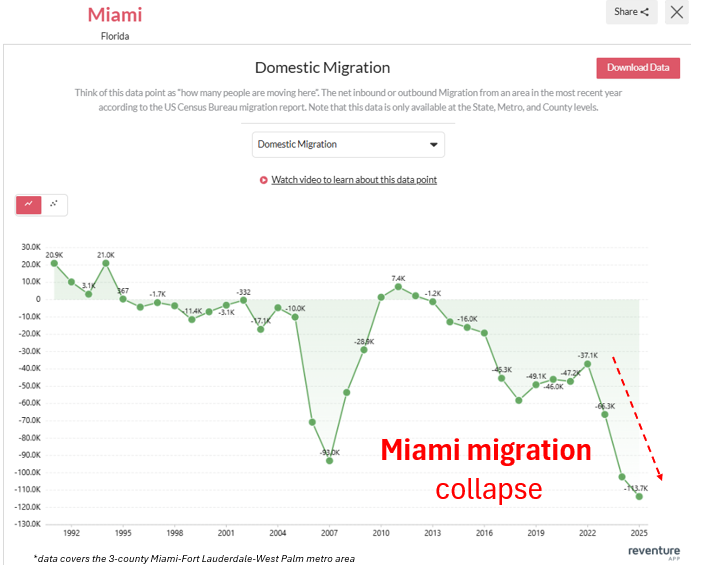
Miami's domestic migration just plunged to the lowest level on record in 2025.
With an astounding -113,000 net Americans fleeing the 3-county metro.
Note that Miami usually loses Americans due to outbound migration, and makes up for it with international immigration.
But the domestic losses are now getting especially severe, suggesting that the area is losing U.S. residents due to its lack of affordability.
Additionally, international migration dropped precipitously in 2025 as well, making Miami-Dade County the 3rd biggest population loser in the U.S.
These demographic statistics in Miami tell quite a different story from the conventional real estate narrative.
And are a primary reason why the real estate market is rolling over.
To access metro and county-level migration data for your area, download our app: reventure.app/mobile
English
That motion would be disingenuous.
This case is exactly how the path to precedent works.
Binding legal precedent can only come from appellate courts. For anyone wondering, an appellate court is a higher court that reviews decisions from lower trial courts.
So a case starts in trial court, produces a ruling or final judgment and can then be appealed to an appellate court.
Appellate courts do not hold new trials with new witnesses or juries. They review the existing trial record and issue written opinions that interpret the law and bind other courts within their jurisdiction.
A jury verdict from this trial court will not create binding legal precedent by itself... but the case is still a necessary first step toward establishing it.
Appellate courts cannot review the issues or create precedent unless the trial happens and produces a final judgment that can be appealed.
By every measure, this proceeding is an important part of how precedent gets made.
English

🚨 MUSK V. ALTMAN DAY 3
OpenAI and Microsoft just filed an emergency motion asking the judge to instruct the jury:
"Your verdict does not create legal precedent, establish legal rules, or bind the outcome of any other case, including any case involving charitable giving."
This is because Musk told the jury yesterday this case could "set precedent to losing every charity in America."
OpenAI and Microsoft lawyers are trying to kill Musk's testimony from yesterday because they think it landed with the jury.
Defendants don’t file emergency instruction motions unless they think the witness scored.

English
Correct. The real solution mentioned above is decoupling the pool from the Tidal Basin and using a controlled water source....like it operated pre-2012 with city tap water. In other words, close off the connection run then it can run like a normal pool with proper treatment.
The tradeoff: evaporation, splashes (especially with the fountain), and leaks require constant top ups with municipal water.
Environmentalists register that as 'losing millions of gallons a year.'
Ironically, when it's connected to the Basin, the same water is lost to evaporation/leaks but they don't count it the same way. Fair point on the city water cost though, however that could be mitigated as well.
English

@intelestia Then they won’t be using it because it’s prohibited. Z
English
The Lincoln Memorial Reflecting Pool renovation has a structural flaw I haven’t seen addressed and it sits outside a typical pool contractor’s scope.
The pool draws its water from the Tidal Basin, which is a 107 acre tidal reservoir connected to the Potomac River. Because water from the pool can flow back into the basin, the National Park Service prohibits chlorine and standard pool chemicals to protect the ecosystem. That removes the primary tools required to control biological growth.
The system relies instead on circulation (~1.5 to 4 million gallons/day), sand filtration, and ozone treatment. That works for debris and partial sterilization but it does not remove the underlying issue. Tidal exchange continuously introduces nitrogen and phosphorus, while the pool’s shallow depth (18-30 inches) maximizes sunlight penetration. Algae heaven.
The pool holds ~6.75 million gallons, and the 2012 redesign replaced municipal water (saving tens of millions of gallons annually) with Tidal Basin intake… trading a controlled system for a nutrient fed open loop. Algae blooms appeared within weeks of reopening and have recurred since, despite increased ozone treatment.
Photosynthesis is the multiplier. Under full sun, algae can double in under 24 hours. Filtration is a linear removal process. Growth is exponential. In an open loop system with constant nutrient input, those curves do not balance.
That’s why the outcome will keep repeating: seasonal algae blooms, green tint, odor, and periodic full drainings despite ongoing treatment. The constraint is the design.
Long term solution: decoupling and a controlled water source.
Mechanical filtration and circulation alone do not solve this. They can remove debris but they do not stop biological growth at the source.
Even if you filtered 100% of the water volume daily, you still lose. Without chemical suppression, the system is biased toward algae dominance.


English
No assumption of chlorine was made... the post explicitly states:
"National Park Service prohibits chlorine and standard pool chemicals."
"Even if you filtered 100% of the water volume daily, you still lose. Without chemical suppression, the system is biased toward algae dominance."
English
Look at the numbers and facts, not the online narrative and emotions.
Assume all the conspiracies are true. Take the time to read a reason that very well may be the one you stand behind anyway.
In reality, the United States is the world’s #1 oil producer and a net exporter. Read that again. No one is positioned to make more off this situation than the US.
We source only roughly ~2% of our petroleum consumption through the Strait of Hormuz... about 0.4 mb/d.
Right now the biggest race on Earth is AI. And the AI race runs on energy. Throttling the rest of the world shifts the competitive curve sharply in favor of the United States.
Think about it: if you own a restaurant and the price of fish doubles for you but quadruples for everyone else, yeah, your costs go up...but you just gained a massive 2x relative advantage. The market eventually offsets the sticker shock and you come out stronger.
By making energy more expensive everywhere else, the impact goes far beyond U.S. gas prices.
China pulls 35 to 50% of its oil imports through the Strait. India is near 35 to 45%. Asia overall absorbs 85-90% of the flow.
The Venezuelan play likely is not a coincidence, it secured access to the #1 proven oil reserves on the planet.
Seemingly, no one benefits more than the U.S. if the Strait is disrupted... both in the immediate term and for the long game.
Yes, higher global prices hit the pump and feed inflation. But U.S. producers benefit, domestic supply is comparatively insulated, and Asia’s energy lifelines become exposed. It's given that broader risks to global markets and retaliation obviously exist, but so do potential benefits.
End result: chokepoint leverage and a massive long term expansion of relative U.S. power.
What about all the conspiracies? Who cares. Let’s assume they’re all true. Multiple narratives can coexist.
You can believe there’s pressure from Israel, internal war mongers, whatever it is....and still land on the same structural outcome for American interests.
By the numbers alone ....even stripping out nuclear concerns.... the U.S. position in energy production and the AI race improves dramatically. That makes the outcome beneficial regardless of motive.
If you are absolutely ruthless on USA #1 and making decisions based purely on keeping USA #1, this is the play. All the other conspiracies may also be true but that’s merely a convenient coincidence for those parties.
Based on everything we’ve seen, I believe the President made this call from a cold, “USA #1” vantage point and all the other parties likely used the above as something to motivate him. It's still real though.
Many people hate on something just because someone they don't like happens to like it. Let them.
English

I could be wrong but as of now the Iran war has only hurt Americans.
Middle Eastern countries get richer, Russia gets richer
Americans get a gas tax and inflation.
YOU get poorer THEY get richer
Tell me how this is America first?
English
@EricLDaugh That's not enough. There’s a fix that needs to be applied for it to work… otherwise it’ll just turn green again.
Explained here:
x.com/i/status/20484…
Intelestia@intelestia
The Lincoln Memorial Reflecting Pool renovation has a structural flaw I haven’t seen addressed and it sits outside a typical pool contractor’s scope. The pool draws its water from the Tidal Basin, which is a 107 acre tidal reservoir connected to the Potomac River. Because water from the pool can flow back into the basin, the National Park Service prohibits chlorine and standard pool chemicals to protect the ecosystem. That removes the primary tools required to control biological growth. The system relies instead on circulation (~1.5 to 4 million gallons/day), sand filtration, and ozone treatment. That works for debris and partial sterilization but it does not remove the underlying issue. Tidal exchange continuously introduces nitrogen and phosphorus, while the pool’s shallow depth (18-30 inches) maximizes sunlight penetration. Algae heaven. The pool holds ~6.75 million gallons, and the 2012 redesign replaced municipal water (saving tens of millions of gallons annually) with Tidal Basin intake… trading a controlled system for a nutrient fed open loop. Algae blooms appeared within weeks of reopening and have recurred since, despite increased ozone treatment. Photosynthesis is the multiplier. Under full sun, algae can double in under 24 hours. Filtration is a linear removal process. Growth is exponential. In an open loop system with constant nutrient input, those curves do not balance. That’s why the outcome will keep repeating: seasonal algae blooms, green tint, odor, and periodic full drainings despite ongoing treatment. The constraint is the design. Long term solution: decoupling and a controlled water source. Mechanical filtration and circulation alone do not solve this. They can remove debris but they do not stop biological growth at the source. Even if you filtered 100% of the water volume daily, you still lose. Without chemical suppression, the system is biased toward algae dominance.
English
🚨 NOW: President Trump just DROPPED this incredible footage of his contracted crews CLEANING UP and BEAUTIFYING the Lincoln Memorial Reflecting Pool
Algae and goose poop being cleaned out. Dems let it fester there, GROSS.
TRUMP: “When this project is finished, it will be fantastic!”
LFG! The left hates this because it was Trump’s idea! BUILDER IN CHIEF 🇺🇸
Saving us HUNDREDS OF MILLIONS versus what it would’ve costed
English
@yonann The victim recognized the only way Martin Shkreli would put real effort into helping him was if he framed it as a path to making a billion dollars from it.
English

Martin Shkreli says his friend with 500 broken bones told him to make a drug and charge whatever he wants
"My friend has osteogenesis imperfecta, a rare bone disease, he's had over 500 bones broken in his life, he's about 4 feet tall, he can't really move, his disease will probably kill him"
"He would be ecstatic if somebody made a billion dollars off of his disease and then he got to walk. He told me come up with a drug for my disease, charge whatever you want, help me walk, I hope you become rich"
English
Correction: “what was perceived to be”… one of the most secure areas on Earth.
The Secret Service today couldn’t take on a 1993 John Malkovich (In the Line of Fire).
Apparently, all this recent shooter had to do was show up the day before and he could have walked in carrying anything, from guns to explosives.
Chalk it up as yet another wake-up call for the Secret Service to live up to what we imagined them to be.


English

CNN anchor Wolf Blitzer shaken but still coolly reporting the extraordinary peril the President and Cabinet survived, unscathed. A shooter inside one of the most secure areas on earth, it’s a stunning event.
English
@rustyrockets Yeah, we need a new form of punishment.
Sending all the shooters who are also LGBT 🌈 to be locked up with sex-starved men in prison for the rest of their lives…
is the real-world equivalent of a jihadist expecting 70 virgins.
English

