Adam Blumberg, CFP ®
13.9K posts

Adam Blumberg, CFP ®
@Interaxis8
CFP® | Chief Compliance Officer @Protocol_Wealth Fiduciary, non-custodial crypto-native wealth & treasury management SEC-registered RIA


1/ Natively tokenized @galaxyhq shares are now available on @Kamino’s Superstate Market. Eligible ex-US investors can bring shares onto @solana through Superstate and use them as collateral to borrow stables. The real shares of a major public company have entered DeFi.

1/ Natively tokenized @galaxyhq shares are now available on @Kamino’s Superstate Market. Eligible ex-US investors can bring shares onto @solana through Superstate and use them as collateral to borrow stables. The real shares of a major public company have entered DeFi.


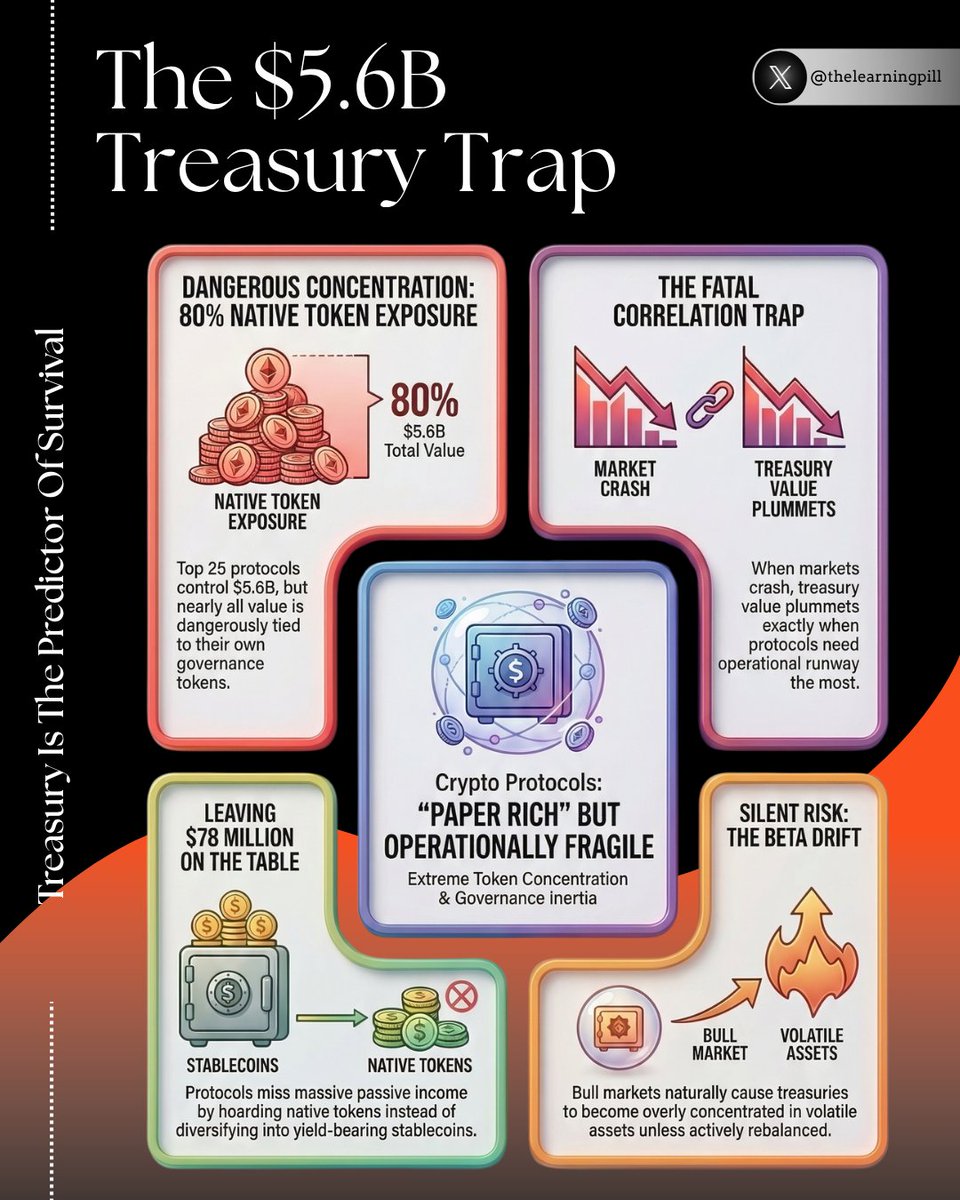
Most protocols manage their treasuries like a college student with their first credit card — reactive decisions, no strategy, and a lot of hope things work out. Traditional investment management has a foundational tool that DAOs desperately need: the Investment Policy Statement (IPS). Think of an IPS as the constitution for your treasury. It defines objectives, risk tolerance, asset allocation ranges, and decision-making processes before emotions and market volatility cloud judgment. For a protocol treasury, this means answering critical questions upfront: Are we optimizing for runway extension, yield generation, or strategic investments? What percentage should stay in stablecoins versus native tokens? Who has authority to execute trades, and what requires community governance? Many of the best protocols I've seen operate like endowments — they have clear policies that survive leadership changes and market cycles. They know exactly when to rebalance, when to take profits, and when to deploy capital for growth. Without an IPS, treasury management becomes a series of ad-hoc decisions driven by current market sentiment and liquidity needs. Protocols that want to survive and thrive beyond the next cycle should start thinking like institutions. That means bringing institutional-grade treasury management practices on-chain. @Protocol_Wealth

Most protocols manage their treasuries like a college student with their first credit card — reactive decisions, no strategy, and a lot of hope things work out. Traditional investment management has a foundational tool that DAOs desperately need: the Investment Policy Statement (IPS). Think of an IPS as the constitution for your treasury. It defines objectives, risk tolerance, asset allocation ranges, and decision-making processes before emotions and market volatility cloud judgment. For a protocol treasury, this means answering critical questions upfront: Are we optimizing for runway extension, yield generation, or strategic investments? What percentage should stay in stablecoins versus native tokens? Who has authority to execute trades, and what requires community governance? Many of the best protocols I've seen operate like endowments — they have clear policies that survive leadership changes and market cycles. They know exactly when to rebalance, when to take profits, and when to deploy capital for growth. Without an IPS, treasury management becomes a series of ad-hoc decisions driven by current market sentiment and liquidity needs. Protocols that want to survive and thrive beyond the next cycle should start thinking like institutions. That means bringing institutional-grade treasury management practices on-chain. @Protocol_Wealth


Introducing Whop Treasury. Earn 6% yield on all money earned on Whop.

Simply tokenizing assets will not attract onchain demand. Institutions need to go DeFi-native. Bryan Choe, Head of Research @RWA_xyz, breaks down the real playbook: from allocation vaults to liquidity sleeves. More on the latest episode of Bluechip Dialogues with @GarettJones.


1/ Today, we’re proud to announce a partnership with @InvescoUS, the first external asset manager on the Superstate platform. Invesco will take over investment management responsibilities for USTB. In May, USTB will become Invesco USTB. This is a major moment for Superstate.


The way we safeguard digital assets is about to change. For decades, financial regulation has assumed that protecting investors requires intermediaries: custodians, balance sheets, and institutional gatekeepers. But crypto introduced something fundamentally different. Recent events have also made something clear: not all “vaults” meet the standard investors should expect. Using smart contracts alone is not enough. Security and investor protection depend on how these systems are designed, governed, and constrained. Today, we submitted a letter to the SEC and CFTC proposing a new path: Non-custodial smart contract vaults can satisfy the SEC’s qualified custody and CFTC’s customer property segregation requirements — under defined guardrails. At a high level, custody and segregation rules have always been solving for the same risks: misappropriation, commingling, and exposure to intermediary insolvency. What’s changed is that we now have infrastructure that can address those risks directly in code, rather than through reliance on intermediaries. Properly designed vaults mean: ✔️ Client assets are never exposed to intermediary insolvency ✔️ Withdrawal rights can’t be overridden, even by insiders ✔️ Misappropriation is structurally eliminated ✔️ Asset ownership is continuously verifiable in real time Offering vaults as an option matters because many digital assets cannot be supported by qualified custodians today, and advisers face real tension between compliance frameworks built for traditional markets and the realities of on-chain assets. That’s why our letter proposes 7 guardrails for a vault to qualify: 1⃣ No unilateral authority to withdraw client assets 2⃣ Programmatic enforcement of client redemption, withdrawal, and transfer rights 3⃣ Cryptographic segregation of client assets 4⃣ Governance and upgrade mechanisms that are transparent, time-locked, and constrained 5⃣ Robust security and operational controls 6⃣ Independent audits and real-time verification 7⃣ No economic interests in underlying protocols These guardrails distinguish between vaults as infrastructure for investor protection and vaults as unstructured risk. If adopted, this would be the first regulatory framework where investor protection is achieved through non-custodial, programmable systems rather than institutional intermediation. Where safeguarding is embedded in the infrastructure itself. We believe this is precisely the type of alternative compliance framework envisioned by the recent SEC–CFTC MOU, and we encourage both agencies to engage through the Joint Harmonization Initiative to develop a coordinated, vault-based custody standard.