Rowow

598 posts

Rowow banner
Rowow

Rowow

@iRowow

Did you know that the corn belt produces more oxygen than the amazon rainforest

Florida Katılım Temmuz 2012
21 Takip Edilen128 Takipçiler
Rowow
Rowow@iRowow·
@SUNNYLAND24 @AmericanSbCorp Arsenic sits directly above antimony on the periodic table, so it behaves much the same in solution and follows antimony through the circuit. The old Idaho plant leached the ore in hot caustic and plated the antimony out with current, and arsenic control was the hard part.
English
0
0
0
1
☀️Alex Sunderland☀️
$UAMY $PPTA $XTPT #Antimony Industry I'll have a 🧵 on this later today. The focus will be on $PPTA's arsenic levels and how they compare to an actual high-grade antimony deposit like @AmericanSbCorp. You don't have to be an environmentalist to appreciate the difference in the scale of arsenic management between projects. Once you look at the numbers, it's hard to ignore. More later.
warren Shirley@warrenShirley15

@SUNNYLAND24 I’ve read that the arsenic levels at the PPTA mine make antimony mining a real problem

English
3
2
18
1.7K
Rowow
Rowow@iRowow·
@World_Data_A The 2,000 tonne number is mostly mine waste and tailings. The separation plant part is the 75 cubic metres of acid water and roughly a tonne of radioactive residue per tonne of oxide. Steel pickling lines already recover spent acid with membranes, so that half is a choice.
English
0
0
0
3
World Data Analysis
World Data Analysis@World_Data_A·
Read this and decide whether you still want rare earth refining ! Common claims about why China dominates rare earth refining Claim 1: “No one else has the technology” Wrong Claim 2: “China just has better economies of scale” Incomplete Root cause: Advanced countries largely refuse to do this extremely dirty refining themselves because of the severe environmental damage. So the work (and the pollution) ends up in China Rare earth refining produces enormous waste and pollution per unit of product - Roughly 2,000 tons of toxic waste (acidic wastewater, heavy metals, radioactive residue) for every 1 ton of rare earth oxide. - Heavy use of sulfuric/hydrochloric acid and other chemicals. In-situ leaching acidifies soil and releases arsenic, cadmium, mercury, thorium and uranium into water systems. - Areas like Bayan Obo and Jiangxi in China have suffered massive contamination of farmland, rivers and groundwater, with reported clusters of cancer and other health problems. Illegal mining in Myanmar is also polluting the Mekong basin. Comparisons - Producing 1 kg of neodymium (critical for magnets) requires processing ~200 tons of earth, about 40 times more material movement than producing 1 kg of gold. - Emissions intensity is roughly 40× higher than steel and 8× higher than aluminum per unit of metal. While the total mining footprint of renewables + rare earths is still much smaller than coal-based power systems, the local chemical and radioactive pollution from rare earth refining is exceptionally severe, often worse than conventional metal or coal mining when poorly managed. Cleaner technologies exist (advanced solvent extraction, better waste treatment, electrochemical methods), but the current dominant processes remain highly damaging. As long as wealthy countries outsource this stage, the environmental cost stays concentrated in China (and a few other places). Source: @BBC , MRS Bulletin, Chinese Society of Rare Earths
World Data Analysis tweet media
English
4
4
28
662
Rowow
Rowow@iRowow·
@roblun1 Sorting is the right thing to celebrate: the magnet is a couple of percent of a drive by weight and most of the value. Worth noting Mesa does the separation and the mixed oxide is made in Kingston, then split into single elements by partners. That last step is the thin one.
English
0
0
0
2
⚗️ NdPr DyTb | Rare Earths ⛏️⚗️🔥🔬🧲 Analyst ⭐
🇺🇸♻️ Feedstock is already flowing into Cyclic Materials' new Mesa, Arizona plant, before the ribbon's even been cut. Great work by the team here, this is what "urban mining at scale" actually looks like. 👏 Hard disk drives and automotive components are rolling in daily, each shipment a batch of rare earth magnets that would otherwise end up landfilled. 🧲 Cyclic Materials in Depth Dive can be found here👇 x.com/roblun1/status… 🏭 The Facility 📍 8341 E. Pecos Rd, Mesa, Arizona, Cyclic's first U.S. plant 💰 $20 million investment ⚙️ Designed to process up to 25,000 metric tons of end-of-life components annually 🤝 The ERI Partnership ERI processes over 1 million pounds of e-waste daily, using AI-driven sorting to identify magnet-bearing electronics across its nationwide network before routing qualified feedstock to Cyclic. This pre-sorting step matters enormously, turning a low-grade, diffuse waste stream into a concentrated magnet feedstock before it even reaches Arizona. "This partnership will transform that volume into an impactful supply of rare earths for the U.S.", Ahmad Ghahreman, Cyclic Materials CEO ⚖️ The smart part: Cyclic doesn't chase full separation ⚗️ 25,000 tons of raw feedstock at Mesa concentrates down to roughly 750 tons of magnet material via Mag-Xtract, then Cyclic's Kingston, Ontario hub converts that into recycled Mixed Rare Earth Oxide (rMREO), a blended Nd/Pr/Tb/Dy oxide product. ⚠️Critically, Cyclic stops there, it doesn't push further into individually separated high-purity REOs. That's a smart OPEX call: full separation (solvent extraction or ligand-based chemistry) is capital- and energy-intensive. Instead, Cyclic sells its MREO downstream to specialists built for that step, like its supply agreement with Solvay's La Rochelle plant for further separation and purification. 🏭Mesa, Arizona (Spoke facility): Closer Look 🔍 🔍Input: up to 25,000 metric tons per year of end-of-life components (HDDs, EV motors, wind turbine parts, MRI scrap, data center e-waste) 📍Output: Cyclic's Mag-Xtract process concentrates this down to roughly 750 metric tons per year of magnet material (steel, copper, aluminum are stripped out and sold separately) 📍That's already a ~33:1 mass reduction just to get from raw feedstock to concentrated magnet powder, Mesa doesn't produce oxides at all, only the magnet concentrate. 🏭Kingston, Ontario (Hub facility, the actual separation step): Input: 500 metric tons per year of magnet-rich feedstock (from Mesa and other spokes) Output: recycled Mixed Rare Earth Oxide (rMREO), the actual REE product, containing neodymium, praseodymium, terbium and dysprosium 📍🔍So the real yield chain is roughly 25,000 tons of raw e-waste → 750 tons of magnet concentrate → a hub converts that concentrate into MREO. Cyclic's planned South Carolina hub, for comparison, will process 2,000 tons of magnet material into just 600 tons of MREO (scaling to 6,000 tons in → 1,800 tons of MREO out). 📍🔍Logistics/collection cost dominates. Moving and pre-sorting tens of thousands of tons of e-waste to extract a few hundred tons of usable magnet material is why the ERI partnership (AI pre-sorting at the point of collection) exists, without it, Cyclic would be paying to ship and process huge volumes of near-worthless plastic and steel just to get to the magnets. ♻️ The bigger picture 💻🖥️📻📳 ♻️Recovered magnets, copper, and aluminum feed straight into clean energy, EV, electronics, and defense supply chains, with Cyclic focused on what it does best (recovery and concentration) and letting downstream separation specialists finish the job. 👀 🖥️Old hard drives and scrapped car parts are quietly becoming America's next rare earth mine. @CyclicMaterials @SolvayGroup @eridirect #RareEarths #CriticalMinerals #CyclicMaterials #ERI #Solvay #Recycling #CircularEconomy #Arizona #SupplyChain #NdFeB #UrbanMining #Reshoring
⚗️ NdPr DyTb | Rare Earths ⛏️⚗️🔥🔬🧲 Analyst ⭐ tweet media⚗️ NdPr DyTb | Rare Earths ⛏️⚗️🔥🔬🧲 Analyst ⭐ tweet media⚗️ NdPr DyTb | Rare Earths ⛏️⚗️🔥🔬🧲 Analyst ⭐ tweet media⚗️ NdPr DyTb | Rare Earths ⛏️⚗️🔥🔬🧲 Analyst ⭐ tweet media
⚗️ NdPr DyTb | Rare Earths ⛏️⚗️🔥🔬🧲 Analyst ⭐@roblun1

📚 Part of a Bigger Series x.com/roblun1/status… This Cyclic Materials breakdown is part of my ongoing series on the new magnet‑recycling and separation ecosystem — covering how different technologies and business models stack up across Ionic Technologies, Cyclic Materials, REEcycle, ReElement, Ucore, and HyProMag, comparing product purity, processing routes, scalability, and where each fits in the emerging circular magnet supply chain. ♻️ Cyclic Materials — Closing the Loop on Rare Earth Elements, Cyclic Materials is a privately held cleantech company, it is not listed on public stock exchanges like the NYSE or NASDAQ, and its shares are not available for purchase by the public. The global rare earth magnet recycling rate is currently below 1%. That means ~50,000–80,000 tonnes of critical magnets hit landfill every single year. Cyclic Materials is purpose-built to fix that. 🇨🇦🇺🇸🇪🇺 🔬 Two-Stage Proprietary Technology 🔵 MagCycle℠ — Mechanical Separation (Spoke) MagCycle (Physical Separation): This initial "spoke" stage uses mechanical and physical processes to separate magnetic materials from other components like copper, aluminium, and steel. It is specifically designed to overcome the challenge of handling permanent magnets, which tend to stick to machinery and other metals during traditional shredding. 1. Feedstock-agnostic shredding + advanced magnetic separation. 2. No smelting. No toxic acid attack. Zero liquid discharge. 3. Processing EV motors, wind turbines, HDDs, MRI machines & more. **>90% intermediate purity** | 70% smaller environmental footprint vs. mining. 🟠 REEPure℠ — Hydrometallurgical Refinement REEPure℠ is an advanced hydrometallurgical process that dissolves concentrated magnet scrap and precipitates recycled Mixed Rare Earth Oxide (rMREO), with independently verified reductions in CO₂, water use and energy consumption compared to primary mining. Cyclic has not publicly detailed whether REEPure℠ uses classic solvent extraction trains, ion-exchange, or other separation architectures; only that it is a proprietary hydrometallurgical route optimised for recycled magnet feed Converts concentrated magnet scrap → recycled Mixed Rare Earth Oxide (rMREO) 61.2% less CO₂ | 95% less process water | 88% less energy vs. primary extraction cyclicmaterials.earth/resources/solv… Mixed Rare Earth Oxides = rMREO ⚠️ rMREO is the critical upstream precursor — it feeds licensed separators like Solvay who produce the individual oxides (NdPr, Dy, Tb) needed for magnets. Cyclic Materials’ current technology stack is commercially configured to stop at rMREO, relying on partners like Solvay to carry out the complex final separation into individual oxides. Public information does not show Cyclic operating its own full rare earth separation circuit to high‑purity individual REOs, so their present system functions as an upstream recycler/upgrade step rather than a complete mine‑to‑magnet solution. Cyclic’s REEPure℠ chemistry is built to take magnet scrap → recycled Mixed Rare Earth Oxide (rMREO), then Solvay’s La Rochelle plant does the hard work of splitting that MREO into individual NdPr/Dy/Tb oxides. Based on what’s disclosed, Cyclic is not running its own full separation train to high‑purity individual REOs today — its tech is currently positioned as an upstream recycler and MREO producer rather than a complete separator 🏭 Hub & Spoke Infrastructure 📍 Hub100 — Kingston, Ontario 🇨🇦 → OPEN June 2024. First rMREO produced in North America from recycled magnets. 100 t/yr 📍 Centre of Excellence — Kingston 🇨🇦 → Q1 2026 140,000 sq ft | 500 t/yr rMREO + advanced R&D + mini-Spoke line. 📍 Commercial Spoke — Mesa, Arizona 🇺🇸 → Q1 2026 25,000 t/yr raw feedstock | Supporting 375 t/yr REO equivalent. Enough for 250,000 EV motors or 500,000 wind turbines annually. 📍 Mega-Campus — McBee, South Carolina 🇺🇸 → 2028 $82M investment | Hub + Spoke on one site 600 → 1,800 t/yr rMREO at full scale 🎯 Focused on Heavy Rare Earths — Dy & Tb for EV drivetrains & defence 🤝 Strategic Partners & Offtake 🔵 Solvay — La Rochelle, France (definitive supply agreement, June 2024) Kingston rMREO → Solvay France → individual separated NdPr oxides for European magnet manufacturers. The first functioning trans-Atlantic recycled REE supply chain. 🔴 Arnold Magnetic Technologies (US defence & aerospace) Recycled Sm, Nd, Dy + Co for DoD-compliant defence magnets. Zero Chinese content. ⚙️ VACUUMSCHMELZE (VAC) — 10-year exclusive agreement 100% of NdFeB manufacturing swarf from VAC's Sumter SC plant → McBee Hub. 🚗 SYNETIQ (IAA) — UK's largest vehicle salvage firm 🦁 InMotion Ventures (Jaguar Land Rover) — investor + feedstock partner. 🌬️ Renercycle — European wind turbine magnets. 🛵 Lime — e-scooter & e-bike magnets. ☁️ Sims Lifecycle Solutions — decommissioned HDD server magnets 🟢 Neo Performance Materials — trans-Atlantic MOU Jan 2026 ⚠️Cyclic has built a strong pipeline of potential feedstock partners, but fully utilising its planned hub-and-spoke capacity still depends on aggregating enough end-of-life motors, turbines and electronics in practice, not just in MoUs and press releases. Cyclic’s own material shows that every big step-up in capacity (Kingston CoE, Mesa, then McBee) assumes a lot more inbound magnet material actually shows up, consistently and at the right quality mix. Up to now, they’ve announced impressive named partners (SYNETIQ, Lime, Renercycle, Sims, VAC, Arnold, Neo, Solvay), but the public info does not give hard, contractually guaranteed tonnages that fully cover future 500 t/yr + 375 t/yr + 600–1,800 t/yr rMREO output. Cyclic’s model currently relies on a highly distributed, global network: feedstock from multiple countries into regional Spokes and Hubs, and rMREO then shipped to Solvay in France for final separation. Until more local separation capacity is in place, the overall supply chain remains fragmented rather than fully integrated. 💰 Capital Formation — >$158M USD Raised. The company has grown through private funding rounds, most recently closing a $75 million USD Series C in January 2026. This round was led by investors including the Canada Growth Fund and existing partners like BMW i Ventures and Energy Impact Partners. ▪ Series A 2023 — $27M | BMW i Ventures + Energy Impact Partners ▪ Series B Sept 2024 — $53M | ArcTern + Microsoft Climate Fund + Hitachi + BDC Capital ▪ Series B Ext 2025 — +$2M+ | Jaguar Land Rover (InMotion) + Amazon ▪ Series C Jan 2026 — $75M | Global scale-up ▪ Govt Grants — ~CAD $12.7M+ | Natural Resources Canada (NRCan), SDTC, IRAP 🔐 Supply Chain Traceability. Partnership with Circulor — blockchain Digital Product Passports on all rMREO Fully DFARS + EU CRMA compliant. Immutable chain of custody. Zero conflict mineral risk 🌍 Why It Matters China controls ~85% of global REE processing and ~70% of magnet production. EU CRMA mandates 25% domestic recycled REE by 2030. US DoD deadline: zero Chinese-origin magnets by January 2027. Cyclic Materials is one of the very few companies already shipping recycled rMREO to a licensed commercial separator — right now. 🔑 🌐 cyclicmaterials.earth @CyclicMaterials @SolvayGroup #CyclicMaterials #RareEarths #CriticalMinerals #REE #MagnetRecycling #CircularEconomy #NdFeB #MagCycle #REEPure #UrbanMining #CleanTech #EVs #WindEnergy #Solvay #DefenceSupplyChain #CriticalMaterials #SupplyChainResilience #Dysprosium #Neodymium #Terbium #Sustainability #ClimateInvestment #Canada #USManufacturing #EUGreenDeal @roblun1

English
1
0
7
799
Rowow
Rowow@iRowow·
@Sanjay_Sriv The scheme is written as integrated, so the oxide-to-metal step has to be built too, and that step is molten salt electrolysis, not a sintering line. The tighter limit is feedstock: 500 tonnes a year of IREL oxide against 6,000 tonnes of magnets means imports continue.
English
0
0
0
1
Sanjay Srivastava
Sanjay Srivastava@Sanjay_Sriv·
The most vulnerable bottleneck in "Make in India" isn't semiconductors or steel. It’s a foreign-dominated supply chain for an invisible $163M component: Rare Earth Permanent Magnets (REPMs). 🧲 Here is the strategic playbook India plans to close the gap: The Core Vulnerability: * 80%+ of India's $163M metal-based permanent magnet imports originated from China in FY26. * 94% of global permanent magnet production is controlled by Beijing. * 95% of global rare earth value sits in permanent magnets: the core component powering EV drive trains, robotics, smartphone vibration motors, wind turbines, and defence electronics. The Counter-Strategy & Execution Realities: * ₹7,280 Cr Incentive Plan: Scheme focused on building 6,000 MTPA of domestic sintered REPM capacity through capital subsidies and sales-linked incentives. * ECMS Integration: Expanding the Ministry of Electronics and IT (MeitY) component scheme to convert rare earth oxides directly into magnet alloys locally. * State Anchor: Leveraging IREL (India) Limited for upstream oxide refining and dedicated Rare Earth Corridors to ensure domestic raw material feedstock for private REPM facilities. * IP & Technology Hurdles: Tender deadlines for the ₹7,280 Cr scheme have seen multiple extensions as domestic bidders work to lock in complex international tech tie-ups and raw material supply lines. * First Movers: Grounding projects like Lohum Cleantech’s ₹500 Cr facility to process oxides to alloys locally. The Strategic Imperative: Assembling end-products without controlling foundational components leaves national supply chains exposed. Overcoming initial bidding delays and localizing magnet production can transform India from an assembly ecosystem into a sovereign, deep-tech manufacturing power. @PMOIndia @MinesMinIndia @GoI_MeitY By @Subhayan_ET #MakeInIndia #SupplyChain #AtmanirbharBharat #ElectronicsManufacturing #Geopolitics
Sanjay Srivastava tweet mediaSanjay Srivastava tweet media
English
2
17
33
723
Rowow
Rowow@iRowow·
@Trinity_Metals @USAmbRwanda Nice to see the plant running. Worth noting the tungsten side already has a landing spot: the concentrate from Nyakabingo goes to the converter in Towanda, Pennsylvania, one of the very few outside China. Having the mine and the conversion step lined up is the rare part.
English
0
0
0
3
Trinity Metals
Trinity Metals@Trinity_Metals·
#Lastweek, Trinity Metals was pleased to welcome John Armiger, Chargé d'Affaires at the @USAmbRwanda in Rwanda, to our Trinity Musha Mines, where he was received by our Chairman, Shawn McCormick. During the visit, Mr. Armiger toured our 12 tph processing plant, currently in the testing phase and expected to significantly increase production capacity, as well as the Heza Decline, where ongoing underground development is shaping the future of our operations. We were honored to host John Armiger and appreciate the opportunity to share the progress we are making as we continue building for the future. #TrinityMetals #CriticalMinerals #Mining #Rwanda #ResponsibleMining #OperationalExcellence #USRwandaRelations
English
1
25
55
2.3K
Rowow
Rowow@iRowow·
@skrubin The 4 to 5 tonnes is the honest number. That slag runs germanium at parts per million and the plant is rated near 30 tonnes a year, so the limit is throughput, not what is in the pile. Scrap ramps faster, which is why the DPA notice covers swarf and spent parts.
English
0
0
0
1
Sam Rubin
Sam Rubin@skrubin·
This week in Germanium news If you build anything with infrared optics, semiconductors, or fiber, the last two weeks deserve your attention. A few things landed almost on top of each other: 𝟭. 𝗪𝗮𝘀𝗵𝗶𝗻𝗴𝘁𝗼𝗻 𝗿𝗲𝗮𝗰𝗵𝗲𝗱 𝗳𝗼𝗿 𝘁𝗵𝗲 𝗗𝗲𝗳𝗲𝗻𝘀𝗲 𝗣𝗿𝗼𝗱𝘂𝗰𝘁𝗶𝗼𝗻 𝗔𝗰𝘁 — 𝗼𝗻 𝘀𝗰𝗿𝗮𝗽. The July 30 determination gives Commerce authority over "recoverable" critical minerals: swarf, spent optics, waste streams containing germanium. When a government starts rationing the 𝘳𝘦𝘤𝘺𝘤𝘭𝘪𝘯𝘨 stream, that's a supply signal, not a paperwork exercise. 𝟮. 𝗕𝗲𝗹𝗴𝗶𝘂𝗺 𝗽𝘂𝘁 𝗶𝘁𝘀 𝘁𝗿𝗲𝗮𝘀𝘂𝗿𝘆 𝗯𝗲𝗵𝗶𝗻𝗱 𝗮 𝗖𝗼𝗻𝗴𝗼𝗹𝗲𝘀𝗲 𝗴𝗲𝗿𝗺𝗮𝗻𝗶𝘂𝗺 𝗽𝗹𝗮𝗻𝘁. A state guarantee now backs Umicore's advance payments to Gécamines' STL unit, drawing germanium from the Big Hill slag heap in Lubumbashi. The headline everyone repeated: "up to 15% of global demand." The part worth reading twice — today that operation produces about 𝟰–𝟱 𝘁𝗼𝗻𝗻𝗲𝘀 𝗮 𝘆𝗲𝗮𝗿. Much of the industry assumed Congo would quietly solve the germanium problem. Four to five tonns doesn't solve it; it's the first rung of a very long ladder, and it took a sovereign backstop just to reach that. 𝟯. 𝗖𝗵𝗶𝗻𝗮 𝗶𝘀 𝗾𝘂𝗶𝗲𝘁𝗹𝘆 𝗯𝘂𝘆𝗶𝗻𝗴 𝘂𝗽 𝗶𝘁𝘀 𝗼𝘄𝗻 𝗴𝗲𝗿𝗺𝗮𝗻𝗶𝘂𝗺. Reports point to state purchasing of domestic material at record levels. Read that plainly: the country that already produces ~60% of the world's germanium is now hoarding its own supply rather than letting it flow out. Anyone treating germanium as a solved problem is reading last year's memo.
Sam Rubin tweet media
English
7
7
56
12.8K
Rowow
Rowow@iRowow·
@AtomsNotBits @iperionx The head office matters less than the feed. US sponge production stopped in 2020, and titanium is one of the metals you cannot plate out of water, so the furnace step is hard to skip. Going to powder from scrap sidesteps it, which makes scrap supply the thing to watch.
English
0
0
0
2
Atoms Not Bits
Atoms Not Bits@AtomsNotBits·
BREAKING: Major Australian critical-minerals company @iperionx plans to redomicile in Texas, creating a new U.S.-domiciled player in the critical-minerals market. The company already operates titanium and critical-minerals facilities across the U.S.
English
5
29
300
17.6K
Rowow
Rowow@iRowow·
@craigling10 The membrane route is mostly buying time. Ponds hold brine a year or more while the sun concentrates it; a selective membrane does it in hours on a fraction of the footprint. The real fight is magnesium, a near-twin ion that outnumbers lithium hundreds to one in some brines.
English
0
0
0
6
craig ling
craig ling@craigling10·
Direct lithium extraction is an alternative method that research teams and companies are exploring. These systems use membranes, solvents and electrochemical processes to selectively remove lithium ions from brine. One possible strategy is being developed by Wang's team at Monash University. The team began by evaporating the brine so that it formed a solid salt mixture and then used acetone and ethanol to selectively dissolve lithium salts while leaving most other compounds behind. In a laboratory study published last month, they report that the process recovered around 95% of the lithium present1. The method substantially reduces freshwater use compared to traditional methods, the researchers say. And the method could be coupled with solar-powered systems that capture and condense the evaporated water, allowing it to be recycled instead of being lost to the atmosphere. The solvents could also be recovered and reused. Wang says that the technique could eventually be used to recover lithium present in industrial waste streams and mining residues, which are otherwise wasted. Peter Sherrell, a materials scientist at RMIT University, Melbourne, says this approach has several advantages over existing methods, such as the high rate of lithium recovery and the fact that the solvents can be recovered and reused. But whether the industry will invest in the technology so it can be used in the real world remains to be seen, he adds. Separating lithium with heat A start-up company associated with the Australian National University in Canberra is using heat to extract lithium from brine. Most dissolved ions move away from areas with high temperatures. But under specific conditions “lithium ions are thermophilic — they like the heat”, says Juan Felipe Torres, the founder and chief executive of Soret Tech, the company investigating the method. Torres and his team use temperature changes to separate ions that are dissolved in the brine from each other. By creating a temperature gradient, Torres says that lithium can be extracted without evaporation ponds and so reduces fresh water loss and cuts land use. Torres says that the technique could eventually make it economical to mine lithium from the concentrated brine produced by desalination plants. nature.com/articles/d4158…
English
1
0
0
21
Rowow
Rowow@iRowow·
@Kesse85585Chris Refining is the right bottleneck. Terrestrial flowsheets run on cheap bulk inputs (coke, lime, fresh acid) that will not be there. Electrically driven chemistry is the exception, and the first resource ever made on Mars was oxygen, split from CO2 by an electrolyzer in 2021.
English
0
0
0
5
Chris Kessel
Chris Kessel@Kesse85585Chris·
The real bottleneck to a self-sustaining city on Mars isn’t getting there. It’s that we still have to ship millions of tons of finished industrial capacity from Earth. Introducing Project Aegis-Forge — a fully autonomous, AI-driven modular foundry that eats local regolith (Mars,
Chris Kessel tweet media
English
5
0
2
151
Rowow
Rowow@iRowow·
@CoffeeStocksGuy The Pulawy siting is the underrated part. The separation plant sits beside a working fertilizer and chemicals complex, so the acid and ammonia it burns through arrive over the fence, not by ship. Reagent logistics quietly kills more of these projects than the chemistry does.
English
0
0
0
4
Rowow
Rowow@iRowow·
@OwenGregorian Red mud is a smart target. Bauxite refining already dissolved the rock once, so what is left sits fine grained, iron rich, and stacked in ponds nobody wants. Pulling iron first is the right order too, it is the largest share of the mass and it masks the rarer metals behind it.
English
0
0
0
4
Owen Gregorian
Owen Gregorian@OwenGregorian·
US startup turning mining waste into defense minerals gets funds to reduce China reliance | Bojan Stojkovski, Interesting Engineering FAST Metals has raised $4.3 million and landed its first commercial customer, validating its technology for recovering critical minerals from mining waste. US mining tech startup FAST Metals is moving closer to commercial deployment after raising $4.3 million in pre-seed funding and securing its first customer, Metalox Mineral Corporation. As part of the strategic partnership, FAST Metals will process one ton of red mud and other iron-rich waste feedstock per week at Metalox’s Florida facility, a step the company says demonstrates the commercial viability of its mineral recovery technology. The startup has also signed additional agreements with trading partners as it works to expand its operations. The funding round was led by New Climate Ventures, with backing from Azolla Ventures, Humba Ventures, Astor Swiss, and Rio Tinto’s mining technology accelerator with Founders Factory. Transforming toxic mining waste into critical materials A growing mountain of industrial waste could become a new source of critical materials. Global alumina production has generated more than four billion tons of red mud, a byproduct of bauxite processing that contains an estimated $3 trillion to $4 trillion worth of metals used in defense, manufacturing and clean energy industries. Now, FAST Metals is developing technology designed to recover value from this highly alkaline waste stream by removing iron from low-grade materials such as red mud and extracting rare earth elements and other base metals. The approach aims to transform a long-standing environmental challenge into a commercial opportunity while reducing the volume of waste and the regulatory burden associated with its storage and management. According to Dr. Sumedh Gostu, co-founder and CEO of FAST Metals, the company’s patented technology platform is designed to recover critical minerals from low-grade feedstock by removing iron and transforming alumina refining waste into a new source of valuable materials. The technology can extract metals and minerals including iron, gallium, alumina, titania and rare earth elements, while creating a cleaner material stream that can be processed more efficiently for further recovery. Gostu said the process aims to unlock previously untapped resources from industrial waste while reducing the environmental impact associated with traditional waste management. Helping miners recover more value from existing assets The company notes its technology could help miners and extractors unlock new revenue opportunities from existing assets while reducing operational costs. The newly raised capital will be used to advance FAST Metals’ technical and commercial development, including further optimization of its recovery process and expanding engagement with customers across the mining, metals and critical minerals industries. As governments in the US and other Western markets look to reduce their dependence on China’s dominance across the critical minerals supply chain, the startup is positioning waste recovery as a potential alternative source of strategic materials. “Further proven by our valued partnership with Metalox, we offer miners and extractors a more sustainable approach that can unlock new revenue from existing assets while lowering operating costs” Gostu concluded. Furthermore, while the US remains a key market, FAST Metals is also targeting regions with large alumina industries, including Australia, as well as opportunities across the EU, the Middle East, India and North America. interestingengineering.com/energy/us-turn…
Owen Gregorian tweet media
English
10
1
19
2.5K
Rowow
Rowow@iRowow·
@staunovo The deposit is the easy half. Tungsten ore does not go to a smelter; it gets dissolved and converted to an intermediate salt, then reduced to metal powder, and that conversion capacity is what the US mostly lacks. Without it even a record find ships out as concentrate.
English
0
0
0
2
Giovanni Staunovo🛢
Massive US tungsten discovery could run into Nasa roadblock Miner may have found America’s largest deposit of crucial defence metal but space agency is blocking development ft.com/content/6abf82…
English
1
5
12
7K
Rowow
Rowow@iRowow·
@Arkasiraee The spec driving it is brutal: reactor zirconium has to get under about 100 parts per million hafnium, starting from rock where the two sit locked at 50 to 1. That final separation, not the zircon sand, is why so few countries can sell nuclear grade metal.
English
0
0
0
4
Ammanichanda
Ammanichanda@Arkasiraee·
Some of the world's most advanced technologies depend on a material whose greatest challenge begins before it is even used, separating it from its chemical twin. Hafnium and Zirconium occur together in nature, share almost identical chemical behaviour, and are so difficult to distinguish that separating them became one of the most demanding challenges in industrial chemistry. Yet after separation, their roles become completely opposite. Nuclear engineers need zirconium almost free of hafnium because zirconium absorbs very few neutrons, allowing nuclear fuel assemblies to operate efficiently, while hafnium is valuable precisely because it absorbs neutrons exceptionally well. Its thermal neutron absorption cross-section exceeds 100 barns, compared with zirconium's 0..18 barns a difference of more than 500 times. The same element that must be removed from nuclear zirconium becomes essential in reactor control rods, where its neutron absorption capability allows operators to regulate or shut down nuclear reactions safely. The refining difficulty is not discovering hafnium it is isolating it. Hafnium is primarily recovered from zircon minerals where it exists at only around 1-2% of the zirconium content, requiring advanced chemical separation techniques such as solvent extraction, ion exchange, and repeated purification stages. Unlike conventional metals where the challenge is mining and refining large volumes, hafnium production depends on mastering chemistry precise enough to separate two elements that nature almost perfectly combined. This capability is concentrated among a limited number of industrial ecosystems because possessing zircon resources does not automatically provide the technology needed to produce high-purity hafnium. The result is a material produced in quantities measured in only 200 -300 tonnes annually, compared with around 1.8 billion tonnes of steel produced every year. A tonne of construction steel may cost roughly $1,000, while high-purity hafnium can reach approximately $1.8-3 million per tonne depending on purity and market conditions. Beyond nuclear technology, Hafnium became a core enabler of modern computing. As semiconductor manufacturers pushed transistor dimensions smaller, traditional silicon dioxide insulation layers began reaching physical limits as electrons leaked through ultra-thin barriers. Hafnium oxide provided a solution through its high dielectric constant of around 20-25, compared with silicon dioxide's 3.9, enabling better insulation performance and helping continue transistor scaling in advanced processors. Hafnium's importance does not come from the amount of material the world consumes, but from the extreme precision required to separate, purify, and transform it into a material essential for nuclear safety and semiconductor technology. A material produced in only tiny quantities has become a cornerstone of two of the world's most advanced industries, controlling nuclear reactors and enabling the continued scaling of modern semiconductor technology.
Ammanichanda tweet mediaAmmanichanda tweet mediaAmmanichanda tweet mediaAmmanichanda tweet media
English
2
7
23
969
Rowow
Rowow@iRowow·
@BennyLam Keeping scrap home only pays if the refining shows up with it. Most boards leave because the smelter end barely exists here. The natural home is a copper refinery, where boards ride the copper in and the gold drops out in an electrorefining sludge that pays the power bill.
English
0
0
0
5
Benniji
Benniji@BennyLam·
The US just copied China's export-control playbook - on its own garbage. On July 30, Trump signed a Defense Production Act order letting Commerce restrict exports of scrap, e-waste and battery black mass holding critical minerals. The US exports roughly 33,000 tonnes of e-waste a month, most of it to Asia, where the minerals are refined and sold back. Washington is now hoarding the one critical-mineral stream it fully controls: its own trash. This is the mirror-image of China's 2025 rare earth curbs. Beijing restricted exports of minerals it refines. The US is restricting exports of minerals it can't refine - rare earth separation is still largely Chinese (about 90% of heavy rare earth processing) and US tungsten hasn't been commercially mined since 2015. Export controls are only as strong as the processing chain behind them. Restricting scrap without building domestic separation and refining capacity just parks the problem stateside: the minerals stay, but so does the bottleneck. Recycling capacity is the whole ballgame, and it takes years and billions to build. Both superpowers now treat waste as a strategic asset. The next US-China fight isn't over who mines the minerals - it's over who refines the trash. #USChina #CriticalMinerals #RareEarths #AISupplyChain
English
1
0
0
35
Rowow
Rowow@iRowow·
I heavily support the buyback method. Currently investment methods are designed to maximize takeover which is self damaging to the investor. The founder understands the vision better than anyone. They should promote the founder to grow it's share of ownership based off success, not depleating it
English
0
0
0
4
Spark_gap
Spark_gap@REALspark_gap·
amazon.com/Venture-Capita… Thomason introduces the Safer (Simple Agreement for Future Equity with Repurchase), an open-source financial instrument engineered to fix the misalignment between founders and investors. The Safer combines the uncapped equity upside of a traditional SAFE with the steady, downside-protecting yield of revenue-based financing, allowing companies to buy back investor claims using a percentage of their gross revenue. This sounds interesting 🤔 @iRowow @benmagelsen @EthicalSkeptic @ThePharmaPhD @Jefferson1776X
English
3
0
7
1K
Rowow
Rowow@iRowow·
Bokoni restarting matters more for supply reliability than for volume. Buyers have been burned by how fast one shaft or smelter outage moves the price, so users design platinum out where they can. The harder place to design it out is hydrogen electrolysers, where the metal sits on the electrode itself.
English
0
0
0
2
Rowow
Rowow@iRowow·
The processing side gets less attention than the legal one. Nodules are oxides rather than sulphides, so they can be leached in acid rather than smelted, and the metal comes back out of solution with current. The catch is manganese, close to 30 percent of the rock, which needs a market or it becomes the waste problem.
English
0
0
0
1
The Metals Company
The Metals Company@themetalsco·
The U.S. has once again reminded the world of the strategic opportunity presented by the responsible development of deep seabed minerals, and its clear and longstanding legal right to regulate their exploration and commercial recovery in the high seas. In a statement delivered yesterday at the ISA, the U.S. State Department commented: "For the United States, responsible seabed mineral development is a strategic national security and economic priority; we view seabed minerals in the broader context of critical mineral supply chain security. Global demand for critical minerals is rising rapidly, and diversified supply chains are necessary for geopolitical and economic stability. Humankind depends on modern technologies. It is prudent that we acknowledge that ocean resources can meet this demand with impacts significantly lower than many land-based alternatives." Read the full statement: metals.co/wp-content/upl… #deepseamining $TMC
The Metals Company tweet media
English
3
27
124
9.1K
Rowow
Rowow@iRowow·
Crawford's grade is about a quarter of a percent nickel, so it lives or dies on scale and cost per tonne rather than on any one metal price. The other open question is where the concentrate goes, since battery grade nickel has to be finished in a refinery, plated out of solution, and that capacity gets booked years ahead.
English
0
0
0
3
Mike Angelle ⬛⬜⬛⬜⬛⬜
BREAKING NEWS FOR CANADIANS 🇨🇦 The federal government has officially approved the construction of the Crawford Project in Northern Ontario, which is set to become one of the largest nickel mines in the world. Canada Nickel CEO Mark Selby confirmed the monumental decision today, announcing that construction is officially scheduled to begin in 2027. This massive critical minerals project represents a multi-billion dollar investment in Canada's green economy and EV supply chain, promising to create thousands of jobs while positioning the country as a dominant global leader in sustainable mining. As global demand for nickel surges, this approved megaproject marks a historic milestone for Canadian industry, resource development, and economic growth. ctvnews.ca/video/2026/07/… #BreakingNews #CanadaNews #Mining #Nickel #EV #Ontario #Economy
English
9
18
72
1.3K
Rowow
Rowow@iRowow·
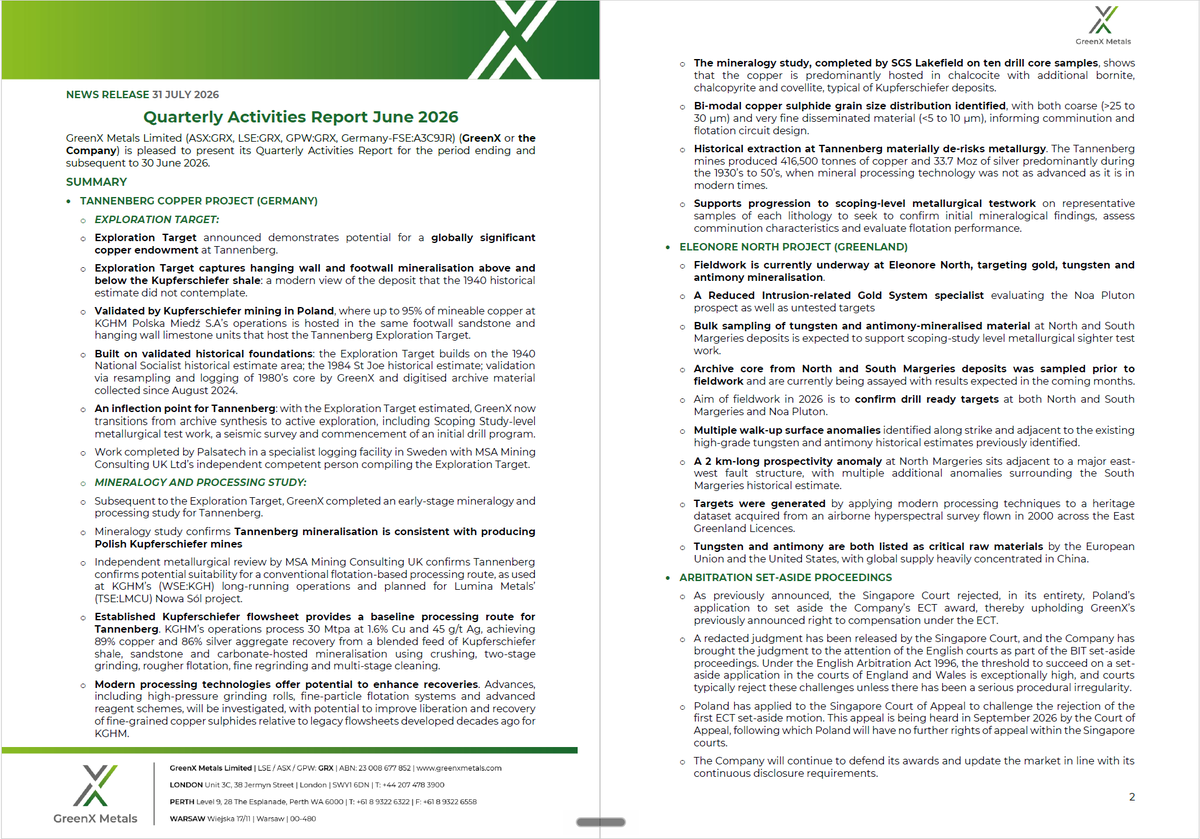
The Kupferschiefer comparison cuts both ways: that shale carries organic carbon that floats with the copper and pulls concentrate grade down, which is why KGHM's flowsheet is so involved. Silver is worth pinning down early, since it collects as sludge under the copper refining cells and often pays for the mine.
English
0
0
0
2
GreenX Metals
GreenX Metals@GreenxMetals·
GreenX Quarterly Activities Report is out. Tannenberg: Exploration Target work has moved us into active exploration. New mineralogy and metallurgical review confirms our copper-silver mineralisation matches the same #Kupferschiefer deposits mined at scale by @KGHM_SA in Poland, and the flowsheet planned for @LuminaMetals' Nowa Sól. Proven processing pathway for this deposit style. Next up: scoping level testwork, a seismic survey, and our initial drill programme, commencing late 2026. Eleonore North: 2026 field season underway, targeting gold, tungsten and antimony. Bulk sampling and RIRGS mapping progressing at Noa Pluton and the Margeries prospects. 🖇️ api.investi.com.au/api/announceme… #GRX $GRX #GreenX #CriticalMinerals #exploration #Tannenberg #copper #Germany #Greenland #gold #tungsten #antimony #KGHM
GreenX Metals tweet media
English
2
10
35
2.1K
Rowow
Rowow@iRowow·
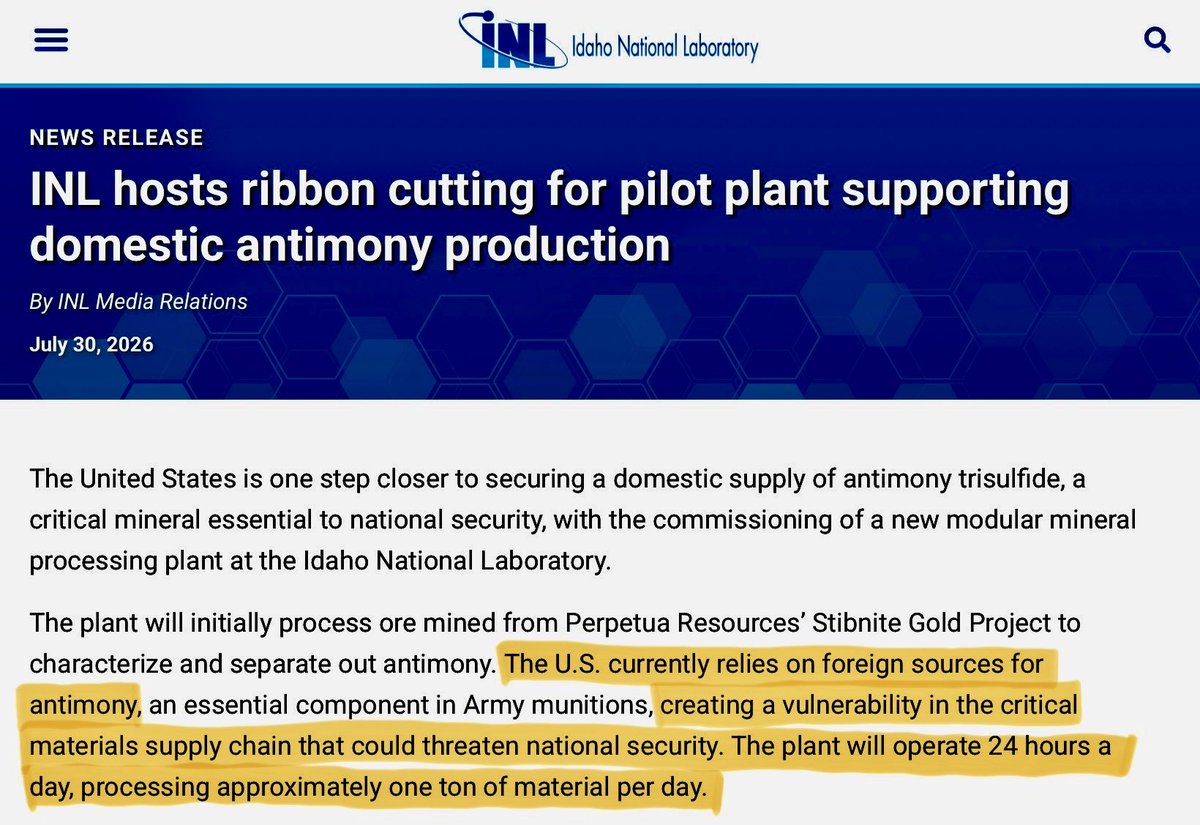
The mine date is the wrong clock. The chokepoint is refining, and the country is down to about one commercial smelter. Plenty of antimony already rides along in lead, where electrolytic refining drops it into the anode residue, so recovering it is a separation problem more than a mining one.
English
0
0
1
2
Montana Magnet
Montana Magnet@USAC_Bull·
The U.S. Army just opened a pilot plant to rebuild domestic production of antimony. $PPTA says their mine MIGHT begin producing in 2029. DLA approved $UAMY for MIL-SPEC antimony trisulfide in 2023. Gary gets 3 more years to make the monopoly even harder to break. 😭
Montana Magnet tweet media
English
10
3
50
7.5K