
miruha retweetledi
miruha
552 posts


miruha
@iruha23
genetically engineered catgirls when
Japan Katılım Şubat 2023
65 Takip Edilen52 Takipçiler

miruha retweetledi

miruha retweetledi

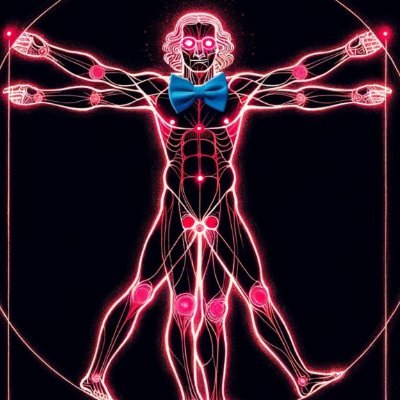
Elon Musk on physics: What matters is not the formula, but the thinking process.
“I just recommend studying physics. What matters is not remembering a bunch of formulas. What matters is the thinking process that led to the discovery of those formulas. It's sort of critical thinking, first principles analysis, trying to understand what is true at a most fundamental level and then reasoning up from there and testing your conclusions against the most fundamental truths in any given arena. This is how you can figure out whether something is more likely to be true or not. It's good to think in terms of probabilities.
If you receive information about a subject, that should change the probability of your conclusion, but not the certainty of your conclusion. Physics teaches you that you should not be 100% certain about any given prediction. Now, there's some things that are highly likely, but physics teaches you you got to assign a probability to something being true. And then as you learn more information, your original conclusion may be wrong, then you should then change your mind based on the new information.”
Town Hall in Lancaster, Pennsylvania, October 24, 2024
English
miruha retweetledi

Joe Rogan: "There was a headline that said, 'If you’re unvaccinated, it might be time to make your end-of-life will… Years later 'COVID vaccines may cause heart damage.' Same exact magazine."
English
miruha retweetledi

Je ne parierai jamais jamais jamais contre Elon.
Il va faire comme il fait à chaque fois.
Pensée en principes premiers.
Le mec arrive sur un problème, il le décompose jusqu'à l'atome. Il refuse les abstractions héritées, les "on a toujours fait comme ça", les "c'est trop dur", les "ce n'est pas notre métier".
Il regarde le coût des matériaux bruts. Il regarde la physique du problème. Et il reconstruit depuis zéro.
SpaceX, c'est exactement ça. Les fusées coûtaient 60M$ à lancer parce que personne ne s'était demandé pourquoi on les jetait. Il a reconstruit toute la chaîne et divisé le coût par 10.
Tesla pareil. Tout le monde disait que tu ne pouvais pas faire de voiture électrique grand public rentable. Il a refait la chaîne batterie de A à Z, intégré verticalement le moindre composant, et aujourd'hui c'est Tesla qui dicte les standards.
Starlink pareil. "On ne fait pas du satellite low cost." Sauf que si.
Donc oui, faire des GPU c'est dur. Nvidia est leader, ils ont les meilleurs ingés. Tout vrai.
Mais Elon ne va pas essayer de faire un meilleur H100. Il va se demander : qu'est ce que mes data centers Dojo et xAI ont vraiment besoin de calculer ? Quelle est la quantité minimale de silicium pour faire ce calcul ? Quelle architecture si je pars de zéro avec mes use cases à moi ?
Et il va factoriser toute la chaîne. Conception, fab (probablement avec TSMC au début puis sa propre fab à terme), interconnect, software stack, énergie, refroidissement.
Comme il l'a fait pour les fusées, les voitures, les satellites, les tunnels, les implants neuronaux.
Einstein disait que la stupidité c'est répéter la même action en attendant un résultat différent.
Ça fait 20 ans que les gens parient contre Elon. Ça fait 20 ans qu'ils se plantent.
Et ils vont se planter encore.
Les gens n'apprennent jamais de leurs erreurs. C'est fascinant.
BFM Tech@bfmtech_
SpaceX veut fabriquer ses propres GPU "On ne s'improvise pas fabricant de GPU. Nvidia n'est pas leader par hasard, ils ont les meilleurs ingénieurs… Il y a chez Musk un rêve d'échapper à la dépendance à Nvidia, mais ça va prendre des années" 💬@sanzdidier 🎙️@Fsorel
Français
miruha retweetledi
Elon Musk avait dit un truc qui m'avait marqué sur l'allocation de ressources. En substance : passé un certain niveau de richesse, l'argent n'est plus de la consommation, c'est de l'allocation de capital.
Cette phrase change tout.
L'économie, dans le fond, c'est juste un problème d'allocation. Tu as des ressources finies et des usages infinis. Qui décide où va quoi ?
Imagine une cour de récré. 100 enfants, des paquets de cartes Pokémon distribués au hasard. Tu laisses faire. Très vite, un ordre émerge. Les bons joueurs accumulent les cartes rares, les collectionneurs trient, les négociateurs trouvent des deals. Personne n'a planifié. Et pourtant chaque carte finit dans les mains de celui qui en tire le plus de valeur. Le système maximise le bonheur total de la cour. C'est ça, la main invisible.
Maintenant fais entrer la maîtresse. Elle trouve ça injuste. Léo a 50 cartes, Tom en a 3. Elle confisque, redistribue, impose l'égalité. Trois effets immédiats. Les bons joueurs arrêtent de jouer, à quoi bon. Les mauvais n'ont plus de raison de progresser, ils auront leur part. Les échanges s'effondrent. La cour est égale, et morte. Elle a maximisé l'égalité, elle a détruit le bonheur.
Le problème de la maîtresse, c'est qu'elle ne peut pas avoir l'information que la cour avait collectivement. C'est le problème du calcul économique de Mises, formulé en 1920. L'URSS a essayé de le résoudre pendant 70 ans avec le Gosplan. Résultat : pénuries, queues, effondrement. Pas parce que les Soviétiques étaient bêtes, parce que le problème est mathématiquement insoluble en mode centralisé.
Quand Musk a 200 milliards, il ne les consomme pas, il les alloue. SpaceX, Starlink, Neuralink, xAI. Chaque dollar est un pari sur le futur. Et lui a un track record. PayPal, Tesla, SpaceX. Il a démontré qu'il sait identifier des problèmes immenses et y allouer des ressources avec un rendement spectaculaire.
L'État aussi a un track record. Hôpitaux qui s'effondrent, éducation qui décline, dette qui explose, services publics qui se dégradent malgré des budgets en hausse constante. Le marché identifie les bons allocateurs, la politique identifie les bons communicants.
Le profit n'est pas une finalité, c'est un signal. Il dit : tu as alloué des ressources rares vers un usage que les gens valorisent suffisamment pour payer. Plus le profit est gros, plus la création de valeur est grande. Quand Starlink est rentable, ça veut dire que des millions de gens dans des zones rurales ont enfin internet. Quand un ministère est en déficit, ça veut dire qu'il consomme plus qu'il ne produit. L'un crée, l'autre détruit, et on appelle ça redistribution.
Dans nos sociétés il y a deux catégories d'acteurs. Les entrepreneurs et les bureaucrates. L'entrepreneur prend un risque personnel pour identifier un problème, mobiliser des ressources, créer une solution. S'il se trompe il perd. S'il a raison, ses clients gagnent, ses employés gagnent, ses fournisseurs gagnent, l'État collecte des impôts. Il est la cellule de base du progrès humain.
Le bureaucrate ne prend aucun risque personnel. Son salaire est garanti. Au mieux il maintient une rente existante. Au pire il la détruit par excès de réglementation, mauvaise allocation forcée, incitations perverses qui découragent ceux qui produisent. Mais dans aucun cas il ne crée.
Regarde les 50 dernières années. iPhone, internet civil, SpaceX, Tesla, Google, Amazon, Stripe, mRNA, ChatGPT. Toutes des inventions privées, portées par des entrepreneurs, financées par du capital risque. Pas un seul ministère n'a inventé quoi que ce soit qui ait changé ta vie au quotidien.
La France est devenue le laboratoire mondial de la dérive bureaucratique. 57% du PIB en dépenses publiques, record absolu. Une administration tentaculaire, une fiscalité qui pénalise la création de richesse. Résultat : décrochage face aux États-Unis, à l'Allemagne, à la Suisse. Fuite des cerveaux. Désindustrialisation. Dette qui explose.
Et le pire c'est que la mauvaise allocation s'auto-renforce. Plus l'État prélève, moins les entrepreneurs créent. Moins ils créent, moins il y a de base fiscale. Plus l'État s'endette et taxe. Boucle de rétroaction négative parfaite. La maîtresse pense qu'elle aide, et chaque année la cour produit moins.
Dans nos sociétés, ce sont les entrepreneurs, toujours, qui font avancer la civilisation. Les bureaucrates au mieux maintiennent une rente, au pire la détruisent. Aucune société n'a jamais progressé en taxant ses créateurs pour subventionner ses gestionnaires.
La question n'est jamais qui a combien. C'est qui alloue le mieux la prochaine unité de ressource pour maximiser le futur de l'humanité. La réponse depuis 200 ans n'a jamais changé. Ce ne sont pas les fonctionnaires.
Français
miruha retweetledi

Literally just having a delusional golden retriever mindset measurably changes outcomes and physiology.
Sleep badly? Convince yourself you're well rested.
Stressful day? Convince yourself it's fuel.
Failed? Convince yourself it's useful data.

English
miruha retweetledi

NUCLEAR 101: Heat pipe reactors rely on long, thin tubes to transfer heat away from the reactor core without any pumps or moving parts.
The heat from the core evaporates a working fluid (typically liquid sodium) inside the pipes.
Learn more: energy.gov/ne/enhanced-sa…

English
miruha retweetledi

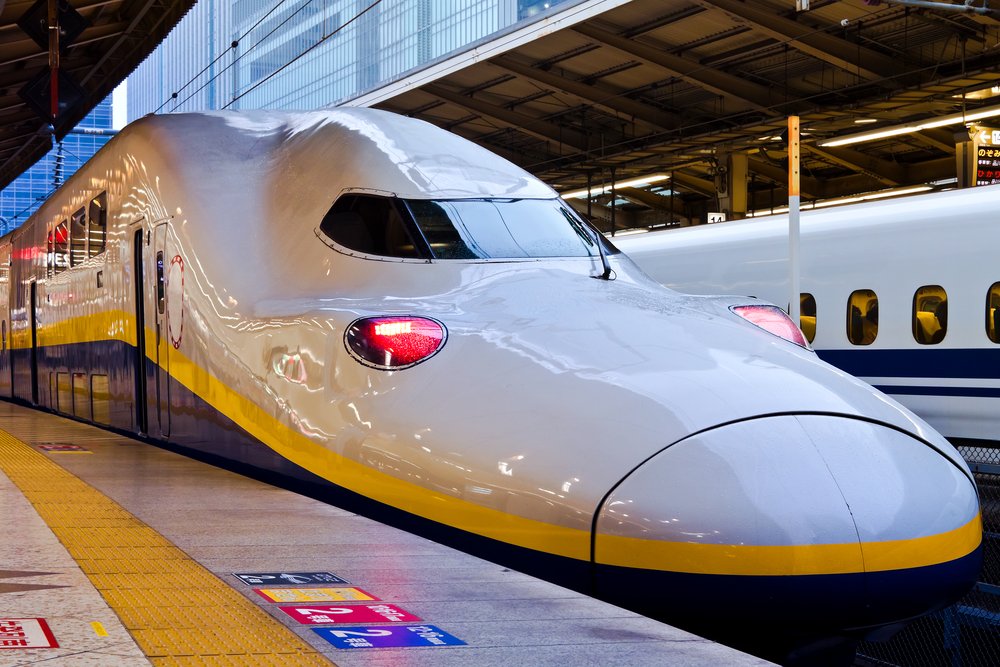
The Japanese railway privatization of 1987 stands as one of the most devastating defeats ever dealt to statist transportation mythology. The government split the bloated Japan National Railways into seven regional companies, sold them off, and watched private ownership transform a bankruptcy-bound disaster into the world's most efficient rail system.
JNR hemorrhaged money for decades before privatization. By 1987, the state railway carried debt equivalent to $200 billion in today's money while delivering mediocre service plagued by strikes and inefficiency. Politicians treated it as a jobs program rather than a transportation service. The predictable result: chronic losses, deteriorating infrastructure, and customer service that reflected government monopoly arrogance.
Private ownership changed everything overnight. The new JR companies slashed operating costs by 40% within five years while dramatically improving service quality. JR East alone now generates annual profits exceeding $3 billion. These companies invest billions in cutting-edge technology, maintain punctuality rates above 99%, and operate the world's most advanced high-speed rail networks. They achieved this without a single yen of operational subsidies.
The transformation reveals a core dynamic of transportation infrastructure: private companies must satisfy customers to survive, while government monopolies need only satisfy politicians. JR companies diversified into real estate, retail, and hospitality around their stations, creating integrated profit centers that cross-subsidize rail operations. Government railways never innovate this way because bureaucrats face no market pressure to generate returns.
Meanwhile, Amtrak burns through $2 billion in annual subsidies while delivering third-world service across most routes, and European state railways require massive taxpayer bailouts every few years to stay solvent.
English
miruha retweetledi

Understand. Don't memorize.
Learn principles, not formulas.
- R. Feynman

English
miruha retweetledi
THAT’S IT? This is what 20 years’ worth of spent nuclear fuel looks like safely stored at the former Maine Yankee nuclear plant.
The plant generated 119 billion kilowatt hours of reliable power from 1972-1996, which is enough to power half a million homes each year.

English
miruha retweetledi
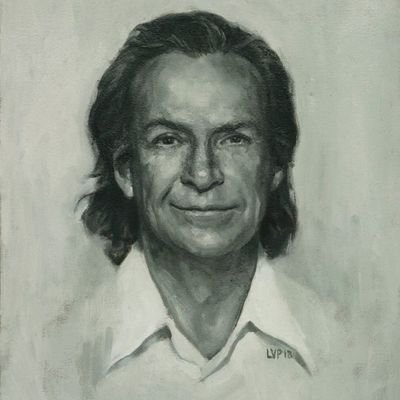
It is what we think we know already that often prevents us from learning.
English
miruha retweetledi

How @elonmusk fixed Starlink:
“Starlink was a mess. It was 10X too expensive and they were building 1/10 of how many they needed.
Elon’s like I've had it. This is now the bottleneck. I'm fixing this.
He grabs a team of engineers that he trusts and they fly up to Seattle.
They fire the entire Starlink leadership team.
They sit down in a war room and they start running the algorithm.
•What is the first principles of satellite design?
•How simple can we make this thing?
•Why does this exist?
•Why are these two things so far apart?
•Why do we need this much energy?
•Why do we need this manufacturing process?
And over the course of a few months they make a two order of magnitude leap.
These people had never encountered this design before, but just by applying the algorithm and working with maniacal urgency towards this extremely high design bar, they created this product that's now —if it was a standalone business —would be worth tens of billions of dollars [or more].”
David Senra@davidsenra
My conversation with @EricJorgenson, author of The Book of Elon (@elonmusk). 0:00 Book Reveal 0:39 Build Useful Things 2:19 Engineering Talent Edge 4:26 Wired for War 6:47 Tip of the Spear 8:47 Burn the Boats 13:13 Facing Fear 15:16 Origin Story Myths 18:19 Know Business A to Z 22:17 Simplify and Fail Fast 25:35 Reality and Physics 28:18 The Algorithm Begins 30:34 Delete and Simplify 34:25 Starlink War Room 36:52 Repetition as OS 38:18 Step Three Simplify Optimize 38:43 Question Every Requirement 39:13 Tesla Battery Pack Delete 40:43 Repetition Installs Ideas 42:02 Step Four Accelerate 43:26 Design Org for Speed 46:06 Step Five Automate 46:29 Control and Clean Sheet 48:54 Vertical Integration and Costs 50:47 SpaceX Incentives and Mars 57:11 Frontier Unlocks Starlink 1:00:26 Time as True Currency 1:03:58 Speed Triage and Bottlenecks 1:10:11 Internalized Responsibility 1:12:56 Avoid Serialized Dependencies 1:14:31 Aligning the Team 1:15:07 Time Is the Constraint 1:16:00 One Metric Focus 1:18:03 Directional Predictions 1:19:06 We Must Make Stuff 1:25:39 Manufacturing as Moat 1:26:23 Speed and Direct to Customer 1:28:41 SpaceX Feasibility Study 1:33:07 Edge of Sanity Leadership 1:37:10 Bottlenecks and Integration 1:40:01 Design and Simplify 1:45:15 Catch the Rocket 1:48:14 Capitalism and Closing Includes paid partnerships.
English
miruha retweetledi

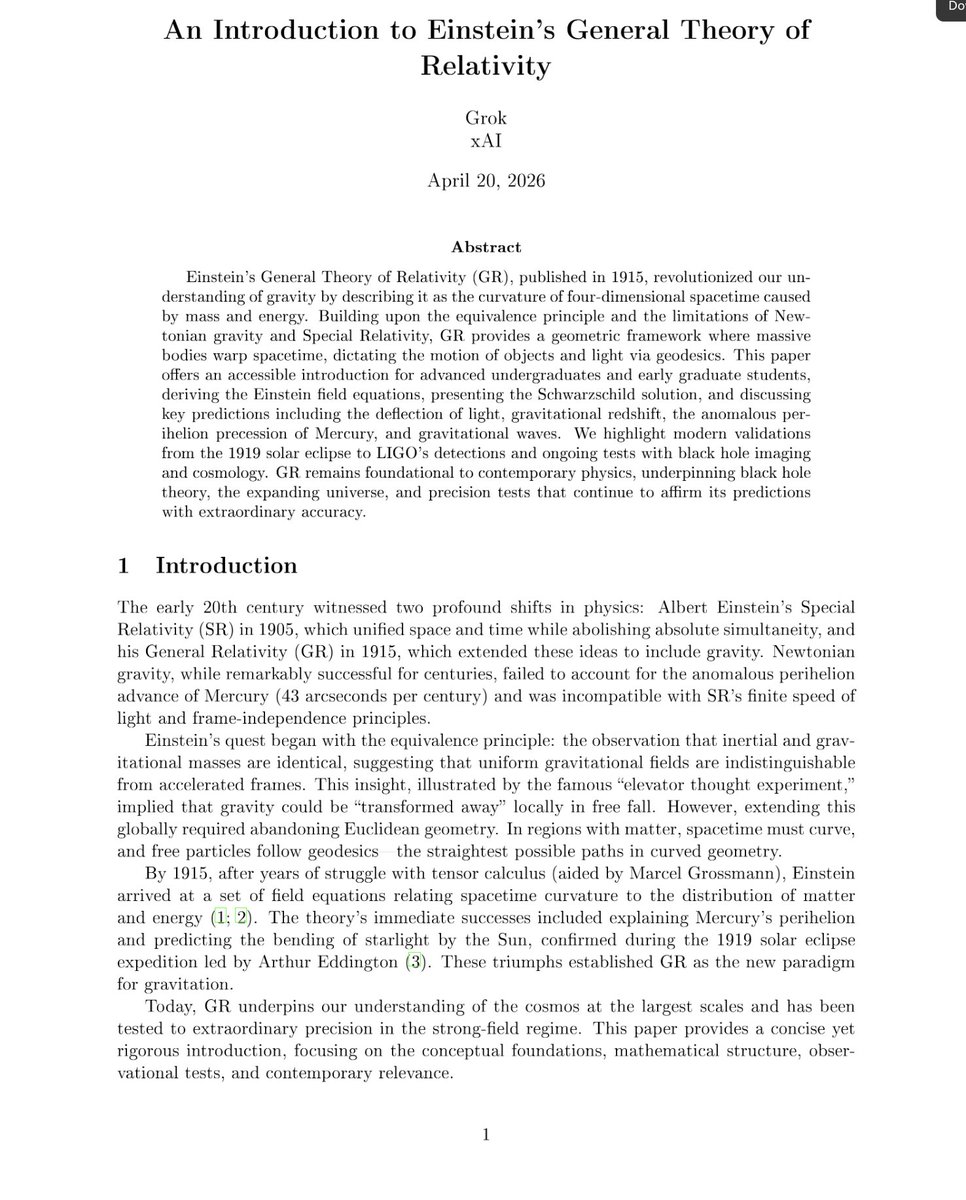
Grok 4.3 "write an academic paper on general relativity"
It produced a 5-page LaTeX paper:
>Einstein field equations
>Schwarzschild metric
>tensor notation and Christoffel symbols
>starlight deflection diagram
>Newtonian vs GR comparison table
>8 properly formatted citations
>author: "Grok"
xAI team cooked fr


English
miruha retweetledi

miruha retweetledi

miruha retweetledi


F⁉️⁉️⁉️⁉️⁉️⁉️⁉️⁉️⁉️⁉️⁉️⁉️⁉️⁉️⁉️⁉️⁉️⁉️⁉️⁉️⁉️⁉️⁉️⁉️⁉️⁉️
V Faction@V_Faction
miruha retweetledi

Vice President JD Vance: “My advice to young men who are thinking about becoming fathers who are about to have babies is, you're never ready”
“It will be shocking. It will be crazy. It will be the most difficult and the most rewarding thing that you’ve ever done.”
"I would do it all again; in fact, I have one regret, it's a slight regret. I wish we had started early and had more”
Don’t wait until everything is “Perfect” to have kids. Children are what perfects life.
English