Jack Hau

79 posts

Jack Hau banner
Jack Hau

Jack Hau

@jackhau0212

i talk to LLMs for a living | prev: ai @imperialcollege & engineering @ucl

🇬🇧 LDN | 🇭🇰 HK Katılım Kasım 2013
359 Takip Edilen44 Takipçiler
Jack Hau
Jack Hau@jackhau0212·
@botirkhaltaevv Surely the multiplier is a function of how well you use AI and it is not the same the how technical you are. There might be some correlation but I wouldn’t rule out the (non-technical) meticulous context gatherer over a (technical) 1-shot wonder prompter
English
1
0
0
34
Botir Khaltaev
Botir Khaltaev@botirkhaltaevv·
@jackhau0212 AI is a multiplier the more technical you are the larger you're coefficient.
English
1
0
1
60
Botir Khaltaev
Botir Khaltaev@botirkhaltaevv·
AI has widened the gap between the technical and the non technical. Not the opposite.
English
2
0
4
589
Jack Hau
Jack Hau@jackhau0212·
I’ve been using @harborframework for a while for evals, and I’m a huge fan. I love the design and the core principles behind how an environment is modelled. The thing that gets me most excited is that good evals unlock so much more than benchmarking. They become the foundation for hill-climbing, auto-research, RL, GEPA, trajectory analysis, SFT data generation, and more. Rollouts, rollouts, rollouts.
Alex Shaw@alexgshaw

Rollouts for eval, rollouts for RL, rollouts for GEPA, rollouts for prod, rollouts for trajectory analysis, rollouts for SFT data gen, rollouts rollouts rollouts

English
3
3
49
8.3K
Jack Hau
Jack Hau@jackhau0212·
OPSD is kinda OP
Dwarkesh Patel@dwarkesh_sp

Recently met @srush_nlp and he started giving me an impromptu lecture on how targeted on-policy self-distillation works. I asked him if I could record it on my iPhone. The basic idea is this: if the model made a mistake at some point in the rollout (for example, calling a tool that doesn't exist), we want to discourage this specific error, but we don't want to just learn from the final reward, because it's a very noisy signal spread out over the whole trajectory. So we have another model read this trajectory and figure where the error was made. It simply inserts some hint tokens to the part of the trajectory right above where the mistake was made. Now with these injected hint tokens, have the model run a forward pass. You're not having to regenerate a new rollout - aka no new decode required. The hint causes the model to assign lower probabilities to the error tokens. You then trains the original model to match these new probabilities, teaching it to downweight that specific mistake.


Nederlands
0
0
1
237
Ben Clavié
Ben Clavié@bclavie·
very excited about the upcoming @aiDotEngineer is going to be very nice, looking forward to meeting a ton of people I only really know through their profile picture
English
6
1
26
4.4K
Alex Mackenzie
Alex Mackenzie@alex__mackenzie·
Hosting another eng gathering in London this month (~20 places), come along (just DM) if you enjoy discussing: Distributed Systems Databases High Frequency Trading Web Browsers Compilers AI Infra ++
English
14
5
37
7.4K
Jack Hau retweetledi
Adithya S K
Adithya S K@adithya_s_k·
Excited to release the Ultimate guide to RL environments! Definitions of RL environments differ wildly in the LLM era, so we spent the last month building several RL environments across 6 different frameworks, domains and complexities to map out which are easiest to build with and which can be scaled to 1000s.
English
50
164
1.3K
247.7K
Jack Hau
Jack Hau@jackhau0212·
@Vtrivedy10 genuinely love the framing of fitting an agent and this has given me a lot of inspiration (thanks!) do you not think that a better mental model for this would be agent is harness(model), eval is the loss function.
English
0
0
1
66
Viv
Viv@Vtrivedy10·
Data Driven Agent Design with Evals & Hill Climbing Algorithms this is a mental model dump i’ve been thinking through + iterating on as we’re building self-improvement infra around agents: - mining Trace Data to find errors and tweak the agent harness - building + maintaining evals - using evals to guide the agent update/generation process What are the inputs for fitting an agent: the main idea is what does a sklearn fit(model, data) function look like for agents agent = fit (model, harness, evals) Data Driven Agent Design: Evals are training data for agents - every eval encodes behavior we want to see in our agent, just as every training data point in standard ML produces a gradient to shift model weights Every eval we fit our agent towards votes for how to alter the harness to make that eval pass “Can I start from an empty harness. Fit to evals, and produce a great agent? Should that be how we do things + inject some more human priors” Verifiable Signals: Evals are akin to specs but better because they’re verifiable and measurable We can use rubrics that give a dense feedback signal for work, programmatic verification, and LLM as a judge to evaluate subjective behavior You can directly measure which evals pass and which don’t at a glance. This is very useful, you can’t as easily do the same attribution via a simple markdown spec Iterating on Evals over Time: Evals are model and harness dependent. “Spring Cleaning” and updating of Evals is important as you no longer need them Agent design is focused on vibes today, but could benefit by being open to more data driven design. Just as frontier labs spend millions on data quality, teams can invest time into fantastic eval curation and design. The future of specialized agents will depend on encoding that specialization is something measurable. Data matters, and good evals are a data signal to build a good agent 🚀
Viv tweet media
English
20
26
267
16.5K
Jack Hau retweetledi
Atlassian Williams F1 Team
Atlassian Williams F1 Team@WilliamsF1·
Welcoming Claude, @AnthropicAI's frontier AI model, as the team’s Official Thinking Partner! Through this partnership, Claude will be integrated across the entire Williams organisation—working alongside engineers and team strategists to support how the team thinks, plans, and performs. Read more about the partnership – and what it means for our mission to get back to the front of the grid - here: bit.ly/46sYJtg
Atlassian Williams F1 Team tweet media
English
157
272
4K
886.6K
Jack Hau retweetledi
SpaceX
SpaceX@SpaceX·
SpaceX has acquired xAI, forming one of the most ambitious, vertically integrated innovation engines on (and off) Earth → #xai-joins-spacex" target="_blank" rel="nofollow noopener">spacex.com/updates#xai-jo…
SpaceX tweet media
English
3.9K
7.6K
45K
19.3M
Jack Hau
Jack Hau@jackhau0212·
is model pruning just cardio for neural networks?
English
0
0
0
31
Jack Hau retweetledi
Karan Dalal
Karan Dalal@karansdalal·
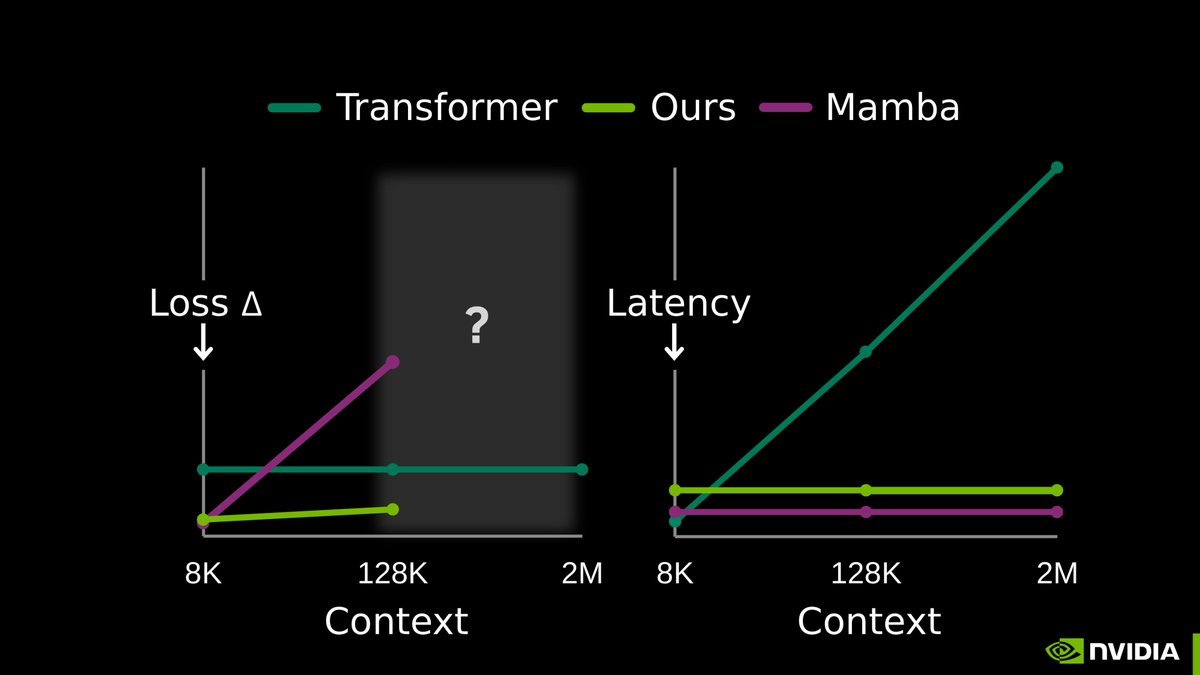
LLM memory is considered one of the hardest problems in AI. All we have today are endless hacks and workarounds. But the root solution has always been right in front of us. Next-token prediction is already an effective compressor. We don’t need a radical new architecture. The missing piece is to continue training the model at test-time, using context as training data. Our full release of End-to-End Test-Time Training (TTT-E2E) with @NVIDIAAI, @AsteraInstitute, and @StanfordAILab is now available. Blog: nvda.ws/4syfyMN Arxiv: arxiv.org/abs/2512.23675 This has been over a year in the making with @arnuvtandon and an incredible team.
Karan Dalal tweet media
English
91
320
2.1K
576.1K
Jack Hau
Jack Hau@jackhau0212·
TIL Colorado has 697 sides
Español
0
0
0
69