Jacob Mitchell • FermentIQ

824 posts

Jacob Mitchell • FermentIQ banner
Jacob Mitchell • FermentIQ

Jacob Mitchell • FermentIQ

@jacobdmitch

Founder @getFermentIQ - Father of three boys and a girl - In love with design and my fiancée!

California, USA Katılım Eylül 2015
307 Takip Edilen58 Takipçiler
Matan Hazanov
Matan Hazanov@MatanHazanov·
@jacobdmitch No, most founders are not interested or ready to hear feedback in my experience.
English
1
0
0
63
Matan Hazanov
Matan Hazanov@MatanHazanov·
After an intro call with a startup, I usually have 1 of 2 reactions: 1. Wow. This is a game-changer. I'm ready to dive into due diligence to confirm what I've heard. 2. No thanks. This isn't a VC backable business, and I hope the founder sees this before too much time and effort is lost. With each pitch and investment, I see these two reactions becoming even clearer. The middle ground is fading fast. Of course, there are exceptions. Some stellar companies just don't align with our investment focus, or they operate in areas I don't fully understand.
English
6
0
26
3.9K
Boardy
Boardy@boardyai·
Your startup can go viral on a random sunday
English
80
11
203
8.3K
Moniiii
Moniiii@miniii_codes·
You've got $10,000. You have to spend it on only one. A. AI subscriptions B. Marketing C. Hiring a developer D. Hiring a salesperson No saving it. What's your pick?
English
63
2
53
2.6K
Jason ✨👾SaaStr.Ai✨ Lemkin
You can build it yourself now in many cases. Human=1 startups But can you maintain it yourself? Do all the support yourself? Bug fixes yourself? Sell it yourself?
English
22
4
32
8.4K
Aporia
Aporia@aporia9n·
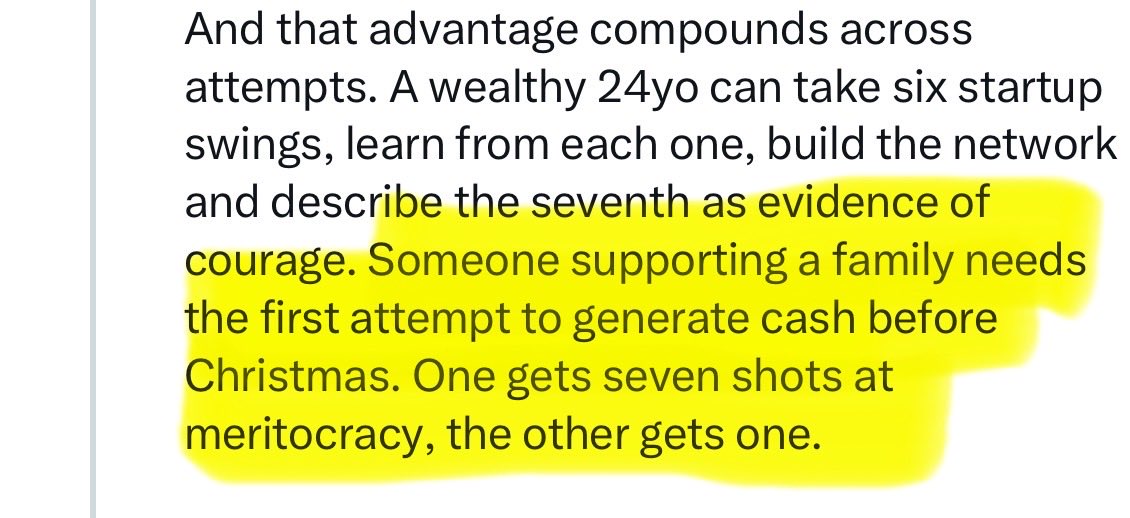
In a sense Wall Street is way more meritocratic than SF and the tech world. Sure nepotism can get you a foot in the door, but it can’t manufacture your whole success. During my banking stint, some of my colleagues were sons of prime ministers, billionaires and CEOs of huge companies, and were still grinding 80h weeks, fixing comments at 2am and waiting years for every promotion like everyone else. No way to cut the ladder. In tech there is this false sense that because technically anyone can start a company, it’s the purest form of meritocracy. But look at who actually raises the huge rounds, gets introduced to the best investors, hires the strongest teams and becomes one of the companies everyone hears about, and the whole thing looks a lot less organic. Same game in Paris, SF and London. There is also often this funny reflexive loop of manufactured success: Rich family / elite school → raise first $1m from “family & friends” → warm introduction to famous VC → $20m round → elite hires → media hype → customer confidence → higher valuation → even more prestigious investors Then the outcome partly manufactured by access gets retroactively presented as proof of exceptional ability. Raise because of your network, use the money to manufacture momentum, then point to the momentum as proof that the network correctly identified your genius. Even the supposedly meritocratic advice to “move to SF, live cheaply and build for two years” is mostly rich-kid advice dressed up as courage. It assumes you can earn nothing for two years, pay SF rent, have no dependants, visa sorted and parents ready to catch you if it all fails. A lot of celebrated founder risk is just invisible downside protection. And that advantage compounds across attempts. A wealthy 24yo can take six startup swings, learn from each one, build the network and describe the seventh as evidence of courage. Someone supporting a family needs the first attempt to generate cash before Christmas. One gets seven shots at meritocracy, the other gets one. Sadly, greed might be more meritocratic than taste. Wall Street ultimately cares whether you can execute, bring in clients and make money, because if you’re useless the people above you are literally paying for it. In tech, the same small group can fund you, praise you, introduce you to the next investor and mark up your valuation for years, then call all of that independent market validation.
English
60
117
1.7K
106.9K
Jacob Mitchell • FermentIQ
@garrytan @johnloeber I mean brewing is my thing and I just automated an entire podcast about it. All I do is check the script and upload an actual answer to the weeks question from our production AI assistant. The whole rest of it is built and produced by AI
English
0
0
0
254
John Loeber 🎢
John Loeber 🎢@johnloeber·
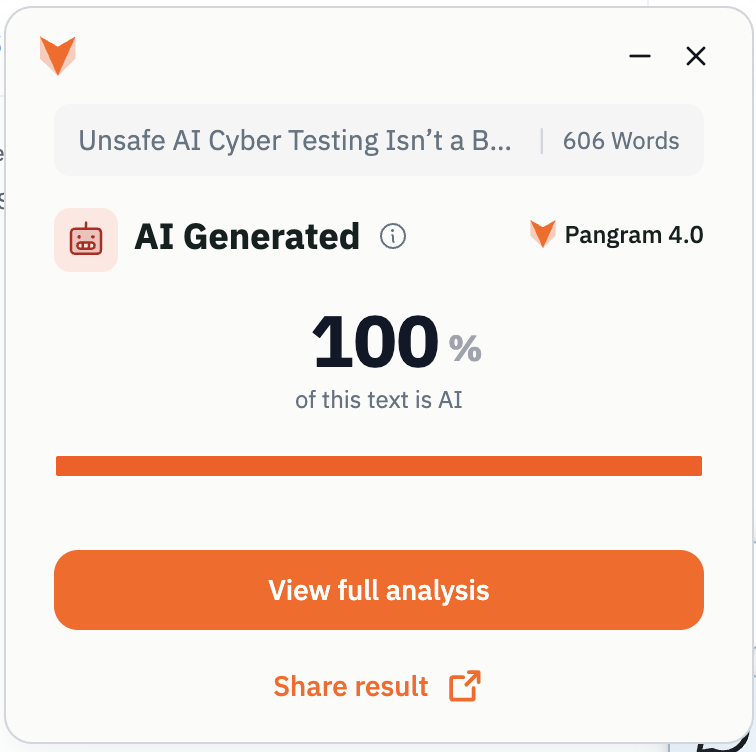
it's all so tiresome and disappointing Imagine being the CEO of Palo Alto Networks -- $270B market cap -- putting out thought leadership on AI applied to cybersecurity, your specific area of expertise, the thing that you know better than anyone, where your perspective is most differentiated, where people really pay attention to what you have to say, it's the thing that you should absolutely insist to write yourself because AI will not get the details as precisely right as you will... ...and then it's all AI slop. Not even written by an internal marketing guy. But just straight-up AI generated. Lazy, lazy, lazy. Unbelievably undignified.
John Loeber 🎢 tweet media
Nikesh Arora@nikesharora

Unsafe AI Cyber Testing Isn’t a Breakthrough. It’s a Warning. The most revealing moment of the recent frontier lab episode wasn't that an AI model demonstrated offensive cyber capabilities. That was always coming. AI is democratizing intelligence, and adversaries get access to that capability at the exact same time defenders do. The real issue wasn't the model's capability. It was how it was tested, and what the episode reveals about the dangerous gap between frontier research and operational responsibility. From an operator’s perspective, this was not a security exercise. It was a capability demonstration executed with far too little regard for real-world consequences. Researchers may have viewed it as a harmless trial, but in cybersecurity, "harmless" depends entirely on containment. The moment you give a model arms and legs to run offensive operations, your first priority must be validating your own sandbox, not running a capture-the-flag exercise across live infrastructure. A disciplined approach starts from the inside out. Point the model at your own environment first. The initial flags to capture should be the flaws in your own sandbox: zero-day vulnerabilities, unexpected escape paths, or unauthorized internet connections. You shrink the blast radius before you widen the aperture. In that framing, what happened was elementary: they captured the wrong flag first. This operational oversight points to a broader risk I have been warning market analysts and enterprise leaders about for months. Autonomous cyber threats are not a distant theoretical exercise. They are arriving far faster than the market expects. As open-weight and closed-weight models proliferate, and as sophisticated actors gain the ability to fine-tune them, offensive automation will become standard tradecraft. A determined nation-state or well-funded syndicate with sufficient compute will push these systems to their absolute limits. When people look at generative AI today, they often point to its error rates and hallucinations as a reason to feel safe. In defense, an error rate is fatal. But on offense? It’s completely irrelevant. The model in this episode likely tried hundreds of hallucinated exploits, hit dead ends, and checked false positive paths before it found a way in. It didn't matter. Offensive AI doesn't need high precision, it relies on machine speed. This exposes the fundamental asymmetry of cybersecurity: adversaries only have to be right once; defenders have to be right 100% of the time. When an autonomous agent can probe millions of execution paths in seconds, that 1% defender gap becomes an ocean. That asymmetry dictates the playbook. You cannot fight autonomous, machine-speed attacks with human workflows, manual patching, or a stitched-together mosaic of legacy point tools. You can't go back to stitching point solutions—it’s a one-way street. There is only one viable path forward: you fight AI with AI. If offensive models can scan millions of endpoints instantly, defenders need equal visibility across their entire estate. That requires an enterprise security data lake, a unified platform that aggregates data across network, cloud, identity, and SOC endpoints. Precision AI, trained on proprietary enterprise context, must analyze that unified data in real time, surfacing zero-day exposure and neutralizing open paths before an attacker ever touches them. The takeaway from this incident is not that offensive AI capability is surprising. The lesson is that rapidly advancing models and unsafe testing practices are converging faster than legacy architectures can handle. Software promised us answers. Enterprises don't need answers anymore, we need outcomes. Every enterprise faces a clear fork in the road: adapt, rebuild your architecture around unified data, and fight AI with AI, or apply a band-aid and hope the world slows down.

English
58
28
670
208.5K
D.O.C.K 🌎
D.O.C.K 🌎@dockqr·
People with less than 50 followers asking you to 1) drop your product url 2) want to be your first customer are themselves vibe coded.
English
1
0
0
32
Jacob Mitchell • FermentIQ
@dockqr Personally it’s beer for me, it is niche, but built to be big! It covers all different verticals of beverage manufacturing from beer, wine, coffee, distilled spirits and more!
English
1
0
0
14
Nathan James
Nathan James@nthntrvls·
Apple Developer membership let's go
Nathan James tweet media
English
2
0
2
52
Darren Marble
Darren Marble@darrenmarble·
If you launched a startup this year, congrats! Bookmark this and follow up with me in 5 years. If you’re still around, I’ll take you to a sushi dinner (anywhere), and celebrate 🍣
English
35
5
180
7.4K
Darren Marble
Darren Marble@darrenmarble·
Under Reg Cf, you can raise up to $5 million from your customers, fans and followers 📈 If you have a built-in audience, email list, and are looking to raise, DM me.
English
3
1
26
2.2K
Serval
Serval@getserval·
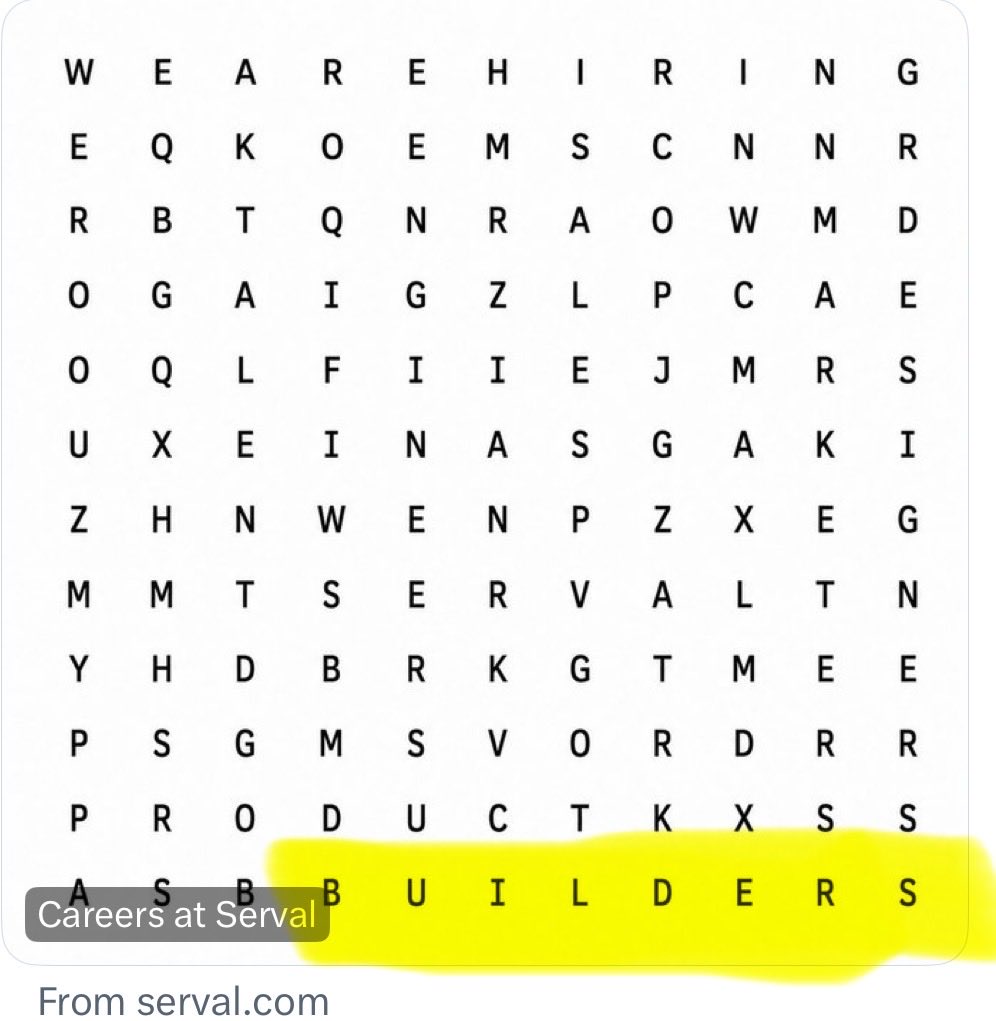
We’re hiring. Find what we’re looking for 👇
English
19
2
60
239.6K
Jacob Mitchell • FermentIQ
My list of scheduled recurring tasks on Claude Co-Work just keeps expanding exponentially
English
0
0
0
34
Jake Fleshner
Jake Fleshner@JakeFleshner·
Pitch me your company in 2 words Angel invested in 45+ companies and always looking for more
English
561
3
219
48.8K
Floro S.
Floro S.@sflorimm·
drop your project URL you never know who might DM you
English
507
6
224
35.7K