Sabitlenmiş Tweet
Parul Jain
175 posts

Parul Jain
@jainparul321
Postdoc with Daniela Schiller and Jennifer Foss-Feig. PhD mentored by Jonathan D. Victor and Nicholas Schiff. Interested in understanding cognition in humans.
New York, NY Katılım Eylül 2012
477 Takip Edilen127 Takipçiler
Parul Jain retweetledi

1/ I am thrilled to begin sharing the latest release of pyEM, a Python package I built for fitting cognitive computational models to behavioral data using hierarchical expectation maximization (EM) with maximum a posteriori estimation (MAP).
github.com/shawnrhoads/py…

English
Parul Jain retweetledi

This theory proposes that a deep cortical layer (layer 6b) may act like a coordinator, integrating top-down signals and neuromodulators.
The layer 6b theory of attention
cell.com/neuron/fulltex…
#neuroscience
English
Parul Jain retweetledi

Online now: Recurrent connectivity shapes spatial coding in hippocampal CA3 subregions dlvr.it/TTQFBM
English
Parul Jain retweetledi

New in @AmJPsychiatry — personally I think this is my best paper so far. Highest statistical rigor, strongest causal inference (via a series of natural experiments), and multiple clinical applications.
Thanks @KJBinSTL and team tagged below.
psychiatryonline.org/doi/10.1176/ap…

English
Parul Jain retweetledi

New paper!
Electric fields generated by groups of neurons also feed back onto those neurons, creating a two-way interaction that may help organize activity patterns involved in memory.
doi.org/10.1093/cercor…
Work by @dimitrispp
#neuroscience
English
Parul Jain retweetledi

News alert: New paper!
Electric fields help guide neural activity, even from moment to moment
“The brain is a rollicking sea of electrical influences”
picower.mit.edu/news/electric-…
work by @dimitrispp
#neuroscience
English
Parul Jain retweetledi

Modeling how autistic and non-autistic groups learn about their own and each other’s preferences nature.com/articles/s4422…
English
Parul Jain retweetledi

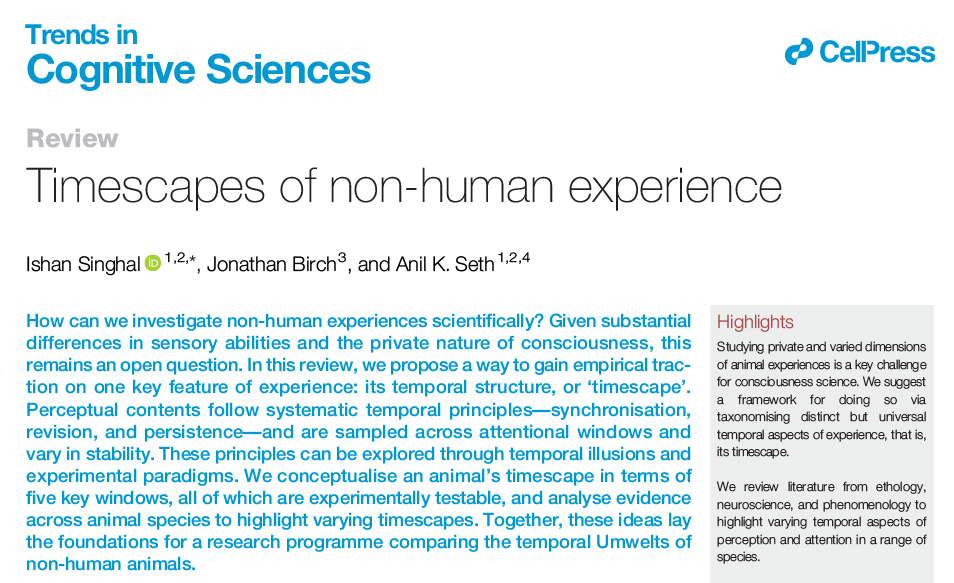
Timescapes of non-human experience
Review by Ishan Singhal (@ishan276), Jonathan Birch (@birchlse), & Anil K. Seth (@anilkseth)
Free access before August 6: tinyurl.com/2zvex592

English
Parul Jain retweetledi

What if much of human thought is navigation? 🧠
New open-access review: I argue that the DMN + hippocampal–entorhinal system form a domain-general engine for "mental navigation" across physical and abstract spaces (e.g. social, conceptual, and value).
sciencedirect.com/science/articl…

English
Parul Jain retweetledi

Article: "Human hippocampal ripples tune cortical responses based on predicted uncertainty"
Coauthors: @FrankDarya S. Moratti @RHellerstedt @SarntheinJ Ningfei Li @andreashorn_ @lukasimbach L. Stieglitz, A. Gil-Nagel, R. Toledano, B. A. Strange
nature.com/articles/s4159…
English

New publication alert! Reviewing neuroimaging studies, we find that certain representations are only accessible when social relationships are observed overtime as opposed to at the moment.
Neuron@NeuroCellPress
Online now: From first impressions to bonds: The neural dynamics of social relationships dlvr.it/TTBmFL
English
Parul Jain retweetledi

🚨 New paper @Nature ! We asked why two hippocampal areas with very different anatomy, CA3 and CA1, often seem to code space so similarly.
By recording bats flying up to 200 m, we found the difference was hidden by scale!
nature.com/articles/s4158…
🧵
1/10
English
Parul Jain retweetledi

Imagine a 19-year-old scrolling TikTok. She watches a creator list five "signs you have undiagnosed anxiety." She recognizes three in herself. By the end of the week, she's describing herself as anxious to her friends. A month later, she's avoiding situations she used to handle fine.
What went wrong?
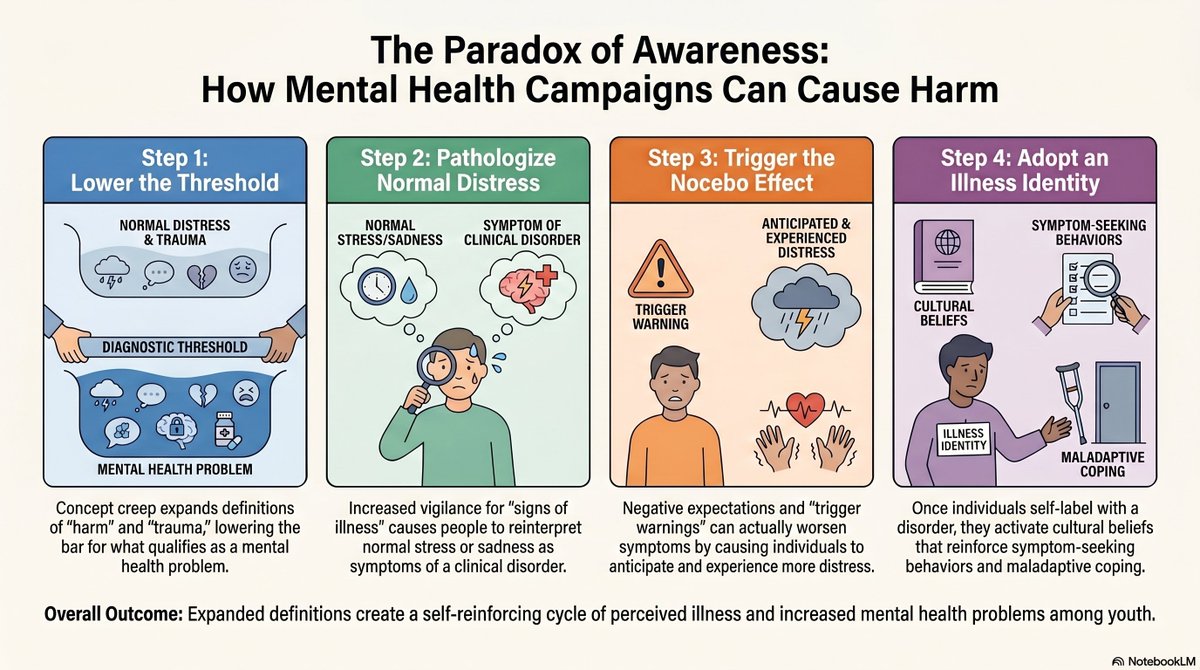
In a new paper by my PhD student Dasha Sandra, titled "Why mental health awareness can harm: Converging explanations for a societal problem", we argue that well-meaning mental health awareness can backfire, and we identify how. Four separate literatures (concept creep, nocebo effects, prevalence inflation, and illness self-labeling) have been circling the same problem from different angles. We show they converge on three mechanisms:
1.Awareness lowers the threshold for what counts as a disorder.
2. It trains people to scan their inner lives for symptoms and reinterpret normal distress as pathology.
3. Once someone adopts an illness identity, they behave in ways that confirm and deepen it.
The evidence is wide. Learning that loneliness is harmful makes solitude feel worse. Learning that stress is harmful worsens well-being and performance. Awareness videos about fake conditions like "wind turbine syndrome" produce real headaches. Trigger warnings raise anticipatory anxiety without reducing distress.
This does not mean awareness should stop. It means awareness can have unintended consequences, including manufacturing the suffering it tries to prevent. Inoculating people against these mechanisms works, and we already have evidence it does.
Link to paper: michael-inzlicht.squarespace.com/s/The-psycholo…

English
Parul Jain retweetledi

📢 New preprint out!
In three samples (N=594), incl. a U.S.-representative cohort & test-retest cohort, we formalize social motivation, learning, & homeostatic control within a computational framework & identify a phenotype linked to chronic loneliness
doi.org/10.31234/osf.i…

English
Parul Jain retweetledi

Multimodal Representation Learning for Parsing Biological Heterogeneity in Psychiatric Neuroimaging | Biological Psychiatry
biologicalpsychiatryjournal.com/article/S0006-…
English
Parul Jain retweetledi

Finally got around to incorporating all Github feedback on my open access textbook, making around 20 minor improvements, and updating some references. 17 chapters of state of the art stats and methods education, freely available for any course you teach. lakens.github.io/statistical_in…

English
Parul Jain retweetledi

🚨 @mark_ho_ & I are recruiting a joint postdoc interested in computational models of social interaction & computational psychiatry
💻 Ideal candidates have experience with multi-player web-based experiments & computational cognitive modeling
🔗 apply.interfolio.com/165809

English