
Jake Peters
167 posts

Jake Peters
@jake_net
technologist, entrepreneur, explorer, traveller, photographer, and currently co-founder & Chief Product/Technical Officer of Fora (https://t.co/SFBwyTijD4)
NYC Katılım Nisan 2009
446 Takip Edilen314 Takipçiler
@gokulr This is what my role is and I call myself CTO/CPO or sometimes CPTO, but think of myself as a product builder. Product, Engineering, Design, and Prod Ops/Support report to me, Analytics dotted line in but that’s just how our org formed. What do you think the role is called?
English

PREDICTION: THE CPO ROLE, AS WE KNOW IT, WILL VANISH IN FIVE YEARS
At young AI native companies, the traditional PM role is on the wane, replaced with a product builder archetype that’s a combination of Product, Design and Engineering.
These companies will never hire a CPO. A separate product leader leads to too much cognitive dissonance when the IC roles doing the actual work are blending, extra overhead and imposes an unnecessary coordination tax on the product development organization.
Five years from now, these companies will be the leaders and set the cultural tone for the next generation, so my prediction is that all tech companies will stop hiring for the CPO role in five years. There will be a singular product development leader at each org. Ironically, this new role might still be called the CPO, except they will run the entire product development org.
CPTO is far too unwieldy of a title and only exists today to alleviate confusion.
Career implication: early / mid career product leaders need to stop aspiring to become CPOs. instead, you need to develop a panoply of product development skills across all three disciplines (+ analytics), be able to fluidly navigate the roles, and become a product builder, period.
Farewell, CPO! It was a good 15-20 year run for this role in tech. But like everything else, it’s time to evolve.
English
Jake Peters retweetledi

@Jason @UberEats Next time book with @hellofora and we’ll get you F&B $ to help cover that. foratravel.com/partners/dorch…
English
@gokulr We did this at @foratravel to get our booking platform live. We had a deadline we couldn’t move — a conference — and made it happen in 7 weeks. It was an alpha release. cc @evanbfrank @eyossi
English
TIMEBOXING FOR PRODUCT LAUNCHES
In March 2003, we presented the launch plan for Google AdSense to Sergey Brin. I was proud of our well fleshed out plan, with a well designed product featuring self-serve sign-up, ad management, and reporting, supported by metrics and testimonials from beta partners who were already seeing success from it. We proposed a launch date of mid September.
Sergey’s succinct feedback: “No”.
“Sergey, what do you mean? We’re pretty confident we can launch an awesome, differentiated product.”
“The product looks great but it’s taking far too long. Launch it in June.”
“June?! That’s less than three months away!”
Sergey reiterated: “Team, I need this launched by June. I will support you and help you cut through any bottlenecks. I know you can do this.”
Fast forward to 3am on June 18, 2003. Our tech lead pushed code to production and formally launched Google AdSense. The launch was incredibly successful, resulting in one of the fastest growing Internet products to date.
To get the product launched within three months, Sergey employed a technique called timeboxing, imposing a hard deadline (3 months) as a constraint on product launch. At Amazon, Jeff Bezos employed the same technique, telling a SWAT team in late 2004 that he wanted them to launch Amazon Prime before Amazon’s earnings in February.
Why did two of the most consequential advertising / commerce products - ever - both launch through timeboxing? Because it works.
Timeboxing works for three primary reasons. First, it leads to improved prioritization. By limiting the time for a project, it forced us to decide what was most important to work on. I remember cutting large swathes of features and flows in one fell swoop to make the deadline. Ironically, many of those flows later proved redundant and were never built out. And this brings up the second reason - product editing. Cutting features leads to launching a simpler, leaner, better product. This process made me a staunch believer in the power of editing to build great products. Finally, timeboxing creates a sense of urgency, increasing efficiency. Since the launch date was fixed in stone, we couldn’t procrastinate; all timelines were clearly laid out working backwards from the launch date.
In order for timeboxing to work, you need four conditions to hold true.
1. Committed Leader: Sergey backed his talk and adopted our project (as did Bezos at Amazon, I’m sure). He (and Susan Wojcicki, my boss) attended our team meetings, unblocked decisions and helped funnel resources to our team. They came to our war room the night of the launch and stayed with us till the launch at 3am. Timeboxing needs these kind of leaders, who are willing to be in the trenches with the team, invaluable in high pressure situations.
2. Empowered team: Our team had the right skill sets to launch the product. We had the full spectrum of necessary skills, were able to unblock ourselves and were not gated by other teams. If a timeboxed team has to spend a chunk of time waiting for other teams, it’s not going to work.
3. Seemingly unrealistic but not irrational timeline: The timeline that Sergey pulled out of thin air - 3 months to launch - seemed unrealistic, but on closer examination, it wasn’t crazy. A lot of the complex back-end ad targeting and serving work was close to complete, and most of the remaining work was productizing the flows. It did force us to focus on the essential features, the ones that REALLY mattered, which ultimately proved to be a good thing.
4. Sparingly used: The 3-month sprint to launch was exhilarating but also exhausting. The technique needs to be used judiciously and carefully, in high stakes situations.
tl;dr CEOs and leaders: Timeboxing can be an incredibly powerful tool in your arsenal to drive motivation, energy, clarity and to get things done. However, you need a committed leader, an empowered team, a rational (if unrealistic) timeline for it to be effective, and you need to use it thoughtfully.
Go out there and timebox!
English
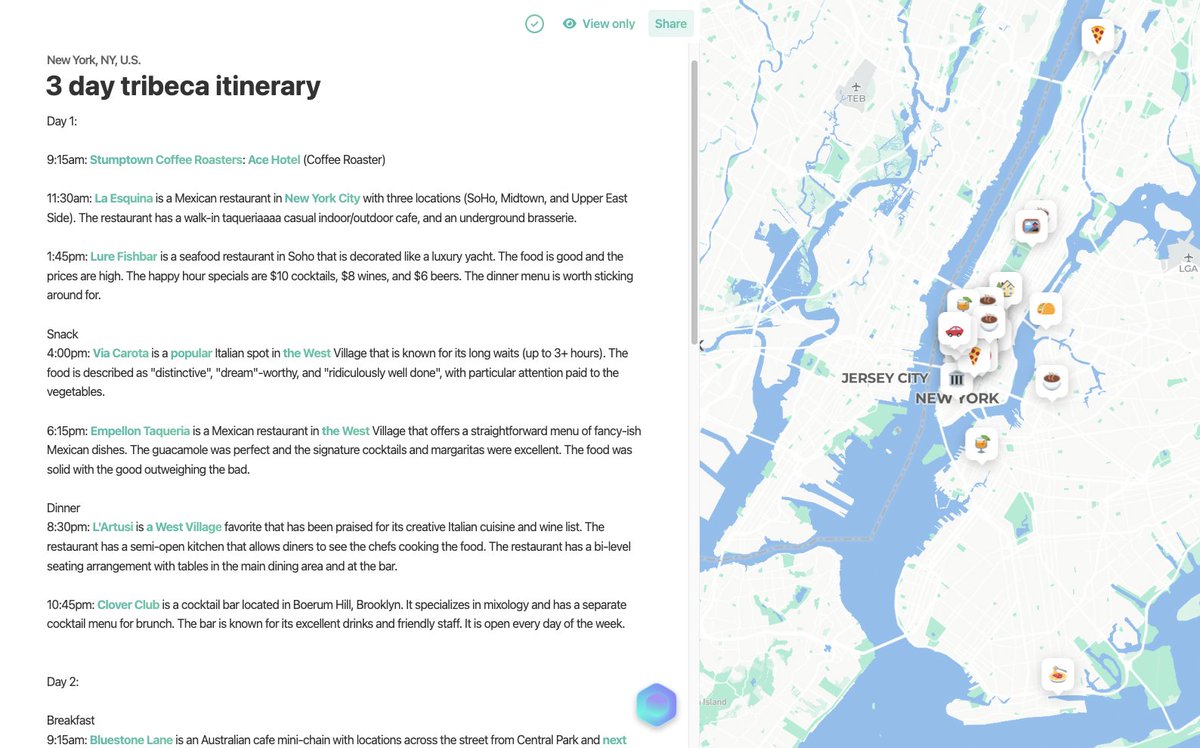
@matthewer Neat @matthewer -- having trouble with location constraints though... how is location factored in? None of these results are in tribeca... (tripnotes.ai/app/notes/e0bf…)
English

Meet Tripnotes, a travel A.I. with taste. Ask it for recommendations, itineraries, and more. Head to tripnotes.ai to give it a spin!
English
@petesoder That look will keep you warmer this winter in the backcountry powder.
English


@ceonyc I live off 4th Ave to the north. Just took subway home. Walking down 4th Ave there are no signs of anything out of the ordinary. It’s bizarre.
English
@gokulr We built our initial website for Fora in Webflow — it’s been an amazing ride and as we prepare to migrate to our “real” site which will allow us to do more down the road, I’m glad we spent a while with Webflow and a bunch of other no-code tools. cc @evanbfrank
English
I love this headline from a startup deck. I wish every entrepreneur and every product team did this.
Ask yourself: "How can I test customer hypotheses with ZERO engineers?"

English
Fora in the news about Omicron travel trends and opportunities wsj.com/articles/trave… @hellofora @evanbfrank @HenleyVQ
English
Jake Peters retweetledi
What we're seeing at @hellofora this Omicron holiday season. Thank you @WSJ for the coverage!
Travel isn’t returning to pre-pandemic patterns, and these travel startups are OK with that wsj.com/articles/trave…
English
Jake Peters retweetledi

Read about our two recent investments, aiming to enable the growing travel agent space with modern tools. More from @omal: forerunnerventures.com/our-perspectiv…
English
Jake Peters retweetledi
We are excited to welcome Fora to the portfolio! ✈️
Evan Frank@evanbfrank
Thank you @techcrunch @christinemhall for telling our story and announcing our $5m seed investment, led by @omal at @ForerunnerVC For those who want to turn travel into dollars, Fora can help start your next career tcrn.ch/2Z0b6gZ via @techcrunch
English
Jake Peters retweetledi
Thank you @techcrunch @christinemhall for telling our story and announcing our $5m seed investment, led by @omal at @ForerunnerVC
For those who want to turn travel into dollars, Fora can help start your next career tcrn.ch/2Z0b6gZ via @techcrunch
English
@joekrug @im_diogodantas @RohanGanachari We also have an issue with rich text line spacing — if we manually enter blank lines in Webflow it works, but the spacing we are entering in airtable is being ignored when syncing.
English
@joekrug @im_diogodantas @RohanGanachari So any tips on what we can do now? We are trying to go live with a new website but having some last minute problems that’s blocking us from going live.
English
@joekrug question for you: any way to see details of failures or a sync log when using Nobull? Love the Airtable -> Webflow sync but having trouble debugging failures. cc @im_diogodantas
English
@joekrug @im_diogodantas @RohanGanachari And for whatever reasons it’s not obvious why the syncing isn’t happening and what’s challenging is we don’t know what’s not getting updated. This is turning into a bit of a serious issue that we didn’t anticipate being a problem during early testing.
English
@wolfejosh Thanks @wolfejosh! It's wonderful to have your support. Any product managers looking to join at the ground floor of our product organization (and work with Henley!): jobs.foratravel.com.
English

Our dear family friend Henley Vasquez (with whom we and many of our friends plan all our travel) launched this new venture foratravel.com
She is RECRUITING people who want to be TRAVEL advisors + entrepreneurs and make money selling travel experiences...
English