James Hood

3.1K posts

James Hood

James Hood

@jameshoodcodes

Husband, Father, Principal Engineer @awscloud, @AWSCloudFormer (previously: AWS SAM/SAR, Amazon Fulfillment, AWS MTurk), Blogger, Coder, Hockey fan 🏒🥅

Seattle, WA Katılım Mart 2016
358 Takip Edilen2K Takipçiler
Sabitlenmiş Tweet
James Hood
James Hood@jameshoodcodes·
2025 has been the most gratifying year of my career. Felt privileged to share the #AWSreInvent stage with @abaibourova and tell the true story of how I went from #AI skeptic to power user, sparking a company-wide grassroots movement of tens of thousands of #Amazon builders.
Gunnar Grosch@GunnarGrosch

Part 4 of DEV Track Spotlight 🤖 DEV323 with @jameshoodcodes (AWS) & @abaibourova (Amazon Prime Video) From AI skeptic to power user to company-wide transformation - the honest story of scaling AI adoption across thousands of engineers. #AWSreInvent #DEVTrack #AWSCommunity

English

1
1
6
661
James Hood retweetledi
Gergely Orosz
Gergely Orosz@GergelyOrosz·
What does it mean for software engineering when we no longer write the code? Here's the take from Boris Cherny (@bcherny), the creator of Claude Code. Timestamps: 00:00 Intro 11:15 Lessons from Meta 19:46 Joining Anthropic 23:08 The origins of Claude Code 32:55 Boris's Claude Code workflow 36:27 Parallel agents 40:25 Code reviews 47:18 Claude Code's architecture 52:38 Permissions and sandboxing 55:05 Engineering culture at Anthropic 1:05:15 Claude Cowork 1:12:48 Observability and privacy 1:14:45 Agent swarms 1:21:16 LLMs and the printing press analogy 1:30:16 Standout engineer archetypes 1:32:12 What skills still matter for engineers 1:35:24 Book recommendations Brought to you by: • @statsig  — ⁠ The unified platform for flags, analytics, experiments, and more. statsig.com/pragmatic • @SonarSource – The makers of SonarQube, the industry standard for automated code review. Proactively find and fix issues in real-time with the SonarQube MCP Server: sonarsource.com/products/sonar… • @WorkOS – Everything you need to make your app enterprise ready. workos.com Three interesting things from this conversation: 1. Boris automated himself out of code review well before AI. Boris was one of the most prolific code reviewers at Meta company. And he worked hard to minimize time spent on code review. His system::every time he left the same kind of review comment, he logged it in a spreadsheet. Once a pattern hit 3-4 occurrences, he’d write a lint rule to automate it away! 2. PRDs are dead on the Claude Code team: prototypes replaced them. Instead of writing Product Requirement Documents (specs), they build hundreds of working prototypes before shipping a feature. Boris: “There’s just no way we could have shipped this if we started with static mocks and Figma or if we started with a PRD.” 3. This is the year of the generalist (and maybe the year of those with ADHD) Boris’s work has shifted from deep-focus single-threaded coding to managing multiple parallel agents and context-switching rapidly. As Boris put it: “It’s not so much about deep work, it’s about how good I am at context switching and jumping across multiple different contexts very quickly.”
English
50
252
2K
486.3K
Mikey O'Brien
Mikey O'Brien@mikeyobrienv·
Day 1 with ASBX. Building the tools that builders use to build. 🛠️ Happy to be a part of the Amazon Builder Software Experience team!
English
1
0
5
248
Mikey O'Brien
Mikey O'Brien@mikeyobrienv·
/review extension in action
English
1
0
6
379
James Hood retweetledi
Deepak Singh
Deepak Singh@mndoci·
Kiro CLI launched ACP support so you can now use agentic capabilities across any client that supports ACP. You can now use Kiro in JetBrains, Eclipse, Zed, or old school Emacs and Neovim. ACP standardizes how code editors and AI agents communicate, allowing any agent and editor with ACP support to just work together. No need to build custom plugins and integrations anymore. #agent-client-protocol-acp-support" target="_blank" rel="nofollow noopener">kiro.dev/changelog/cli/…
English
1
2
10
3.4K
James Hood retweetledi
Deepak Singh
Deepak Singh@mndoci·
Meet Kiro IDE 0.9. It supports agent skills based on the open agentskills.io standard. The skills format is compatible with other AI tools, so you get access to literally thousands of existing skills. 0.9 also adds support for custom subagents. While Kiro has had support for general purpose subagents, and now you can now customize these subagents and they manage their own context and only load the tools they need: you can create one for frontend dev, one for backend, one for data analysis, you get the point. We’ve also improved how the agent does refactoring work. We created two new specialized refactoring tools (a semantic rename and a semantic relocate tool) that use language servers to rename and relocate references across multiple files with precision. This approach - offloading agent work to fast, deterministic, specialized tools like IDE diagnostics, or even property-based testing libraries - has delivered better speed and overall agent output quality while saving tokens. #custom-subagents" target="_blank" rel="nofollow noopener">kiro.dev/changelog/ide/…
English
0
3
14
976
James Hood retweetledi
Andrej Karpathy
Andrej Karpathy@karpathy·
A few random notes from claude coding quite a bit last few weeks. Coding workflow. Given the latest lift in LLM coding capability, like many others I rapidly went from about 80% manual+autocomplete coding and 20% agents in November to 80% agent coding and 20% edits+touchups in December. i.e. I really am mostly programming in English now, a bit sheepishly telling the LLM what code to write... in words. It hurts the ego a bit but the power to operate over software in large "code actions" is just too net useful, especially once you adapt to it, configure it, learn to use it, and wrap your head around what it can and cannot do. This is easily the biggest change to my basic coding workflow in ~2 decades of programming and it happened over the course of a few weeks. I'd expect something similar to be happening to well into double digit percent of engineers out there, while the awareness of it in the general population feels well into low single digit percent. IDEs/agent swarms/fallability. Both the "no need for IDE anymore" hype and the "agent swarm" hype is imo too much for right now. The models definitely still make mistakes and if you have any code you actually care about I would watch them like a hawk, in a nice large IDE on the side. The mistakes have changed a lot - they are not simple syntax errors anymore, they are subtle conceptual errors that a slightly sloppy, hasty junior dev might do. The most common category is that the models make wrong assumptions on your behalf and just run along with them without checking. They also don't manage their confusion, they don't seek clarifications, they don't surface inconsistencies, they don't present tradeoffs, they don't push back when they should, and they are still a little too sycophantic. Things get better in plan mode, but there is some need for a lightweight inline plan mode. They also really like to overcomplicate code and APIs, they bloat abstractions, they don't clean up dead code after themselves, etc. They will implement an inefficient, bloated, brittle construction over 1000 lines of code and it's up to you to be like "umm couldn't you just do this instead?" and they will be like "of course!" and immediately cut it down to 100 lines. They still sometimes change/remove comments and code they don't like or don't sufficiently understand as side effects, even if it is orthogonal to the task at hand. All of this happens despite a few simple attempts to fix it via instructions in CLAUDE . md. Despite all these issues, it is still a net huge improvement and it's very difficult to imagine going back to manual coding. TLDR everyone has their developing flow, my current is a small few CC sessions on the left in ghostty windows/tabs and an IDE on the right for viewing the code + manual edits. Tenacity. It's so interesting to watch an agent relentlessly work at something. They never get tired, they never get demoralized, they just keep going and trying things where a person would have given up long ago to fight another day. It's a "feel the AGI" moment to watch it struggle with something for a long time just to come out victorious 30 minutes later. You realize that stamina is a core bottleneck to work and that with LLMs in hand it has been dramatically increased. Speedups. It's not clear how to measure the "speedup" of LLM assistance. Certainly I feel net way faster at what I was going to do, but the main effect is that I do a lot more than I was going to do because 1) I can code up all kinds of things that just wouldn't have been worth coding before and 2) I can approach code that I couldn't work on before because of knowledge/skill issue. So certainly it's speedup, but it's possibly a lot more an expansion. Leverage. LLMs are exceptionally good at looping until they meet specific goals and this is where most of the "feel the AGI" magic is to be found. Don't tell it what to do, give it success criteria and watch it go. Get it to write tests first and then pass them. Put it in the loop with a browser MCP. Write the naive algorithm that is very likely correct first, then ask it to optimize it while preserving correctness. Change your approach from imperative to declarative to get the agents looping longer and gain leverage. Fun. I didn't anticipate that with agents programming feels *more* fun because a lot of the fill in the blanks drudgery is removed and what remains is the creative part. I also feel less blocked/stuck (which is not fun) and I experience a lot more courage because there's almost always a way to work hand in hand with it to make some positive progress. I have seen the opposite sentiment from other people too; LLM coding will split up engineers based on those who primarily liked coding and those who primarily liked building. Atrophy. I've already noticed that I am slowly starting to atrophy my ability to write code manually. Generation (writing code) and discrimination (reading code) are different capabilities in the brain. Largely due to all the little mostly syntactic details involved in programming, you can review code just fine even if you struggle to write it. Slopacolypse. I am bracing for 2026 as the year of the slopacolypse across all of github, substack, arxiv, X/instagram, and generally all digital media. We're also going to see a lot more AI hype productivity theater (is that even possible?), on the side of actual, real improvements. Questions. A few of the questions on my mind: - What happens to the "10X engineer" - the ratio of productivity between the mean and the max engineer? It's quite possible that this grows *a lot*. - Armed with LLMs, do generalists increasingly outperform specialists? LLMs are a lot better at fill in the blanks (the micro) than grand strategy (the macro). - What does LLM coding feel like in the future? Is it like playing StarCraft? Playing Factorio? Playing music? - How much of society is bottlenecked by digital knowledge work? TLDR Where does this leave us? LLM agent capabilities (Claude & Codex especially) have crossed some kind of threshold of coherence around December 2025 and caused a phase shift in software engineering and closely related. The intelligence part suddenly feels quite a bit ahead of all the rest of it - integrations (tools, knowledge), the necessity for new organizational workflows, processes, diffusion more generally. 2026 is going to be a high energy year as the industry metabolizes the new capability.
English
1.6K
5.4K
39.4K
7.6M
James Hood retweetledi
Matt Pocock
Matt Pocock@mattpocockuk·
My Ralph Wiggum breakdown went viral. It's a keep-it-simple-stupid approach to AI coding that lets you ship while you sleep. So here's a full explanation, example code, and demo.
English
211
367
4.9K
583.3K
James Hood retweetledi
DHH
DHH@dhh·
You can't let the slop and cringe deny you the wonder of AI. This is the most exciting thing we've made computers do since we connected them to the internet. If you spent 2025 being pessimistic or skeptical on AI, why not give the start of 2026 a try with optimism and curiosity?
English
203
418
4.9K
309.1K
James Hood retweetledi
NeetCode
NeetCode@neetcode1·
A lot of people are saying they hardly hand write code anymore. And honestly, it's pretty true, even for me. But this does NOT mean what a lot of people think it does. People are definitely still thinking about code, implementation details, architectural design, performance, etc etc. And if you're not, you'll probably be cooked alive by the people who are actually reading the code they commit. Coding has definitely changed, but contrary to what people are taking from @karpathy recent tweets, a lot of the same skills definitely translate, and frankly are pretty mandatory. Honestly, I'm enjoying this new world. As long as there is thinking to be had, I don't really care what layer of abstraction it belongs to. I guess I'm different from some of my coding purist friends in this regard.
English
69
91
1.9K
191.6K
James Hood retweetledi
Gunnar Grosch
Gunnar Grosch@GunnarGrosch·
Part 22 of DEV Track Spotlight 🤖 DEV403 with @jameshoodcodes & @maishsk "I am also a former AI skeptic. My previous experience with AI was trying flashy demos on real world code and watching it crash and burn." Then he discovered Agent SOPs. #AWSreInvent #DEVTrack
Gunnar Grosch tweet media
English
1
3
4
315
James Hood retweetledi
Boris Cherny
Boris Cherny@bcherny·
When I created Claude Code as a side project back in September 2024, I had no idea it would grow to be what it is today. It is humbling to see how Claude Code has become a core dev tool for so many engineers, how enthusiastic the community is, and how people are using it for all sorts of things from coding, to devops, to research, to non-technical use cases. This technology is alien and magical, and it makes it so much easier for people to build and create. Increasingly, code is no longer the bottleneck. A year ago, Claude struggled to generate bash commands without escaping issues. It worked for seconds or minutes at a time. We saw early signs that it may become broadly useful for coding one day. Fast forward to today. In the last thirty days, I landed 259 PRs -- 497 commits, 40k lines added, 38k lines removed. Every single line was written by Claude Code + Opus 4.5. Claude consistently runs for minutes, hours, and days at a time (using Stop hooks). Software engineering is changing, and we are entering a new period in coding history. And we're still just getting started..
Boris Cherny tweet media
English
900
1.8K
20.6K
4.6M
James Hood retweetledi
pedram.md
pedram.md@pdrmnvd·
oh you’re using claude code? everyone’s using open code. just kidding we’re all on amp code. we’re using cline, we’re using roo code. we just forked our own version of roo. were using kilo code. we were on coderabbit but their ceo yelled at us so now we’re using qorbit. apple just acquired them for $30bn so we just migrated our entire team to slash commands. one guy is still on aider. the PM is on loveable. he just shipped a new product on replit. the intern installed a slackbot that lets you chat with your spreadsheet. legal is still reviewing devin’s enterprise contract. we evaluated junie for three ukrainians using jetbrains. someone in slack just asked “has anyone tried amp?” we are using goose for scripts. next week we’re piloting augment code. the CTO heard good things about trae.​​​​​​​​​​​​​​​​ our CEO is friends with the guy from conductor. our CFO resigned. our CISO said we’ve had fourteen supply chain attacks in the last week. we’re shipping the worlds most expensive todo app.
English
124
491
6.4K
783.3K
James Hood retweetledi
Jake
Jake@nayshins·
I feel like the next blog I write should be about the benefits of using property based testing + claude code
Boris Cherny@bcherny

@palashkaria @karpathy 1. Almost always use Plan mode 2. Give Claude a way to verify its output with unit tests, the Claude Chrome extension, or an iOS/Android sim 3. Hold the same bar for human and Claude code. Use /code-review to automate most of code review

English
10
1
127
20.7K
James Hood retweetledi
Alex Albert
Alex Albert@alexalbert__·
Agent Skills is now an open standard It's been great to see the traction Skills are already getting in the industry and this makes it easier for everyone to build and contribute to them🚀 agentskills.io/home
English
113
357
3K
787.3K
James Hood retweetledi
David Yanacek
David Yanacek@dyanacek·
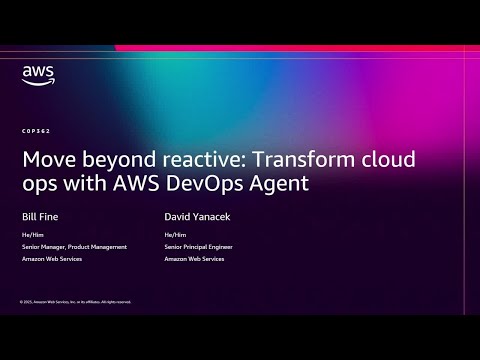
The new AWS DevOps Agent is out in open preview! Speed up your incident resolution time, and prevent future ones. More in this #AWSreInvent talk, but you can set it up and use it in (much) less time than the talk takes! youtube.com/watch?v=JajBEY…
YouTube video
YouTube
English
0
4
13
1.7K
James Hood
James Hood@jameshoodcodes·
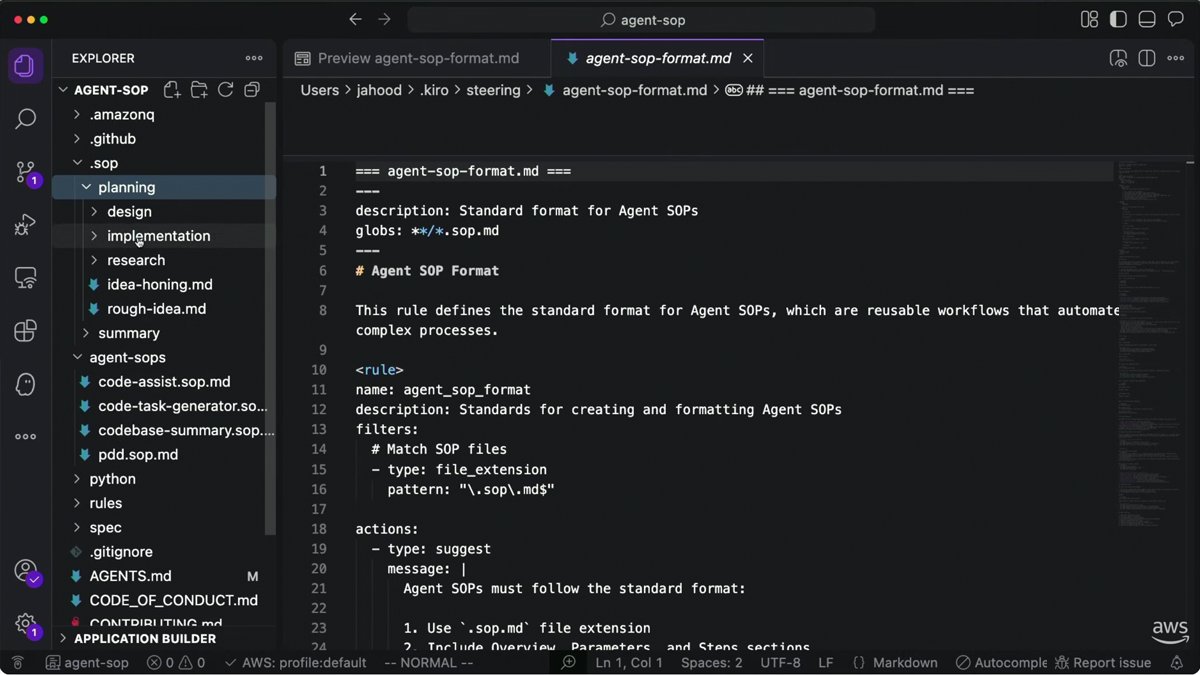
Also got to demo Agent SOPs, a simple but powerful technique for creating “determin-ish-tic” agentic workflows. Agent SOPs are an innovation that came from our internal builder community and is now open source to benefit the broader AI community. github.com/strands-agents…
English
0
1
1
141
James Hood
James Hood@jameshoodcodes·
2025 has been the most gratifying year of my career. Felt privileged to share the #AWSreInvent stage with @abaibourova and tell the true story of how I went from #AI skeptic to power user, sparking a company-wide grassroots movement of tens of thousands of #Amazon builders.
Gunnar Grosch@GunnarGrosch

Part 4 of DEV Track Spotlight 🤖 DEV323 with @jameshoodcodes (AWS) & @abaibourova (Amazon Prime Video) From AI skeptic to power user to company-wide transformation - the honest story of scaling AI adoption across thousands of engineers. #AWSreInvent #DEVTrack #AWSCommunity

English
1
1
6
661