Jamie Gull

1.4K posts

Jamie Gull banner
Jamie Gull

Jamie Gull

@jamiegull

Founder/GP Wave Function Ventures investing in early stage deep tech. Former SpaceX engineer on Falcon 9 reentry and Co-Founder/CEO Talyn Air, Y Combinator.

Los Angeles, CA Katılım Mart 2009
2.8K Takip Edilen2.1K Takipçiler
Sabitlenmiş Tweet
Jamie Gull
Jamie Gull@jamiegull·
Stoked to get to finally announce Wave Function Ventures $15M Fund 1! Wave Function was created to partner with deep tech founders building hardware solutions to the world’s most important problems. I'm 9 investments in, with 15-20 left to go.
English
42
19
343
735K
Pavel Prata
Pavel Prata@pavelprata·
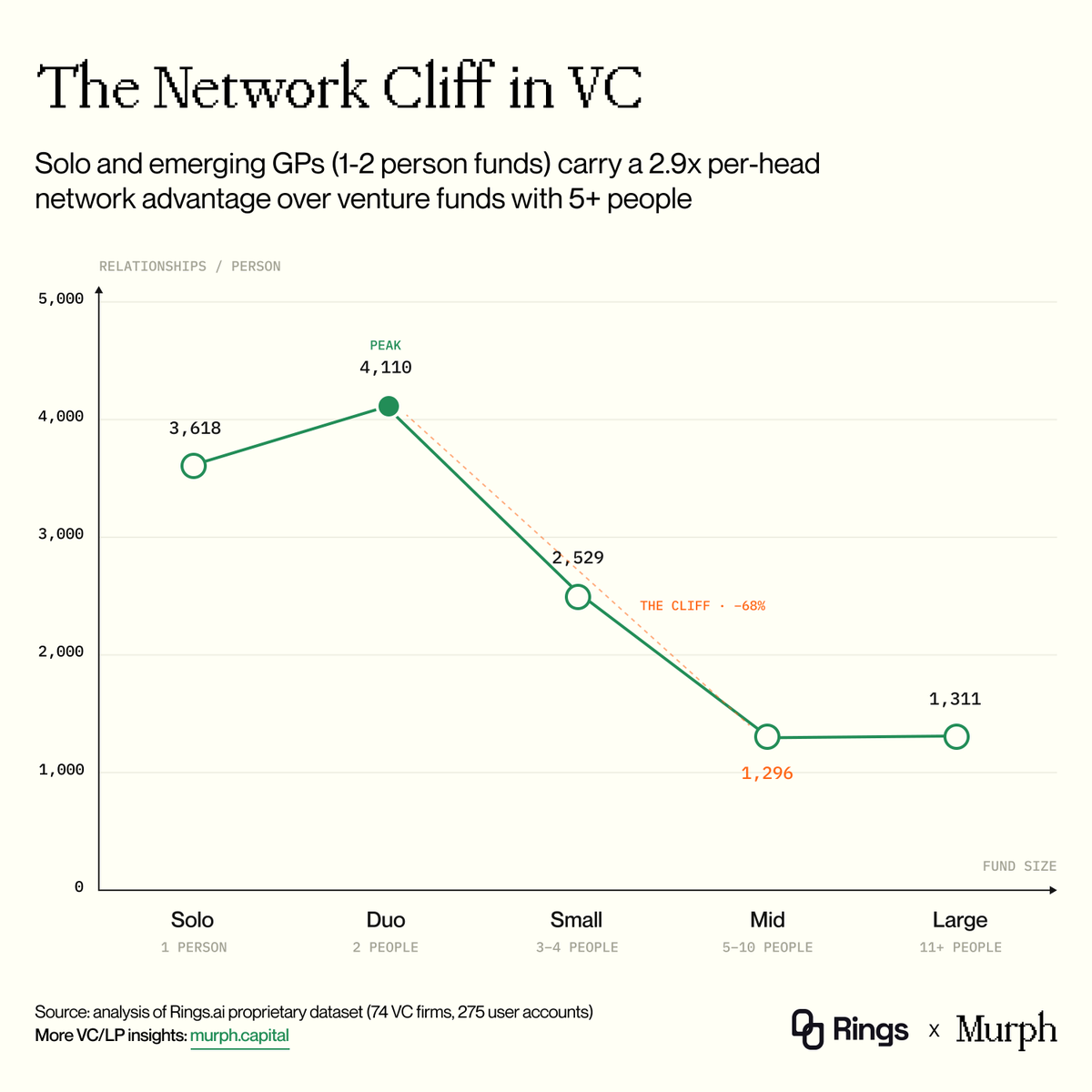
Do solo and emerging GPs actually have a network edge? I've been speaking with a lot of emerging VCs lately, and every second one leads with the same narrative: "we have a broad, defensible network." So I looked at the @RingsApp dataset (74 funds, 275 user accounts) to check whether that's actually true. And a few numbers stood out to me: - Solo and duo GPs carry 2.9x more relationships per person than funds with 5+ people - The peak is at 2 people – 4,110 relationships per person. Solo GPs sit at 3,618 - Cross into 3-4 people and you're already at 2,529 - At 5-10 people the median drops to 1,296. That's a 68% decline from peak - Mid and large funds are essentially identical – 1,296 vs 1,311. Adding headcount at that point changes nothing And yeah, it seems that the edge is real, but based on my experience talking to GPs across fund sizes, I don't think it's because solo GPs are unusually well-connected people. I think it's structural and a few things explain it: 1/ Survival pressure. At a larger firm you can be an average networker and still get deal flow through the brand, through partners, through inbound. Solo GPs don't have that buffer. You build relationships or you don't see deals. That's an existential pressure, and it produces genuinely different behavior. 2/ Time allocation. Every growing firm pays "a scale tax" – internal meetings, team management, etc. Solo GPs don't pay it. Every hour a partner at a larger firm spends on internal alignment is an hour a solo GP spends on a call with a founder or LP. 3/ Relationship quality. When you're one person, you can't delegate relationships, so you do the intro yourself, the follow-up yourself, you remember the details. At larger firms relationships often become institutional (like "we know that founder!"), but nobody specifically knows them well. Solo GPs build connections that are personally held, which makes them informationally richer and harder to replicate. 4/ Signal clarity. At a big firm people come to you because of where you work. The brand amplifies deal flow – but it also distorts it. When someone calls a solo GP, it's because they know that specific person. I think this makes a real difference in the quality of the relationship, not just the quantity. And the part I find most interesting (and maybe a bit uncomfortable for EMs to sit with) is that this advantage is time-limited by design. Based on the data, it starts compressing not when you raise Fund III, but when you make your 3rd hire. The cliff happens between 2 and 5 people, not between 10 and 50. I think the funds that preserve the edge are the ones that build infrastructure early enough to turn individual relationships into something the firm actually owns (automated CRM enrichment, shared context, real visibility into who knows whom), because without it the network doesn't belong to the firm, it belongs to a person. For LPs this reframes the DD question, because team size is commonly used as a proxy for network breadth, but the data says it's almost the opposite — the right question isn't how big the network is, it's where it lives, who owns it, and what happens to it if the key person walks out the door.
Pavel Prata tweet media
English
7
12
87
17.3K
Christian Keil
Christian Keil@pronounced_kyle·
I want to fund a space warfighting prime. Space is a unique domain. It's huge, hostile, and fragile — so we need tech that can help America secure outer space *while preserving the domain itself.* If you're thinking about the future of space and defense, please get in touch.
English
117
48
1.3K
150.6K
Andy Lapsa
Andy Lapsa@AndyLapsa·
Hey that's a neat truck
Andy Lapsa tweet media
English
23
76
1.4K
63.5K
Molly O’Shea
Molly O’Shea@MollySOShea·
If your humanoid robot company's CEO isn't a major sci-fi junkie then.. you're ngmi Can you guess Brett Adcock’s favorite sci-fi movie? PS — what’s the greatest sci-fi movie of all time? @adcock_brett @Figure_robot
Molly O’Shea@MollySOShea

BREAKING: First-Ever Full Tour of Figure's Humanoid HQ CEO Brett Adcock Exclusive look through every department on their San Jose campus: BotQ Factory, Testing, Design, Demos & more. Brett walks us through how Figure is built: - System integration lab: where robots are stress-tested with software faults & physical pushes - Helix AI: team floor where the controls & neural network engineers train the vision-language-action model that runs onboard every Figure robot - Reinforcement learning & stability testing: where Figure demos the Vulcan project — surviving a lost knee mid-task - Home: environment where Figure 03 autonomously tidies a living room using their Helix neural network (no teleoperation) - BotQ: manufacturing facility where heads, batteries, and limbs come together on the assembly line, including the custom-built battery line & end-of-line burn-in bays - Industrial design studio: (opened publicly for the first time) housing every generation of Figure robot ever built, including: Figure 01 with its Frankenstein forearms, Figure 02, & the sleek Figure 03 that recently appeared at the White House, plus the evolution of Figure's hands & feet Brett shares why he believes humanoid robots may achieve AGI before any other form factor, why Figure pivoted entirely from hand-coded controls to neural networks, & teases that Figure 04 will be their "iPhone 1 moment." This was so much fun! Big thank you to Brett & the team at Figure for opening the doors for us! @adcock_brett @Figure_robot 𝐓𝐈𝐌𝐄𝐒𝐓𝐀𝐌𝐏𝐒 (00:00) Inside Figure’s Humanoid Campus (00:48) The humanoid factory (03:18) First humanoid guest at the White House (05:29) Controlling a robot with infinite movements (10:46) The truth about robot failures (13:00) Attacking a humanoid robot (testing responses) (16:12) Building a general purpose robot (23:05) The "Never Fall" protocol (28:56) Is the home robot teleoperated? (33:36) Leasing a 24/7 robot (35:01) Can a humanoid build a real car? (43:32) From flying robots to humanoids (45:59) The hidden path to physical AGI (56:21) Figure's secret design studio (01:00:44) Figure 4: The biggest leap in robotics (01:06:25) Training robots in spandex (01:10:26) Westworld, TIME Magazine, & Deadmau5

English
19
4
135
21K
Erik Bruckner
Erik Bruckner@E_Bruxxx·
Have seen a lot of debate lately around “traditional VCs” vs “operator/untraditional VCs” and honestly think both sides massively oversimplify it. Very real differences in how they think, underwrite risk, and work with founders. Traditional path VCs (MBA → banking → consulting → growth equity → VC) are often extremely polished. Typically very good at process, fundraising strategy, market sizing, financial storytelling, LP communication, pricing rounds, understanding how institutional capital behaves, etc. They know how the machine works. And contrary to Twitter discourse, that absolutely matters. A lot of founders underestimate how valuable these skillsets can become later in a company’s life. But from what I’ve personally seen, that path can also sometimes create investors who over-index on consensus and “what a venture-backable company is supposed to look like.” Now compare that to operator/untraditional VCs. These are people who built companies, worked in industry, military, engineering, manufacturing, sales, blue collar environments, startups, or just took weird nonlinear paths before entering venture. Typically, they have a much higher tolerance for ambiguity, chaos, and imperfect businesses because they’ve actually lived through operational pain. A lot of them evaluate founders less like spreadsheets and more like people. BUT… Operator VCs have weaknesses too, and people rarely talk about them honestly. Some operator VCs massively over-project their own experience onto founders. “I built a company before, therefore this founder should operate exactly how I did.” That becomes dangerous fast. Some also underestimate how important capital markets, positioning, narrative, downstream financing strategy, and institutional relationships actually are. Building a company and investing in one are not the same skillset. Truthfully, some of the worst investors I’ve ever met came from BOTH camps. The traditional guys who’ve never actually built anything but think every business can be modeled neatly in Excel… AND the ex-operators who think one successful operating experience suddenly makes them experts in every category forever. The best VCs I’ve personally met usually sit somewhere in the middle combining adaptability and realism with the strategic discipline and market understanding of traditional finance. Most importantly: strong opinions loosely held. They don’t walk into founder meetings trying to “win” intellectually. They listen. Because at the end of the day, founders are the ones spending years in the arena.
English
10
2
35
1.7K
colby h2/acc
colby h2/acc@H2Colby·
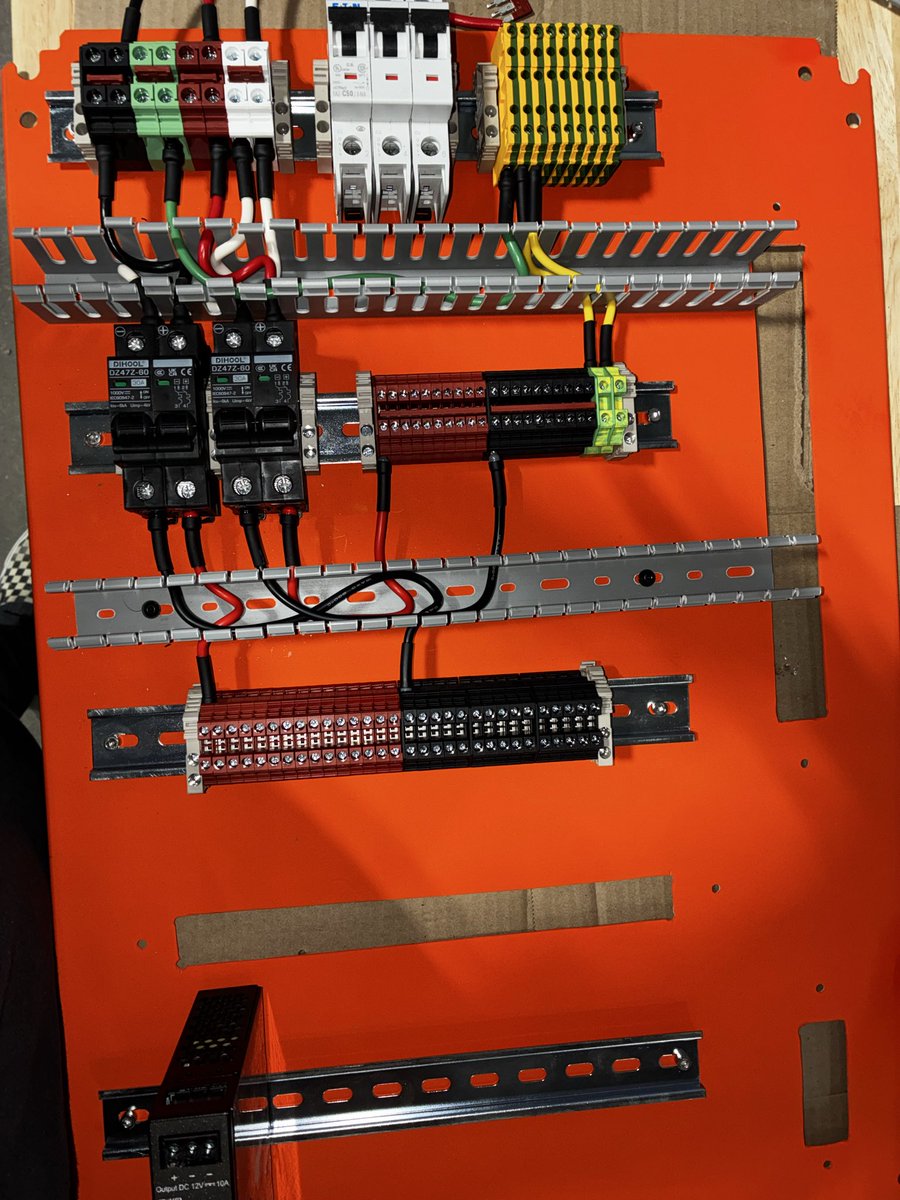
two pics for the timeline to enjoy this evening a - most beautiful ceiling ever seen in a shipping container b - my electrical panel so yall can tell me how to make it better
colby h2/acc tweet mediacolby h2/acc tweet media
English
6
0
17
938
ian
ian@IanRountree·
You can just IPO
ian tweet media
English
2
4
39
3.8K
Jamie Gull
Jamie Gull@jamiegull·
Epic! Nice work @maddiehalla
Maddie Hall@maddiehalla

1/ @OctopusEnergy is backing Living Carbon with $500M to reforest degraded land and remove CO₂ across North America. This major project financing comes with an additional ~$13M investment in our carbon business. Living Carbon is putting low quality land back to work. Our innovative reforestation turns low quality land into thriving forests faster to remove carbon or produce sustainable forest products. Read more about it in today’s @WSJ (link in the comments) →

English
2
0
4
470
TBPN
TBPN@tbpn·
President of @blackstone Jon Gray says his firm's biggest theme after data centers is electricity: "Data centers, robots, autonomous vehicles, reindustrialization. It all needs power. It's everything from LNG, to renewables, to pipelines, to electrical equipment, to utility services."
English
11
28
368
60K
Eli Dourado
Eli Dourado@elidourado·
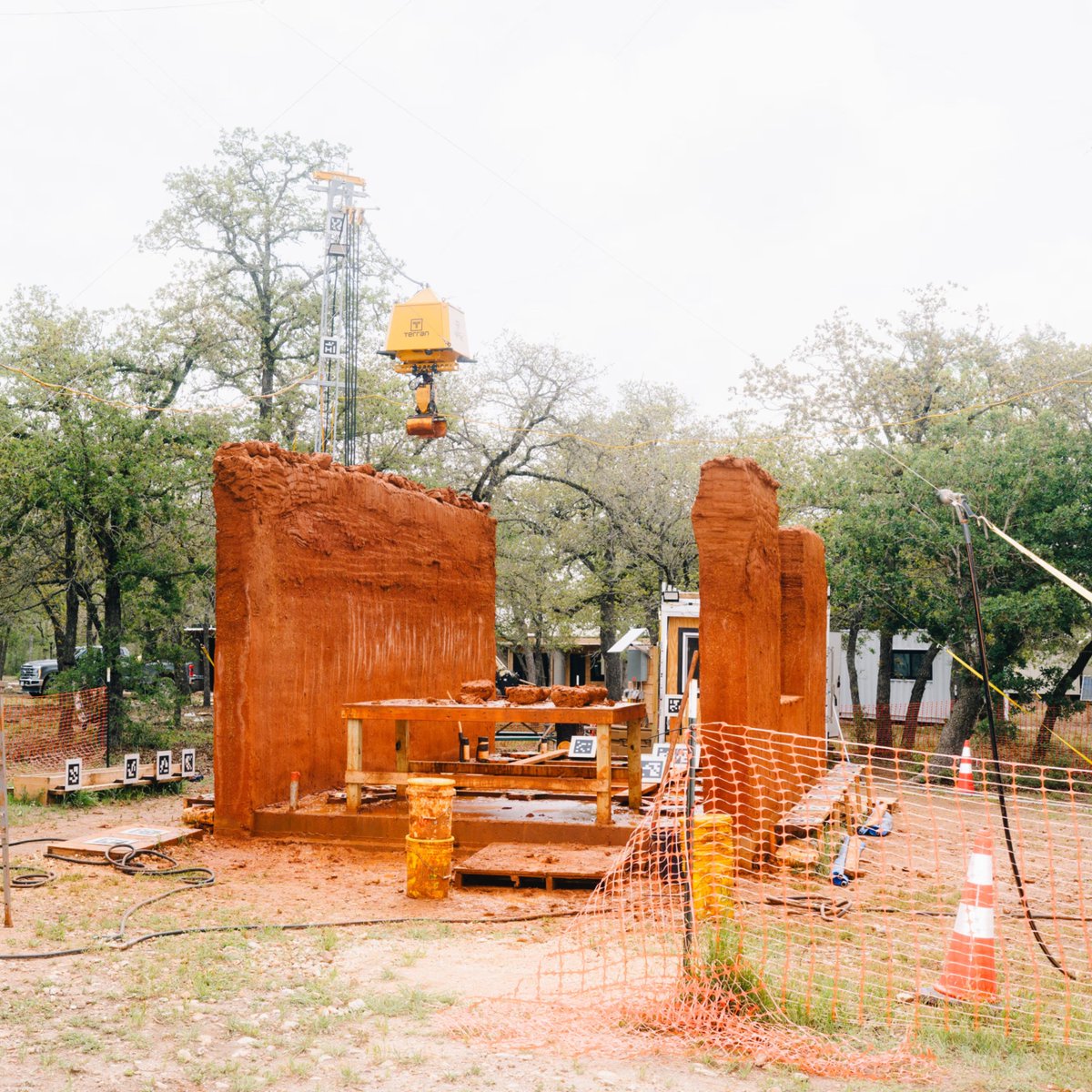
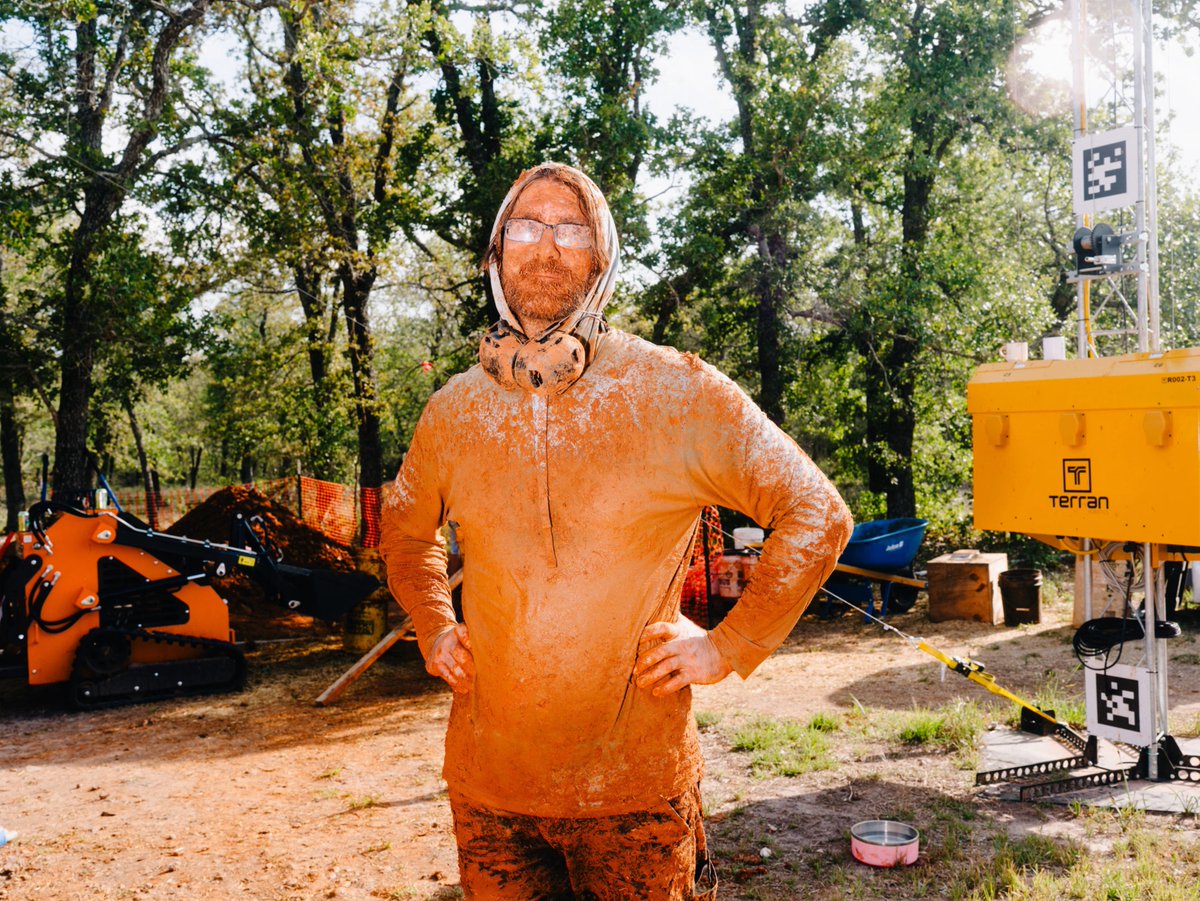
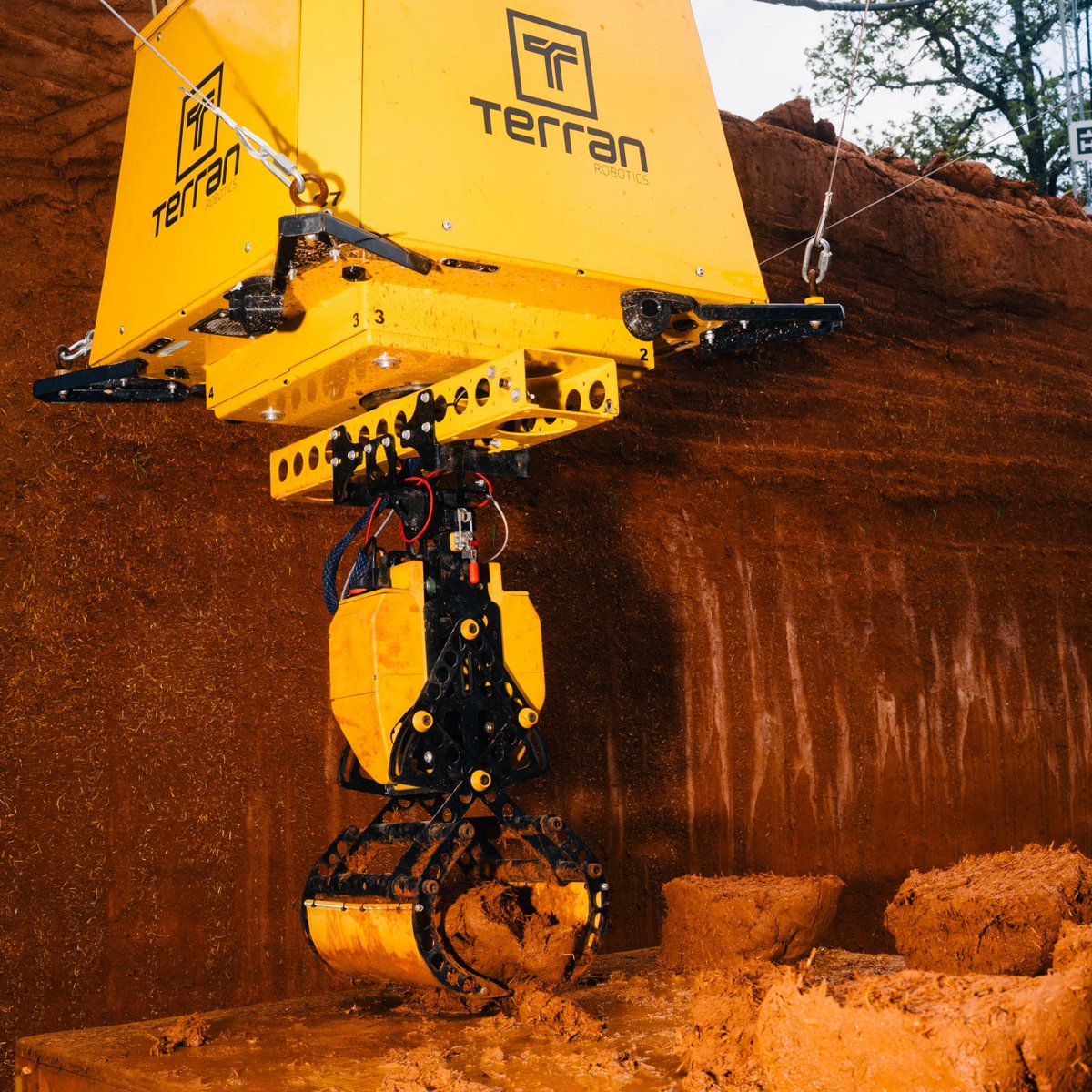
Go to Proto-Town if you want to see robotically constructed adobe houses, high-recovery desal centrifuges, autonomous construction equipment, solar-chemical air conditioning, a radioisotope reactor, and more. It's delightful. wsj.com/business/entre…
Eli Dourado tweet mediaEli Dourado tweet mediaEli Dourado tweet media
English
4
10
126
6.9K
Jamie Gull
Jamie Gull@jamiegull·
@beffjezos You could easily switch progressives and conservatives with many examples.
English
0
0
0
7
Beff (e/acc)
Beff (e/acc)@beffjezos·
Welcome to 2026 "Progressives" are Maoist in their hate of free speech and are against AI (techno-regressive) "Conservatives" are for freedom of speech and pro-AI (techno-progressive)
English
32
47
683
14.2K