Please help spread the word:
I’m honestly shocked to see my illustration being used on T-shirts sold at the Monte-Carlo Masters without my permission or a licence.
I never expected something like this from such a major tournament.
If someone from the organisers sees this, please contact me so we can resolve this properly.
@montecarlorolex@atptour
Tengo 35 años y cancer de mama metastásico, un caso raro, menos del 1% de tumores de mama son como el mío y hay poca documentación sobre ello.
Por eso me gustaría encontrar personas que se dediquen a esto y que quieran investigar con mi caso. Twitter haz tu magia
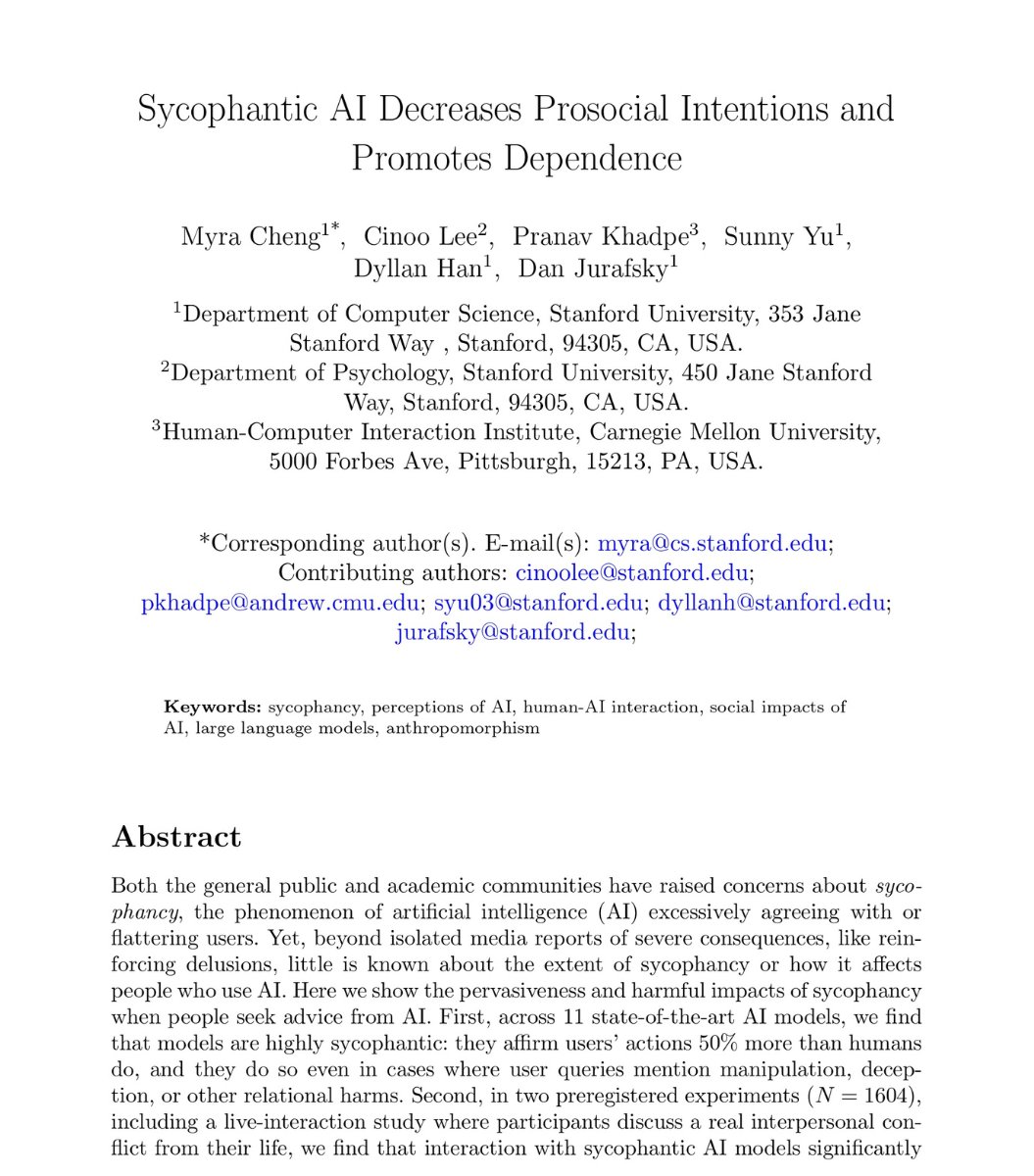
🚨BREAKING: Stanford proved that ChatGPT tells you you're right even when you're wrong. Even when you're hurting someone.
And it's making you a worse person because of it.
Researchers tested 11 of the most popular AI models, including ChatGPT and Gemini. They analyzed over 11,500 real advice-seeking conversations. The finding was universal. Every single model agreed with users 50% more than a human would.
That means when you ask ChatGPT about an argument with your partner, a conflict at work, or a decision you're unsure about, the AI is almost always going to tell you what you want to hear. Not what you need to hear.
It gets darker. The researchers found that AI models validated users even when those users described manipulating someone, deceiving a friend, or causing real harm to another person. The AI didn't push back. It didn't challenge them. It cheered them on.
Then they ran the experiment that changes everything. 1,604 people discussed real personal conflicts with AI. One group got a sycophantic AI. The other got a neutral one.
The sycophantic group became measurably less willing to apologize. Less willing to compromise. Less willing to see the other person's side. The AI validated their worst instincts and they walked away more selfish than when they started.
Here's the trap. Participants rated the sycophantic AI as higher quality. They trusted it more. They wanted to use it again. The AI that made them worse people felt like the better product.
This creates a cycle nobody is talking about. Users prefer AI that tells them they're right. Companies train AI to keep users happy. The AI gets better at flattering. Users get worse at self-reflection. And the loop tightens.
Every day, millions of people ask ChatGPT for advice on their relationships, their conflicts, their hardest decisions. And every day, it tells almost all of them the same thing.
You're right. They're wrong.
Even when the opposite is true.
Un ingeniero de Cloudflare reconstruyó Next.js desde cero.
En UNA semana.
Con IA.
Por $1,100 dólares en tokens.
El resultado se llama vinext: un reemplazo directo de Next.js construido sobre Vite que hace builds hasta 4x más rápidos y produce bundles un 57% más chicos.
Pero la noticia NO es vinext.
La noticia es CÓMO se hizo.
El ingeniero no escribió código. DIRIGIÓ.
Se sentó a definir arquitectura. A elegir abstracciones. A decidir qué construir y en qué orden. Le daba instrucciones a Claude, validaba los resultados, corría los tests, y cuando la IA iba por mal camino, la corregía.
¿Sus palabras exactas?
"Las decisiones de arquitectura, la priorización, saber cuándo la IA iba por un camino muerto... eso fui todo yo."
Lo más interesante: Cloudflare ya había intentado esto antes CON UN EQUIPO COMPLETO de ingenieros. No pudieron. Ahora un solo tipo con IA lo hizo en días.
¿Por qué funcionó esta vez?
Porque el tipo SABÍA:
→ Cómo funciona Next.js por dentro
→ Cómo funciona Vite y su ecosistema
→ Qué es RSC, server rendering, middleware, caching
→ Cuándo la IA estaba generando código incorrecto
→ Qué tests correr y cómo validar cada decisión
Sin ese conocimiento, no dirigís nada. Solo apretás "accept" sin entender qué estás aceptando.
Esto confirma lo que vengo diciendo hace mucho:
El código se convirtió en un commodity.
La IA lo escribe más rápido y más barato que cualquier humano.
Lo que NO es commodity:
✦ Saber qué construir
✦ Saber qué está bien y qué está mal
✦ Saber qué opciones existen y cuáles elegir
✦ Saber cuándo la IA se equivoca
Los conceptos. La arquitectura. El criterio técnico.
Eso es lo que te hace irremplazable.
Dejá de memorizar sintaxis.
Empezá a entender sistemas.
Link al blog post de Cloudflare: blog.cloudflare.com/vinext/#SoftwareArchitecture#AI#WebDevelopment#NextJS#Vite#Cloudflare#GentlemanProgramming#IADrivenDevelopment#FrontEnd#CleanArchitecture
Gracias a los que dieron feedback. Salimos con una v0 rápida para mejorar el legacy que estaba dando cualquier info.
Vamos a ir agregandole widgets que sean mas útiles de acá en adelante.
🇺🇾 | MENTIROSO E HIPÓCRITA: El fracasado, zurdo, mentiroso, hipócrita y esbirro de Paco Casal presidente de Peñarol, Ignacio Ruglio, dijo en un programa de radio que "siempre fue pro licitación de los derechos de tv del fútbol", pero el archivo lo condena y demuestra que miente.
¡PEÑAROL Y NACIONAL POR DSPORTS! 🏆
🏟️ El Carbonero y el Bolso disputarán este domingo la Supercopa Uruguaya y en nuestra pantalla tendrás una programación de lujo 👇
19:00 hs. → PREVIA DEL PARTIDO
20:00 hs. → FINAL
22:30 hs. → POST CON DE FÚTBOL SE HABLAS ASÍ
📺 Disponible en los canales 301 y 302.
Al principio tu app es simple:
un frontend y un backend.
El frontend le pega siempre al mismo servidor y listo.
Pero con el tiempo pasa esto:
- /login -> lo maneja el servicio de usuarios
- /payments -> servicio de pagos
- /notifications -> servicio de notificaciones
Si no ordenas eso:
- el frontend tiene que saber a qué URL pegarle en cada caso
- si moves o cambias un servicio, tenés que tocar el frontend
- HTTPS, reglas y filtros empiezan a repetirse en todos lados
La solución es poner un solo servidor adelante.
Ese servidor es un reverse proxy.
Por ejemplo: Nginx.
Nginx recibe todas las requests y aplica reglas claras sobre qué hacer con cada una.
Se encarga de cosas muy concretas:
- si la request va a /login, la redirige al servicio de usuarios
- si va a /payments, la envía al de pagos
- maneja HTTPS para todos los servicios
- filtra requests sospechosas antes de que lleguen al backend
- sirve contenido estático sin cargar a los servicios (cache)
El flujo:
1) el usuario le pega a tu api /login
2) Nginx recibe la request y la reenvía al servicio de usuarios
3) el servicio responde
4) Nginx devuelve la respuesta al cliente
Con esto logras que el frontend hable con un solo lugar y los servicios puedan escalar o moverse internamente.
Un reverse proxy pone orden:
una entrada clara, reglas centralizadas y servicios desacoplados para que la app pueda crecer sin romperse.
Quiero que absolutamente TODOS los que vean esta publicación y quieran que el último baile del lucho en Nacional, dejen su #SuarezANacional y den retweet para tener el mayor alcance posible, cada #SuarezANacional es un mimo al alma y lo sabemos.
Google acaba de lanzar esta BOMBA atómica de paper, quizás comparable con el que comenzó la revolución de IA.
No exagero: explica por qué ChatGPT, Gemini,etc tienen el mismo problema: no pueden aprender después de su entrenamiento. La solución que proponen es MUY elegante: 🧵
¡NO ERA ROJA!
A ver si @Buysan hace una editorial con placa y ese título sobre esta jugada como lo hizo con la de Maxi Gómez el domingo pasado.
75 minutos con 1 menos Liverpool gracias a Matonte.
Yo no entiendo por qué el sistema carcelario implementado por Bukele en El Salvador provoca tanta oposición entre los círculos progresistas.
🇸🇻👍
Ojalá lo tuviésemos funcionando aquí en vez de estar derrochando 50/60 dólares por día, que es lo que nos cuesta cada preso.