
Jason Bartram
46 posts
Jason Bartram
@jasonCbartram
Applied Sport Scientist / High Performance Consultant
Katılım Temmuz 2015
537 Takip Edilen377 Takipçiler
@mehulvaitha Thanks Mehul, the tweets were part of an online Twitter conference run by @ESSASpSc and this was their preferred method of 'presenting' #ESSTC21
English

@jasonCbartram Hi, just to let you know in order to create a thread, you need to reply to the original tweet. As it stands, each nth/6 post is a standalone tweet.
English
Critical Power (CP) model describes maximal work capacity, combining an aerobic, rate limited parameter (CP) and a capacity limited parameter (Wʹ). Working above CP will utilise Wʹ until depleted, coinciding with task failure (Vanhatalo 2011)
#ESSTC21
1/6

English

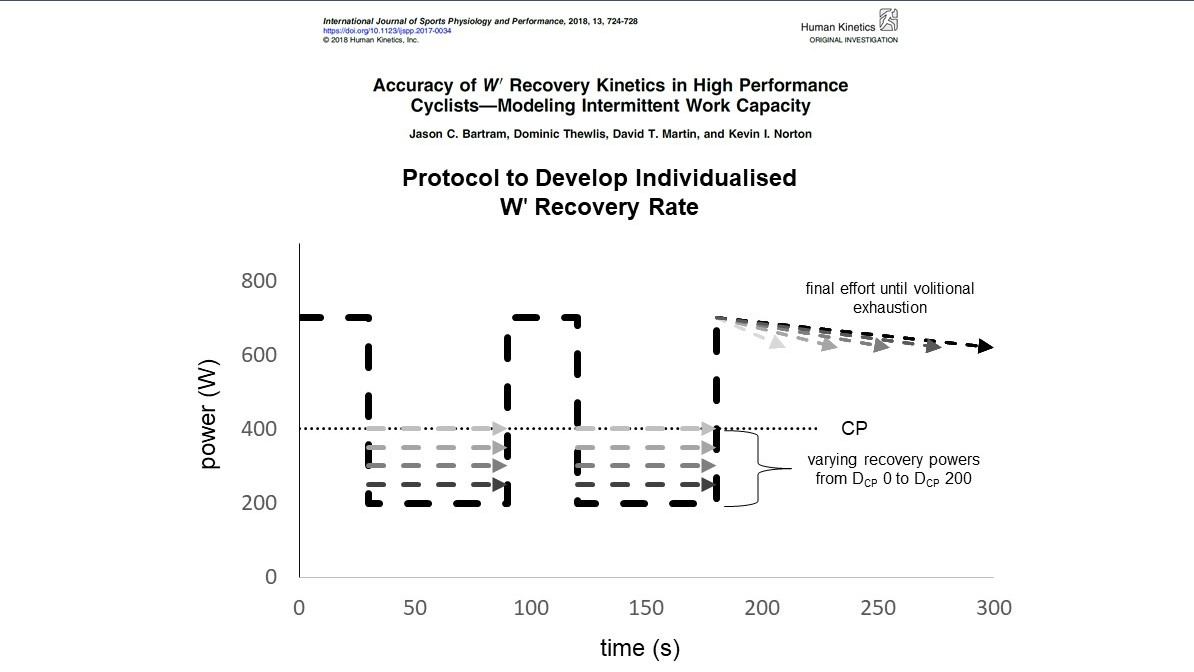
Applying the intermittent CP model to Team Pursuit race analysis will require individualised Wʹ recovery rates. These can be calculated by completing a range of exhaustive intermittent work bouts with varying recovery powers.
#ESSTC21
6/6
English
@DrNathanT Thanks Nathan. It's going to be interesting to see if custom recovery rates will lower this variability, or whether we simply need to lower our expectations regarding applications of the model.
English
@jasonCbartram Same results as I've found in recreational trained individuals. The average W'bal is generally within +/- 1.5kJ of 0 upon exhaustion/task failure, but individual error can be pretty large eg: up to 5 kJ. Great stuff and an excellent article :-)
English
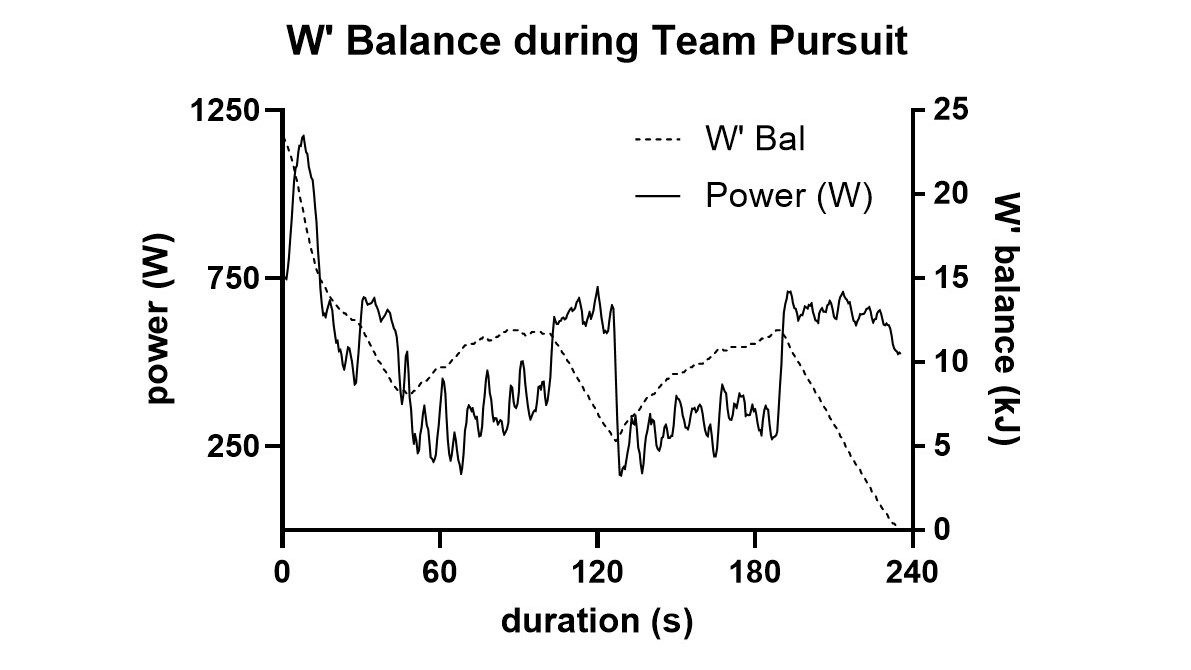
Analysing power data from World Cup Team Pursuits, the mean final Wʹ balances were not different to 0kJ when using the cohort specific recovery rate. However individual variability was still considerably high.
#ESSTC21
5/6

English
@Spragg_Perform Thanks James, reach out if you're ever interested in a collaboration.
English

@jasonCbartram HI Jason, just wanted to say this is an excellent tread!
English
@PughCycle Hi Charlie, yes your insight is spot on, however a well planned and rehearsed strategy should aim to minimise this across riders.
English

@jasonCbartram Great work, Jason! If drafting allows recovery, would the sheltered riders finish with some W' remaining?
English
Individual workloads experienced in a Team Pursuit are supramaximal, intermittent, and exhaustive. Tracking Wʹ balance using the Skiba 2 model, but with a cohort specific recovery rate, should see final Wʹ balances of 0kJ.
#ESSTC21
4/6
English
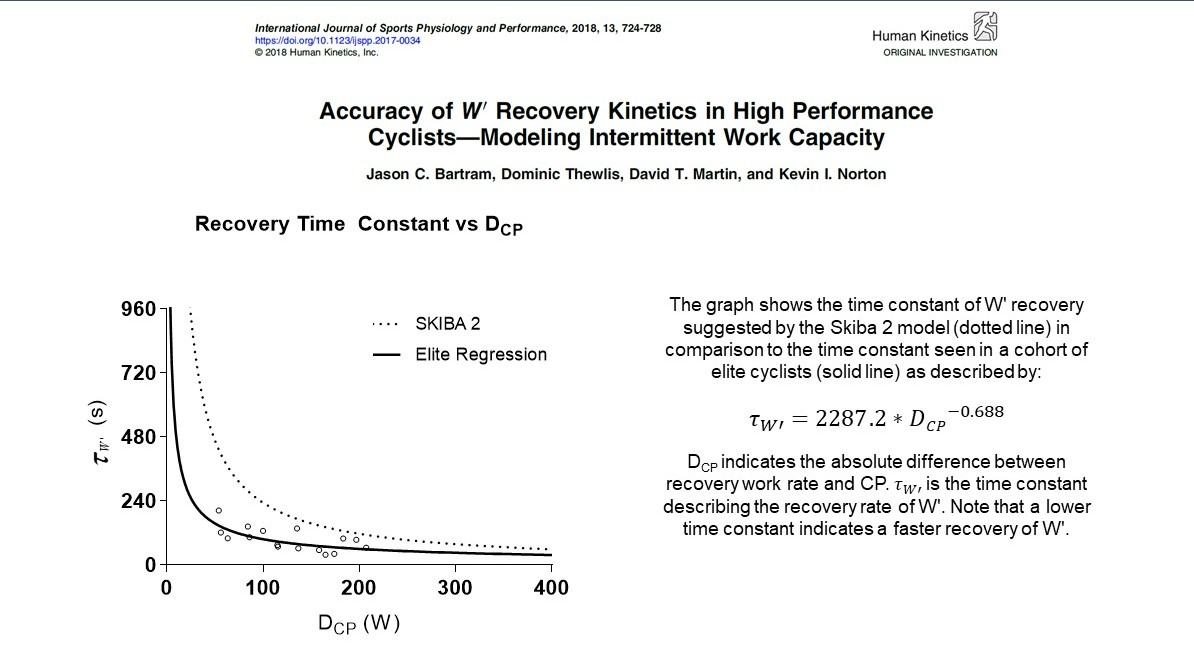
The intermittent Wʹ balance models were developed by Skiba using mostly recreational participants. We have previously shown that elite cyclists recover their Wʹ faster at the same relative intensity (Bartram 2018)
#ESSTC21
3/6
English
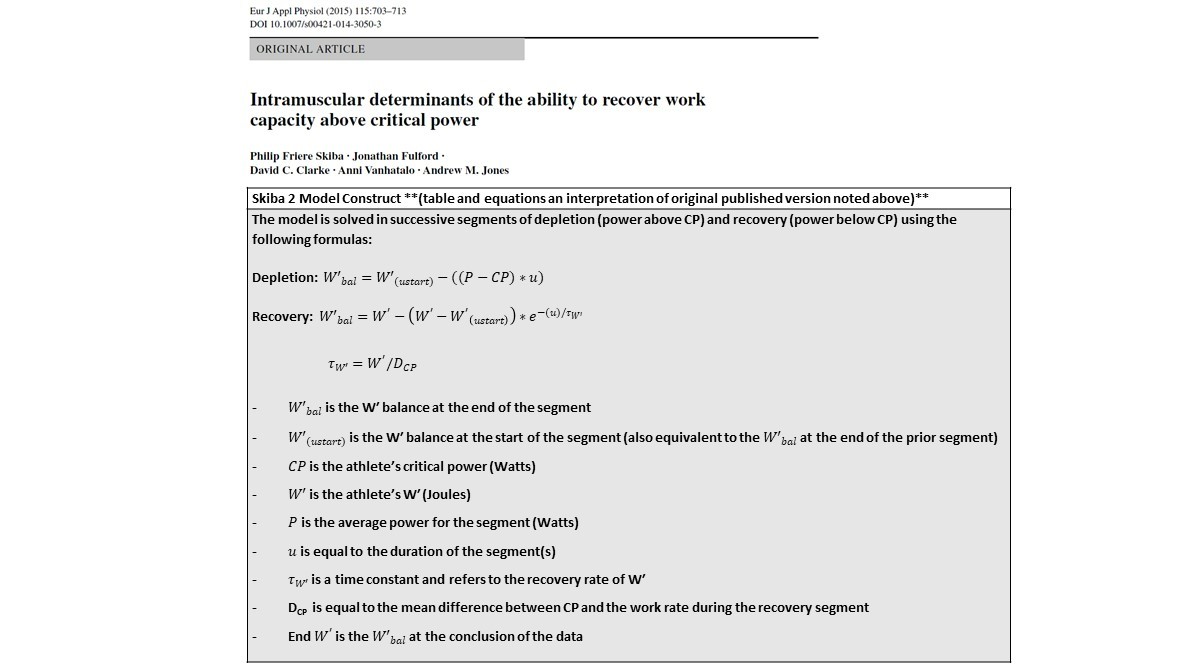
An evolution of the CP model describes both depletion and recovery of Wʹ, enabling application to intermittent work. Wʹ recovery is deemed to occur below CP, is curvilinear relative to time, and is faster at lower work rates (Skiba 2014)
#ESSTC21
2/6
English
Jason Bartram retweetledi

The @AUSParalympics cycling team opened the #Tokyo2020 #Paralympics in extraordinary style with gold medals and world records to @AusCyclingTeam duo Paige Greco and Emily Petricola on the opening day of Track #ParaCycling competition at Izu Velodrome.
auscycling.org.au/nat/news/greco…
English
Jason Bartram retweetledi

We cannot wait ! Get around the @AUSParalympics mob. #ReadySetTokyo
AUS Paralympic Team@AUSParalympics
The countdown is on! In 10 days the largest Australian Paralympic Team to contest a Games overseas will represent our nation at the @Tokyo2020 @Paralympics. The action begins on @7Sport from August 24. Full story: bit.ly/2Xswquw #ReadySetTokyo #Tokyo2020
English
Jason Bartram retweetledi

NEW POD - @jasonCbartram joins the show to review Australia’s Olympic campaign. stanleystreetsocial.com/stanley-street…
English
Hindsight is easy, and intent means everything. Proud of you all @AusCyclingTeam
English
Jason Bartram retweetledi
Check this out. Pretty much every single runner, except the winner @EliudKipchoge, basically had a distance to exhaustion approach in today's men's marathon. How do we best mimic this in research study designs? Time trials not always the best approach IMHO.
Tomoyuki MARUYAMA@Tom1jpn
東京五輪男子マラソン ペース変動グラフ #TOKYO2020 Men's #Marathon Pace Chart youtu.be/Ism1uNnMEnw #大迫傑 #中村匠吾 #服部勇馬 #eliudkipchoge #東京2020オリンピック
English
Jason Bartram retweetledi

Aussies in action on #CyclingTrack Day 1:
Ankudinoff, Edmondson, Baker, Manly, Plouffe (all women’s Team Pursuit) from 1654 AEST
Plapp, Welsford, Porter, Howard, O’Brien (all men’s Team Pursuit) from 1802 AEST
Kerby (New Zealand TP squad)
#couchgames australiancyclinginsider.com/2021/07/31/how…
English
Jason Bartram retweetledi
The new normal if Marcell Jacobs wins the 100m😉 Forza 🇮🇹
Sundsvall, Sverige 🇸🇪 English
Jason Bartram retweetledi

So pleased for @ECHaakonssen gold medal sport scientist!!! 🥇
#Tokyo2020
AusCycling@AusCycling
LOGAN MARTIN, YOU ARE AN OLYMPIC CHAMPION 🥇 Logan has made history as the first ever men's BMX Freestyle @Olympics Champion. @AUSOlympicTeam I @AusCyclingTeam I #Tokyo2020 I #TokyoTogether I #LetsRideTogether
English