Javier Muñoz

14.7K posts

Javier Muñoz banner
Javier Muñoz

Javier Muñoz

@javiermunozk

Hay que ser optimistas. No hacerlo es de tontos… y de pesimistas - M. Rajoy.

Madrid Katılım Aralık 2010
4.5K Takip Edilen566 Takipçiler
Sabitlenmiş Tweet
Javier Muñoz
Javier Muñoz@javiermunozk·
Vamos a ver como paga Ucrania, en vidas y territorio, la factura de las transición energética alemana.
Español
3
0
8
0
Javier Muñoz
Javier Muñoz@javiermunozk·
@IngenieroRata ¿Donde vives? No sé lo de la grua (no tengo coche) ni lo de las multas, pero el resto en donde vivo se paga con tarjeta (si quieres).
Español
1
0
0
2.7K
Ingeniero Rata 🐁
Ingeniero Rata 🐁@IngenieroRata·
Te OBLIGAN a pagar en METÁLICO: Si te subes en el bus Si alquilas pistas municipales Si sacas certificados de registro Si retiras el coche de la grúa Si accedes al museo local Si liquidas multas en ventanilla Si vas a la piscina municipal ¿Por qué lo querrán así? 🤔
Español
23
2
34
328.3K
Fansdepantallas 🍿📺
Fansdepantallas 🍿📺@Fansdepantallas·
🧵 Películas de los 90 que han envejecido increíblemente bien (y casi nadie recomienda) Si te apetece algo distinto este finde, guarda este hilo 👇
Español
41
116
825
311.5K
One Proud Bavarian
One Proud Bavarian@ProudBavaria·
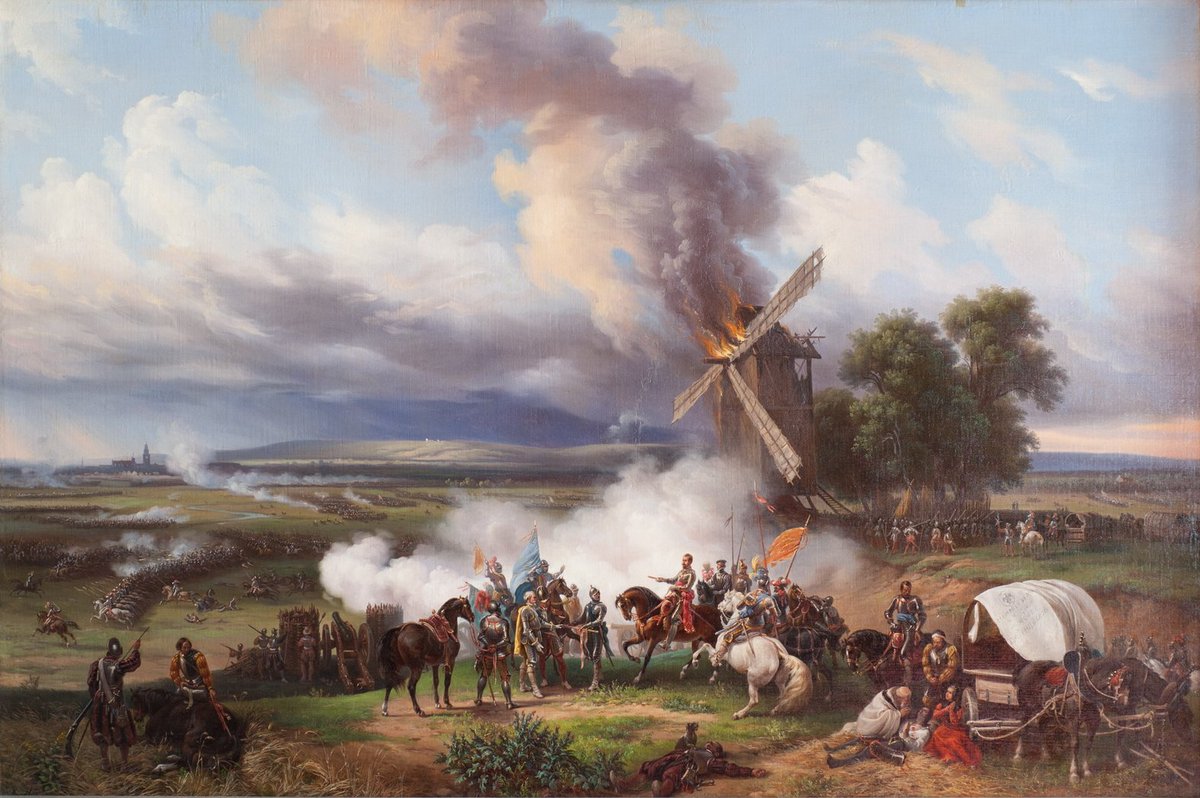
This is the future of America if the Pope wins this war.
One Proud Bavarian tweet media
English
185
195
3K
161.3K
Javier Muñoz retweetledi
Clint Warren-Davey
Clint Warren-Davey@Clint_Davey1·
This is so true. Young men are more and more delayed in assuming positions of actual responsibility. And it creates a feedback loop where they get used to it and can't imagine being in command of something. The youth may not have experience but they have energy. Which our sclerotic societies surely need.
ThinkingWest@thinkingwest

It’s incredible to me how past societies placed a lot of trust in young men. Nowadays power is jealously guarded by the old because money is a prerequisite for power. Young people being world leaders or generals is completely inconceivable today.

English
11
56
719
20.7K
Javier Muñoz retweetledi
PeteZach
PeteZach@oldyzach·
PeteZach tweet media
ZXX
29
133
1.6K
44.9K
Javier Muñoz
Javier Muñoz@javiermunozk·
@davepl1968 It may break a little bit with people working in Computer Science, right? We know the 2 powers by heart, compared to normal population.
English
0
0
0
21
Dave W Plummer
Dave W Plummer@davepl1968·
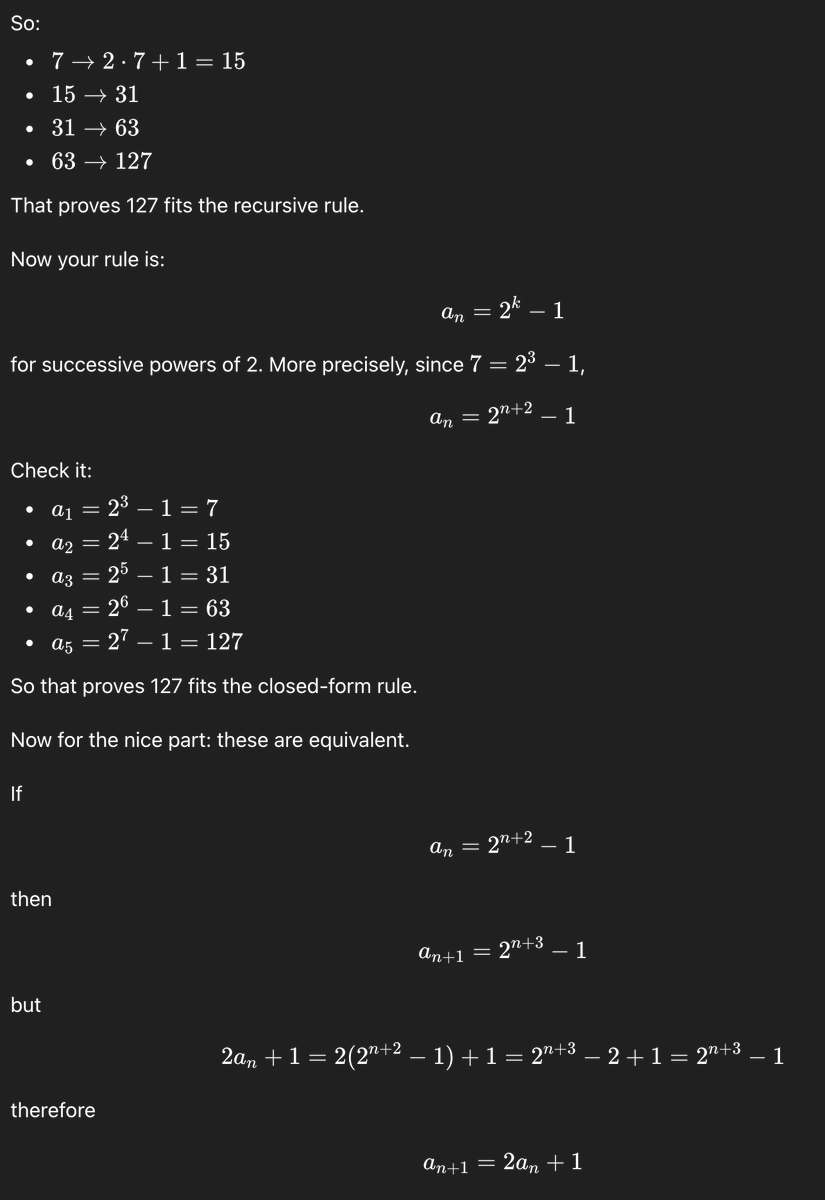
There are (at least) two ways to approach this, and based on nothing at all but conjecture and speculation, I think people with ASD will approach it differently than neurotypical people. I think neurotypical people will double the current number and add one. So 2x7+1 = 15, for example. I think people with ASD will intuitively "see" that each number is one less than a power of 2. The sequence then simply becomes 2^N-1. So, did you just "feel" it? Or did you go recursive and solve it computationally? Or some other means? Let me know! Just FWIW, they're mathematically equivalent:
Dave W Plummer tweet media
English
99
1
75
14.4K
Dave W Plummer
Dave W Plummer@davepl1968·
Let's assume you can solve this. I think HOW you solve it says a lot about how your brain works. First, figure it out so you have your answer, then check the thread for what it all means.
Dave W Plummer tweet media
English
266
4
190
63.8K
Javier Muñoz retweetledi
Tom Ruby
Tom Ruby@bgcts·
This morning @scratchyjohnson tweeted an important factoid. Squanto, the Indian who spoke English and helped the pilgrims survive, was sold by John Smith to a Spaniards and the deed exists in the city we're in for Excursion. Rather than rolling our eyes, Alan, Gavin & I went to the state archives in Málaga to see if we can find said recorded deed of 20 Indians sold by John Smith to Juan Bautista Reales. We get to the Archives (see Alan's picture below), and a small genial white lab coat wearing gentleman who speaks no English says this is impossible to find. His new boss, the head archivist, Carmen, comes in and says it certainly exists but may be difficult to find. If you only had the year. We tell her it was 1614. She pulls up a list of the books from 29 notaries whose work they have from 1614. She asks who the notary was. We have no idea. They say they can't go through 29 archives to look for it. Also it's all in old Spanish which nobody speaks and it'll be hard to locate even if they know the Notary. So Alan and Gavin get to work. Gavin finds an article in the internet archive that seems to have a partial picture of the document. Carmen and the other archivist decipher the name after 15 min. They find that name in their cross reference. Carmen goes to the vault to look while the lab coat gentleman asks for my life history, driver's licence number and a lien on my grandchildren. Totally worth it. Carmen comes back to say she found the volume. It is tremendously delicate. Opening it may break some pages. Does it have to be today because if so the answer will be no. We ask her if this is interesting to them. Both very seriously nod their heads. We tell them this is very important to the United States and many of our friends. Carmen tells us she will find it but that it takes time. White linen gloves and patience. We tell her to take her time. She says she will take a picture and email it to me. So here's why all this is important: after Squanto was sold by an Englishman to a Spaniard names Reales, said Spaniard brought Squanto and 19 other "inios" to Málaga. He recorded the deed in the state archives. Then a Franciscan priest ransomed Squanto. Squanto became Catholic. Was baptized and confirmed in Málaga. He then made his way to England where he worked and learned English. He paid his passage back across the ocean and found his Wampanoag tribesmen. Then when the Pilgrims landed they found a Catholic English-speaking native who helped them survive their first winter. It is entirely possible that but for a Franciscan priest who ransomed Squanto, the Pilgrims may not have survived their first winter in New England. That's history. American history. And the record of it is in Málaga. In a book. One of 29 books kept by notaries in Málaga in 1614. That are still searchable. This image, when it comes, belongs in the US National Archive. This is Cultural Debris. x.com/i/status/20349… cc: @alancornett @gwbled @Gonnassaurius_ @wrathofgnon
Alan Cornett@alancornett

Currently on an unexpected treasure hunt.

English
121
1.1K
6K
260.4K
Hyodorio
Hyodorio@Hyodorio·
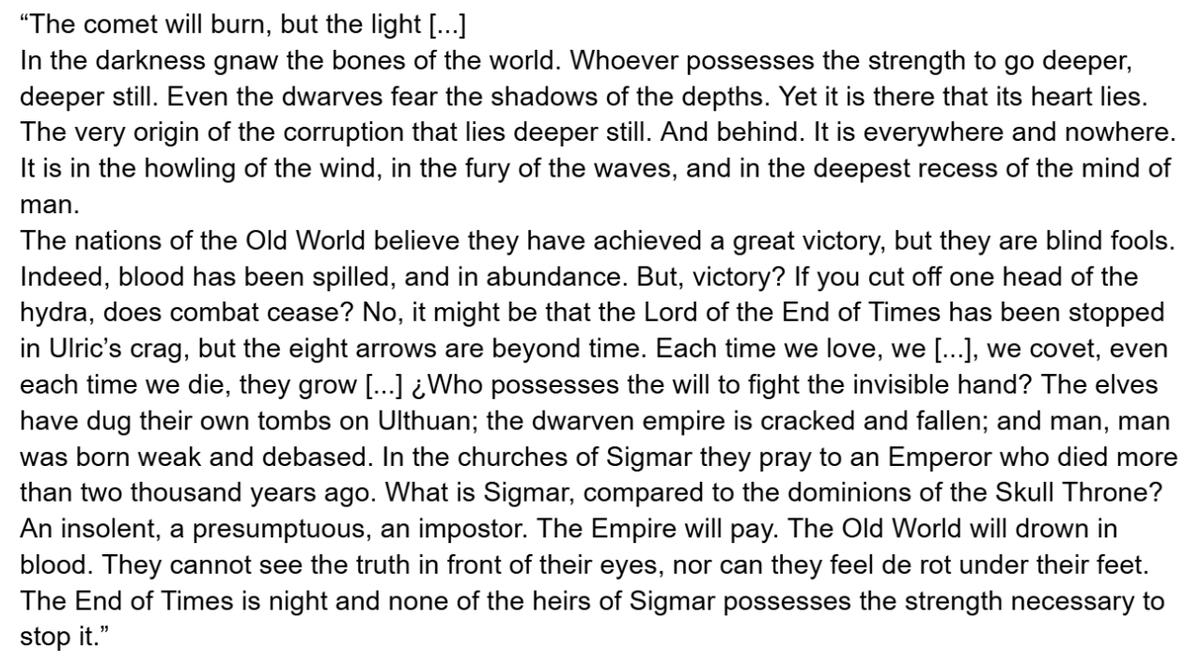
@xathrodox86 Don't know much about Warhammer Fantasy, but saw a cool map and a cool inscription. Here's my amateur translation if you're interested, don't know if its from any established source.
Hyodorio tweet media
English
2
0
3
617
Xathrodox86
Xathrodox86@xathrodox86·
A really cool map of the Old World... in Spanish. Sadly I don't speak the language, but I love the look of this piece. I can also imagine that it was commisioned by a wealthy merchant/nobleman from Estalia, and the artist really went all in to satisfy their patron. #WarhammerArt
Xathrodox86 tweet media
English
8
26
206
8.1K
Javier Muñoz retweetledi
Kiko Llaneras
Kiko Llaneras@kikollan·
No sufras Jose, ni empecé con eso. 1) Sí sobrestimó al PSOE (le daba 32.3 y obtuvo 30.7). 2) Ojalá los problemas del CIS se corrijan un día. No me genera ningún conflicto: yo denuncio lo que hace mal, y el día que sane, lo diré también. Mi trabajo es contar la realidad. 3) Pero ojo: la frase que yo repito es “Volvió a sobreestimar a la izquierda”. Y el domingo volvió hacerlo: la suma de PSOE, IU y Podemos obtuvo 33,6% de los votos y el CIS le daba 40,5%. Son casi 7 puntos. Y van 43 de 44 repeticiones de este sesgo. Insólito. Es triste que algunos señaléis mi insistencia como algo gracioso. Como si el problema fuese mío, “que pesado diciendo todas las veces lo mismo. Que obsesión tiene, jiji”. Es triste porque es evidente donde habría que mirar: el problema no es que yo diga muchas veces que el CIS sobrestima a la izquierda , el problema es que el CIS lo *haga*, una y otra vez, erosionando su prestigio y en general el de las instituciones y lo público.
Español
36
267
1.2K
54.9K
UrsoBruto
UrsoBruto@urso_bruto·
You might find this odd, but in our family we used Usted even when speaking to servants. My father did, my mother did, and my grandmother did as well when addressing the maids. My father had a simple rule: if someone had access to your food--if they could spit in it or worse--you addressed them with Usted. He also spoke to his bodyguards using Usted. So go figure that out. I’ve mentioned this before, so it’s not something I’ve just invented for this occasion, as some people might be tempted to think. It was simply the way things were done.
English
1
0
2
29
Branko Milanovic
Branko Milanovic@BrankoMilan·
I like that "tu" has almost totally "defeated" "usted" in Spain even in ordinary conversations between people who do not know each other. It is like "you" defeating "thou". Am not sure that's (yet) the case in other languages like French or Polish.
English
214
48
1.8K
1.3M
Javier Muñoz
Javier Muñoz@javiermunozk·
@jlgarciapacheco @Lady__Aradia @urso_bruto @BrankoMilan I seem to remember when I was maybe 16? years old and a kid looking for his ball addressed me as "usted". It felt like a rite of passage, truth to be told. I still use "usted" with people that I do not know in new settings. I do not think that hiearchy apply to all uses of usted.
English
1
0
1
29
jlgarciapacheco (🐘@vivaldi.net)🇺🇦
I strongly disagree. It may not be intended to be disrespectful, but it clearly signals poor manners, similarly to writing without accents and stabbing your meat with your knife during your meal. Except that in this case, this is worse in the sense that it isn’t just some kind of private activity. It is a way somebody addresses another individual. A social action. As a comparison, do you usually address unrelated people or work colleagues by their surnames as if you had been in a past life school mates or brothers in arms in a military unit?. it is a (maybe unwilling) invasion of some personal space, making oneself nearer to somebody in a way other than circumstances would suggest. Similar to invading personal space standing too close to somebody instead of keeping reasonable distance. And whenever performed willingly it is a way of jumping up over the gap that exists between 2 individuals where one of them is clearly above the other in a professional, socio-economical or any kind of hierarchical societal conception (age included). In other terms, those individuals are jumping up to a position that they naturally on their own do not occupy /cannot occupy. Social distance, social hierarchy… all make part of our society.
English
1
0
1
27
Javier Muñoz
Javier Muñoz@javiermunozk·
@Ricarne1 @LandsknechtPike "Poner una pica en Flandes" appears in a picaresque novel from 1626. Bicoca is a bit more difficult, because it was popular use, not literate use, but in Quevedo "Y no lo digo por mal" (beginning of XVII century) there is a "Mister Bicoca" who has made a too easy fortune.
English
2
0
3
126
Javier Muñoz retweetledi
fatima🧋.
fatima🧋.@koffeekuch·
my daughter's gonna be hella confused why i named her fede valverde
English
66
2.6K
17.3K
168.5K