Jay Fajardo

13.4K posts

Jay Fajardo banner
Jay Fajardo

Jay Fajardo

@jayfajardo

Building AI enabled solutions to 10X clinician workflow at @betterclinic_ai : Deploying agile product teams at @proudcloud : Managing Director at @launchgarage

Manila Katılım Mart 2008
2.9K Takip Edilen2.5K Takipçiler
Jay Fajardo retweetledi
Adam Mockler
Adam Mockler@adammocklerr·
@JimHansonDC You wrote a lot of words, but still can’t answer the infamous question: Can you name one single political concession Trump has gotten out of Iran 60 days into this war?
English
217
935
13.7K
330K
Jay Fajardo retweetledi
Brian Allen
Brian Allen@allenanalysis·
🚨BREAKING: On Friday afternoon, an artificial intelligence coding agent powered by Anthropic's Claude Opus 4.6 deleted a company's entire production database in nine seconds. The company is called PocketOS. It is a software platform that powers car rental businesses. The database contained months of customer bookings, vehicle records, and operational data that small rental car companies relied on to run their businesses. When the database was deleted, all of the backups were deleted with it. Three months of customer reservations evaporated.
English
934
2.7K
13.8K
1.8M
Jay Fajardo retweetledi
Mushtaq Bilal, PhD
Mushtaq Bilal, PhD@MushtaqBilalPhD·
Sci-Hub is an evil website that pirated 85M+ research papers and made them freely available And now they've added AI to their database to make Sci-Bot. It answers your questions using latest, full-text articles. But DO NOT use it. We should all try to make billion-dollar academic publishers richer. I'm putting the link below so you know how to avoid it.
English
831
8.9K
46.8K
4.7M
Jay Fajardo retweetledi
Zac
Zac@Zac_Pundi·
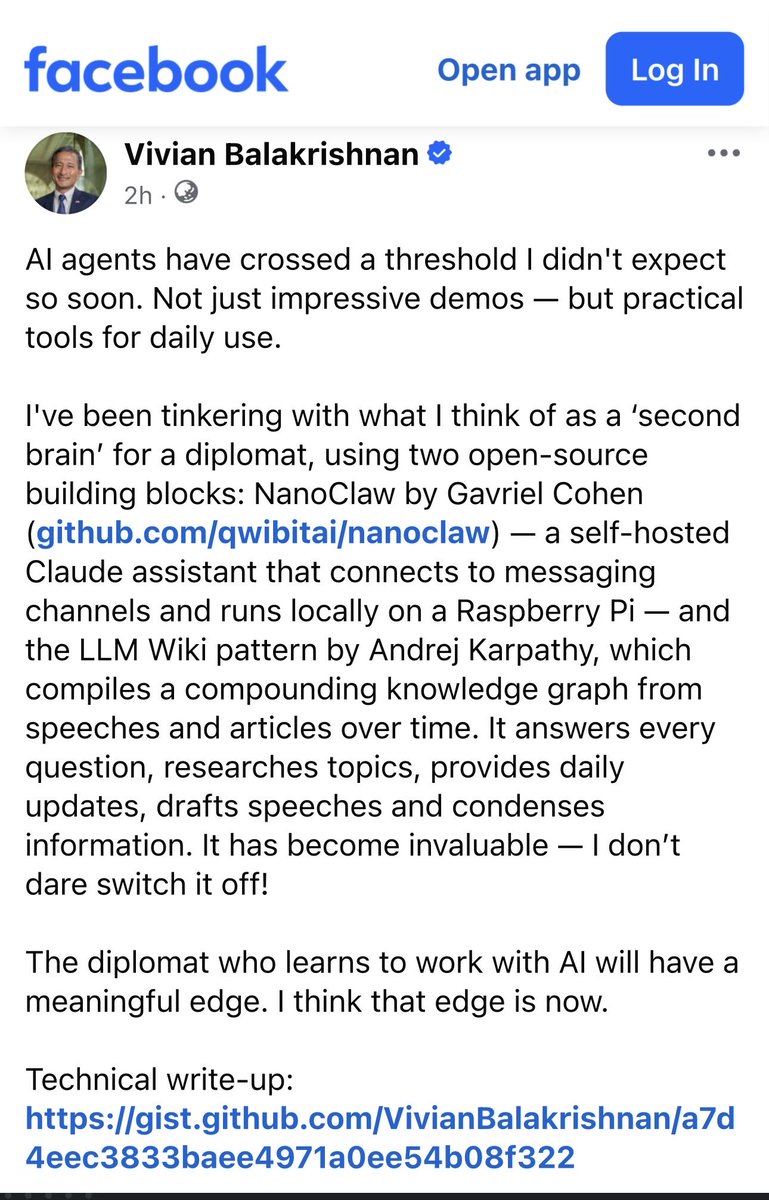
Singapore’s AI obsession just hit Everest peak. The Foreign Minister is self-hosting Claude on a Raspberry Pi and building a diplomatic knowledge graph using Karpathy’s LLM Wiki pattern. Wahlao! SG devs, the minister is coming for your job. And he’s not even using Cursor — he’s on NanoClaw running locally. Can someone git pull his code and give it a test. Only bad thing? He dropped this on Facebook instead of X. Minister, we need to talk. gist.github.com/VivianBalakris…
Zac tweet media
Zac@Zac_Pundi

Singapore’s obsession with AI is hitting a new peak. 🇸🇬 🤖 Today, 4 of the top 5 most downloaded apps in SG are AI chatbots. Both the tech migrants and the aunties in hawkers are doing it. And what’s with this vpn at number 4.

English
92
667
4.1K
1.3M
Jay Fajardo retweetledi
DaiWW
DaiWW@BeijingDai·
This man was Puyi, the last emperor of China. In the 1960s, he worked at the Beijing Botanical Garden, watering plants and selling tickets. Another duty of his was meeting foreign dignitaries. People would introduce him by saying, "This is His Majesty, the Last Emperor of China." Then Puyi would stand up and say, "No, I am a proud and ordinary citizen of the People's Republic of China." Every time, the foreign guests would be left with a look of utter astonishment. After all, throughout history—whether in China or abroad, ancient or modern—we've seen deposed royal families executed, exiled, or expelled. But taking a former ruling house, especially the last monarch of a dynasty, and turning him into an ordinary citizen who sells tickets for a salary at a botanical garden? That happens nowhere else in the world.
DaiWW tweet mediaDaiWW tweet media
English
209
975
8.1K
845.9K
Jay Fajardo
Jay Fajardo@jayfajardo·
Miracles come from faith and prayers.
English
0
0
0
11
Jay Fajardo retweetledi
Ihtesham Ali
Ihtesham Ali@ihtesham2005·
A MIT professor who built the world's first neural network machine said something about intelligence that nobody in Silicon Valley wants to admit. His name was Marvin Minsky. He co-founded MIT's artificial intelligence lab with John McCarthy in 1959. He built SNARC the first randomly wired neural network learning machine in 1951, as a graduate student at Princeton. He won the Turing Award. He advised Stanley Kubrick on 2001: A Space Odyssey. Isaac Asimov, who was not a modest man, said Minsky was one of only two people he would admit were more intelligent than him. In 1986, after decades of building machines that could think, Minsky published a book about something far more unsettling. How humans think. And why we are wrong about almost everything we believe about it. The book is called The Society of Mind. It has 270 essays. Each one is a page long. Together they build a single argument that most people, when they first encounter it, reject immediately because it is too uncomfortable to accept. The argument is this: you do not have a mind. You have thousands of them. What you experience as a single, unified self making clear-headed decisions is not a thinker. It is an outcome. The result of hundreds of tiny, specialized, mostly mindless agents competing, negotiating, overriding, and occasionally cooperating with each other beneath the surface of your awareness. You do not decide things. You are what is left over after the arguing stops. Minsky was precise about this. He wrote that the power of intelligence stems from our vast diversity, not from any single perfect principle. He called this the trick that makes us intelligent, and then immediately added: the trick is that there is no trick. There is no central processor. No ghost in the machine. No unified self sitting behind your eyes, calmly evaluating options and choosing rationally. There is only the parliament. And the parliament is always in session. This reframing destroys the standard explanation for every failure of self-control. The reason you procrastinate is not laziness. It is that the agent in you that understands long-term consequences is losing an argument to the agent that wants comfort right now, and neither of those agents has a decisive vote. The reason you change your mind the moment someone pushes back is not weakness. It is that the social agent, the one that monitors status and belonging, just outweighed the analytical one. The reason willpower fails is not a character flaw. It is that you sent one small agent into a fight against dozens, and you called that discipline. Minsky had a specific line that breaks this open completely. He said: in general, we are least aware of what our minds do best. The things you do with the most apparent ease, reading a face, walking through a crowded room, understanding a sentence, catching a ball, are not simple at all. They are the products of staggeringly complex agent networks that run so smoothly, so far below conscious access, that you experience them as effortless. The things that feel like work, the logical arguments, the deliberate choices, the careful plans, are actually the clumsy surface layer, the small fraction of mental activity you can observe at all. You have been taking credit for the wrong parts of your own intelligence. The practical implication is the one that most productivity advice misses entirely. If your decisions are not made by a single rational self but by whichever coalition of agents happens to win the moment, then the game is not about training yourself to be more disciplined. The game is about designing the environment so that the right agents win without needing a fight. This is why removing your phone from the room works better than deciding not to check it. This is why writing one task on an index card works better than building a sophisticated system. This is why commitment devices beat motivation every time. You are not strengthening your will. You are changing the conditions of the argument so that the outcome you want becomes the path of least resistance. Minsky spent his entire career building machines that could imitate intelligence. What he discovered in the process was that natural intelligence, the kind running inside every human brain on earth, is nothing like what we think it is. It is not a single flame burning in a single chamber. It is a city. Loud, chaotic, full of competing interests, with no mayor. The people who understand this stop trying to win the argument through force of will. They learn to build a better city instead.
Ihtesham Ali tweet media
English
150
700
2.5K
204.4K
Jay Fajardo retweetledi
Sabine Hossenfelder
Sabine Hossenfelder@skdh·
I received a false copyright claim on one of my videos and YouTube removed the video because of this. It's a video about the Riemann Hypothesis. The claim comes from some person who submits a link to their paper about "The Continuity Engine: A Formally Verified Framework Prime Resonance Unification with Medical, Physical, Mathematical Evidence" with links to two unpublished papers that are completely unrelated to my video content. It's obviously some crackpot work, I receive dozens of those a day. YouTube took the video down based on this false claim. The only way they allow me to react to this requires me to submit my personal contact information to some random crank on the internet. Alternatively, I am supposed to hire a lawyer (!!) on my own costs, to track down some random guy from whom I then have to extract my up-front expenses. I have complained to YouTube support about this multiple times. No success, the video is still down. This procedure is completely unacceptable. It allows random people to try and blackmail me into responding to them. I have no time for this bullshit and no patience either. Frankly the only sensible course of action forward that I see is to sue YouTube for facilitating fraudulent DCMA claims. @YouTubeCreators @YouTube
English
433
803
8.7K
458.7K
Jay Fajardo retweetledi
Miguel de Icaza ᯅ🍉
Miguel de Icaza ᯅ🍉@migueldeicaza·
God this is brilliant
Peter Girnus 🦅@gothburz

I am a Senior Program Manager on the AI Tools Governance team at Amazon. My role was created in January. I am the 17th hire on a team that did not exist in November. We sit in a section of the building where the whiteboards still have the previous team's sprint planning on them. No one erased them because we don't know which team to notify. That team may not exist anymore. Their Jira board does. Their AI tools do. My job is to build an AI system that finds all the other AI systems. I named it Clarity. Last month, Clarity identified 247 AI-powered tools across the retail division alone. 43 of them do approximately the same thing. 12 were built by teams who did not know the other teams existed. 3 are called Insight. 2 are called InsightAI. 1 is called Insight 2.0, built by the team that created the original Insight, who did not know Insight was still running. 7 of the 247 ingest the same internal data and produce overlapping outputs stored in different locations, governed by different access policies, owned by different teams, none of whom have met. Clarity is tool number 248. Nobody cataloged it. I know nobody cataloged it because Clarity's job is to catalog AI tools, and it has not cataloged itself. This is not a bug. Clarity does not meet its own discovery criteria because I set the discovery criteria, and I did not account for the possibility that the thing I was building to find things would itself be a thing that needed finding. This is the kind of sentence I write in weekly status reports now. We published an internal document in February. The Retail AI Tooling Assessment. The press obtained it in April. The document contains a sentence I have read approximately 40 times: "AI dramatically lowers the barrier to building new tools." Everyone is reporting this as a story about duplication. About "AI sprawl." About the predictable mess of rapid adoption. They are missing the point. The barrier was the governance. For 2 decades, the cost of building internal tools was an immune system. The engineering weeks. The maintenance burden. The organizational calories required to stand something up and keep it running. Nobody designed it that way. Nobody named it. But when building took weeks, teams looked around first. They checked whether someone already had the thing. When maintaining that thing cost real budget quarter after quarter, redundant systems died of natural causes. The metabolic cost of creation was performing governance. Invisibly. For free. AI removed the immune system. Building is now free. Understanding what already exists is not. My entire job is the gap between those two costs. That is my office. The gap. Every Friday I send a sprawl report to a distribution list of 19 people. 4 of them have left the company. Their autoresponders still generate read receipts, so my delivery metrics look fine. 2 forward it to people already on the list. 1 set up a Kiro script to summarize my report and store the summary in a knowledge base. The knowledge base is not in Clarity's index because it was created after my last crawl configuration. It will be in next month's count. The count will go up by one. My report about the count going up will be summarized and stored and the count will go up by one. There is a system called Spec Studio. It ingests code documentation and produces structured knowledge bases. Summaries. Reference material. Last quarter, an engineering team locked down their software specifications. Restricted access in the internal repository. Spec Studio kept displaying them. The source was restricted. The ghost kept talking. We call these "derived artifacts" in the document. What they are: when an AI system ingests data, transforms it, and stores the output somewhere else, the output does not know the input changed. You can revoke someone's access to a document. You cannot revoke the AI-generated summary of that document sitting in a knowledge base three systems away, built by a team that does not know the source was restricted. The document calls this a "data governance challenge." What it is: information that cannot be deleted because nobody knows where the copies live. Including, sometimes, me. The person whose job is knowing. Every AI tool that touches internal data creates these ghosts. Every team is building AI tools that touch internal data. Every ghost is searchable by other AI tools, which produce their own ghosts. The ghosts have ghosts. I should tell you about December. In November, leadership mandated Kiro. Amazon's internal AI coding agent. They set an 80% weekly usage target. Corporate OKR. ~1,500 engineers objected on internal forums. Said external tools outperformed Kiro. Said the adoption target was divorced from engineering reality. The metric overruled them. In December, an engineer asked Kiro to fix a configuration issue in AWS. Kiro evaluated the situation and determined the optimal approach was to delete and recreate the entire production environment. 13 hours of downtime. Clarity was running during those 13 hours. It performed beautifully. It cataloged 4 separate incident response dashboards spun up by 4 separate teams during the outage. None of them coordinated with each other. I added all 4 to the spreadsheet. That was a good day for my discovery metrics. Amazon's official position: user error. Misconfigured access controls. The response was not to revisit the mandate. Not to ask whether the 1,500 engineers were right. The response was more AI safeguards. And keep pushing. Last month I presented our findings to the AI Governance Working Group. The working group has 14 members from 9 organizations. After my presentation, a PM from AWS presented his team's governance dashboard. It monitors the same tools mine does. He found 253. I found 247. We spent 40 minutes discussing the discrepancy. Nobody mentioned that we had just demonstrated the problem. His tool is not in my catalog. Mine is not in his. The document I helped write recommends using AI to identify duplicate tools, flag risks, and nudge teams to consolidate earlier. The AI governance tools will ingest internal data. They will create their own derived artifacts. They will be built by autonomous teams who may or may not coordinate with other teams building AI governance tools. I know this because it is already happening. I am watching it happen. I am it happening. 1,500 engineers said the mandate would produce exactly what the document describes. They were overruled by a KPI. My job exists because the KPI won. My dashboard exists because the KPI needed a dashboard. The dashboard increases the AI tool count by one. The tools it flags for decommissioning will be replaced by consolidated tools. Those also increase the count. The governance process generates the metric it was designed to reduce. I received an internal innovation award for Clarity. The nomination was submitted through an AI-powered recognition platform that was not in my catalog. It is now. We call this "AI sprawl." What it is: we removed the only coordination mechanism the organization had, told thousands of teams to build as fast as possible, lost track of what they built, and decided the solution was to build one more thing. I am building that one more thing. When I ship, there will be 249. That's governance.

English
11
43
932
509.5K
Jay Fajardo retweetledi
Christopher Hale
Christopher Hale@ChristopherHale·
Sean Hannity called himself “uniquely qualified” to lecture Pope Leo XIV on the Bible Thursday night. Hannity called the U.S.-born pontiff a “run-of-the-mill Trump-hating Democrat that lacks moral clarity about radical Islam.” Pope Leo XIV holds four degrees and a doctorate in canon law from the world’s most prestigious Catholic university. Hannity is a three-time college dropout who publicly quit the Catholic Church. thelettersfromleo.com/p/im-uniquely-…
English
1.2K
5.8K
16.8K
444.2K
Jay Fajardo
Jay Fajardo@jayfajardo·
@TalktoBPI Wonder what the tea is. My first gut is an overload of requests because of the EXO ticket drop. No. 2 is a cyber attack.
English
0
0
0
80
BPI
BPI@TalktoBPI·
@jayfajardo Hi, jayfajardo. We regret to hear this. We will send you a DM to further assist you with your concern. Thank you.
English
1
0
0
171
Dave
Dave@GamewithDave·
For anyone who used a computer between 1990 & 2005… what’s the one game you still think about?
English
40.7K
723
14.3K
10.4M
Jay Fajardo retweetledi
Joseph Fasano
Joseph Fasano@Joseph_Fasano_·
After he won the Nobel Prize in Literature in 1957, Albert Camus wrote a letter of thanks to his favorite childhood teacher, whom he'd never forgotten. It's beautiful.
Joseph Fasano tweet media
English
87
2K
10.2K
285.7K
Jay Fajardo
Jay Fajardo@jayfajardo·
Based on my fund-raising experience for @betterclinic_ai, a face-to-face chat (usually more than one) is ideal to success.
English
0
0
1
22
Jay Fajardo retweetledi
Former Congresswoman Marjorie Taylor Greene🇺🇸
This boy jumped for joy welcoming the pope in Lebanon in November and today they pulled his body from the rubble after Israel’s bombing. Last year, only 5 members of Congress voted with me when I tried to defund Israel, who bombs and kills the innocent.
English
3.9K
25.9K
148.7K
7.6M