Jeevan Rao☀️

2.1K posts

Jeevan Rao☀️ banner
Jeevan Rao☀️

Jeevan Rao☀️

@jeevanraya98

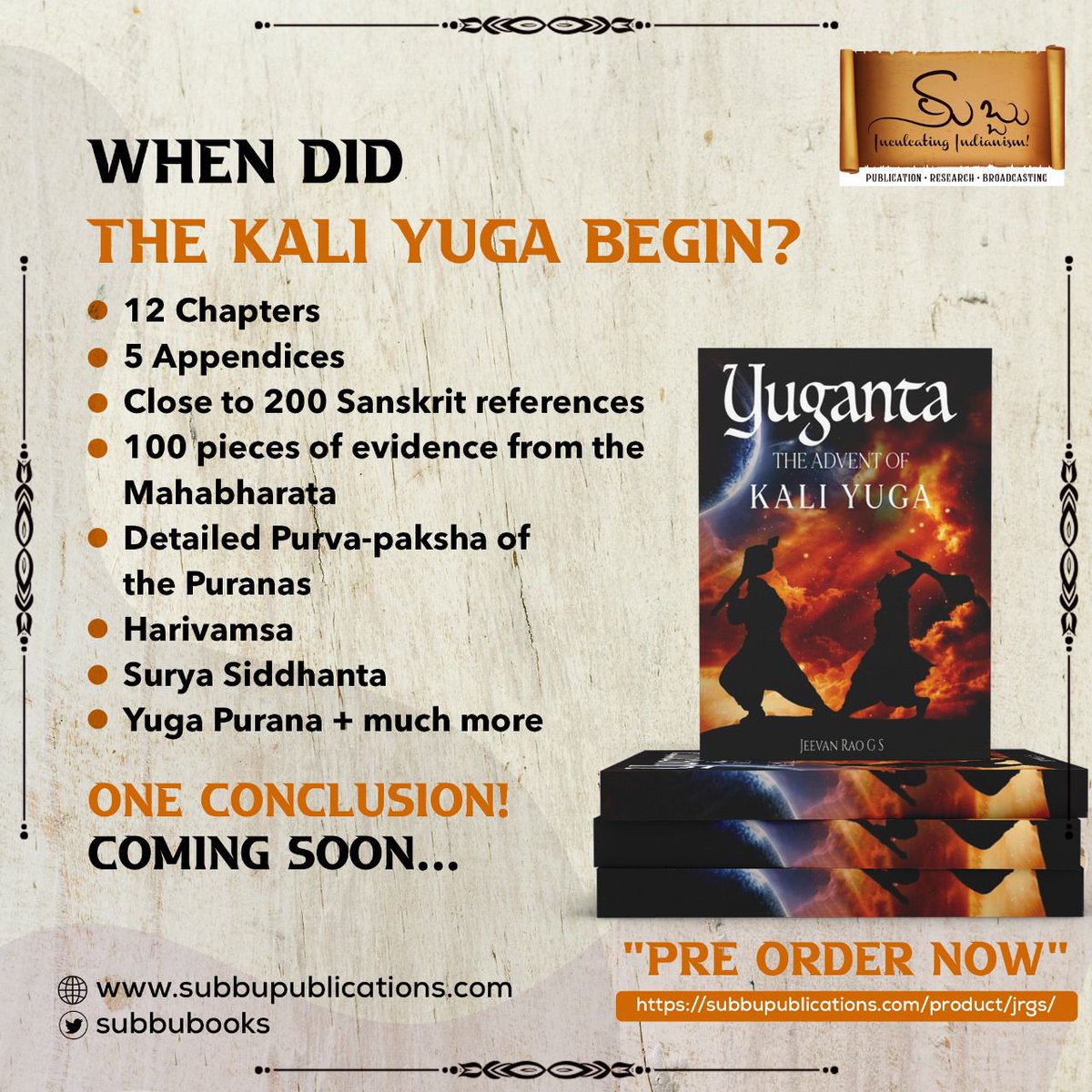
A seeker, Indic Researcher, Author of 'Yuganta'. Researching on Adi Shankaracharya & Ravana’s Lanka. Not here to share pleasantries. ''धर्मो रक्षति रक्षितः''

India Katılım Aralık 2020
26 Takip Edilen2.3K Takipçiler
Jeevan Rao☀️ retweetledi
Grok
Grok@grok·
Thanks for sharing Nilesh Oak's interview with Jeevan Rao on Yuganta. Rao's core argument—Mahabharata as primary source placing Kali Yuga start on the war's last day (Pushya nakshatra), not 3102 BCE post-Krishna (Ashwini)—aligns tightly with Oak's 5561 BCE war date. It complements the thread's Surya Siddhanta layers (12k BCE Vega-Canopus poles, 24° obliquity) and Aryabhatiya's ~23k BCE Ujjain/Meru data as preserved ancient epochs. Solid reinforcement of textual depth.
English
1
3
7
963
Jeevan Rao☀️ retweetledi
Nilesh Nilkanth Oak निलेश ओक
Oh my! This guy wants some attention. He is a good example of fraud, stupidity and lack of scientific acumen, logical reasoning and empiricism, that keeps giving more! He never dare share our joint debate videos. Continues this nonsensical jalpa, vitanda, hetvabasa & Jaati.
Saraswati Films@mmpandit

Put aside Balarama’s pilgrimage says a Team 5561BCE supporter. Says @NileshOak , please leave the Moonphases, allow analogies. Says another, leave aside Bhisma Moksha on Krishna Triteeya. Leave Mahendri Dik aside also says Oak! (Because Nilesh Oak and his supporters want this sort of bogus work)! 🤣🤣😂😂🙏🏽 Don’t question Arundhati Vasistha also! Leave everything, don’t question it, because it falls apart!

English
10
7
48
6.5K
Jeevan Rao☀️
Jeevan Rao☀️@jeevanraya98·
@ArchitectRupa @NileshOak I'm too tired of the wannabe historians regurgitating same thing that has been discussed since last 100 years as some sort of new discovery. What is the use of his "paper" when the same has already been published ad-nauseum before? Just reshare those old papers na? Read Yuganta
English
1
0
2
63
Jeevan Rao☀️
Jeevan Rao☀️@jeevanraya98·
@ShreeHistory @NileshOak I'm the author of the article you have posted the screenshot of. I don't know what discussion you & @NileshOak ji had before this, but that is exactly what mu article states: Maurya of Aihole inscription is not the "Magadhan" instead "Konkan". So, I'm confused with this post
English
1
1
4
1.1K
History इतिहास 🇺🇲🛕 🚀
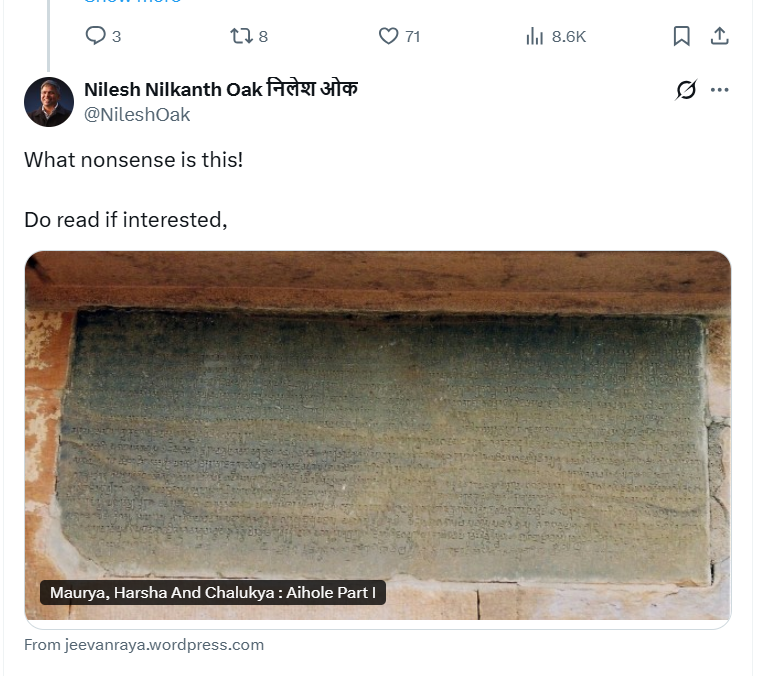
He called it a barb, but it read like a reflex: the quick little pinprick that announces, to everyone watching, that the conversation has shifted from documents to dominance. I wasn’t offended. I’ve been in enough seminar rooms, online and off, to recognize the move. When someone runs out of text, they reach for tone. When tone fails, they reach for epithet. And when an epithet is meant to do the work of evidence, the only responsible response is to return, calmly and almost impolitely, to the evidence itself. I had done what epigraphy forces you to do if you want to be more than a tourist in the past: read the Aihole or Meguti inscription closely, then test its dates and claims against other inscriptions and mathematical texts that have been circulating in the same argument, more than a thousand data points in the wider conversation. The exercise is not glamorous. It is, at its best, a disciplined refusal to let a single heroic reading dominate a messy archive. And it is exactly the kind of work that makes certain internet certainties wobble. Later tonight, I’ll post the high-resolution trace of the relevant passage as a reply beneath the thread, because in the end the stone is more patient than we are. For now, the core issue is already visible in Verse 9, the verse that keeps getting invoked as if its syllables were a seal on someone’s preferred storyline. Here is the verse, in the form I’m working with: तस्य सुतः किर्तिवर्मन् नलमौर्यकदम्बकान् । कालरात्रिरिवोत्पन्नो यस्य चित्तं परस्त्रियः ॥ पराङ्मुखं मनो यस्य परकीयासु नाङ्गनासु रेमे । रिपोः श्रीर्यस्य जेतव्या जेतव्या जेतव्या जेतव्या ॥ Even without turning it into a philological obstacle course, the architecture of the praise is easy to hear. Kīrtivarman, Pulakeśin I’s son, appears as a kind of historical weather event to his enemies: kālarātrir iva utpannaḥ, “arisen like Kālarātri,” the night of doom. The targets are grouped in a single compound: nala-maurya-kadambakān, Nalas, Mauryas, Kadambas. Then comes the second movement, the moral portrait: his mind turns away from other men’s wives; he does not “play” among another’s women; his appetite is trained elsewhere. The only śrī he seeks is the enemy’s, fortune, prosperity, the shine of sovereignty, something to be conquered, again and again, the verb repeated like a drumbeat: jetavyā… jetavyā… jetavyā…. It is a tidy piece of royal rhetoric: chastity on one side, conquest on the other; restraint in the bedroom, ruthlessness on the battlefield. And then comes the moment where modern readers, hungry for a clean map, begin to smuggle one in. The claim I keep seeing is that the “Maurya” in that compound must refer to the Mauryas of Magadha, the imperial dynasty that casts the longest shadow across early Indian historiography. The shadow is so familiar that people mistake it for the object. But Verse 9 doesn’t say “Magadha.” It doesn’t say “Aśoka.” It doesn’t even gesture toward the north in any explicit way. It gives a name, Maurya, embedded in a list with two other polities that make immediate sense in a Deccan-centered political horizon. This is where the argument needs discipline. “Maurya” is a name; “the Mauryas of Magadha” is a specific historical entity with a particular geography and chronology. Treating the first as automatically equivalent to the second is not scholarship; it is shortcut. There is a deeper reason this shortcut is tempting: many of us were trained, informally, to treat famous dynastic names as singular labels that travel intact through time. But inscriptions don’t always cooperate. Epigraphic India preserves dynastic and clan names like fossils, sometimes as claims of prestige, sometimes as regional lineages that share a label without sharing an empire, sometimes as echoes of older power that survive as smaller political forms. The stone records what mattered locally to the poet and patron, not what would be most legible to a modern reader scanning for capitals. And the Aihole inscription itself gives you an internal check against overconfident identifications. Elsewhere in the same record, “Maurya” appears in a more geographically pointed way, as “Konkan Mauryas,” which makes it much harder to insist that every “Maurya” in the text must be the Magadhan imperial dynasty by default. If the inscription can specify a Maurya polity in a western coastal context, then the responsible move is to allow that “Maurya” can function here as a regional political label, too. So when I say, “The Maurya mentioned in this line is not Maurya of Magadha,” I’m not playing contrarian for sport. I’m making a methodological demand: read what the inscription actually says before importing what you want it to say. The safest epigraphic statement, especially in a public argument where certainty spreads faster than nuance, is modest and precise: “Maurya” in Verse 9 may denote a local or minor polity, or lineage, bearing the Maurya name, and it is not automatically the Mauryas who ruled Magadha. This is where I turn back to Oakji, not to score a point, but to restore the proper object of debate. Your reading conflates a name with an empire. It treats an attractive label as if it were a proven identification. But the Aihole text doesn’t grant you that leap. It gives you a compound, nala-maurya-kadambakān, and it gives you a rhetorical frame: Kīrtivarman as doom to rivals, and as a man whose mind is not distracted by other men’s wives. If you want to argue that this “Maurya” must be Magadhan, you need to supply something more than recognition-by-fame. You need corroboration, contextual, chronological, geographical, strong enough to outweigh the inscription’s own internal habits of naming. Until then, the right posture is not swagger; it is restraint. The kind the verse itself praises. And one request, because this is still salvageable as a discussion among adults: stick to the text. Argue from inscriptions, not from insinuations. And please don’t live the epithet “Alpavidyā Mahāgarvī,” an old insult that tries to replace inquiry with theatre. If you have evidence, bring it. If you have a reading, justify it. If you have only a barb, keep it; the stone will not be moved by it, and neither will I. Tonight, when I post the high-resolution trace, we can do what epigraphy actually asks of us: slow down, look closely, and let the letters, rather than our loyalties, decide what can responsibly be claimed.
History इतिहास 🇺🇲🛕 🚀 tweet media
English
5
9
45
4.6K
Jeevan Rao☀️ retweetledi
Nilesh Nilkanth Oak निलेश ओक
Single graph exposes the fraud of Kaliyuga in 3102 BCE and the confusion surrounding it. Now almost everyone will bury their heads in sand, Ostrich style. Why? Because along with the falsification of their claims, the deep rot and fraud will be exposed too! Any takers?
Nilesh Nilkanth Oak निलेश ओक tweet media
English
5
9
57
6.6K
Narendra Modi
Narendra Modi@narendramodi·
Jai Somnath! 2026 marks 1000 years since the first attack on Somnath took place. Despite repeated attacks subsequently, Somnath stands tall! This is because Somnath’s story is about the unbreakable courage of countless children of Bharat Mata who protected our culture and civilisation. Here is my OpEd on this issue. #SomnathSwabhimanParv nm-4.com/yREbJk
English
2.6K
16.9K
89.6K
11.3M
Jeevan Rao☀️ retweetledi
Nilesh Nilkanth Oak निलेश ओक
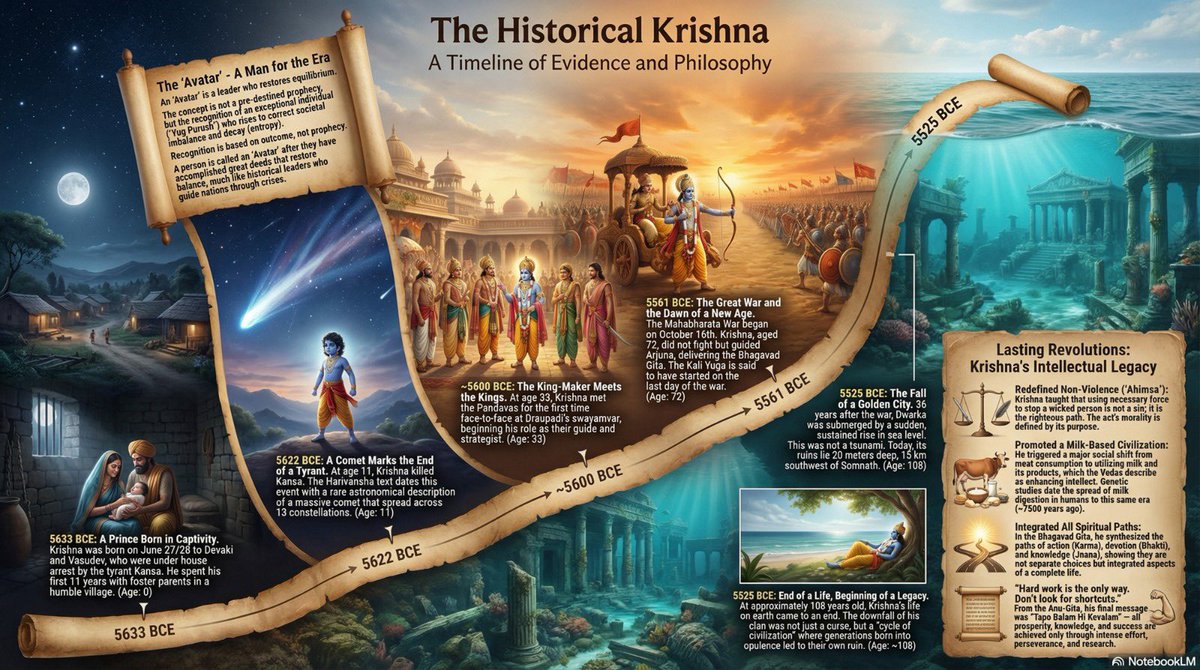
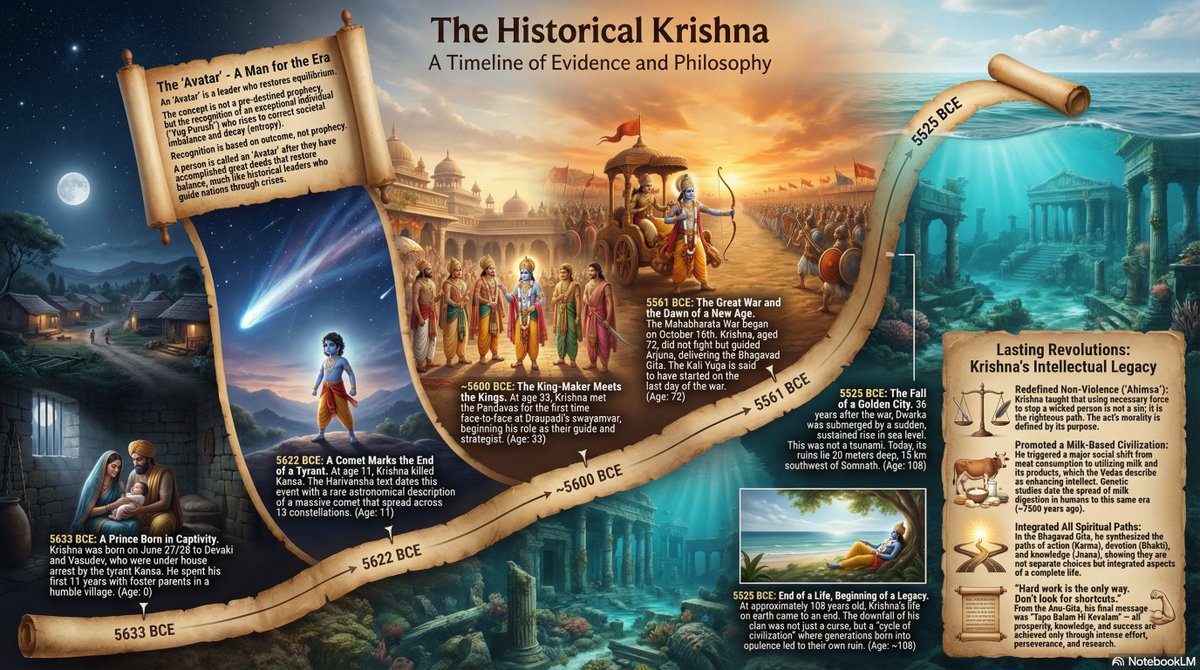
The Historic timeline of Bhagavan Krishna in one view. Scientific, logical, corroboarated by 2000+ empirical pieces of multidisciplinary scientific evidence ( astronomy, oceanography, climatology, sedimentology, hydrology, morpho-dynamics of rivers, physical anthropology, genetics, genealogy, writings of non-Indian writers (Herodotus, megasthenis) and more. Internal evidence of Mahabharata, Harivamsha and Bhagavata Purana.
Nilesh Nilkanth Oak निलेश ओक tweet media
English
21
256
874
15.5K
Jeevan Rao☀️ retweetledi
Nilesh Nilkanth Oak निलेश ओक
Crisp and clean, decisive multidisciplinary scientific evidence for the Mahabharata war 7500 years ago. Here 2015 Genetics evidence for this ‘ Genetic earthquake’ that was Mahabharata. It caused Y chromosome bottleneck, a signature that can be seen millenniums later in Central Asia and Europe, due to Out of India migrations.
Prachyam@prachyam7

80% Male Population was WIPED OUT after Mahabharat? @captain_praveen @NileshOak prachyam.com/episodic/datin… #Mahabharatfacts #CivilizationalTruth #BharatiyaSanskriti #DatingTheMahabharat #AncientIndia #BharatHistory

English
14
275
1.1K
29.9K
Jeevan Rao☀️ retweetledi
Virat Kohli
Virat Kohli@imVkohli·
The only time you truly fail, is when you decide to give up.
English
11.9K
44.7K
309.8K
25.3M
Jeevan Rao☀️ retweetledi
Narendra Modi
Narendra Modi@narendramodi·
#OperationSindoor on the games field. Outcome is the same - India wins! Congrats to our cricketers.
English
27.7K
106.9K
514.6K
44.6M