Lord Abney

641 posts

Lord Abney banner
Lord Abney

Lord Abney

@jeffabney97

I am 60 years old and I know things. My passions... Technology (anything with a power button), photography, traveling, college football, and family.


Austin, TX Katılım Kasım 2013
315 Takip Edilen575 Takipçiler
Lord Abney
Lord Abney@jeffabney97·
$TE will not have upward momentum until 1. G2 $350 funding is finalized. Expected this month. 2. Section 232 ruling issued. T1 stated they have multiple term sheets being analyzed. which means they have options. G2 $350 million gap funding will likely result in some dilution, so I expect share price to drop around $3.50. Section 232 ruling in affirmation (seems likely) along with G2 funding will provide upward momentum to the $8-10 range by March 27 is my guess.
English
3
0
2
301
RocketMan
RocketMan@RKLBMan·
$SIDU trades at a $200M market cap today. But man these numbers suck. I see the Lonestar $120M contract, which will take years to realize if they execute. And yes they have $40M cash. Is that why people are excited about this??
RocketMan tweet media
English
22
1
52
11.7K
Lord Abney
Lord Abney@jeffabney97·
TE will have no upward momentum for awhile. I wonder if the Jan 21 Culper short report kicked off an internal review which led to sudden and immediate departure of the CFO. It was the previous CFO that suggested $402 million rev. Shortly after promoting Vallero alum to CFO T1 promoted an M/L alum to CLO. These 2 probably spent the last 6 weeks cleaning things up. Which I wonder is related to board departures as well. The cautious tone in earnings call is likely these 2 applying corp rigor that might have deficient prior. Time will tell if guidance is much cleaner now
English
0
0
1
66
S&J Investments
S&J Investments@SJCapitalInvest·
How could I pull the plug so quick on $TE and $OSS after holding large positions? My number one thing is the macro and sector momentum. I’ve said I don’t like the macro and I have a bad handle on market The table is not hot right now. My leash is much shorter.
English
16
0
71
9.8K
Lord Abney retweetledi
Bari Weiss
Bari Weiss@bariweiss·
Incredible investigation today from @CBSNews. Our reporters visited "ground zero" for hospice fraud: Los Angeles, California. One building had 89 registered hospices . . . Read it here: cbsnews.com/projects/2026/…
English
3.3K
10.4K
45.4K
41.4M
Lord Abney retweetledi
T1 Energy
T1 Energy@T1_Energy·
Something's brewing. #SXSW2026
T1 Energy tweet media
English
7
5
81
4.2K
Sovey
Sovey@SoveyX·
I don’t understand why everyone’s so obsessed with this meteorologist. She’s just… giving the weather report? Like, temperatures, precipitation chances, the usual stuff. No clue what the big deal is. 🤔
English
356
38
855
17.8K
Lord Abney retweetledi
John Stossel
John Stossel@JohnStossel·
When he won his Nobel prize, Al Gore said the Arctic summer may be ice-free by 2014. Later he said it was LIKELY by 2016. Those dates came and went. There's still LOTS of ice. Turns out alarmists' predictions are alarmist. But they grab headlines. We debunk here:
English
171
1.8K
7.9K
166K
Lord Abney
Lord Abney@jeffabney97·
Their international factories in Malaysia and Vietnam are getting hit from both sides — tariff uncertainty is causing underutilization (why run the factory at full capacity if tariffs might make the output uncompetitive?) and they're also transitioning those facilities to Series 7 technology which means planned downtime. Both of these are dragging down their 2026 guidance. This is bullish for TE
English
0
0
1
134
Lord Abney
Lord Abney@jeffabney97·
The SCOTUS ruling could actually accelerate Section 232 action on solar inputs. The White House just lost its broadest tariff tool. They're going to lean harder on the tools they still have — and Section 232 is the main one. If anything, the political pressure to show they can still protect American manufacturing increases, which means those polysilicon tariffs that benefit TE could come faster.
English
0
0
2
98
Lord Abney
Lord Abney@jeffabney97·
Hey @Marriott — as a Titanium Platinum Elite member, I expect better. Two recent stays, same problem: charged multiple times for a single stay I never checked out of. Now I can't even submit my expense reports. Called support — useless. Hotels promised callbacks — crickets. This is NOT the level of service your top-tier members deserve. Fix this. #MarriottBonvoy #TitaniumElite
English
2
0
0
329
Lord Abney
Lord Abney@jeffabney97·
Learn Windbg Part 2: Finding the guilty driver Now that we know what happened (a WDF rule was broken), the next question is who did it. Scroll past the BugCheck arguments in the !analyze -v output and you'll hit the fields that start pointing fingers. PROCESS_NAME: System This tells us the crash happened in a kernel-mode system thread — not a user app. That's expected for a driver-level crash. Don't read too much into this. When you see System here, it just means the fault was deep in the OS plumbing, which is where drivers live. MODULE_NAME and IMAGE_NAME Here's where we get our suspect: MODULE_NAME: GuiSTDFUDev IMAGE_NAME: GuiSTDFUDev.sys That's our driver. GuiSTDFUDev.sys — this is an STMicroelectronics DFU (Device Firmware Update) driver. If you've ever used an STM32 microcontroller or a device that flashes firmware over USB using ST's tools, this is the driver that handles that communication. Notice this line near the top of the output: Unable to load image \SystemRoot\System32\Drivers\GuiSTDFUDev.sys, Win32 error 0n2 Error 0n2 = "file not found." WinDbg tried to grab the driver binary to resolve function names, but it couldn't find it. That's why the FAILURE_BUCKET says unknown_function — WinDbg knows the driver caused the crash, it just can't tell us which function inside it because it doesn't have the file to map the symbols. This is common with third-party drivers. Microsoft's symbol server doesn't carry symbols for every vendor's driver. Keep that in mind — it doesn't mean the analysis failed. It just means we're working with offsets instead of function names. FAILURE_BUCKET_ID FAILURE_BUCKET_ID: 0x10D_5_GuiSTDFUDev!unknown_function Read this like a sentence: BugCheck 0x10D, subcode 5, caused by GuiSTDFUDev, function unknown. That's your one-line crash summary. STACK_TEXT — Reading the call stack This is the big one. The stack trace is essentially the timeline of what happened leading up to the crash. Read it bottom to top — the bottom is where execution started, the top is where everything went wrong. Here's what the stack tells us, in plain English: The system was doing a Plug and Play surprise removal — something got unplugged or a device disappeared unexpectedly. You can see this in the lower frames: nt!PnpSurpriseRemoveLockedDeviceNode nt!PnpDeleteLockedDeviceNode nt!IopRemoveDevice Windows said "this device is gone, clean it up." That request flowed down through the PnP and power state machines in WDF: Wdf01000!FxPkgPnp::PnpSurpriseRemoval Wdf01000!FxPkgPnp::PnpEventFailedIoStarting Wdf01000!FxPkgPnp::PowerPolStopping Wdf01000!FxPkgPnp::PowerGotoD3Stopped Wdf01000!FxSelfManagedIoMachine::Suspending WDF was walking the driver through a clean shutdown sequence — "stop your I/O, power down, release your resources." Standard procedure. Then the driver got called: GuiSTDFUDev+0xba0f GuiSTDFUDev+0x148bf Those +0x offsets are where the driver's own code was executing. We don't have function names because WinDbg couldn't load the image, but we know the driver was doing something in response to the self-managed I/O suspend callback. And then it made the fatal call: Wdf01000!imp_WdfIoTargetSendInternalIoctlOthersSynchronously+0x58b The driver tried to send a synchronous internal IOCTL to an I/O target. But remember Arg2 from Part 1? The handle it passed was NULL. The driver tried to send a request to... nothing. WDF caught it: Wdf01000!FxVerifierBugCheckWorker nt!KeBugCheckEx Game over. Blue screen. Putting it all together Here's the full story from this one dump: A USB device (likely an STM32 board or something using ST's DFU protocol) was surprise-removed — maybe unplugged, maybe the USB bus glitched. Windows told the GuiSTDFUDev.sys driver to clean up. During the shutdown sequence, the driver tried to send an I/O request using a handle that was either already released or was never properly initialized. It passed a null handle to WdfIoTargetSendInternalIoctlOthersSynchronously. WDF's verifier caught the invalid handle, flagged it as a type mismatch (subcode 5), and triggered the BSOD. ELI5 Back to our mechanic shop. We checked the security cameras (the stack trace). Here's what we saw: A car was being towed away from the lot (surprise removal — the device disconnected). The shop manager told the mechanic (GuiSTDFUDev) to stop working on it and put the tools away. But the mechanic panicked, grabbed for a tool that was already gone, and tried to use an empty hand to tighten a bolt. The shop manager saw this, hit the emergency stop, and shut the whole shop down. The mechanic's name badge says "GuiSTDFUDev.sys" — it's an ST Microelectronics firmware update driver. It doesn't handle surprise disconnections gracefully. That's the root cause.
Lord Abney tweet media
English
0
0
0
39
Lord Abney retweetledi
Math Files
Math Files@Math_files·
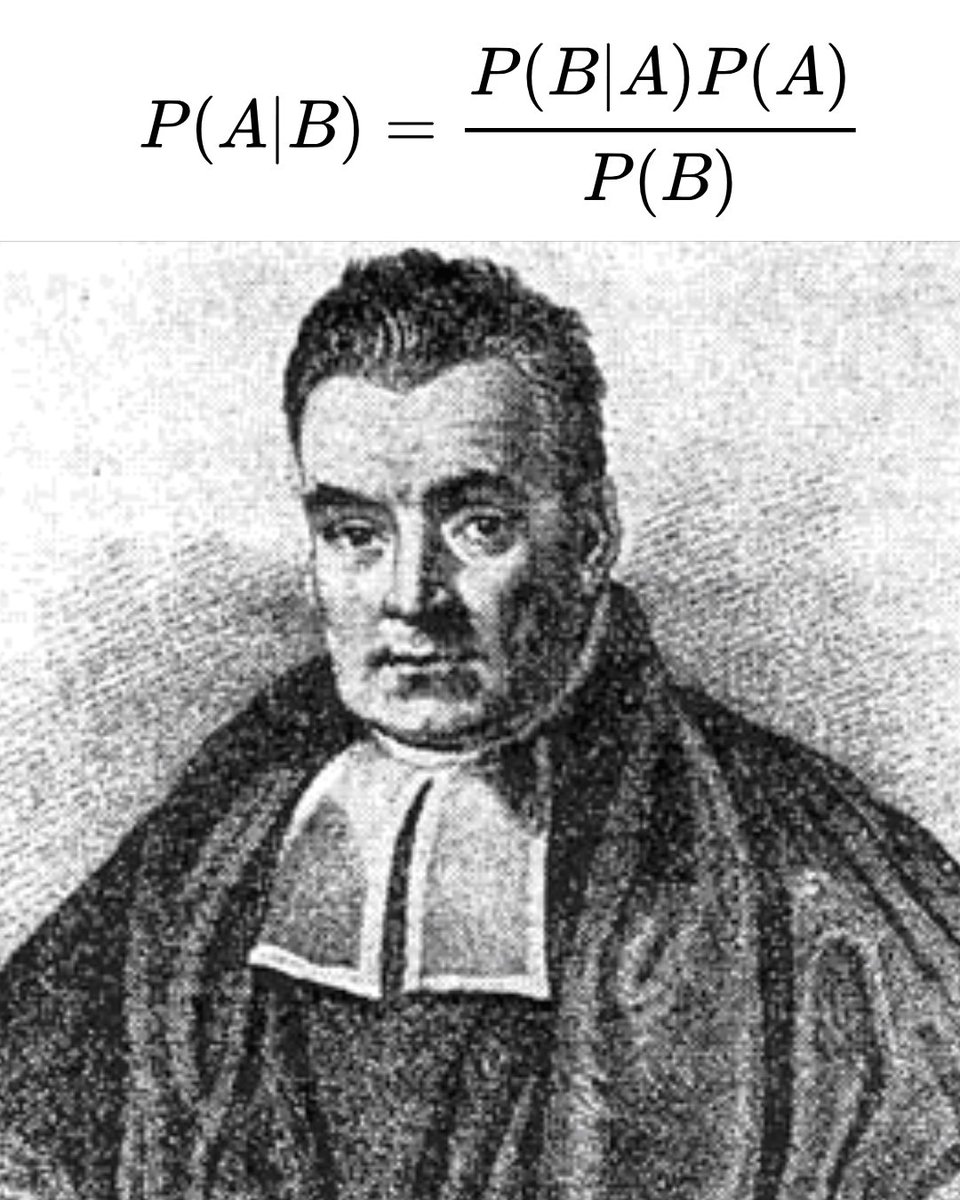
Bayes’ theorem is probably the single most important thing any rational person can learn. So many of our debates and disagreements that we shout about are because we don’t understand Bayes’ theorem or how human rationality often works. Bayes’ theorem is named after the 18th-century Thomas Bayes, and essentially it’s a formula that asks: when you are presented with all of the evidence for something, how much should you believe it? Bayes’ theorem teaches us that our beliefs are not fixed; they are probabilities. Our beliefs change as we weigh new evidence against our assumptions, or our priors. In other words, we all carry certain ideas about how the world works, and new evidence can challenge them. For example, somebody might believe that smoking is safe, that stress causes mouth ulcers, or that human activity is unrelated to climate change. These are their priors, their starting points. They can be formed by our culture, our biases, or even incomplete information. Now imagine a new study comes along that challenges one of your priors. A single study might not carry enough weight to overturn your existing beliefs. But as studies accumulate, eventually the scales may tip. At some point, your prior will become less and less plausible. Bayes’ theorem argues that being rational is not about black and white. It’s not even about true or false. It’s about what is most reasonable based on the best available evidence. But for this to work, we need to be presented with as much high-quality data as possible. Without evidence—without belief-forming data—we are left only with our priors and biases. And those aren’t all that rational.
Math Files tweet media
English
2.2K
8.4K
37K
27.2M
Lord Abney
Lord Abney@jeffabney97·
I debug Windows issues for a living. I analyze dmp files on a daily basis. Here I will share how I debugged a BSOD I had on my personal device. Let's learn WinDbg 🧵 I'm going to start breaking down how to read a crash dump (.dmp) file. Starting with the first thing you see when you run !analyze -v — the BugCheck and its 4 arguments. Here's a real dump I'm working with: #debugging #bsod #windows #WinDbg #sysadmin The BugCheck is WDF_VIOLATION (0x10D) WDF = Windows Driver Framework. It's a safety layer that monitors drivers. When a driver breaks one of WDF's rules, it throws this stop code. Think of WDF as a referee — it saw a foul and blew the whistle. Arg1: 0x0000000000000005 This is the most important argument. It's the WDF error subcode — it tells you WHAT rule was broken. 0x5 = "A framework object handle of the incorrect type was passed to a framework object method." A driver handed WDF the wrong type of object. Arg2: 0x0000000000000000 This is the handle value the driver actually passed in. It's NULL (0x0). The driver passed nothing when WDF expected a valid object handle. Arg3: 0x0000000000001200 — Reserved Arg4: 0xffff9a0b03a58010 — Reserved Not every argument is always useful to us. "Reserved" means Microsoft uses them internally. Arg4 looks like a kernel memory address — likely an internal WDF structure pointer. Don't ignore them, but don't stress over them either. So from just these 4 arguments alone, here's what we know: → A driver violated a WDF rule → It passed a null handle where a valid object was expected → The handle type was wrong That's a lot of info before we even scroll down. ELI5 🚗 Think of your PC like a car at a mechanic shop. Arg1: The mechanic's checklist says "wrong part was used" (error #5) Arg2: The mechanic looks at the part and... there is no part. Someone tried to install nothing. Arg3 & Arg4: The mechanic scribbled some internal shop codes on the work order. Only the shop knows what they mean. The shop manager (WDF) shut everything down and refused to let the car leave because the work was unsafe. That's your BSOD. Next up: finding WHICH driver caused this crash. Stay tuned. 🔧
Lord Abney tweet media
English
0
0
0
55
S&J Investments
S&J Investments@SJCapitalInvest·
Seeing all my stocks dive 5% at open after I spent all my cash dip buying last Friday. $TE $BE $AMPX $ASTS $LPTH
English
15
1
75
9.6K
Lord Abney
Lord Abney@jeffabney97·
@SoveyX Sydney Sweeney has same effect on me.
English
0
0
0
178
Sovey
Sovey@SoveyX·
1. This sounds painful. 2. Who was the first guy to figure this out? 3. A bunch of guys just signed up for ski jumping classes.
English
37
13
148
16.1K