Jerome

1.6K posts

Jerome banner
Jerome

Jerome

@jeromeq2004

Writing about tech, AI, and the tools that actually work. Building in public. Words on Medium.

Singapore Katılım Aralık 2024
1K Takip Edilen168 Takipçiler
Jerome
Jerome@jeromeq2004·
ah fair, i'm out of date then. two pools makes way more sense. the subsidized composer bit is the interesting part though, feels like they're eating cost to keep you on their own model instead of the api passthrough. has the composer pool felt tighter or looser to you since the switch?
English
1
0
1
8
Chris Covington
Chris Covington@_ChrisCovington·
@jeromeq2004 @Amank1412 Cursor hasn’t been request based in awhile. You get two pools of tokens per month, one for composer and the other for whatever else. The other pool was about $50 of api for the $20 last I checked. I imagine composer is more subsidized
English
1
0
1
44
Aman
Aman@Amank1412·
Composer 2.5’s benchmark scores are pretty crazy for the price. Does anyone have experience with cursor’s $20 subscription? Wondering how the usage limits compare to Codex and Claude
Aman tweet media
English
43
4
224
33.1K
Jerome
Jerome@jeromeq2004·
@minchoi Wild that every lab landed on the terminal in basically the same month. Makes me think the harness is starting to matter more than whichever model's underneath. Anyone actually switched their daily driver over the harness, not the model?
English
0
0
0
68
Jerome
Jerome@jeromeq2004·
@TimJayas feels more like peak-load throttling than them "losing computation power". tokens/sec usually tanks right after a model gets popular and the gpus are saturated. does it speed back up for you off-peak, or slow around the clock?
English
0
0
12
1.3K
Tim Jayas
Tim Jayas@TimJayas·
Something is WRONG with Codex GPT 5.5 now Token per speed in chat is ridiculously low I guess OpenAI is losing computation power
English
45
7
248
23.9K
Jerome
Jerome@jeromeq2004·
the recombination vs invention line is carrying most of the argument here. a lot of what we call human invention is also just recombination we only label "new" in hindsight. honest question: what would count as a model inventing a new problem you couldn't wave off as recombination after the fact?
English
0
0
3
398
Valerio Capraro
Valerio Capraro@ValerioCapraro·
Finally, a big name has the courage to tell it: we are nowhere near AGI. Demis Hassabis, CEO of Google DeepMind and Nobel laureate for AlphaFold, put it neat and clear: "Today's systems are nowhere near [AGI]. Doesn't matter how many Erdős problems you solve… I think it's far, far from what a true invention, or someone like Ramanujan, would have been able to do." This is the elephant in the room that many AI enthusiasts prefer not to see, or are actively trying to hide. Erdős problems are well defined, often combinatorial, on finite spaces. They are exactly the kind of problems on which current AI can achieve spectacular performance with a lot of compute and knowledge. A neural network can search a huge graph of possibilities. It can recombine existing knowledge at unprecedented scale. It can discover surprising solutions inside an already defined conceptual space. But true invention is something else. True invention is not only solving a problem. It is inventing new objects, new dimensions, new connections. It is inventing new problems. From resolving to inventing there is a discontinuity that we don't know how to bridge. We are making extraordinary tools. But we are nowhere close to AGI.
Valerio Capraro tweet media
English
247
382
1.9K
313.1K
Jerome
Jerome@jeromeq2004·
the cursor data detail is the bit i'd watch. train on cursor traces and swe-bench specifically goes up, so a big eval jump might just be teaching to the test again. same thing that had grok 4 at #1 on the charts and like #66 once people actually used it. i'll believe v9 when the agentic coding holds up two weeks in, not on the launch graph.
English
0
0
3
460
JUMPERZ
JUMPERZ@jumperz·
if elon's claims hold, this is the wildest one-gen jump in the model race, he says grok v9 looks great, and it might. but here's where grok actually sits today: >9th on swe-bench at 70.8%, the model in production right now (grok 4.3) is built on v8-small, 0.5T params so grok v9 is around 3x that. if this is true, grok lands in the frontier tier between opus 4.7 and gpt-5.5. a 17-point jump in one generation. and you will see people switching to grok for the full loop research and coding in the same model.. if they don't, we've been here before cause grok 3 was overclaime tho.. and grok 4 was #1 on charts, #66 in real world tests... lets see, in 2-3 weeks we know..
JUMPERZ tweet media
Elon Musk@elonmusk

Grok foundation model V9-Medium (1.5T) has finished training. Evals look good. A lot of Cursor data was added in supplementary training and there is more to come. Fine-tuning is underway and reinforcement learning begins in a few days. 2 to 3 weeks to public release. This will be a major improvement over the 0.5T v8-small that currently serves all Grok production traffic, especially for difficult coding tasks.

English
4
3
54
6.7K
Jerome
Jerome@jeromeq2004·
the cursor data angle is the bit i keep chewing on. training on how people actually wrestle code into shape, failed edits and retries and all, feels way more useful than another pass over clean github commits. though part of me wonders if it just teaches the model our bad habits too. what's your bet?
English
0
0
0
51
Mark Kretschmann
Mark Kretschmann@mark_k·
1.5T. Cursor. Grok. Music to the ears of AI people. Grok V9-Medium from @xai has reportedly finished training, and fine-tuning is already underway. RL starts in a few days, with a public release apparently 2 to 3 weeks out. The most interesting bit: a lot of Cursor data was added during supplementary training. If that actually shows up in real coding tasks, this could be a pretty big jump over the current 0.5T v8-small model serving Grok in production. The coding model race is getting very interesting.
Mark Kretschmann tweet media
English
26
8
190
8K
Jerome
Jerome@jeromeq2004·
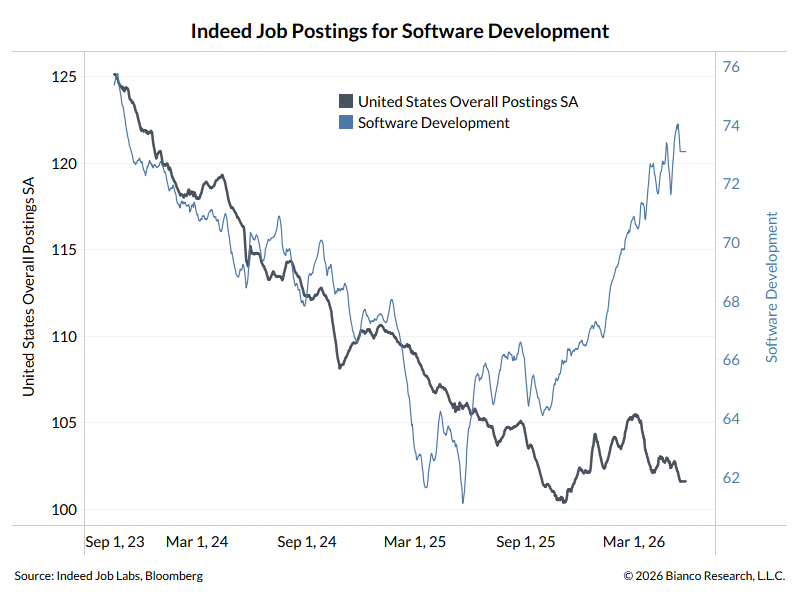
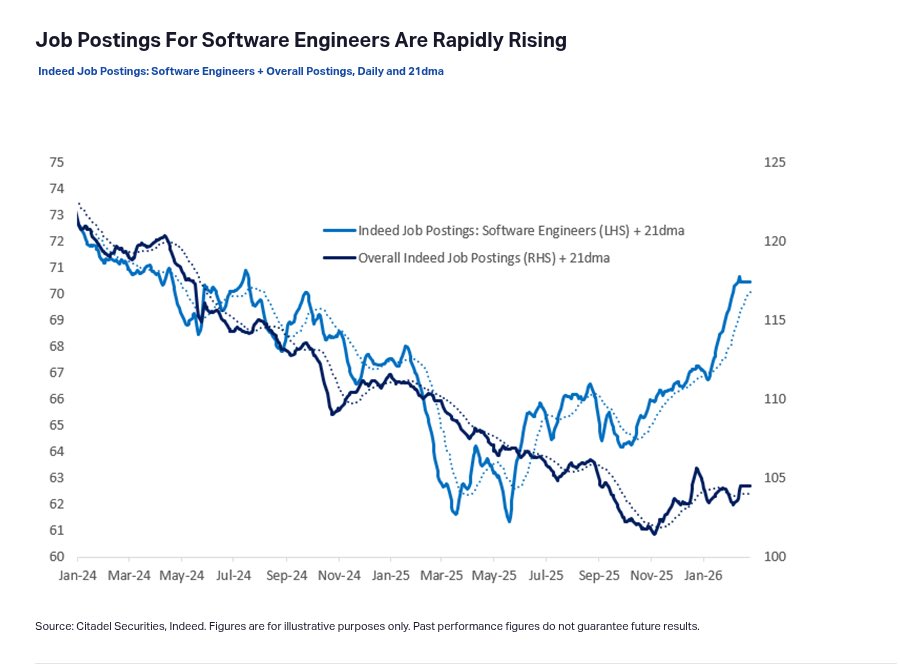
the level recovering to a 3-yr high is the part everyone screenshots. but for the "AI isn't killing jobs" read, the composition matters more than the level. is it junior reqs coming back, or all senior and staff? entry-level coding is the slice agents eat first. does the data split by seniority?
English
0
0
1
593
Jim Bianco
Jim Bianco@biancoresearch·
@DavidSacks Your chart is a few months out of date. The current data (through May 15) shows that software job postings are at a three-year high. The demand for coders is growing by the week.
Jim Bianco tweet media
English
30
48
366
139.6K
David Sacks
David Sacks@DavidSacks·
Q: How are job postings for software engineers rising rapidly despite AI agents automating coding? A: Because there’s far more code to manage than ever before. We’re already seeing a 14x YoY increase in GitHub commits, and it’s accelerating. AI has dramatically lowered the cost of writing code, so it’s now being used across far more businesses, applications, and use cases. We’re at the beginning of a massive productivity boom driven by the proliferation of bespoke software throughout the entire economy. Coding has been AI’s breakout use case this year. The fact that it’s increased demand for software engineers — rather than decreased it — should call into question the entire “AI will cause mass job loss” narrative.
David Sacks tweet media
English
795
1.4K
8.8K
1.4M
Jerome
Jerome@jeromeq2004·
induced-demand read holds up. but that 14x commit number is doing a lot of work. a chunk of those are AI writing the code now, so it's partly counting model output, not human demand. real q is whether review and maintenance headcount is climbing as fast as the commits, or whether that's where the squeeze quietly lands.
English
0
0
1
409
Jerome
Jerome@jeromeq2004·
another "self-improving personal agent OS" dropped today. mine's been self-improving for months and still books my meetings in the wrong timezone
English
0
0
0
12
Jerome
Jerome@jeromeq2004·
everyone's arguing about whether AI speeds up coding. it writes 200 lines in two seconds and then i spend an hour finding the 3 that are confidently wrong. so we're even
English
0
0
0
9
Jerome
Jerome@jeromeq2004·
@AJSubrizi this hits. the sneaky part isn't the big automated calls, it's the defaults. once the tool quietly pre-picks the "reasonable" option you stop noticing there was even a choice. where do you catch yourself slipping most? for me it's which libraries i even bother to consider.
English
1
0
1
24
Antonio Subrizi
Antonio Subrizi@AJSubrizi·
Most developers do not want to admit, or even consider, that the automation they trust is quietly shaping the decisions they think they are making themselves.
English
1
0
0
22
Jerome
Jerome@jeromeq2004·
@DerekNee @thsottiaux the nerf thing is so hard to pin down though. half the time switching tools "fixes" it just cause you reset context and re-explain the task clean. was the claude run from a fresh prompt or the same exact context you'd already handed codex?
English
0
0
1
1.4K
Derek Nee
Derek Nee@DerekNee·
codex got noticeably nerfed past few days. ran several tasks for 20+ hours, none finished. switched to claude code, done in 30 min. something's off @thsottiaux
English
188
37
1.3K
142.5K
Jerome
Jerome@jeromeq2004·
the speed number will get all the attention but the review step is the part that actually matters. generation was never the slow bit. the slow bit is catching the thing that compiled clean and still did the wrong job. does the self-review actually flag its own bad calls, or mostly wave them through?
English
0
0
0
110
Vaishnavi
Vaishnavi@_vmlops·
HERE'S THE HARNESS THAT MAKES CLAUDE CODE 25X FASTER Most devs use claude code raw. this repo wraps it in a full plan → work → review loop & it slaps claude code harness turns claude into a disciplined dev partner. instead of just vibing through tasks, it enforces a structured cycle that actually ships quality code what it does differently: ▫️ go-native engine replaces node.js hooks went from 40-60ms to 10ms ▫️ 13 guardrail rules block destructive ops (rm -rf, force push, secret writes) automatically ▫️ parallel workers run simultaneously, each self-reviewing before handoff ▫️ `/harness-work all` runs the full loop with one command: plan → implement → review → commit ▫️ precompact hook prevents claude from getting cut off mid-task during long sessions the install is 30 seconds: if you use claude code seriously, this is worth checking out. github → github.com/Chachamaru127/…
Vaishnavi tweet media
English
12
29
229
14.4K
Jerome
Jerome@jeromeq2004·
the cost thing is what nobody actually models. you pay a person once a month. an agent you pay per token, every retry and dead end included. different shape of cost entirely. though inference keeps dropping fast, so does the gap hold a year out, or is this the expensive early innings?
English
1
0
1
183
Devaansh Bhandari
Devaansh Bhandari@ThisIsBhandari·
“AI will replace engineers.” Meanwhile: • Microsoft reportedly pushed engineers off Claude because token costs exploded. • Uber reportedly burned through their entire 2026 AI budget in just four months due to the heavy use of AI coding tools by their developers. • Even Nvidia’s own VP admitted compute costs were higher than employee costs for his team. No doubt AI is an insanely powerful tool, but replacing humans at scale may cost far more than employing them. One startup CEO recently revealed their 4 person team generated a $113k monthly AI bill. And beyond cost, companies still haven’t solved the security side properly. Passwords, API keys, phone numbers, addresses, internal docs, all of this flows through AI systems daily, creating massive leakage risks.
Ricardo@Ric_RTP

Microsoft just banned its own engineers from using AI. The tool was literally costing MORE than the humans it was supposed to replace. They lied to you about AI adoption and now the whole narrative is blowing up: Microsoft gave thousands of engineers access to Claude Code six months ago and encouraged them to use it. Engineers loved it and adoption exploded. But then the invoices arrived. Token-based pricing means every query, every code review, every debugging session costs money. At scale across 100,000 engineers, the numbers became so large that Microsoft issued an internal order to cancel nearly all Claude Code licenses by end of June and force everyone onto their own cheaper tool instead. The company that invested $5 billion in Anthropic just told its own people to stop using Anthropic's product because it costs too much. Uber's story is even worse... Their CTO Praveen Neppalli Naga told The Information that the budget he planned for the full year was "blown away already" by April. Uber had rolled out Claude Code in December 2025. By March, 84% of their 5,000 engineers were using it with 70% of all committed code coming from AI systems. Heavy users were burning $500 to $2,000 per month each. Naga himself spent $1,200 in a single two-hour demo session. The company had even built internal leaderboards ranking engineers by how much AI they used. They literally gamified the spending and then ran out of money. Now look at what Nvidia's own VP of applied deep learning Bryan Catanzaro said to Axios last month. Direct quote: "For my team, the cost of compute is far beyond the costs of the employees." This is a VP at the company that SELLS the chips saying that using AI is more expensive than paying humans. Think about what this means for the entire AI narrative. Every CEO on every earnings call for the past two years has said the same thing: AI will make us more efficient, reduce headcount, and cut costs. The stock market rewarded every company that said it. Fired workers, stock goes up. Announced AI adoption, stock goes up. But the actual companies deploying AI at scale are discovering the math doesn't work. The MORE employees use AI, the HIGHER the bill. Goldman Sachs forecasts a 24x increase in token consumption by 2030 as companies adopt AI agents. Gartner just published a report showing that even though individual token prices will drop 90% by 2030, total enterprise AI costs will go UP because agents consume exponentially more tokens per task than basic tools. Meta built an internal dashboard called "Claudeonomics" to track which employees use the most AI. Amazon started pushing engineers to "tokenmaxx," their internal term for consuming as many AI tokens as possible. Both companies are spending hundreds of billions on AI infrastructure this year alone. And Microsoft, the company that bet its entire future on AI, just told 100,000 engineers to stop using the tool they liked best because the per-token bills got out of control. The companies building AI are telling investors it saves money. The companies using AI are finding out it costs more than the humans it was supposed to replace. And even the company that makes the chips just admitted it through its own VP. This is the gap nobody on Wall Street is pricing in. $725 billion in AI infrastructure spending this year across Big Tech. And the first companies to actually deploy these tools at scale are already pulling back because the economics don't work. What do you think?

English
32
7
60
13.6K
Jerome
Jerome@jeromeq2004·
the "too much context is as bad as too little" point is the one nobody believes until they live it. i bloated a CLAUDE.md to ~400 lines thinking more rules meant better output, and quality dropped. it started ignoring half of them. trimmed back to the 15 that actually mattered and it got sharper. did the pod say where the cliff is?
English
0
0
0
71
Anatoli Kopadze
Anatoli Kopadze@AnatoliKopadze·
Boris Cherny, the creator of Claude Code, just explained why the features most users never find are the ones that matter most in this podcast he breaks down not just how to use Claude, but what it all means for the next few years: > the right way to give Claude context before it starts working > why giving it too much information is just as bad as too little > how Claude Code is already changing how engineers build things > how the people who built Claude actually use it day to day based on this podcast and months of using Claude myself, I put together a guide on everything Claude can do that most people have no idea exists you can find it below
Anatoli Kopadze@AnatoliKopadze

x.com/i/article/2057…

English
19
23
116
19.7K
Jerome
Jerome@jeromeq2004·
the part i keep snagging on: most company SOPs aren't actually written down. the real process lives in someone's head as "well, except when X happens." workflows nail the happy path, but the value was always in the exceptions nobody documented. does /workflows have a story for the edge cases, or does that stay human?
English
0
0
3
380
ᴅᴀɴɪᴇʟ ᴍɪᴇssʟᴇʀ 🛡️
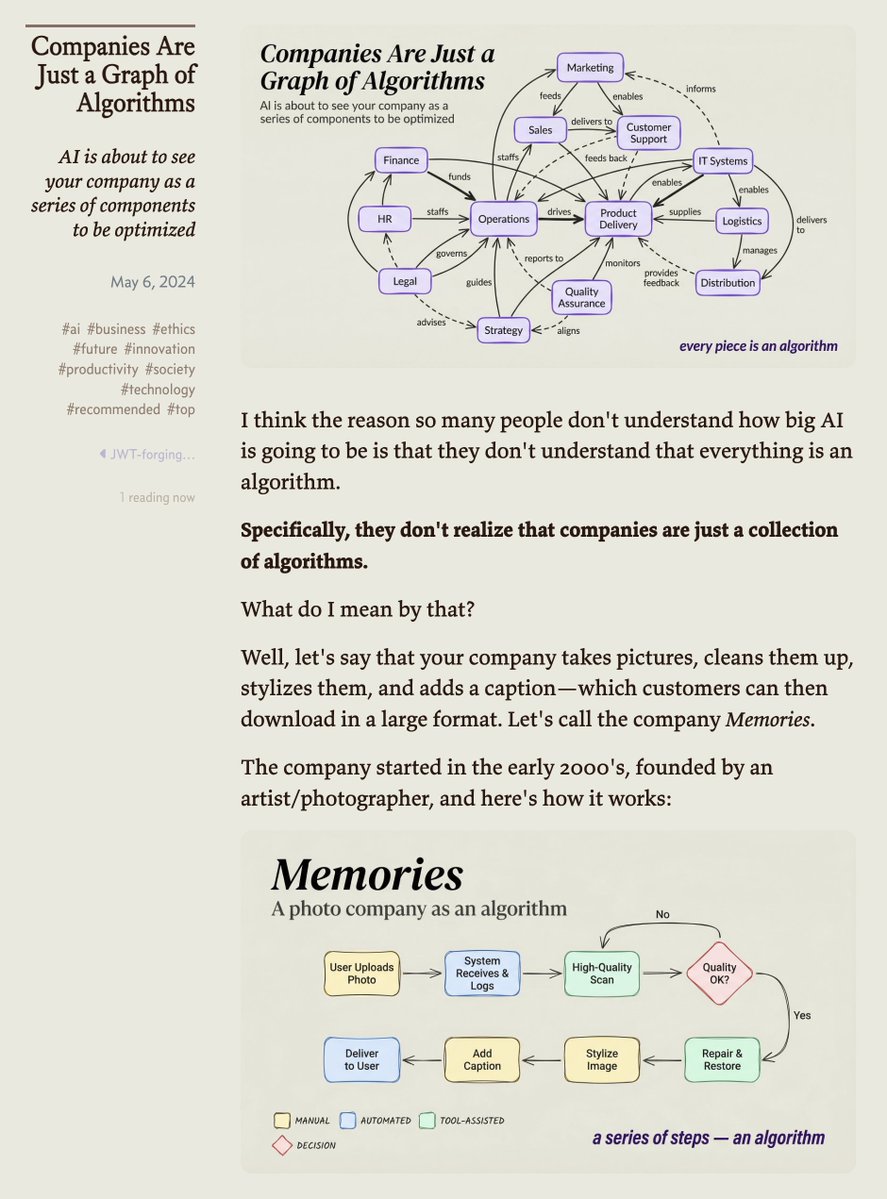
Claude Code is about to release a feature called /workflows that I think will be extremely significant. Especially for Enterprise AI. I talked about this in 2024 in a post called Companies Are Just Graphs of Algorithms. Basically the idea is that all work is just an algorithm, i.e., a series of steps to accomplish a goal. Skills and Cowork have been heading in this direction already, and we've seen what that's done to company valuations in various spaces. Well this is closer to the final form. It's turning the regular, expected work that's done in companies into pseudo-deterministic workflows that follow defined SOPs. The human role will be determining what problems to solve (taste, expeirence, etc), building new products from that, and then optimizing these workflows from above. But the work itself will be these workflows executed according to SOPs.
ᴅᴀɴɪᴇʟ ᴍɪᴇssʟᴇʀ 🛡️ tweet media
English
185
361
2.6K
238.9K