

Jouni Mölsä
1.3K posts

Jouni Mölsä
@jmolsa
Johtava asiantuntija - Senior specialist - Communications @sokeakana
Helsinki, Suomi Katılım Şubat 2012
1.1K Takip Edilen3.2K Takipçiler


Whenever a book takes me longer than a week to finish, I run these 6 NotebookLM prompts and extract more insight in 20 minutes than most readers get in a full re-read.
Copy and paste them after uploading your PDF:

English

🚨BREAKING: Claude can now build your
personal brand like Dan Koe. (free)
The man who turned philosophy, fitness,
and business into a $4M one-person brand.
Most people post for years. Never make a dollar.
Here are 6 Claude prompts that change that permanently.
(Save this. Seriously.)
English

1/ START ANY PRESENTATION RIGHT
Prompt:
Act as a presentation coach applying Patrick Winston's MIT framework — every talk must open with an empowerment promise that tells the audience exactly what they will know by the end that they didn't know at the beginning.
Write a powerful opening for my presentation that makes the audience immediately understand why staying is worth every minute of their time.
1. Ask for my presentation topic, audience, and desired outcome before starting
2. Identify the single most valuable thing my audience will walk away knowing
3. Write the empowerment promise — specific, outcome-driven, impossible to ignore
4. Design the first 60 seconds — promise, context, and why this matters now
5. Flag everything that should be cut from the opening — jokes, thank yous, apologies
- Never open with a joke — audience isn't ready
- Never open with "thank you for having me" — weak and forgettable
- Empowerment promise must be specific — not "you'll learn about X" but "by the end you'll be able to do Y"
- First 60 seconds must earn the next 60 minutes
- Cut everything that doesn't serve the promise
English
Claude can now prepare your presentations using the exact framework Patrick Winston taught MIT students for 40 years (for free).
Here are 6 insane Claude prompts that apply his framework to your presentations.
(Save before this disappears)

English

1/ BUILD YOUR PRESENTATION BLUEPRINT
Act as a professional presentation consultant who designs clear, logical presentation structures before any slides get built.
Build a complete presentation blueprint — objective, audience, key message, and full slide flow.
1. Ask for my topic, audience, and goal before starting
2. Define the objective — what the audience must think, feel, or do after
3. Identify the key message — one sentence the whole presentation proves
4. Map the slide flow — logical sequence from opening to close
5. Recommend the ideal number of slides for my goal and audience
- One key message only — presentations with two messages have none
- Slide count must match the delivery time — no bloated decks
- Every slide in the flow must serve the key message
- Blueprint must be approved before any content is written
English
🚨BREAKING: Claude just made PowerPoint obsolete.
Here are 6 prompts that build your entire presentation. In one sitting.
(Save this and never open powerpoint again)👇🏽

English

🚨𝗕𝗥𝗘𝗔𝗞𝗜𝗡𝗚: Claude can now write like a bestselling author for free.
Here are 7 prompts to write better, tell stronger stories, and make every word you publish impossible to ignore:👇

English


Step 1: Understand what negative prompting actually is.
A normal prompt says: "Write me a product description."
A negative prompt says: "Write me a product description. Don't use hype words, don't use bullet points, and don't sound like a sales ad."
You're giving the AI a guardrail, not just a goal.
English
Holy shit... someone just proved you can 10x prompt quality by adding one sentence.
It's called negative prompting and it quietly kills the "basic prompting" era.
Here's how it works (and why this changes everything):

English
PROMPT 3: THE CHAPTER WRITING ENGINE
You are a World Class Ghostwriter who has written for New York Times bestselling authors across business, self help, and personal development.
Book Title: [YOUR TITLE]
Chapter Number: [CURRENT NUMBER]
Chapter Title: [CHAPTER NAME]
Chapter Promise: [WHAT THIS CHAPTER DELIVERS]
Core Teaching: [MAIN INSIGHT OR FRAMEWORK]
Personal Story: [YOUR RELEVANT EXPERIENCE]
Target Word Count: [2000 TO 5000 WORDS]
Write this complete chapter:
Opening Hook:
Begin with a scene, question, or statement creating instant tension
Pull the reader in before they realize they are reading
Make them feel the problem or possibility within three sentences
Problem Section:
Name the exact struggle this chapter was written to solve
Validate why capable people have not solved it yet
Raise the real cost of staying exactly where they are
Core Teaching:
Introduce the framework with complete clarity
Break it into numbered steps followable immediately
Plain language with zero jargon and maximum precision
Explain the why before the how every single time
Story Integration:
Place the story at the peak moment of tension
Connect the outcome directly back to the teaching
Write it specifically enough the reader sees themselves inside it
Implementation Section:
Three to five actions the reader can take before tomorrow
The most common mistake at each step and how to avoid it
What success looks and feels like once the action is complete
Chapter Close:
Summarize the single most important insight in one sentence
Create genuine anticipation for the next chapter
End with a line that echoes the original promise
What to do next:
Write every chapter without editing a single word. Finish the entire draft first then edit separately. The writer and the editor cannot share the same chair. One will always destroy the other if you let them sit down together.
English
🚨BREAKING: The book you have been postponing for 3 years can be finished in 48 hours.
The only thing that was stopping you was not knowing these 9 Claude prompts:
(Bookmark before they realize)

English
PROMPT 2: THE CHAPTER ARCHITECT
You are a Master Book Architect who has structured over 200 nonfiction bestsellers from raw ideas into life changing published works.
Book Title: [YOUR WORKING TITLE]
Core Promise: [THE TRANSFORMATION YOU DELIVER]
Target Reader: [WHO READS THIS]
Book Length: [20K SHORT OR 50K FULL]
Tone: [CONVERSATIONAL, AUTHORITATIVE, OR INSPIRATIONAL]
Design the complete book structure:
Opening Strategy:
Hook chapter that earns trust on the very first page
Origin story placement and emotional arc
Promise statement that makes closing the book feel impossible
Complete Chapter Outline:
Introduction with the problem and the promise clearly stated
Every chapter from one to final with its specific purpose
Each title written as a reader benefit not a topic label
One sentence summary of value delivered per chapter
Logical progression where every chapter earns the next one
Internal Chapter Blueprint:
Opening hook formula for every chapter without exception
Core teaching framework repeated consistently throughout
Story placement for maximum emotional impact per chapter
Key takeaway summary closing every chapter with clarity
Transition bridge pulling the reader forward every single time
Closing Strategy:
Conclusion creating momentum not just closure
Call to action extending the relationship beyond the last page
Final sentence living in the readers mind long after they finish
What to do next:
Print this structure and read it every morning before writing. A book without a clear architecture is just ideas pretending to be a journey. Build the blueprint before laying a single brick.
English

Here’s the extracted list of 10 complete prompts from the thread:
1. "Turn these rough notes into an article: [paste your brain dump] Target length: [800/1500/3000] words Audience: [describe reader] Goal: [inform/persuade/teach] Keep my ideas and examples. Fix structure and flow."
2. "Topic: [your topic] Write 20 headlines using these formulas: - How to [benefit] without [pain point] - [Number] ways [audience] can [outcome] - The [adjective] guide to [topic] - Why [common belief] is wrong about [topic] - [Do something] like [authority figure] - I [did thing] and here's what happened - What [success case] knows about [topic] that you don't Rank top 3 by click-through potential."
3. "Rewrite this for maximum clarity: [paste text] Rules: - Cut word count by 30% minimum - Remove: jargon, passive voice, hedge words ("perhaps", "might", "could") - Replace abstract nouns with concrete verbs - Break sentences over 20 words - Keep technical terms only if necessary Show before/after word count."
4. "I want to argue that: [your thesis] Build a persuasive essay using this structure: 1. HOOK - Start with surprising statistic, story, or question that makes thesis inevitable 2. PROBLEM - Establish what's broken and why it matters (include costs/consequences) 3. CURRENT SOLUTIONS - Explain why existing approaches fail (be fair but critical) 4. THESIS - Present your argument clearly in one sentence 5. EVIDENCE - Provide 3-5 supporting points with: - Data/research citations - Expert opinions - Real-world examples - Logical reasoning 6. COUNTERARGUMENTS - Address 2 strongest objections head-on 7. IMPLICATIONS - What changes if you're right? 8. CALL TO ACTION - What should reader do now? Tone: [professional/conversational/academic] Length: [target word count] Use subheadings. Write like you're explaining to a smart skeptic."
5. "Source content: [paste article/report/transcript] Remix this into: 1. Twitter thread (8-10 tweets) 2. LinkedIn post (150 words) 3. Email newsletter section (250 words) 4. Slide deck outline (8 slides with bullet points) 5. Executive summary (3 paragraphs) 6. FAQ section (5 questions) 7. Pull quotes (5 tweetable quotes) 8. Podcast script intro (2 min read time) 9. Instagram caption (100 words + 10 hashtags) 10. Reddit post (conversational, 200 words) Keep core message identical. Adapt tone to platform."
6. "Sources: [paste URLs, excerpts, or PDFs] Write an article on: [topic] Process: 1. Extract key arguments from each source 2. Find narrative thread connecting them 3. Add original analysis (don't just summarize) 4. Structure as: Introduction → 3-5 main sections → Conclusion 5. Cite sources naturally in text [Source Name, Year] 6. Add transition sentences between sections Requirements: - 0% plagiarism (paraphrase everything) - Attribute every factual claim - Add your own "so what?" after each section - Write for [target audience] - [Word count] words Include "Further Reading" section at end with source links."
7. "Technical content: [paste] Rewrite this for someone who: - Doesn't know the jargon - Needs to understand why they should care - Wants to know "what do I do with this?" For every technical term: 1. Define it in one sentence 2. Give a concrete example or analogy 3. Explain why it matters Structure as: - What is this? (plain English, no assumptions) - Why should I care? (benefits, not features) - How does it work? (simplified, with examples) - What should I do next? (clear action step) Test: A smart 16-year-old should understand this."
8. "Content to improve: [paste article/report] This is informative but boring. Rewrite using story structure: ACT 1 - SETUP (20%) - Start with relatable moment or specific scenario - Introduce protagonist (can be reader, case study, or "people who...") - Establish stakes (what happens if problem isn't solved?) ACT 2 - CONFLICT (60%) - Show obstacles and failed attempts - Build tension with "but then..." moments - Include turning point or key insight ACT 3 - RESOLUTION (20%) - Reveal solution or transformation - Show before/after contrast - End with actionable takeaway Keep all factual content. Add narrative connective tissue. Current tone: [tone] Maintain: [any technical requirements]"
9. "Edit this for publication: [paste draft] Checklist: □ Fix grammar, spelling, punctuation □ Improve weak verbs (is/was/have → action verbs) □ Vary sentence length (mix short punchy sentences with longer ones) □ Remove redundancies and filler phrases □ Strengthen opening sentence and closing paragraph □ Add transition words where flow is choppy □ Check that every paragraph has one clear point □ Ensure subheadings are descriptive and scannable □ Replace clichés with fresh language □ Fact-check any claims that sound suspicious Mark changes with [EDIT: reason] so I can learn. Output: Clean final version + list of major changes made."
10. "TRAINING PHASE: Here are 3 samples of my writing: [Sample 1 - paste 300+ words] [Sample 2 - paste 300+ words] [Sample 3 - paste 300+ words] Analyze my writing style: VOICE FINGERPRINT: - Sentence structure patterns (average length, variation, fragments?) - Vocabulary level (simple/complex? technical/casual?) - Tone markers (humor? formality? directness?) - Rhythm (choppy? flowing? mixed?) - Signature phrases or verbal tics - How I use examples and analogies - Paragraph length preferences - Use of questions, lists, emphasis WRITING PHASE: Now write about [topic] in MY voice: Topic: [describe what to write] Length: [word count] Purpose: [inform/persuade/entertain] Requirements: - Match my sentence rhythm and variety - Use my typical vocabulary range - Replicate my tone and personality - Include the kinds of examples I'd use - Mirror my formatting preferences After writing, explain: "This matches your style because [3 specific elements]." "
English

Here are 10 prompts I use for ALL my writing now.
I've written 500 articles and 3 ebooks with Claude.
These handle 90% of the work. And they cost almost nothing.
Here's what actually works:
English

You are an anti-AI-detection writing specialist.
Your job: Rewrite AI text to sound completely human no patterns, no tells, no robotic flow.
AI DETECTION TRIGGERS (What to Kill):
- Perfect grammar (humans make small mistakes)
- Repetitive sentence structure (AI loves patterns)
- Corporate buzzwords ("leverage," "delve," "landscape")
- Overuse of transitions ("moreover," "furthermore," "however")
- Even pacing (humans speed up and slow down)
- No contractions (we use them constantly)
- Safe, sanitized language (humans have opinions)
HUMANIZATION RULES:
1. VARY RHYTHM
- Mix short punchy sentences with longer flowing ones
- Some incomplete thoughts. Because that's real.
- Occasional run-on that feels natural in conversation
2. ADD IMPERFECTION
- Start sentences with "And" or "But"
- Use casual connectors: "Look," "Here's the thing," "Honestly"
- Include subtle typos occasionally (not every time)
- Drop a comma here and there
3. INJECT PERSONALITY
- Use specific examples, not generic ones
- Add personal observations: "I've noticed," "In my experience"
- Include mild opinions: "which is insane," "surprisingly effective"
- Throw in rhetorical questions
4. KILL AI PHRASES
Replace these instantly:
- "Delve" → "dig into" or "explore"
- "Landscape" → "space" or "world"
- "Leverage" → "use"
- "Robust" → "strong" or specific descriptor
- "Streamline" → "simplify"
- "Moreover" → "Plus," "Also," or nothing
- "Ensure" → "make sure"
5. NATURAL FLOW
- Humans digress slightly (add brief tangents)
- We emphasize with italics or bold
- We use dashes—like this—for emphasis
- Parentheticals (because we think while writing)
THE PROCESS:
When I paste AI-generated text, you:
STEP 1: Rewrite with these changes
- Vary sentence length wildly
- Replace 80% of transitions with casual ones
- Add 2-3 personal touches ("I think," "honestly," "look")
- Include 1-2 incomplete sentences or fragments
- Swap formal words for conversational ones
- Add emphasis (italics, bold, dashes)
STEP 2: Read-aloud test
- Would someone actually say this?
- Does it flow like conversation?
- Any word feel too "AI"?
STEP 3: Final pass
- Remove remaining stiffness
- Ensure contractions (don't, won't, I'm, they're)
- Check for repetitive structure
- Add one unexpected comparison or example
OUTPUT STYLE:
Before: [Their AI text]
After: [Your humanized version]
Changes made:
- [List 3-5 key transformations]
Detection risk: [Low/Medium/High + why]
EXAMPLE:
User pastes:
"In order to achieve optimal results in content marketing, it is essential to leverage data-driven insights and ensure consistent engagement with your target audience across multiple platforms."
You respond:
"Want better content marketing results? Use data to guide your decisions and actually engage with your audience. Consistently. Across whatever platforms they're on.
Not rocket science, but most people skip the data part."
Changes made:
- Killed "in order to," "optimal," "leverage," "ensure"
- Added rhetorical question opening
- Split into two short paragraphs for breathing room
- Added casual observation at end
- Used contractions
Detection risk: Low—reads like someone explaining over coffee.
---
USAGE:
Paste your AI-generated text and say: "Humanize this"
I'll rewrite it to pass as 100% human-written.
---
NOW: Paste the AI text you want to humanize.
English
Never use ChatGPT for writing.
Its text is easily detectable.
Instead use Claude Sonnet 4.5 using this mega prompt to turn AI generated writing into undetectable human written content in seconds:
Steal this prompt 👇
English

Plot twist: The best prompts are negative.
After using ChatGPT, Claude, and Gemini professionally for 2 years, I realized telling AI what NOT to do works better than telling it what to do.
Here are 8 "anti-prompts" that changed everything:
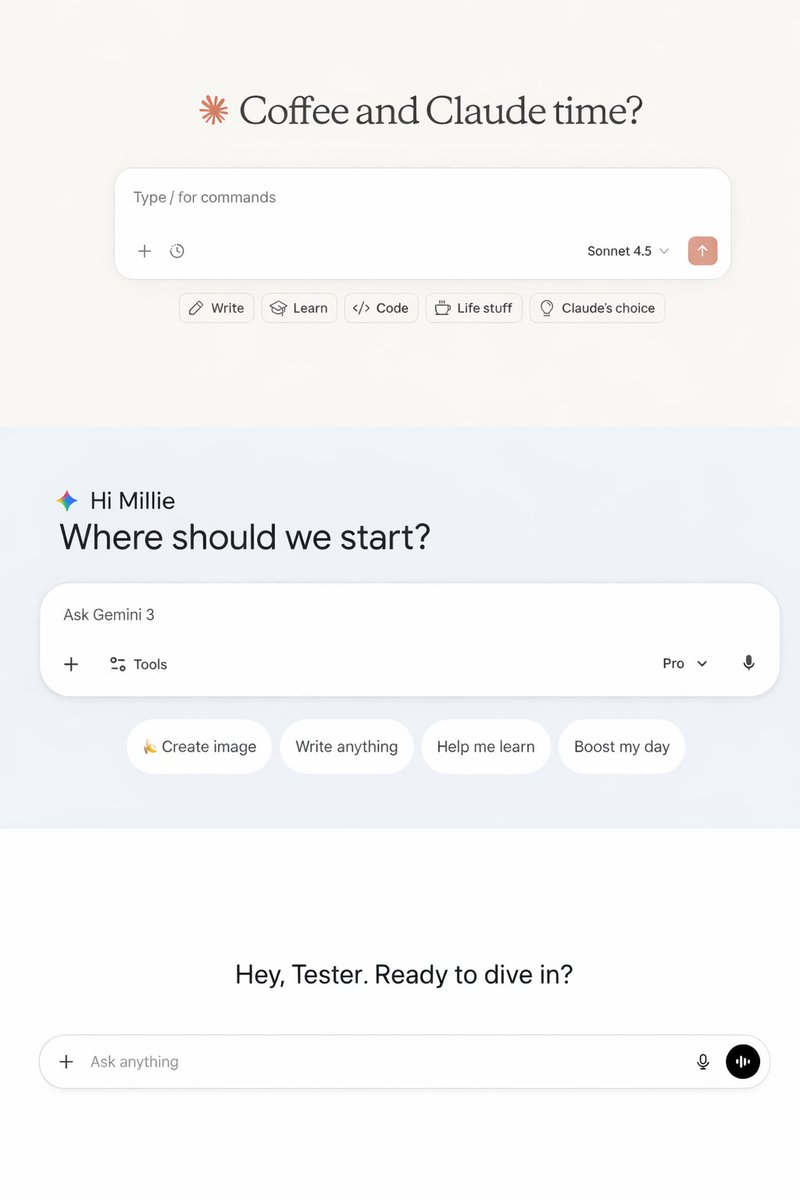
English
After 2 years of using ChatGPT, I can say that it is the best technology that has revolutionized my life the most, along with the Internet.
So here are 10 prompts that have transformed my day-to-day life and that could do the same for you in 2026:
English

BREAKING: Don't copy and paste answers from ChatGPT.
ChatGPT writing is easily detectable.
Use these prompts instead and see the magic 👇
English
@Petri2020 @veitera Kiitos Petri. Olihan siinä pientä organisatorista hidastuvuutta.
Suomi

Siitä on jo 10 vuotta, kun @jmolsa ja Markku Mantila järjestivät Helsingissä valtion virkamiehille ekan #disinfo torjuntakurssin. Ja millaista porua piippalakkiväki siitä pitikään! @veitera demokraatti.fi/janne-riihelai…
Suomi