

Chanik Jo
98 posts

Chanik Jo
@jo_chanik
Assistant Professor of Finance at CUHK working on fun stuff in asset pricing, household finance, and behavioral finance. @UofT PhD
Hong Kong Katılım Kasım 2021
881 Takip Edilen1.2K Takipçiler

My experience as well with some schools in China. Took it to be due to broad belt tightening measures coming from govt fiscal pressure.
But on the other hand, giving up on reimbursement and using my own research funding may also be an appropriate redistribution.
Stefan Nagel@ProfStefanNagel
Rant of the day: The reimbursement process for seminar visits has really gotten insanely burdensome with universities treating a speaker getting a few hundred bucks reimbursement like a million dollar supplier.
English
Chanik Jo retweetledi

No, it’s the other way around. Bachelier introduced Brownian motion in 1900 to study option prices.
The Black-Scholes formula is following up on his early work.
In the meantime, brownian motion made its way from mathematical finance to physics.
Philosophy Of Physics@PhilosophyOfPhy
Finance Borrowed this Equation from Physics✍️ The Black–Scholes equation (1973) is mathematically the same diffusion (heat) equation used to describe Brownian motion introduced by Albert Einstein in 1905. A risk-free portfolio behaves like heat flowing through a metal rod. Volatility is diffusivity. Payoffs are boundary conditions. Markets are just noisy physical systems. In 1997, the Nobel Prize in Economic Sciences was awarded for this idea, essentially a physics equation. Built on the Wiener process, the same math describes pollen grains, stock prices, quantum paths (Richard Feynman), and even early-universe fluctuations. Different fields. Same diffusion.
English
Chanik Jo retweetledi
A useful graph to remind everyone that wealth inequality statistics that mostly ignore the heterogeneity in pension systems and more generally welfare states are useless to compare countries.
Simon Kuestenmacher@simongerman600
When I am making claims that Australia is becoming a more unequal society, I always point to South Africa and Brazil as societies without a functioning middle class. This chart shows wealth inequality by country. A quintessential question of our time is whether we want a middle class or not - currently we are actively shrinking it across the Western world. Source: visualcapitalist.com/wealth-inequal…
English

@MCroce_MacroFin Which one is more fun? I guess South Africa > FamaMacbeth 😂
English

After a wonderful week in #SouthAfrica, I am getting ready for a wondefful lecture about #FamaMacBeth 😎🫣

English
@sc_cath I guess this means an exogenous increase in wealth inequality with shareholders getting richer and consumers suffering. Plus, it’s an overall welfare loss due to the deadweight costs from higher prices caused by the tariffs. Typical unintended consequences 😂
English
Effectively, this is a transfer from consumers—who effectively bore the tax—to U.S. companies, which receive the refund.
unusual_whales@unusual_whales
BREAKING: The US government now may owe US companies $175 billion in tariff refunds, per CNN
English
Chanik Jo retweetledi
This is a deep misunderstanding of how economics works.
Economists don’t start with unrealistic assumptions to reach irrelevant conclusions. Theorists spell out the assumptions under which an idealized, stylized result can be proven—and very often that result is an irrelevance result. In finance, for instance: Modigliani–Miller (capital structure doesn’t matter), no-trade theorems (nobody trades), etc.
The point isn’t the conclusion. We all know firms do optimize their capital structure (we teach how) and people trade trillions of dollars of securities every day.
The “result” is really the assumptions: they tell you what has to be true for a phenomenon not to matter or not to exist—and therefore what frictions make a field interesting or a phenomenon exists. A huge share of economic research is about relaxing those assumptions and studying what changes.
So when we say markets work “perfectly” under perfect competition, perfect substitutes, complete markets, and fully rational agents, we’re not claiming those conditions hold. We’re saying the literature should be built around the violation of these assumptions.
Mayukh@mayukh_panja
Economics is mostly a bullshit field of study. It is specifically for people who can do a little bit of stats and calc and want to feel smart but too dumb to study physics or math. Most economic theories are built like this: they start with an assumption about human behavior. Then without checking if the assumption is true, they will pile on layers of sloppy math on it and come to all sorts of conclusions that obviously don’t hold up in the real world. Recently a couple of economists won the Nobel Prize for being the first to realize that assumptions about human behavior must be tested and they went out and did some field work, and proved that a lot of assumptions in economic theories about how humans behave with money are well just not true. I was working at a bank for 2 years and saw firsthand that economics PhDs tend to be the dumbest. These people are completely alien to the idea of first principles thinking and treat axioms as if they were written in the Bible. Also they don’t really understand what an axiom is. Economics only exists because your average normie is easily impressed buy math and midwits in power are not scientific enough to realize that it is all voodoo and keep taking economists seriously. I don’t blame them though, at some point they hit an intelligence wall and the average economist brain is simply not equipped to have meta level thoughts about their own field of study. I guess this is one of those bullshit jobs like HR, therapy, astrology, project management that will just stay around for a while cause most humans are either mid or retarded.
English
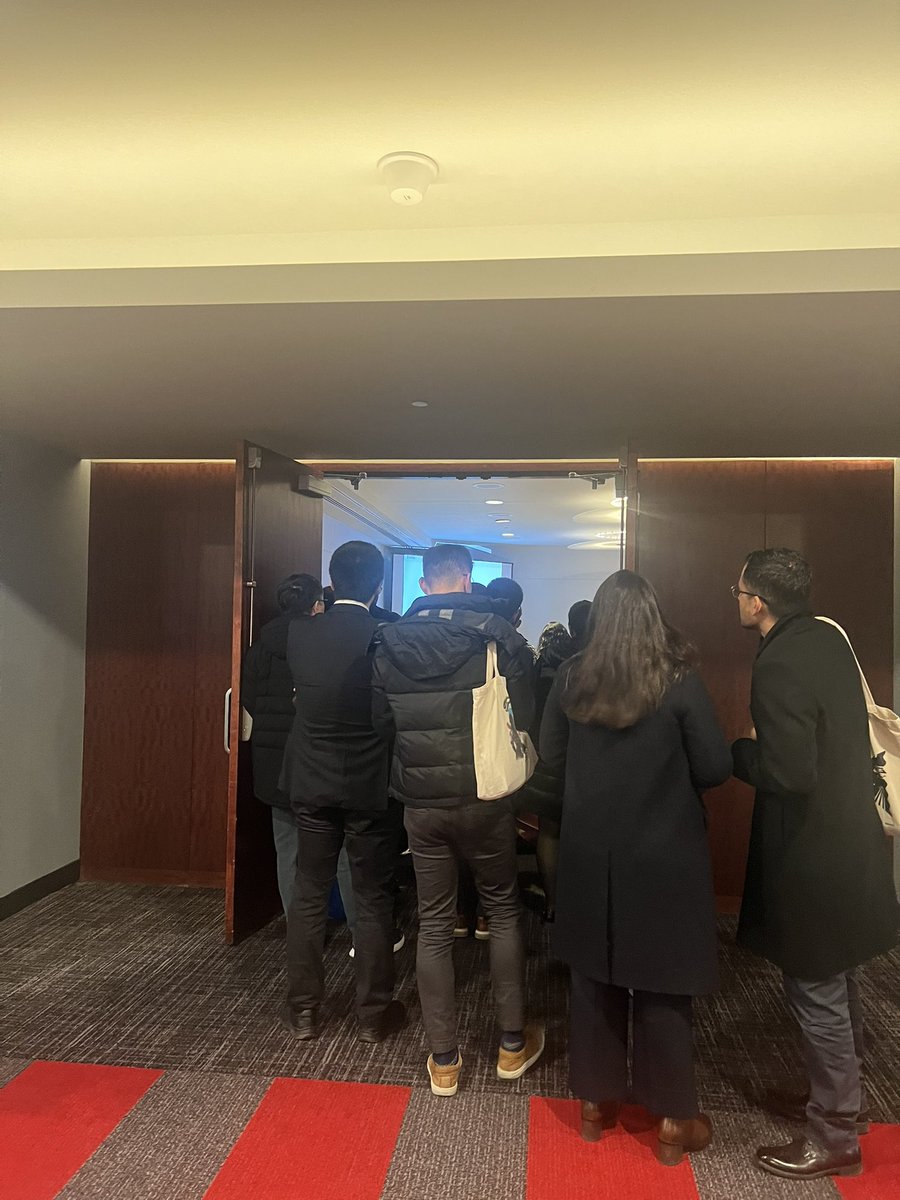

Scenes from the current AEA/ASSA, where booking space has not caught up to current attendance levels.

English
Chanik Jo retweetledi


It has been a stressful semester so jumping out of an airplane from 13,000 feet over the Niagara Falls seems like a good idea.
Niagara Falls, NY 🇺🇸 English
My latest publication on the Journal of Corporate Finance shows that newly public firms still often need to commit to performance sensitive debt to convince new lenders for future financing even though the IPO serves as an information-releasing event.
sciencedirect.com/science/articl…
English
@Junxuan_Wang_ @HKUSTGuangzhou Big Congratulations!! All the best for your new journey!!
English

I am pleased to announce that I have successfully completed the job market process. I will be joining @HKUSTGuangzhou as an Assistant Professor in the Thrust of Financial Technology within the Society Hub.
English
@henry_h_zhang @townsend_rm I look forward to meeting you here in HK!
English

I am thrilled to announce that I will begin my career as an assistant professor at the Department of Finance at the CUHK Business School. I am incredibly grateful to my advisors at MIT, Rob Townsend @townsend_rm, Dave Donaldson, and Tong Liu, for their support and guidance. I look forward to developing my research agenda in an exciting and growing department in a beautiful location!

English
Chanik Jo retweetledi

📣new paper alert: An Alpha in Affordable Housing? a collaboration with with @damensven and @MKorevaar_ showing that low-rent/low-income housing earns the highest returns for landlords in the U.S., Belgium, and The Netherlands.

English
@jinfeisheng @sc_cath I suppose part of the yesterday market reaction is driven by uncertainty shocks -- uncertainty about the market structure, US AI dominance, etc
English

I'd love to see a proper IO analysis of the deepseek shock on Nvidia.
What we learned, is that you can do much more with an Nvidia GPU than we thought. But it’s not immediately obvious that this is bad news for Nvidia. Imagine Nvidia had just announced that its next-generation chip would be 10 times more powerful and efficient than the previous one—would that be seen as bad news for the stock?
Yes, achieving a given computational goal now requires fewer GPUs, but that perspective feels shortsighted. Lower costs—both in price and energy consumption—effectively expand the range of feasible applications, which should, in turn, increase demand. So why the sharp drop in Nvidia’s stock price?
One key difference between a sudden leap in next-generation chip performance and the DeepSeek shock is that the latter retroactively upgrades the existing installed base of Nvidia GPUs, making them far more efficient than expected. In a sense, Nvidia is now competing against its own previously sold GPUs. The realization that these existing chips can deliver significantly greater output can be viewed as a massive positive supply shock—one coming from an unexpected "competitor."
So maybe the overall effect on the company's value is ambiguous. Afterall, Nvidia, like any monopoly, must ration quantities to maximize profits.
English
@NickRoussanov This paper shows partisanship matters for consumption using a different setting and data: ssrn.com/abstract=47333…
English

@JohnHCochrane As @ProfJAParker and others show, some do react, at least in terms of their portfolio allocation nber.org/system/files/w…
although not consumption?
direct.mit.edu/rest/article/1…
English

Really good point, which I should not have missed. rational expectations and economic models describe how people behave, not how they answer surveys. If they don’t act do they really believe?
Branislav Slantchev@slantchev
Really, people (both of them). This is cheap talk — people are just expressing the best/worst of their expectations of Trump. Until you show me investment/savings patterns consistent with these wild swings, these data are noise.
English
Chanik Jo retweetledi

Very happy to see our paper out at @JournalFQA !
Journal of Financial and Quantitative Analysis@JournalFQA
@FelixMeyerinck, @VesaPursiainen, and Markus Schmid study how competition shapes customer reactions to lawsuits using mobile phone data. Lawsuits lead to 4% fewer visits, especially in competitive areas. Revenues and returns also decline with competition. jfqa.org/wp-content/upl…
English
@fang_leon I guess with a short window, sometimes you may lose an important variation like yesterday, but on average you can cleanly capture the immediate reaction without contaminating information.
English

@jo_chanik I agree with you that it takes time to digest. But there is a tradeoff between information and identification: longer periods have more contaminating information. This paper makes the point.
ijcb.org/journal/ijcb05…
English
To study the impact of monetary surprise on stock markets, FOMC literature typically examines high-frequency market reactions during a 30-min short window around the announcement. I guess a short window could be misleading if it takes time to digest the surprise, like today 🤔

English