John Ryu

11.3K posts

John Ryu banner
John Ryu

John Ryu

@john_ryu

Building access to institutional caliber investment strategies @SimplifyAsstMgt | Startup investing @hypothesisvc

New York, NY Katılım Şubat 2009
2.6K Takip Edilen3.4K Takipçiler
John Ryu retweetledi
Raphael Schaad
Raphael Schaad@raphaelschaad·
MIT student asked a question earlier today that a lot of young founders are quietly wondering about: "Won’t the frontier labs just do everything?" Yes it's true that OAI/Ant are shipping at incredible pace, but it's quite easy to avoid their blast radius and build amazing startups: OpenAI is not going to build a cattle-herding drone, buy an old F-150 and drive from ranch to ranch like the founder of one of the fastest-growing YC W26 startups, Graze Mate. Anthropic is not going to integrate with dental insurance verification systems (Lance). Google is not going to navigate NATO procurement (Milliray). The value is in the last mile, not the model. Sales cycles require humans who understand the customer. And most importantly, the market is expanding, not shrinking: AI isn't cannibalizing the existing 1% software spend — it's unlocking the other 5-6% that was going to humans. That's a much bigger market for startups yet-to-be-founded than the one the labs are playing in. Now, what DOES seem risky? A thin UI layer on top of ChatGPT with no domain expertise; a general-purpose chatbot or assistant; or a product that gets obsolete when model capabilities improve. But — tools for specific industries; "full-stack" AI companies that actually are the service (AI law firm, AI accounting firm, AI uranium exploration company); or generally products where the customer doesn't want a tool but an outcome — are defensible ideas for startups.
English
76
120
1.2K
238K
John Ryu retweetledi
Nakul Mandan
Nakul Mandan@nakul·
“Founders aren’t made when they start companies. They’re made when they interpret their market correctly.” Episode 2 of @KnuckleUpHQ is live. Qasar Younis (@qasar): Founder and CEO of Applied Intuition. One of the sharpest and most intentional operators you’ll ever meet on the craft of building a company. Full episode ↓ -- 00:00 Intro 01:19 What really makes someone a founder 05:26 The company that almost became Kickstarter 08:12 The most common misread on feedback 13:40 Why most founders don't end up with the best team 19:45 How to pick a co-founder 23:38 Your first 10 hires are really your first 100 28:21 The case for hiring slow and firing slow 33:22 Red, yellow, green: how Applied gives monthly feedback 35:00 The role that knows what’s actually going on in a company 40:01 How to operate with speed and intentionality 42:41 The three things Qasar spends time on 45:57 How Applied is driving AI adoption 52:06 The type of engineer Applied is now looking for 1:01:19 Why this could be the golden age of small companies 1:09:13 Quickfire: red flags, overrated advice, and superpowers 1:12:32 Qasar's advice to his 25-year-old self
English
7
27
437
520.5K
John Ryu retweetledi
Paul Graham
Paul Graham@paulg·
Hamming's talk is so important that I reproduced it on my site. It's one of the only things on my site written by someone else. paulgraham.com/hamming.html
Ihtesham Ali@ihtesham2005

A mathematician who shared an office with Claude Shannon at Bell Labs gave one lecture in 1986 that explains why some people win Nobel Prizes and other equally smart people spend their whole lives doing forgettable work. His name was Richard Hamming. He won the Turing Award. He invented error-correcting codes that made modern computing possible. And he spent 30 years at Bell Labs sitting in a cafeteria at lunch watching which scientists became legendary and which ones faded into nothing. In March 1986, he walked into a Bellcore auditorium in front of 200 researchers and told them exactly what he had seen. Here's the framework that has been quoted by every serious scientist for the last 40 years. His opening line landed like a punch. He said most scientists he worked with at Bell Labs were just as smart as the Nobel Prize winners. Just as hardworking. Just as credentialed. And yet at the end of a 40-year career, one group had changed entire fields and the other group was forgotten by the time they retired. He wanted to know what the difference actually was. And he said it wasn't luck. It wasn't IQ. It was a specific set of habits that almost nobody is willing to follow. The first habit was the one that hurts the most to hear. He said most scientists deliberately avoid the most important problem in their field because the odds of failure are too high. They pick a safe adjacent problem, solve it cleanly, publish it, and move on. And because they never swing at the hard problem, they never hit it. He said if you do not work on an important problem, it is unlikely you will do important work. That is not a motivational line. That is a logical one. The second habit was about doors. Literal doors. He noticed that the scientists at Bell Labs who kept their office doors closed got more done in the short term because they had no interruptions. But the scientists who kept their doors open got more done over a career. The open-door scientists were interrupted constantly. They also absorbed every new idea passing through the hallway. Ten years in, they were working on problems the closed-door scientists did not even know existed. The third habit was inversion. When Bell Labs refused to give him the team of programmers he wanted, Hamming sat with the rejection for weeks. Then he flipped the question. Instead of asking for programmers to write the programs, he asked why machines could not write the programs themselves. That single inversion pushed him into the frontier of computer science. He said the pattern repeats everywhere. What looks like a defect, if you flip it correctly, becomes the exact thing that pushes you ahead of everyone else. The fourth habit was the one that hit me the hardest. He said knowledge and productivity compound like interest. Someone who works 10 percent harder than you does not produce 10 percent more over a career. They produce twice as much. The gap doesn't add. It multiplies. And it compounds silently for years before anyone notices. He finished the lecture with a line I have never been able to shake. He said Pasteur's famous quote is right. Luck favors the prepared mind. But he meant it literally. You don't hope for luck. You engineer the conditions where luck can land on you. Open doors. Important problems. Inverted questions. Compounded hours. Those are not traits. Those are choices you make every single day. The transcript has been sitting on the University of Virginia's computer science website for almost 30 years. The video is free on YouTube. Stripe Press reprinted the full lectures as a book in 2020 and Bret Victor wrote the foreword. Hamming died in 1998. He gave his final lecture a few weeks before. He was 82. The lecture that explains why some careers become legendary and others disappear is still free. Most people who could benefit from it will never open it.


English
82
434
3.7K
770.3K
John Ryu retweetledi
max
max@maxkolysh·
cursor’s long term viability was contingent on maintaining access to ant/oai models. both are actively building cursor competitors that’s an existential platform risk to survive they need their own foundation models. training frontier models requires deep pockets.. and they found the guy with the deepest pockets in the world
English
14
12
306
21.5K
Bryan Kim
Bryan Kim@kirbyman01·
PERSONAL UPDATE: After 5+ years, I am leaving @a16z to start a fund! This was the toughest career decision of my life. I learned from the best partners and was privileged to work with incredible founders. So why leave? It is simply time to build. More to come on this.
English
407
62
2.9K
627.3K
John Ryu retweetledi
nihal
nihal@nihalmehta·
New York is about to make a massive mistake. The NY State Senate is advancing a proposal to decouple from federal QSBS (Section 1202) — the tax provision that lets startup founders exclude gains on qualifying exits. If this passes, founders would owe 10-13% in combined state and city tax on exits that are tax-free at the federal level and in nearly every other major tech state. Even worse: it's retroactive to January 1, 2025. This comes right as the federal government just expanded QSBS benefits and New Jersey moved to full conformity. New York wants to go in the opposite direction. As a seed investor in NYC who has backed hundreds of companies, I can tell you: founders are mobile. If New York becomes one of the most punitive states for startup exits, the best founders will simply build somewhere else — and the jobs, tax revenue, and innovation will follow. NYC has built something special over the last two decades. This proposal puts it all at risk for a short-sighted revenue grab. If you're a founder, investor, or anyone who cares about the NYC tech ecosystem — please sign the TechNYC open letter before Monday below 👇🏾👇🏾👇🏾 Keep building, NYC 🗽
nihal tweet media
English
220
338
1.8K
666.2K
John Ryu retweetledi
pradeep
pradeep@pradeep24·
Announcing jo 1.0 - rebuilt from scratch! Two years ago we launched a macOS productivity sidekick. Today it's something different: a personal AI that actually knows your life. Your Mac. Your dedicated cloud machine. Your data stays yours. askjo.ai
English
22
36
105
43.3K
John Ryu retweetledi
Larry Cheng
Larry Cheng@larryvc·
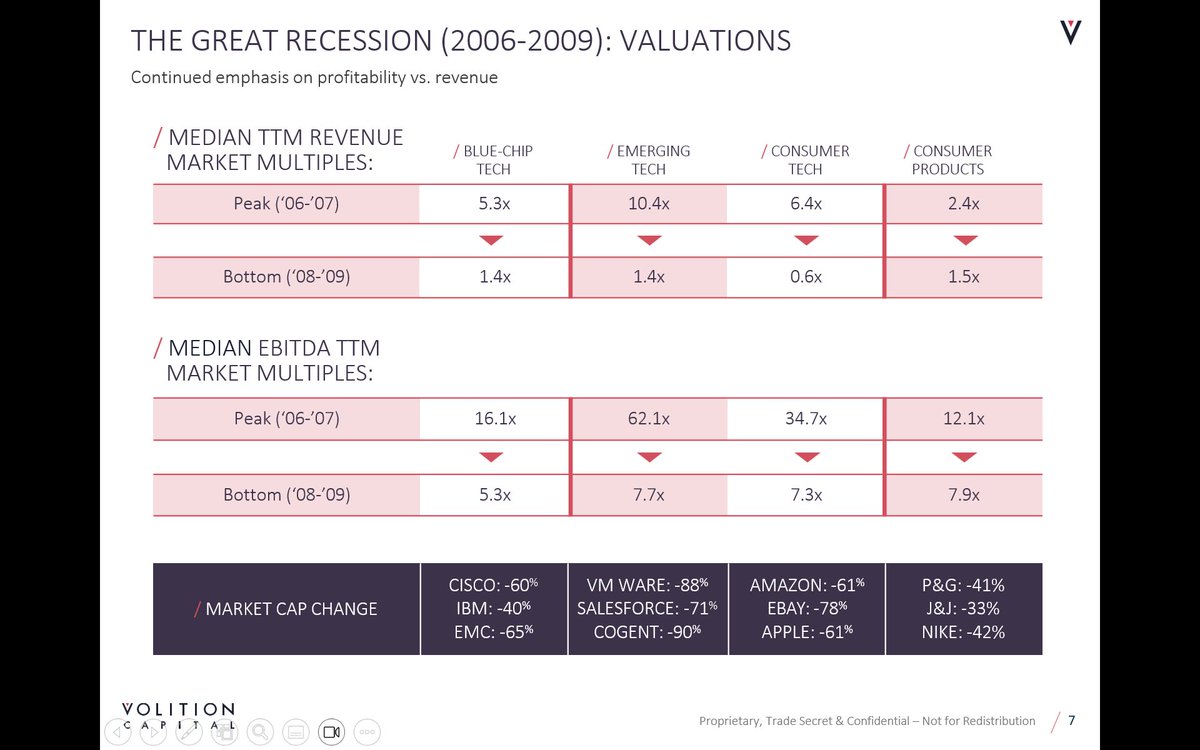
In capital rotations, industry-leading companies are not spared. In 2006-2009, example peak to trough declines: - Amazon (-61%) - eBay (-78%) - Apple (-61%) - Salesforce (-71%) - VMWare (-88%) - EMC (-65%) - etc... Therein lies the opportunity with hard capital rotations.
Larry Cheng tweet media
English
63
95
795
31.4K
John Ryu retweetledi
David Marcus
David Marcus@davidmarcus·
A few thoughts about PayPal, nearly 12 years after I left. I woke up this morning to dozens of messages from former PayPal colleagues. It pushed me to finally speak up. I never spoke publicly about the company after I left. Part of that was loyalty to John Donahoe, who gave me an unlikely opportunity, handing the reins of PayPal to a startup guy who, on paper, had no business running a then 15,000-person organization. But part of it was something else: I had left. I chose not to stay and fight for the changes I believed in. Speaking from the sidelines felt like armchair commentary. Easy opinions without the burden of execution. So I stayed quiet. But twelve years of silence is long enough. And today's news makes it clear the pattern I've watched unfold isn't self-correcting. I left PayPal in 2014 because I was deeply frustrated. We had executed a silent turnaround of a company that had lost its soul. We brought back engineering talent, shipped good products quickly, and acquired Braintree and Venmo. The company was on a tear. So much so that Carl Icahn felt compelled to accumulate a position in eBay and push for a PayPal spinoff. At the time, eBay decided to fight Icahn. It was a difficult period for me, caught between what I felt was right for PayPal and my loyalty to the eBay team. This is when Mark Zuckerberg approached me to join Facebook. The combination of his conviction that messaging would become foundational, the appeal of going back to building products at scale, and my growing exhaustion with the internal politics at PayPal and eBay eventually convinced me to leave and join one of the best teams in the world, one I had admired for a long time. In the summer of 2014, I met John in a café in Portola Valley and told him I had decided to leave. During that conversation, he told me that Icahn had effectively won the fight, that PayPal was going to become an independent company, and he tried to convince me to stay on as CEO, but I had already said yes to Mark, and my word is my bond. There was no turning back. After my departure, the board scrambled to find a replacement, and it took a few months for them to land on Dan Schulman. The leadership style shifted from product-led to financially-led. Over time, product conviction gave way to financial optimization. Much of the momentum we had created still persisted and carried the company forward, mainly driven by Bill Ready, who came over in the Braintree acquisition and rose to COO. Under his leadership, Venmo grew exponentially, and total payment volume (TPV) accelerated quickly. But the shift under Schulman became more pronounced after Bill's departure at the end of 2019. With him went the product conviction that had defined the post-spinoff momentum. Then, for a period, COVID-fueled online shopping hid a lot of the company's new weaknesses. During that period, the company made a fundamental miscalculation: it optimized for payment volume instead of margin and differentiation. It leaned into unbranded checkout, where PayPal had the least leverage, instead of branded checkout, where the margin, data, and customer relationship actually lived. Visa masterfully structured a deal that effectively ended PayPal's ability to steer customers toward bank-funded transactions, which had been a core driver of PayPal's economics. Not long after, PayPal lost a significant portion of eBay's volume. Over time, it saw its share of checkout among its most profitable customers steadily erode as Apple Pay and others continued to execute well. The same pattern repeated itself across lending, buy-now-pay-later (BNPL), and new rails. On lending, PayPal missed the opportunity to turn it into a platform weapon. Products like Working Capital were conservative, short-duration, and optimized for loss minimization. Lending never became programmable, never became identity-driven, and never became a reason for merchants or consumers to choose PayPal over something else. The missed opportunity in BNPL was even more striking. Klarna, Affirm, and Afterpay didn't just offer installment payments, they built consumer finance brands, persistent credit identities, and new shopping behaviors. PayPal saw the BNPL turn, entered the market, and had every advantage: distribution, trust, and merchant relationships. But BNPL was treated as a defensive checkout feature rather than an offensive category. There was no attempt to turn it into a core consumer relationship, no super-app behavior, and no meaningful differentiation for merchants. Others built platforms, PayPal added a feature. The failure to lean into building and owning new rails followed the same logic. After the spinoff, PayPal had a once-in-a-generation opportunity to build a global, at scale payment network. Instead, the company focused on building on top of existing networks and third-party rails. More recently, that mindset carried over to PYUSD. Technically, the product was sound. Strategically, it launched without a compelling transactional reason to exist. PYUSD had distribution, but no organic demand. It was not embedded deeply enough into flows to become a true settlement layer, a cross-border merchant rail, or a programmable money primitive. It sat adjacent to the product instead of inside the core of it. Acquisitions during this period followed a similar pattern. Honey was not a strategic acquisition for PayPal. It added activity, but not leverage. It lived outside the transaction, monetized affiliate economics rather than payment economics, and never meaningfully strengthened PayPal's control of the customer or the checkout moment. Xoom solved a real problem in remittances, but it never compounded PayPal's advantage. It scaled volume without changing the underlying rails, identity graph, or settlement model, and as importantly, it didn’t cater to a high-value, high-margin customer archetype. None of these were bad companies. They were just a wrong fit for PayPal and became unnecessary distractions. The board eventually recognized the problem. In 2023, they brought in Alex Chriss, an Intuit veteran with a strong product background, explicitly to restore product conviction. It was the right instinct. But Alex came from software, not payments. He understood SMB product development. He didn't have the muscle memory for transaction economics, network effects, or settlement infrastructure. In hindsight, he also made an error: clearing out much of the leadership team that understood payments deeply. Executives with years of institutional knowledge departed within his first year. This morning, Alex was removed as CEO. Branded checkout grew 1% last quarter. The board tapped another operator, Enrique Lores, the former HP CEO who's been on the PayPal board for five years. I don’t know Enrique. And he might be a great leader, but on paper at least, he’s a hardware executive. For a payments company. The common thread through all of this is incentive design. Once PayPal became independent, short/medium-term predictability beat long-term vision and ambition. Stock performance mattered more than platform risk and network opportunity. Financial optimization replaced product conviction. I'm not claiming I would have made every call differently. Running a public company at scale involves tradeoffs I didn't have to make after I left. But the pattern, choosing predictability over platform risk, again and again, was a choice, not an inevitability. Over time, the company that had every advantage and could’ve become the most consequential and relevant payments company of our time, lost its mojo, its product edge, and its ability to compete in a market that’s being rewired and reinvented in front of our eyes. That's the part that's hardest to watch for a company I care so deeply about.
English
614
943
8.9K
2.4M
John Ryu retweetledi
Alex Hormozi
Alex Hormozi@AlexHormozi·
The world will reward you in proportion to your courage, not your intellect.
English
583
2.8K
19.2K
853.5K
John Ryu
John Ryu@john_ryu·
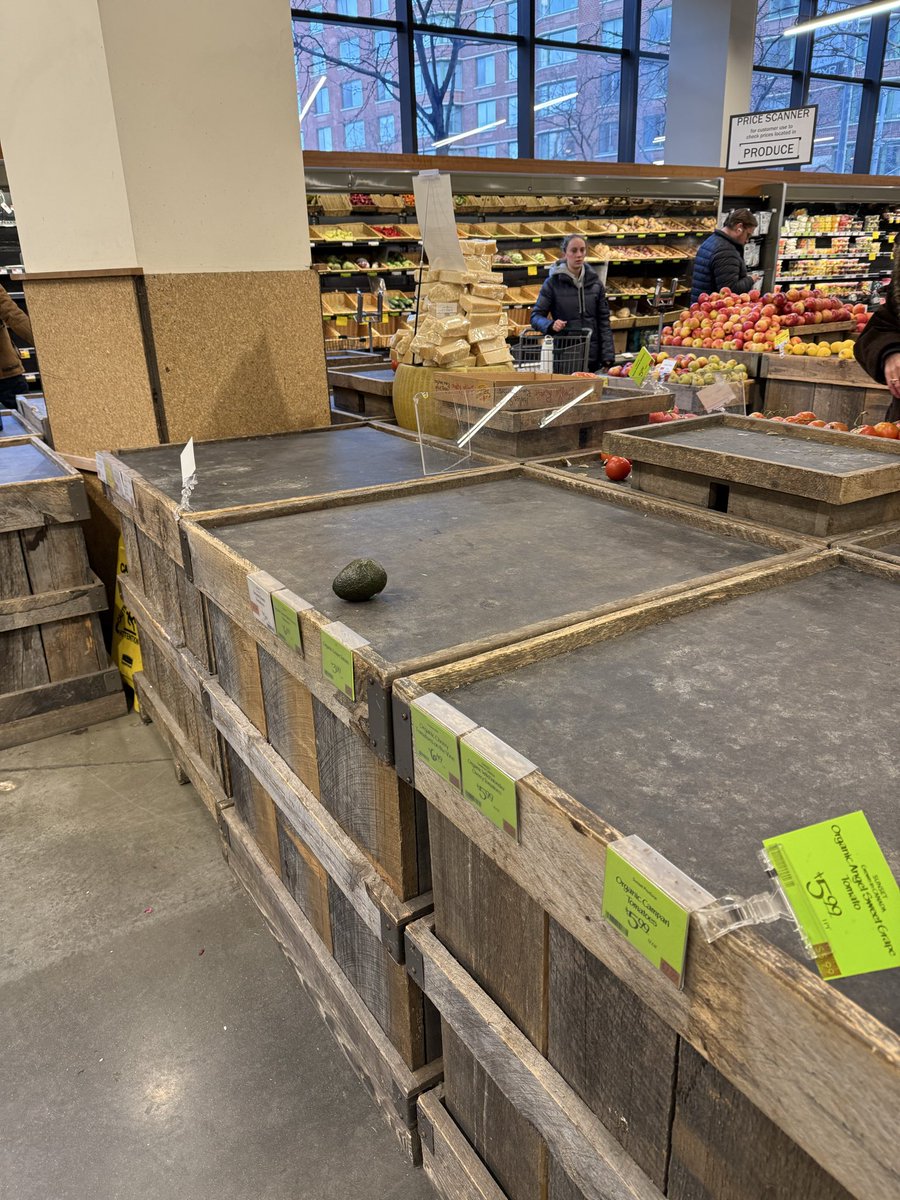
Convinced that this winter storm forecast was manufactured by Big Ag (and Big Toilet Paper) to sell more stuff.
John Ryu tweet mediaJohn Ryu tweet mediaJohn Ryu tweet media
English
2
0
1
90
John Ryu retweetledi
Larry Cheng
Larry Cheng@larryvc·
I'd rather own the S&P 500 index than the bottom 85%-90% of VCs. Even though top quartile performance looks solid, it's mostly unrealized, duration is long, illiquidity is high - the juice isn't usually worth the squeeze.
Jason ✨👾SaaStr.Ai✨ Lemkin@jasonlk

.@a16z: "It's Only The Top 5% of VC Funds That Matter"

English
46
29
319
26.6K
John Ryu retweetledi
Garry Tan
Garry Tan@garrytan·
Hire out of pain. Don't hire because you think you'll need someone soon or maybe sometime later. Wait until you or your team are actually hurting: working weekends, missing family dinners, dropping balls. That pain is the signal that the role is real. I learned this the hard way after watching founders (including myself) hire ahead of need and end up with people in roles that weren't fully formed yet. When you hire out of pain, you know exactly what the job is because you've been doing it yourself. You can evaluate performance because you know what good looks like. And the new hire knows you'll step back in if they fail, because you were just doing it last week.
English
228
400
5.9K
419K
John Ryu retweetledi
Tim Urban
Tim Urban@waitbutwhy·
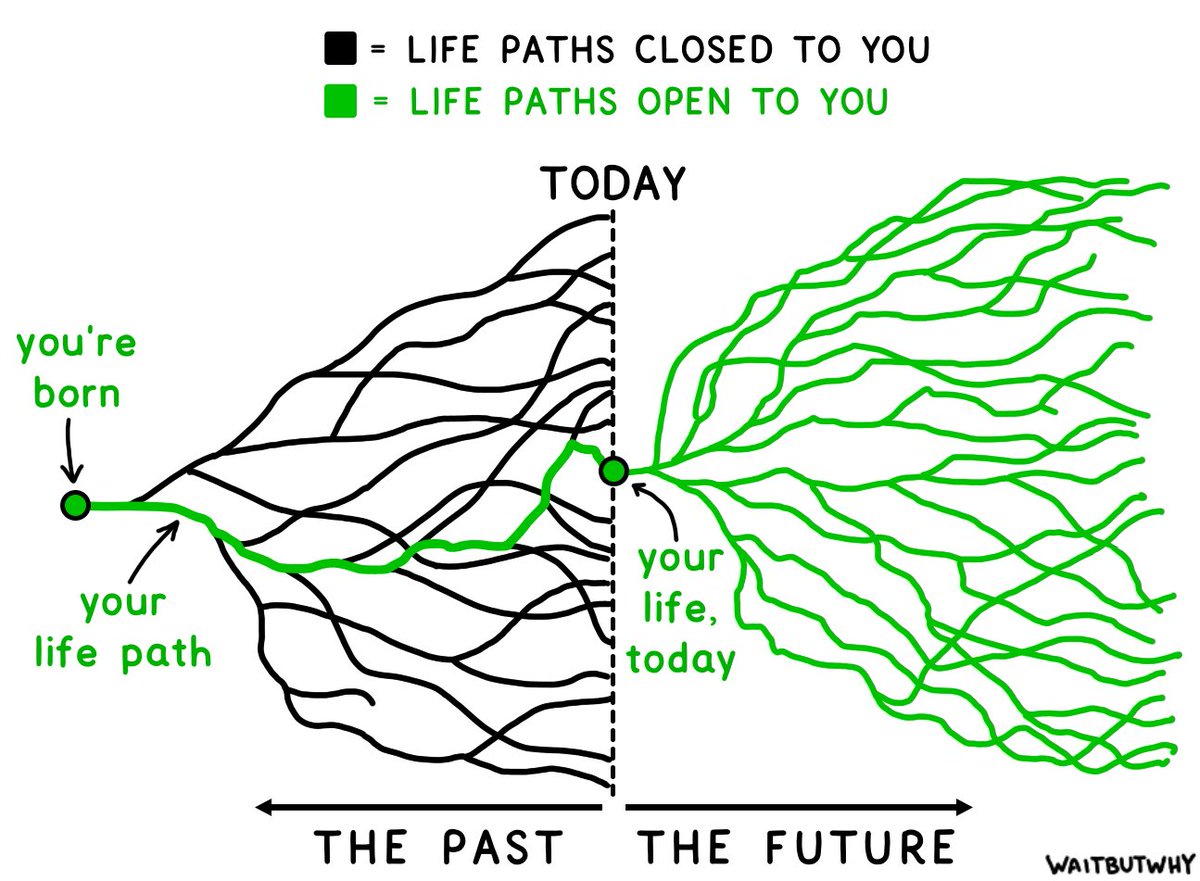
It’s that day when I make you all look at this
Tim Urban tweet media
English
209
3.2K
26.4K
2.2M
John Ryu retweetledi
andy jones
andy jones@andy_l_jones·
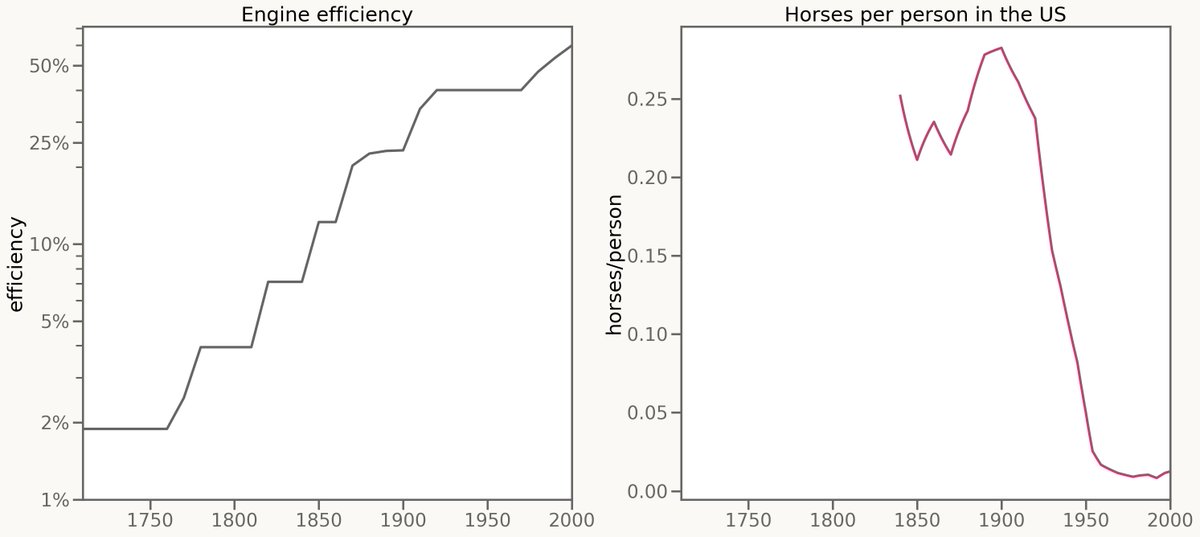
So after all these hours talking about AI, in these last five minutes I am going to talk about: Horses. Engines, steam engines, were invented in 1700. And what followed was 200 years of steady improvement, with engines getting 20% better a decade. For the first 120 years of that steady improvement, horses didn't notice at all. Then, between 1930 and 1950, 90% of the horses in the US disappeared. Progress in engines was steady. Equivalence to horses was sudden.
andy jones tweet media
English
213
745
4.6K
1.3M
John Ryu retweetledi
Marc Randolph
Marc Randolph@marcrandolph·
Listen. I am not smart. 99% of my ideas are bad ones. But my stand out trait is my optimism. I'm a believer. When all of my companies were at their darkest hour, I always believed we would make it out. But that's attitude. And I have three things I do which help a lot: 1. I am pre-disposed to action. I think less and I do more. Rather than working on business plans, forming committees, or any of that bullshit, I immediately jump to "how can I quickly just try this?" 2. I am great at triage. I have a good intuitive sense of which problems - out of the hundreds of things that may be going wrong - will be the ones that, if I fix them, will render the others meaningless. 3. I can focus. When you have a hundred things on fire, it's really hard to say "I'm going to put all my effort into the two critical ones" (see above trait) and ignore all the others - even if they are the ones that are burning the hottest. But hey... that's just me.
English
105
116
1.1K
55.6K
John Ryu retweetledi
Scott Stevenson
Scott Stevenson@scottastevenson·
This is how we always hire: find amazing people and then build a job for them. By definition, amazing people will be rare. So if you think of it as a search problem, this is the fastest way to create high talent density.
Erik Torenberg@eriktorenberg

This is how you hire an org of superstars. People first, roles/process second. There are many ways to put the puzzle together, but you want to prioritize top talent above all. It’s easier to deal with the chaos of non-standardized processes than it is to find & convince top talent. - From @zebriez’s excellent Colossus piece, “Inside Cursor”

English
31
50
928
293K
John Ryu retweetledi
Rahul Sharma
Rahul Sharma@Retail_Guru·
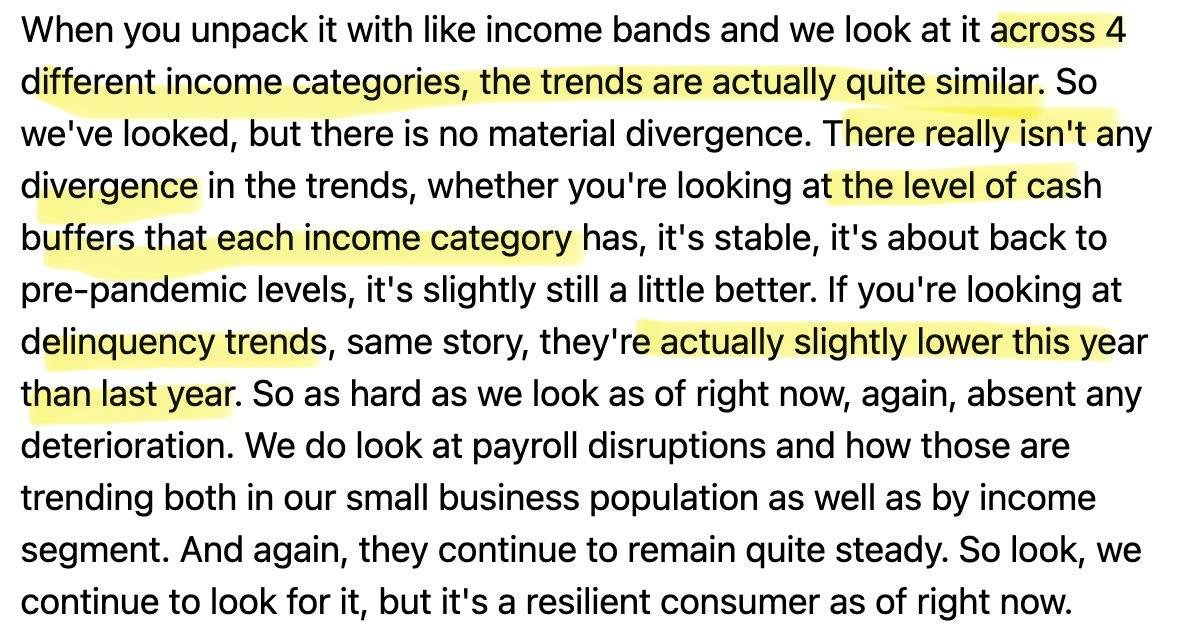
$JPM consumer banking CFO on US consumer: 'very resilient'. Q3 acceleration continues into Q4, including in discretionary. Not seeing divergence across incomes in contrast to McDonalds dour comments on low end. Cash buffers, delinquencies both favorable. $XLF $XLY $MCD
Rahul Sharma tweet mediaRahul Sharma tweet media
Rahul Sharma@Retail_Guru

$BAC CEO Moynihan says US consumer remains resilient. Card spend in October healthy +6%, on par with Q3. That is an acceleration on +4% in H1. 💪 $XLF $XLY $JPM $V $MA $AMZN $WMT $WFC

English
4
2
28
60.8K