John Hawks

25.9K posts

John Hawks banner
John Hawks

John Hawks

@johnhawks

I'm a paleoanthropologist. I explore human fossils and genomes to understand where we came from and what we share with our ancestors.

Wisconsin Katılım Temmuz 2009
250 Takip Edilen30.1K Takipçiler
John Hawks
John Hawks@johnhawks·
@djfreg1 It’s consistent but most of the nodes among these teeth and Denisovans are driven by noise. The tree making algorithm will connect fossils based on coverage and gaps even though that’s not biology
English
0
0
3
82
DaFreg
DaFreg@djfreg1·
@johnhawks Would that better explain Extended Data Fig.3?
English
1
0
1
130
John Hawks
John Hawks@johnhawks·
I feel a little heretical in saying that the headlines may say Homo erectus, but the Denisovan connection is pointing me a different direction. The connections over time within China are an old topic, and protein data has made them resurface again. johnhawks.net/p/rethinking-h…
English
5
8
38
2.7K
John Hawks
John Hawks@johnhawks·
“Few archaeological sites have undergone such geological contortions. Its sediments may have formed in even, flat layers, but in a million-plus years the falling center of the Jordan Rift upended them, so that some tilt upwards almost vertically.” johnhawks.net/p/a-new-age-fo…
English
0
4
15
1.3K
John Hawks
John Hawks@johnhawks·
A remarkable sequence of artifacts in layers upended by the Jordan Rift represent some of the oldest hominins in Eurasia. With a new estimate around 1.9 million years, the Acheulean artifacts from ‘Ubeidiya approach the earliest known in Africa. johnhawks.net/p/a-new-age-fo…
English
0
15
60
2.9K
Michael 英泉 Eisen
Michael 英泉 Eisen@mbeisen·
@johnhawks Yeah, but if they’d just updated their preprint with new genomes nobody would be writing about it today (ok, maybe you would - but nobody else).
English
1
0
0
112
John Hawks
John Hawks@johnhawks·
Lots of interest in recent natural selection over the last week, with the new work from Ali Akbari and coworkers supporting the idea of pervasive selection on ancient genomes. A great step forward based on a foundation of work over more than 20 years. johnhawks.net/p/how-human-ev…
English
8
13
62
9.3K
John Hawks
John Hawks@johnhawks·
Actually there is quite a lot of evidence about the pace of adaptive substitutions on several timescales across human evolution. Our best estimates are all low compared with the picture of selection on adaptive variants across the last 40,000 years. There is a layer of uncertainty regarding how much adaptive evolution might be invisible because it did not result in substitutions. I do not disagree that our count may have included some candidates that later would look like false positives, as has been the case in most genome-wide scans. However our lines of argument concerning acceleration are robust even if the count was an order of magnitude smaller.
English
1
0
0
76
MAFFT Damon
MAFFT Damon@RegimeEnforcer·
@johnhawks The acceleration framing is puzzling. There was no comparative evolutionary work to show whether selection "exploded" in recent time or not. And unfortunately, I still think most of the 2007 paper results were false positives, and that may also affect this paper
English
1
0
1
108
John Hawks
John Hawks@johnhawks·
@mbeisen It’s newer than mine from 2007 🤣. Anyway the 2-year-ago preprint is in the post, and I have to acknowledge it had 7000 fewer ancient genomes than the published version
English
1
0
2
160
Benjamin E. Hardisty
Benjamin E. Hardisty@Priceeqn·
@johnhawks Henry was on my diss. committee in the years before he passed. Of course, when I saw this new work I was very excited!
English
1
0
1
137
John Hawks
John Hawks@johnhawks·
If the main thing we are seeing in recent time is partial sweeps, then a much longer time period would have resulted in many completed sweeps, and certainly that was a common way of thinking about the problem in the early 2000s, and is reinforced in Akbari et al. 2026. Still, even in the early 2000s it was clear that positively selected variants may stall at intermediate frequencies for lots of reasons, either because they reach equilibrium in a balance, or because collectively alleles at many genes bring the phenotype to an optimum without completing a sweep, and today it's not clear what proportion of variants may have one fate versus another. One innovation of the Akbari approach is that only a fraction (~1/3) are new variants and most are standing variants, again tending to reduce expectations of a longer-term effect. Along similar lines, if we look at the modern-Neanderthal difference, there are really incredibly few fixed coding variants in modern humans (~100), most of which would reflect the span between ~700ka and 50ka. It will be very interesting to have a better count of noncoding functional variants. It would also be interesting to think through the scheme of partial and incomplete sweeps and standing variants as possible mechanisms for modern human differentiation from archaics.
English
1
1
1
236
Iain Mathieson
Iain Mathieson@mathiesoniain·
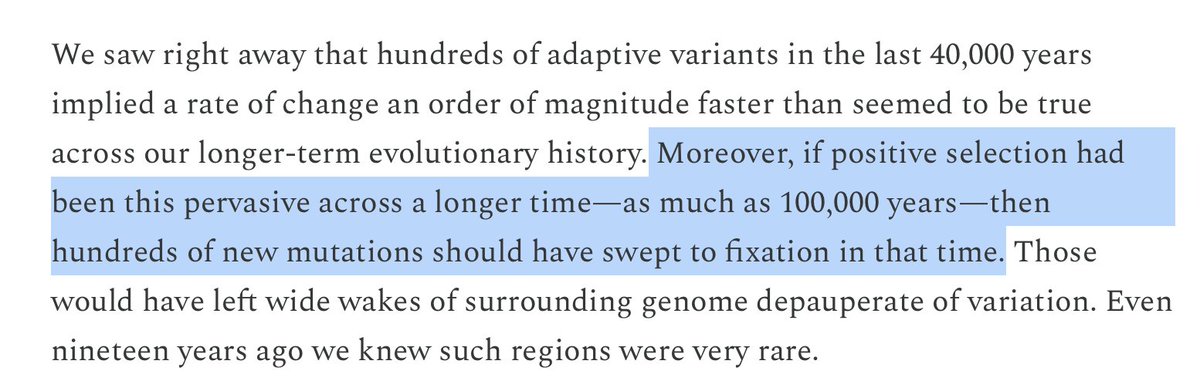
@johnhawks I don't think this is true if – consistent with Akbari et al. and other findings – most of the selection is transient in space and/or time.
Iain Mathieson tweet media
English
1
1
4
478
John Hawks
John Hawks@johnhawks·
It's one of the interesting consequences of neutral theory that selection of this kind doesn't matter much to the number of substitutions between two lineages. So our estimates of genetic divergence are probably not too badly affected by selection. But the relationship between genetic divergence and population divergence can be strongly affected by selection in the common ancestral population, and that factor is very hard to model after a remove of hundreds of thousands of years.
English
1
0
2
211
DaFreg
DaFreg@djfreg1·
Increased positive selection would also impact/inflate divergence estimates based on neutral theory. It would be interesting to see how such (correction) might apply to current Neanderthal and Denisovan divergence estimates. Presumably, this could mean we are not as distantly related as was assumed based on a more neutral clock.
English
1
0
1
303
Apatheia Ⓥ 🇺🇸
Apatheia Ⓥ 🇺🇸@DanKellyFreedom·
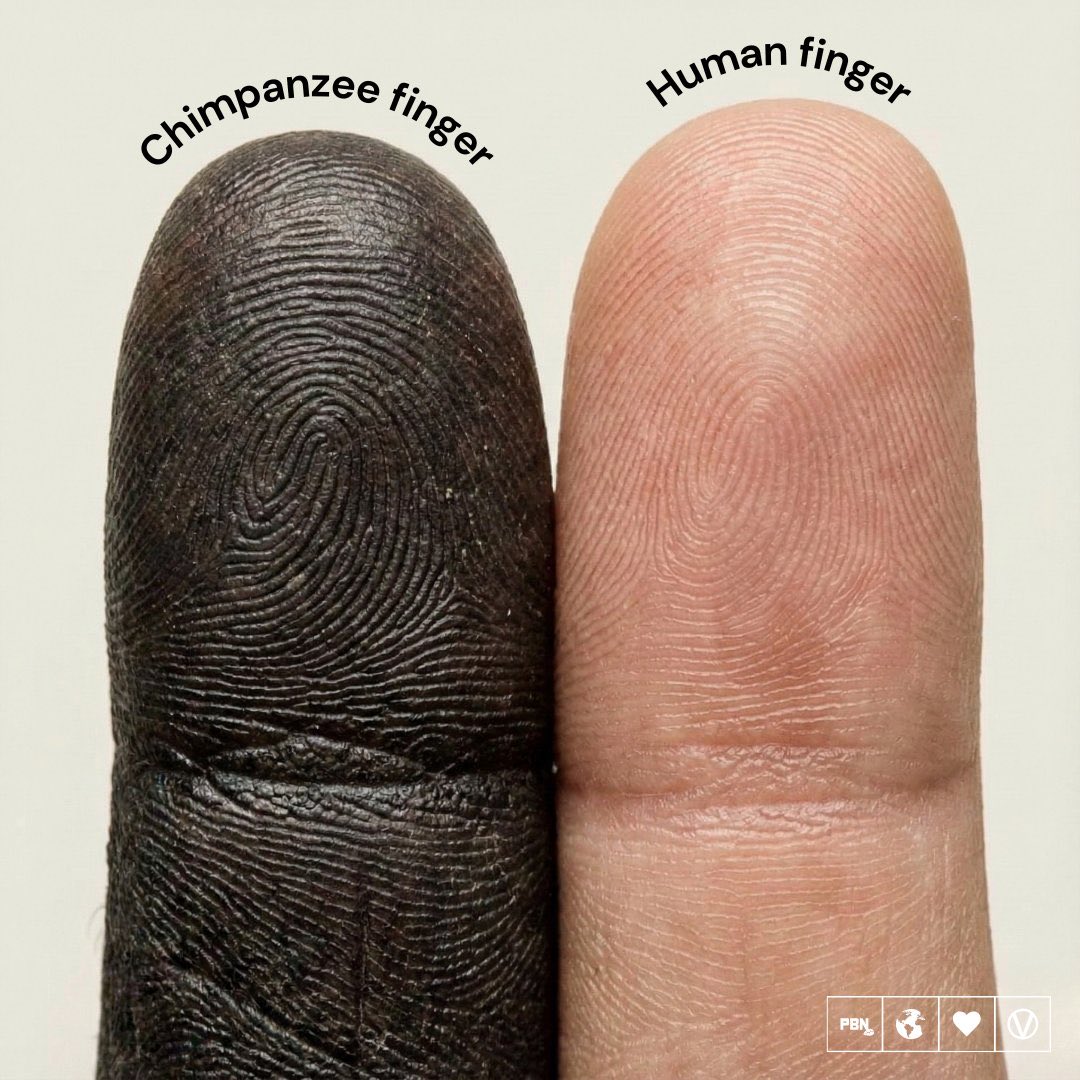
Our evolutionary sibling, with whom we share more DNA than either of us do with gorillas or orangutans.
Apatheia Ⓥ 🇺🇸 tweet media
English
205
84
953
19.2M
John Hawks retweetledi
Nick Jikomes
Nick Jikomes@trikomes·
I’ve done two episodes with @johnhawks and both are excellent. If you’re interested in human evolution, you should check them out and follow Dr. Hawks, who writes frequently about the latest paleoanthropology research. Fun fact: I took a couple of courses with John back in college, which really sparked my interest in human evolution.
Nick Jikomes tweet media
PaleoAnthropology@Qafzeh

Evolution of Human Behavior, Anatomy & Diet, Homo naledi & the Cave of Bones @johnhawks @trikomes Mind & Matter Podcast youtube.com/watch?v=_XLNrl…
English
1
5
21
3.9K
John Hawks
John Hawks@johnhawks·
The National Science Foundation has proposed eliminating the directorate that includes most of the federal funding for fieldwork and research in human origins. It's a sudden acceleration of a decades-long trend. I comment on what this means. johnhawks.net/p/us-federal-s…
English
2
62
110
6.1K
Andrew McCarthy
Andrew McCarthy@AJamesMcCarthy·
This photo has a very personal meaning for me if you care to read it. I saw a photo from @johnkrausphotos on reddit nearly a decade ago of the engines on a Falcon Heavy launch. I was working at a tough sales job at the time. The shot inspired me to learn more about space and spaceflight. Shortly after, I bought my first telescope. I saw Jupiter, Saturn, and Nebulae, and started social media accounts where I shared my amateur photos. Then I was laid off, and Covid happened. Moved from Sacramento to Arizona for clearer skies, cheaper cost of living, and a chance to go all-in on space photography. My audience started to grow. Then, NASA contacted me, asking me if they could use some of my moon photos for something called Artemis. I said yes. During the Artemis I rollout my DMs blew up “Andrew- your photo is on the Mobile Launch Platform!”. Now I knew that astrophotography wasn’t enough… I should probably pay attention to spaceflight. I spent a lot coming out to the first launch attempt, which would be my first rocket launch if it flew. Sadly, it was a scrub. I came home from Florida, sharing my stories of touring the VAB and facilities with my grandfather, who worked on Apollo. He passed shortly after, which affected my ability to return to watch the SLS flew. Feeling bummed out, I focused back on my deep sky work, but then I started hearing about something called “Starship”. I caught a video from @Erdayastronaut where a rocket ship fell through the air belly-first and flipped upright and landed. Inspired, I knew I had to witness one of these machines fly, so I flew to Starbase the moment I could afford it, which was for the second fully integrated flight test. The moment Starship lifted off the pad, I was hooked. There was nothing quite like the experience. I did everything I could to catch every launch I could, and worked to become credentialed media to get better access. Last year I flew from Arizona to Florida & Texas over a dozen times specifically to sharpen my launch photography skills with our first human spaceflight to the moon in over 50 years looming. A decade of preparation for a split second moment. When I picked up my camera from the launch pad yesterday morning and peeked at what was captured, I knew it was all worth it. Thank you, NASA, Artemis, and the all people who inspired me along the way. This is still only the beginning.
Andrew McCarthy tweet media
Andrew McCarthy@AJamesMcCarthy

Pleased to share my favorite high-resolution capture of the Artemis II launch- the moment the SLS is clearing the tower, captured by a sound-triggered camera placed near the pad. I'll have prints linked in my bio for this one, and here's a short thread about how it was captured

English
399
1.1K
10.7K
285K
John Hawks retweetledi
Sasha Gusev
Sasha Gusev@SashaGusevPosts·
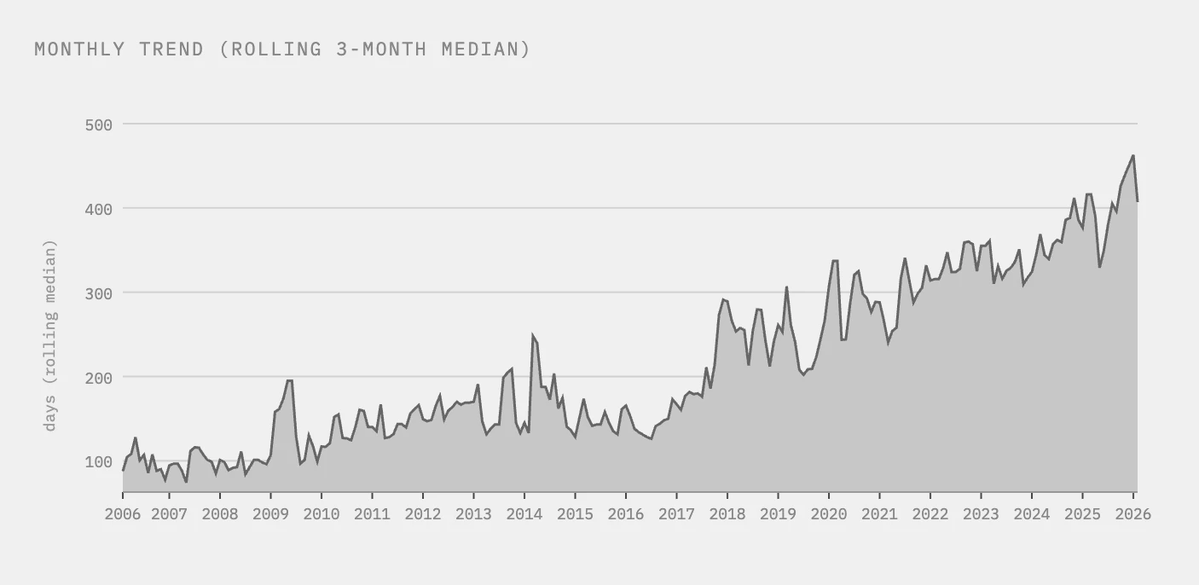
Monthly median Received to Accepted time (days) at Nature Genetics
Sasha Gusev tweet media
English
20
48
235
149.4K
John Hawks
John Hawks@johnhawks·
I took some time to wonder at the beautiful newly-described handaxes and other artifacts from near Sakhnin, Israel, where Acheulean artisans used geodes and fossil-bearing nodules for knapping. johnhawks.net/p/ancient-hand…
English
1
10
44
1.9K