Elastic Network Community

1.7K posts

Elastic Network Community banner
Elastic Network Community

Elastic Network Community

@joinelastic

ENC | Elastic Network Community HUB | TG: https://t.co/gBahQhcfKi

Katılım Eylül 2025
151 Takip Edilen755 Takipçiler
Sabitlenmiş Tweet
Elastic Network Community
Elastic Network Community@joinelastic·
Exactly, and that’s why $ZK is the endgame. It’s not just “a chain” anymore. $ZK is the heartbeat of the Elastic Network, a growing web of 21+ zkChains, from @AbstractChain and @grvt_io to @Sophon, @LC, @ZKcandyHQ, @cronosapp, @Xsolla, @LiftDataAI, @zerodotnetwork, @heurist_ai, @spaceandtime, @NodleNetwork, @oncreator_, @Memento_Bc, @XPLA_Official, @LaChain_Network, @unionchain_io, @0xSANDchain, @ADIChain_, @0xhealthshared, and more coming. Every single chain contributes value, creating one shared, self reinforcing $ZK economy. Every time assets move, every enterprise licenses modules, every zkChain grows, value comes back into the system. $ZK gets bought, burned, rewarded to stakers, and fuels the ecosystem. It’s real utility, not the illusions some are seeing. It’s control by design, not shallow attempts at dominance. That’s the reason why this is bigger than any other regular L1 or L2. It’s a whole financial infrastructure secured by Ethereum and ZK cryptography, private and public, for real-world adoption. So, again, $ZK isn’t just a token, it’s the backbone of the next era of decentralized finance. Spread the word.
ALEX | ZK@gluk64

What a sticky misconception 🙈 @ZKsync is no longer “a chain”. @ZKsync is building Incorruptible Financial Infrastructure for the world. It’s a network of public and private (enterprise) chains secured by Ethereum and ZK cryptography, not validators. Spread the word frens 🙏

English
8
14
127
36.6K
Neutize (ZK arc)
Neutize (ZK arc)@neutize·
connect dots > clarity act > institutions coming onchain > ZKsync has everything ready for them to deploy in days > infra is already proven by @ADIChain_ and others see you at $2, @MadMaxx_eth
ZKsync@zksync

A big step forward for the digital assets industry and U.S. banking. ZKsync × @BitGo partner to deliver a production-ready solution for tokenized deposits, combining secure custody with private, compliant blockchain settlement. Built for banks. Ready for deployment.

English
5
0
10
383
Noah Pravecek
Noah Pravecek@noah_pravecek·
This Bitgo partnership will enable banks to come onchain in a secure, compliant way while keeping transaction data private. One step closer to a Prividium for every bank.
ZKsync@zksync

A big step forward for the digital assets industry and U.S. banking. ZKsync × @BitGo partner to deliver a production-ready solution for tokenized deposits, combining secure custody with private, compliant blockchain settlement. Built for banks. Ready for deployment.

English
2
1
23
1K
vassilis (∎, ∆)
vassilis (∎, ∆)@TziokasV·
> it's extremely clear that banks want to innovate and participate in the digital assets economy. this is not an "if" anymore > they require privacy, security, control, interoperability. also not an "if" anymore > they also require enterprise-grade deployment, verticalized solutions, zero vendor fatigue We, at @zksync, are well aware of all the above after spending years talking but most importantly listening to banks. And we are very confident that a vertical solution for tokenized deposits is the most tangible but still transformational tool than banks (of all sizes) can use to come onchain. On their own terms. Prividium is the core but for it to be the Bank Stack of Ethereum, we need to join forces with digital asset service providers who understand Enterprise. And there is no one better than @BitGo. Together we technically bring to life a Digital Transformation Kit for Banks. A single turnkey solution that can bring banks onchain from 0 ▶️ 1.
ZKsync@zksync

A big step forward for the digital assets industry and U.S. banking. ZKsync × @BitGo partner to deliver a production-ready solution for tokenized deposits, combining secure custody with private, compliant blockchain settlement. Built for banks. Ready for deployment.

English
4
2
23
1K
BitGo
BitGo@BitGo·
Banks have wanted to modernize settlement and treasury ops for years. The infrastructure just wasn't there. @BitGo x @zksync changes that. Tokenized deposits, institutional custody, always-on settlement. Built for regulated banks, ready to deploy. 👇
ZKsync@zksync

A big step forward for the digital assets industry and U.S. banking. ZKsync × @BitGo partner to deliver a production-ready solution for tokenized deposits, combining secure custody with private, compliant blockchain settlement. Built for banks. Ready for deployment.

English
6
15
79
7.1K
Elastic Network Community
Elastic Network Community@joinelastic

Another great partnership has been announced. @ZKsync x @BitGo Banks are ready to move. But moving onchain without a compliance-grade infrastructure is not an option for regulated institutions. BitGo and ZKsync's Prividium are addressing exactly that gap, combining institutional custody and wallet infrastructure with a permissioned, privacy-preserving blockchain built specifically for the banking sector. The goal is clear: Give banks the ability to issue, transfer, and settle tokenized deposits while preserving regulatory oversight, customer protections, and operational control. "Tokenized deposits are how banks bring money onchain without leaving the regulatory system. With BitGo, and powered by Prividium's private infrastructure built for regulated institutions, we're delivering the foundation required for this transition at scale." — Alex Gluchowski (@gluk64) CEO Matter Labs A quick reminder: Prividium is key to Institutions game.

QME
0
0
5
247
ZKsync
ZKsync@zksync·
A big step forward for the digital assets industry and U.S. banking. ZKsync × @BitGo partner to deliver a production-ready solution for tokenized deposits, combining secure custody with private, compliant blockchain settlement. Built for banks. Ready for deployment.
English
19
42
286
36.9K
Elastic Network Community
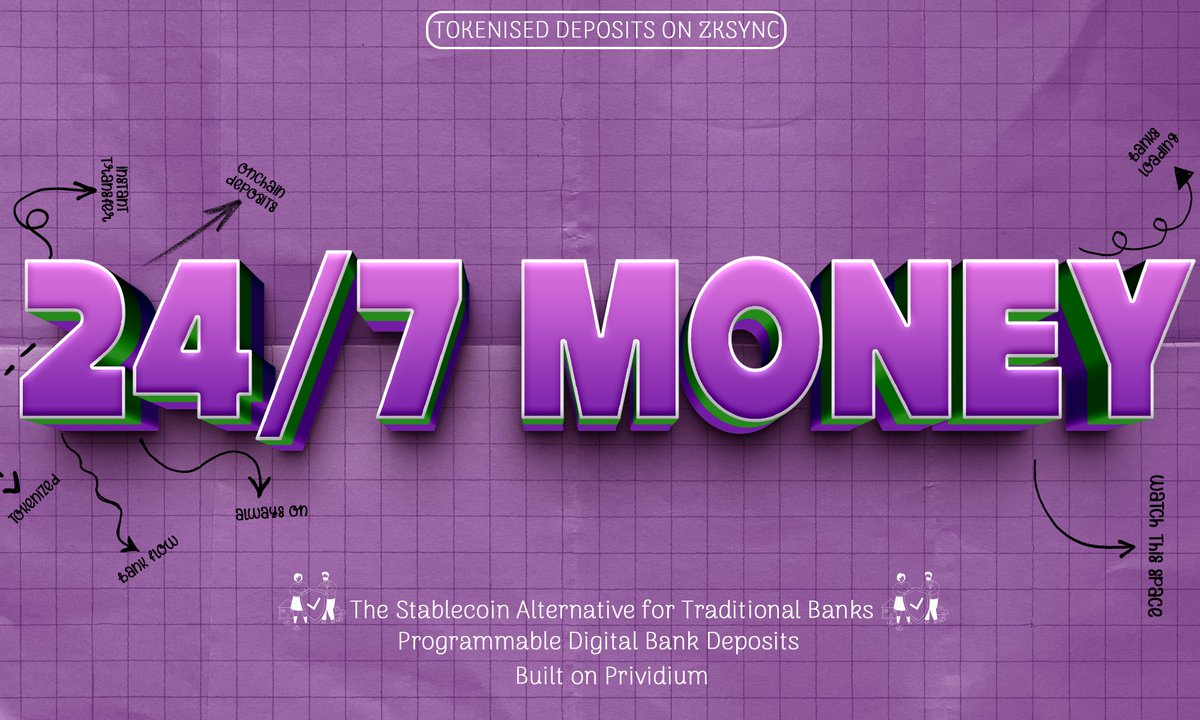
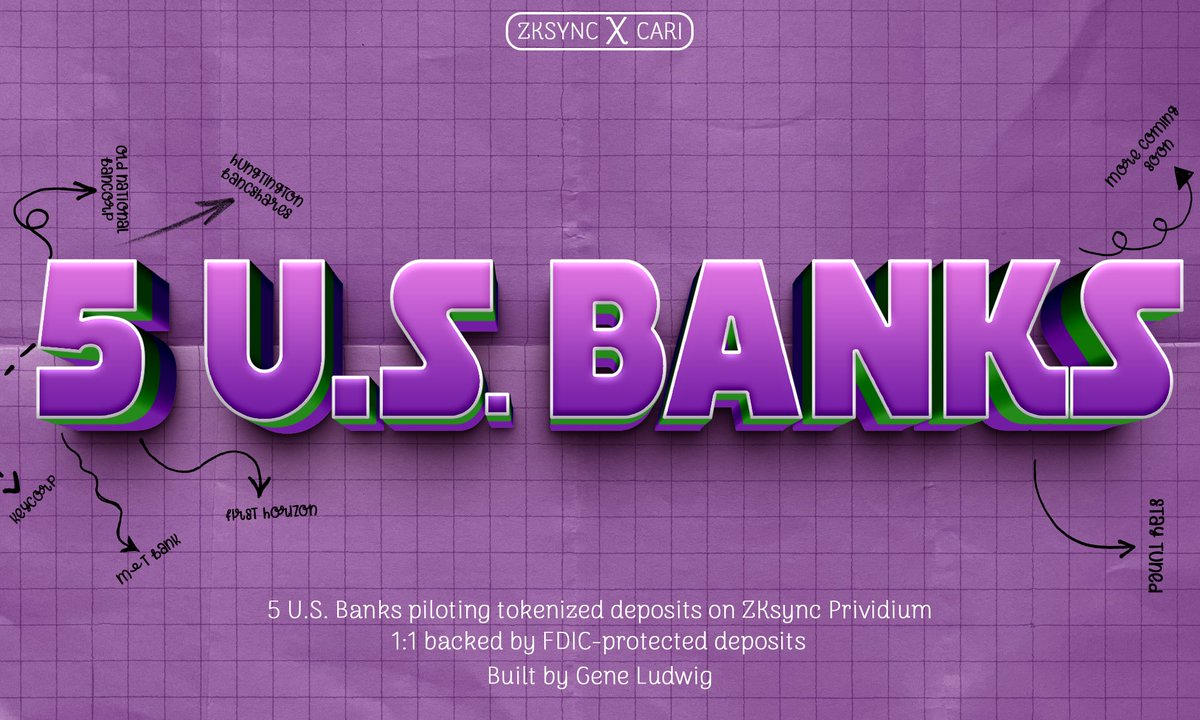
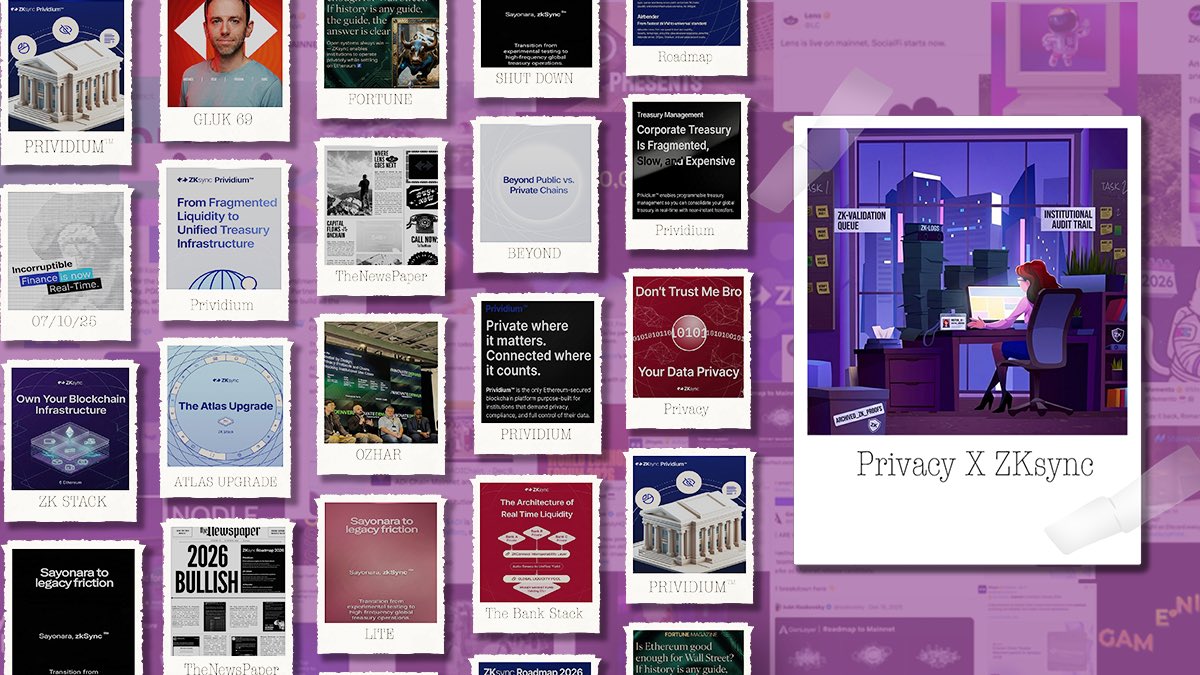
Another great partnership has been announced. @ZKsync x @BitGo Banks are ready to move. But moving onchain without a compliance-grade infrastructure is not an option for regulated institutions. BitGo and ZKsync's Prividium are addressing exactly that gap, combining institutional custody and wallet infrastructure with a permissioned, privacy-preserving blockchain built specifically for the banking sector. The goal is clear: Give banks the ability to issue, transfer, and settle tokenized deposits while preserving regulatory oversight, customer protections, and operational control. "Tokenized deposits are how banks bring money onchain without leaving the regulatory system. With BitGo, and powered by Prividium's private infrastructure built for regulated institutions, we're delivering the foundation required for this transition at scale." — Alex Gluchowski (@gluk64) CEO Matter Labs A quick reminder: Prividium is key to Institutions game.
Elastic Network Community tweet mediaElastic Network Community tweet media
ZKsync@zksync

A big step forward for the digital assets industry and U.S. banking. ZKsync × @BitGo partner to deliver a production-ready solution for tokenized deposits, combining secure custody with private, compliant blockchain settlement. Built for banks. Ready for deployment.

English
5
4
30
2.1K
Elastic Network Community
Elastic Network Community@joinelastic·
Elastic Network Community@joinelastic

Corporate Treasury Is Broken. @ZKsync Prividium Fixes It. Corporate treasury sounds boring, until you realize how much capital leaks through it. And when we say “leaks,” we don’t mean fraud or incompetence. We mean friction. The kind that builds up slowly over decades and becomes invisible because “that’s just how it works.” Large enterprises operate between 500 and 1,200 bank accounts globally and can spend $5–15 million annually just maintaining that structure. Not investing. Not expanding. Just… keeping the system running. Think about that for a second. Liquidity fragments across regions. Cash sits idle in transit. Transfers move in batch cycles with cut-off times that feel like they belong to another decade. Reconciliation still happens manually across different ledgers and jurisdictions. Different time zones. Different systems. Different rulebooks. And someone has to stitch all of that together. In a world where everything else feels instant, treasury still moves at banking speed. It’s not broken though. It’s just… inefficient. And at multi-billion-dollar scale, inefficiency gets expensive fast. So treasurers do what rational operators always do in uncertain systems: they add buffers. They pre-fund accounts to avoid payment failures. They over-reserve for FX exposure. They maintain redundant liquidity just to make sure nothing breaks at 4 p.m. on a Friday. The result: Trapped capital. Two-to-three-day settlement float. 25–40 basis points in lost yield. Millions in operational overhead. That 25–40 bps might sound small, but apply it to billions and it stops sounding small very quickly. For a $3 billion treasury, these structural inefficiencies quietly translate into tens of millions sitting idle every year. The system technically works. It just wasn’t built for a world that runs 24/7. As @jtongdavies recently pointed out, much of today’s financial infrastructure still operates on assumed trust, where counterparties are expected to deliver as agreed, but the system itself doesn’t enforce those guarantees. It works, until it doesn’t. This is where @ZKsync’s Prividium changes the model, not by layering on another fintech dashboard, but by rethinking the coordination layer itself. Instead of fragmented accounts scattered across institutions, enterprises operate a unified multi-asset treasury wallet that can hold tokenized deposits, regulated stablecoins, and yield-bearing instruments in one programmable environment. One control surface instead of hundreds. Sensitive financial data remains private and controlled, while zero-knowledge proofs anchor transactional integrity to Ethereum. In simple terms: the system can prove correctness without exposing the underlying data. Selective disclosure enables audits without exposing proprietary flows to the world. So, privacy here isn’t something you rely on people to respect or policies to protect. It’s built into the system itself. The rules are written in code, and the guarantees come from math, not something that depends on someone promising to do the right thing, shifting from assumed trust to verified trust, where correctness is enforced and proven at the protocol level. Operationally, that shift is bigger than it sounds. Treasury gains consolidated global visibility with no cut-off windows and no batch delays, no waiting for banking hours in another timezone, no “we’ll process it tomorrow.” Transfers settle atomically across participating institutions, eliminating float and freeing liquidity in real time. Not tomorrow morning. Now. Smart contracts automate sweeps into money market funds, FX netting, rebalancing, and intraday liquidity management according to predefined policies. Instead of teams coordinating manually across banks, emails, and spreadsheets, logic executes deterministically. Policy becomes code, and once it’s encoded, it runs exactly as designed.

QME
0
0
2
158
ZKsync
ZKsync@zksync·
"Banks want to innovate but they are caught between two conflicting requirements. Regulation demanding them to preserve control and market pressure to move faster and connect to the new economy." @gluk64 explaining how Prividiums enable banks to come onchain on @therollupco.
English
10
19
137
6.4K
Elastic Network Community
Elastic Network Community@joinelastic·
@zksync 👀👀 👀👀
Elastic Network Community@joinelastic

Corporate Treasury Is Broken. @ZKsync Prividium Fixes It. Corporate treasury sounds boring, until you realize how much capital leaks through it. And when we say “leaks,” we don’t mean fraud or incompetence. We mean friction. The kind that builds up slowly over decades and becomes invisible because “that’s just how it works.” Large enterprises operate between 500 and 1,200 bank accounts globally and can spend $5–15 million annually just maintaining that structure. Not investing. Not expanding. Just… keeping the system running. Think about that for a second. Liquidity fragments across regions. Cash sits idle in transit. Transfers move in batch cycles with cut-off times that feel like they belong to another decade. Reconciliation still happens manually across different ledgers and jurisdictions. Different time zones. Different systems. Different rulebooks. And someone has to stitch all of that together. In a world where everything else feels instant, treasury still moves at banking speed. It’s not broken though. It’s just… inefficient. And at multi-billion-dollar scale, inefficiency gets expensive fast. So treasurers do what rational operators always do in uncertain systems: they add buffers. They pre-fund accounts to avoid payment failures. They over-reserve for FX exposure. They maintain redundant liquidity just to make sure nothing breaks at 4 p.m. on a Friday. The result: Trapped capital. Two-to-three-day settlement float. 25–40 basis points in lost yield. Millions in operational overhead. That 25–40 bps might sound small, but apply it to billions and it stops sounding small very quickly. For a $3 billion treasury, these structural inefficiencies quietly translate into tens of millions sitting idle every year. The system technically works. It just wasn’t built for a world that runs 24/7. As @jtongdavies recently pointed out, much of today’s financial infrastructure still operates on assumed trust, where counterparties are expected to deliver as agreed, but the system itself doesn’t enforce those guarantees. It works, until it doesn’t. This is where @ZKsync’s Prividium changes the model, not by layering on another fintech dashboard, but by rethinking the coordination layer itself. Instead of fragmented accounts scattered across institutions, enterprises operate a unified multi-asset treasury wallet that can hold tokenized deposits, regulated stablecoins, and yield-bearing instruments in one programmable environment. One control surface instead of hundreds. Sensitive financial data remains private and controlled, while zero-knowledge proofs anchor transactional integrity to Ethereum. In simple terms: the system can prove correctness without exposing the underlying data. Selective disclosure enables audits without exposing proprietary flows to the world. So, privacy here isn’t something you rely on people to respect or policies to protect. It’s built into the system itself. The rules are written in code, and the guarantees come from math, not something that depends on someone promising to do the right thing, shifting from assumed trust to verified trust, where correctness is enforced and proven at the protocol level. Operationally, that shift is bigger than it sounds. Treasury gains consolidated global visibility with no cut-off windows and no batch delays, no waiting for banking hours in another timezone, no “we’ll process it tomorrow.” Transfers settle atomically across participating institutions, eliminating float and freeing liquidity in real time. Not tomorrow morning. Now. Smart contracts automate sweeps into money market funds, FX netting, rebalancing, and intraday liquidity management according to predefined policies. Instead of teams coordinating manually across banks, emails, and spreadsheets, logic executes deterministically. Policy becomes code, and once it’s encoded, it runs exactly as designed.

QME
0
0
1
274
zaksans.grvt
zaksans.grvt@ZaksansPG·
was waiting for this moment for years. $GRVT is closer than ever  preview added on @coingecko LFGrvt 🔥
zaksans.grvt tweet media
English
15
4
41
1.1K
Elastic Network Community
Elastic Network Community@joinelastic·
The impact compounds in ways that become obvious once you zoom out. Account sprawl starts to shrink. Reconciliation overhead drops because the system itself enforces a single, consistent source of truth instead of forcing teams to match spreadsheets after the fact. Idle balances can actually be put to work instead of sitting dormant as precautionary buffers. Audit trails are native to the system, not reconstructed later under pressure. And importantly, this doesn’t replace banks or try to sidestep them. It upgrades the rails between them. Liquidity begins to move at the speed of information rather than the speed of paperwork and cut-off times. This is where the distinction becomes critical, not whether systems are faster, but whether they prove settlement has actually occurred instead of assuming it will. Institutions are not asking for, like, speculative DeFi experiments. They’re asking for systems that are private, compliant, performant, and reliable under real regulatory pressure. @ZKsync Prividiums provide private execution environments that remain connected to Ethereum’s liquidity and security when needed. That balance, sovereignty plus interoperability, is what makes this viable. As this architecture matures, treasury stops being a defensive, cost-heavy function and becomes something closer to a programmable liquidity engine. And if you’ve ever looked at how much working capital sits idle in global enterprises, you know that turning idle capital into productive capital is not a small upgrade.
English
0
0
5
300
Elastic Network Community
Elastic Network Community@joinelastic·
Corporate Treasury Is Broken. @ZKsync Prividium Fixes It. Corporate treasury sounds boring, until you realize how much capital leaks through it. And when we say “leaks,” we don’t mean fraud or incompetence. We mean friction. The kind that builds up slowly over decades and becomes invisible because “that’s just how it works.” Large enterprises operate between 500 and 1,200 bank accounts globally and can spend $5–15 million annually just maintaining that structure. Not investing. Not expanding. Just… keeping the system running. Think about that for a second. Liquidity fragments across regions. Cash sits idle in transit. Transfers move in batch cycles with cut-off times that feel like they belong to another decade. Reconciliation still happens manually across different ledgers and jurisdictions. Different time zones. Different systems. Different rulebooks. And someone has to stitch all of that together. In a world where everything else feels instant, treasury still moves at banking speed. It’s not broken though. It’s just… inefficient. And at multi-billion-dollar scale, inefficiency gets expensive fast. So treasurers do what rational operators always do in uncertain systems: they add buffers. They pre-fund accounts to avoid payment failures. They over-reserve for FX exposure. They maintain redundant liquidity just to make sure nothing breaks at 4 p.m. on a Friday. The result: Trapped capital. Two-to-three-day settlement float. 25–40 basis points in lost yield. Millions in operational overhead. That 25–40 bps might sound small, but apply it to billions and it stops sounding small very quickly. For a $3 billion treasury, these structural inefficiencies quietly translate into tens of millions sitting idle every year. The system technically works. It just wasn’t built for a world that runs 24/7. As @jtongdavies recently pointed out, much of today’s financial infrastructure still operates on assumed trust, where counterparties are expected to deliver as agreed, but the system itself doesn’t enforce those guarantees. It works, until it doesn’t. This is where @ZKsync’s Prividium changes the model, not by layering on another fintech dashboard, but by rethinking the coordination layer itself. Instead of fragmented accounts scattered across institutions, enterprises operate a unified multi-asset treasury wallet that can hold tokenized deposits, regulated stablecoins, and yield-bearing instruments in one programmable environment. One control surface instead of hundreds. Sensitive financial data remains private and controlled, while zero-knowledge proofs anchor transactional integrity to Ethereum. In simple terms: the system can prove correctness without exposing the underlying data. Selective disclosure enables audits without exposing proprietary flows to the world. So, privacy here isn’t something you rely on people to respect or policies to protect. It’s built into the system itself. The rules are written in code, and the guarantees come from math, not something that depends on someone promising to do the right thing, shifting from assumed trust to verified trust, where correctness is enforced and proven at the protocol level. Operationally, that shift is bigger than it sounds. Treasury gains consolidated global visibility with no cut-off windows and no batch delays, no waiting for banking hours in another timezone, no “we’ll process it tomorrow.” Transfers settle atomically across participating institutions, eliminating float and freeing liquidity in real time. Not tomorrow morning. Now. Smart contracts automate sweeps into money market funds, FX netting, rebalancing, and intraday liquidity management according to predefined policies. Instead of teams coordinating manually across banks, emails, and spreadsheets, logic executes deterministically. Policy becomes code, and once it’s encoded, it runs exactly as designed.
Janice Tong-Davies@jtongdavies

x.com/i/article/2036…

English
4
5
25
2.7K
ZKsync
ZKsync@zksync·
L1 🤝 L2s Ethereum as the global settlement and liquidity hub. L2s as differentiated execution environments. We have been building toward this for years with a dedicated focus on financial institutions. Private. Secure. Compliant. Onchain. The Bank Stack of Ethereum
joshrudolf.eth@rudolf6_

1/ How L1 and L2s can build the strongest possible Ethereum tldr: we should continue to lean into the unique capabilities of each layer, and make sure all users have a clear path to securely and seamlessly benefit from the core properties of Ethereum

English
28
43
301
38K
Elastic Network Community
110-year-old Turkish grandma shares her secret to a long life: “I am waiting for $ZK to hit $2 and the @MadMaxx_eth series to end.”
Elastic Network Community tweet mediaElastic Network Community tweet media
English
13
5
61
2.7K
ZKsync
ZKsync@zksync·
3/26
57
97
609
87.6K