Jonas Jungar

3.7K posts

Jonas Jungar banner
Jonas Jungar

Jonas Jungar

@jonasjungar

Innehållschef/ sisältöpäällikkö/ Head of Journalistic Standards & Ethics @svenska_yle @jonasjungar.bsky.social Former @risj_oxford Fellow.

Helsinki, Finland Katılım Aralık 2009
464 Takip Edilen2K Takipçiler
Jonas Jungar retweetledi

Anne Applebaum
Anne Applebaum@anneapplebaum·
Orban concedes defeat. The support of Trump, Vance, Putin, Lavrov, Weidel, Milei, Le Pen, Fico, Babis and many others could not overcome Hungarian anger at a stagnant, corrupt regime #block-69dbf1ff8f08ff62487f805e" target="_blank" rel="nofollow noopener">theguardian.com/world/live/202…
English

660
7.5K
22.3K
1.6M
Jonas Jungar retweetledi
Sabine Hossenfelder
Sabine Hossenfelder@skdh·
It is rather foreseeable that in the next years, social media in all formats will drown in AI slop and deepfakes, and many people will return to legacy media simply because of better content control, with the possible exception of large and well-known accounts.
English
381
133
2K
278K
Jonas Jungar retweetledi
Shayan Sardarizadeh
Shayan Sardarizadeh@Shayan86·
President Trump claims not to have ever seen a wind farm in China. But China is a wold leader in wind power, and by far the world's largest producer of renewable energy. Wind farms in China regularly generate more energy every month than all of Europe and north America combined.
Acyn@Acyn

TRUMP: And we are putting up wind. It does not work, aside from ruining our fields and valleys and killing all the birds. Being very weak and expensive, all made in China. I have never seen a wind farm in China. Why is that?

English
61
403
1.1K
102.4K
Jonas Jungar retweetledi
Medialiitto
Medialiitto@Medialiitto·
Suomalaisten luottamus uutisiin on edelleen maailman huippua, selviää Reuters-instituutin Digital News Report 2025 -kyselytutkimuksesta. Tutkimuksen mukaan 75 % suomalaisista luottaa seuraamiinsa uutisiin. Useimpiin uutisiin luottaa 67 %. medialiitto.fi/uutiset/suomi-…
Suomi
0
3
3
358
Jonas Jungar retweetledi
Vatnik Soup
Vatnik Soup@P_Kallioniemi·
In today's Vatnik Soup, I'll share my latest op-ed: How We’re Being Manipulated on Social Media In a world where more people get their news from social media than from newspapers or TV, it’s time we asked a hard question: How much of what we see online is real? The uncomfortable answer is: less than we think. What we often perceive as authentic public opinion is increasingly the result of manipulation—by bots, paid armies of fake accounts, marketing companies, AI-generated news sites, and even entire states weaponizing information. And most of it is happening in plain sight. Let’s start with something disturbingly simple: for the price of a pizza, you can buy massive influence. On freelance marketplaces, it takes just a few clicks to purchase thousands of fake followers, likes, shares, and comments on platforms like Instagram, TikTok, YouTube, and X (formerly Twitter). Ask yourself: how many of your own posts have ever received thousands of likes or shares? The answer, for most people, is probably none—which is exactly what makes this manipulation so deceptive. These engagement-boosting services are typically operated from countries like India, the Philippines, and Vietnam, where a booming industry of digital laborers has turned fake influence into a full-time business. Whether it’s an influencer faking popularity, a company simulating customer praise, or a political actor trying to make a fringe opinion look mainstream—this business of fake engagement is distorting our information environment. It’s hard to tell what’s trending because people care, and what’s trending because someone paid to make it trend. None of this is new. For years, corporations have engaged in social media manipulation under the guise of marketing—commissioning so-called “astroturfing” campaigns where fake accounts pose as everyday people endorsing a product or attacking a competitor. These tactics were once limited to boosting consumer brands, but they’ve now spilled over into politics at scale. Political operatives, PR firms, and even governments are hiring the same engagement tactics once used to sell sneakers or soda to sell ideologies, smear opponents, and seed disinformation. What began as commercial spin is now political warfare. A more insidious form of manipulation is driven not by ideology, but by profit. Engagement farms—often based in countries like India, the Philippines, and Vietnam—are using what’s known as rage farming to grow huge audiences. These operators exploit divisive cultural and political content (often around movements like MAGA) to provoke anger, tribal loyalty, and obsessive engagement. Here’s how it works: the accounts post inflammatory, stolen, or reworded content 24/7—now easily automated with AI—designed to incite outrage and attract likes, shares, and comments. These posts often revolve around polarizing topics like immigration, vaccines, climate change, race, gender, and other issues that are guaranteed to spark strong emotional reactions. The more engagement, the more reach. The more reach, the more ad revenue. With ad share models on platforms like YouTube, Facebook, and X, even a modestly successful rage account can generate hundreds or thousands of dollars a month—a life-changing income in parts of the world where average wages are far lower. As revealed in a 2025 investigation by 404 Media, much of Facebook’s AI-generated junk content comes from content farms in the Philippines and Vietnam, where low-wage workers churn out clickbait, AI slop, and rehashed political outrage designed to harvest engagement and ad revenue. What looks like an army of angry citizens might actually be a couple of laptops in a café in Ho Chi Minh City or Manila. And what looks like political tribalism may in fact be a business model—weaponizing emotion for clicks and cash. Social media algorithms are designed to prioritize content that elicits strong emotional reactions—especially anger, fear, or moral outrage. The result: rage farming content isn’t just tolerated by platforms; it’s often supercharged by them. Engagement becomes visibility. Visibility becomes virality. This creates a feedback loop. Bots and fake engagement push content up the feed. The algorithm picks it up and boosts it further. People see it, react, and share it—believing it’s organically popular. This creates the illusion of consensus, or worse, the illusion of truth. Users who engage with this content are quickly sorted into echo chambers, where they only see posts that confirm their beliefs. This isolates communities, radicalizes individuals, and makes users more vulnerable to future manipulation—political or otherwise. It also weakens a society’s ability to hold constructive debate or recognize objective facts, which are essential for a functioning democracy. The disinformation economy has been supercharged by generative AI. In early 2024, journalist Jack Brewster spent just $105 on the freelancer platform Fiverr to build a fully automated propaganda site. He hired a contractor to create a fake news outlet that used AI—including ChatGPT—to rewrite real articles and push a partisan agenda, publishing dozens of stories a day with zero oversight. It took less than a week. Given how fast AI has advanced since then, today it would likely be cheaper, faster, and require even less skill. The barrier to entry is gone—and as AI becomes more powerful and accessible, flooding the internet with convincing, well-written lies is only getting easier. Russia has taken these tactics to the next level. According to investigations by France24 and others, Russian networks are flooding the internet with millions of fake news websites—machine-generated and translated into dozens of languages. These sites promote pro-Kremlin narratives, rewrite history, and manufacture consent. Their goal isn't just to sway public opinion but to poison the datasets of AI models, a tactic known as "LLM grooming." By overwhelming the internet with plausible-looking but false content, these operations aim to corrupt the future of knowledge itself. If large language models are trained on polluted data, they may start to parrot misinformation without knowing it. This is the new frontier of disinformation: not just influencing people, but influencing the algorithms that influence people. But it’s critical to understand that not all manipulation originates from Russian or Chinese troll farms. Disinformation is now a massive, globalized business—an ecosystem with countless actors, each pursuing their own agendas. Some are financially motivated, chasing ad revenue and click-based profits. Others are political campaigners, ideological extremists, corporate lobbyists, or state-sponsored agents. The tools of manipulation are now widely accessible, meaning anyone—from a nationalist group in Europe to a freelance contractor in Southeast Asia—can run a propaganda campaign. The battlefield is fragmented, competitive, and saturated with noise. And in this chaotic landscape, truth often becomes unpopular and irrelevant.
Vatnik Soup tweet media
English
25
492
1.4K
68K
Jonas Jungar
Jonas Jungar@jonasjungar·
Allt i den här "nyheten" är AI-genererat. Och så finns det fortfarande folk som tycker att det inte behövs etablerade medier, för "man kan faktiskt göra sin egen research". Yeah, right.
Rodo@0xRodo

Google's Veo3 is insane

Svenska
1
0
1
392
Jonas Jungar retweetledi
Shaun Walker
Shaun Walker@shaunwalker7·
“If you don’t engage in good faith we’ll have to abandon our support for your adversary” is quite a negotiating position.
Shaun Walker tweet media
English
80
955
5.7K
580.6K
Jonas Jungar retweetledi
Acyn
Acyn@Acyn·
Reporter: What concessions has Russia offered up thus far to get to the point where you're closer to peace. Trump: Stopping the war, stopping taking the whole country. Pretty big concessions
English
404
193
926
541.4K
Jonas Jungar retweetledi
𝐓𝐨𝐦𝐦𝐢 𝐍𝐢𝐞𝐦𝐢𝐧𝐞𝐧
Keksittekin varmasti, mikä on se valtio, jonka Trump jätti kauppasodan ja kostotullien ulkopuolelle. Reality check: Trump on vuodesta 2016 tehnyt presidenttinä Kremliä pönkittävää politiikkaa ja tekee jatkossakin. Ukrainan asia jää yksin Euroopalle. Silmät auki. Katse palloon.
Suomi
81
50
723
29.4K
Jonas Jungar
Jonas Jungar@jonasjungar·
En allierad tvingas försöka tala förnuft med en annan allierad som har bestämt att "we gotta have" en del av dem. Det är fullkomligt absurt att det här sker och det är viktigt att gång på gång påminna sig om det, innan vi blir avtrubbade och dylikt normaliseras.
Lars Løkke Rasmussen@larsloekke

Dear American friends. We agree that status quo in the Artcic is not an option. So let’s talk about how we can fix it - together. Lars Løkke Rasmussen Danish Foreign Minister

Svenska
1
0
3
376
Jonas Jungar
Jonas Jungar@jonasjungar·
Då man är i en grop är det klokt att inte fortsätta gräva. Men man kan förstås alltid ta till standardreaktionen "mediernas fel".
DOW Rapid Response@DOWResponse

. @SecDef response to the @TheAtlantic article…. “You’re talking about a deceitful and highly discredited “so-called journalist”

Svenska
1
1
2
788
Jonas Jungar retweetledi
Petri Korhonen
Petri Korhonen@Petri2020·
Mitäs arvelette, kuinka nopeasti Atlanticin päätoimittaja on syytteessä a) turvallisuussalaisuuden näkemisestä b) liian hitaasta poistumisesta Signal-ketjusta c) hallintoviranomaisten viestimokan sallimisesta ja kuinka pitkän kakun hän kaikista noista "rikoksista" yhteensä saa.
Petri Korhonen tweet media
Suomi
34
19
582
33.4K
Jonas Jungar
Jonas Jungar@jonasjungar·
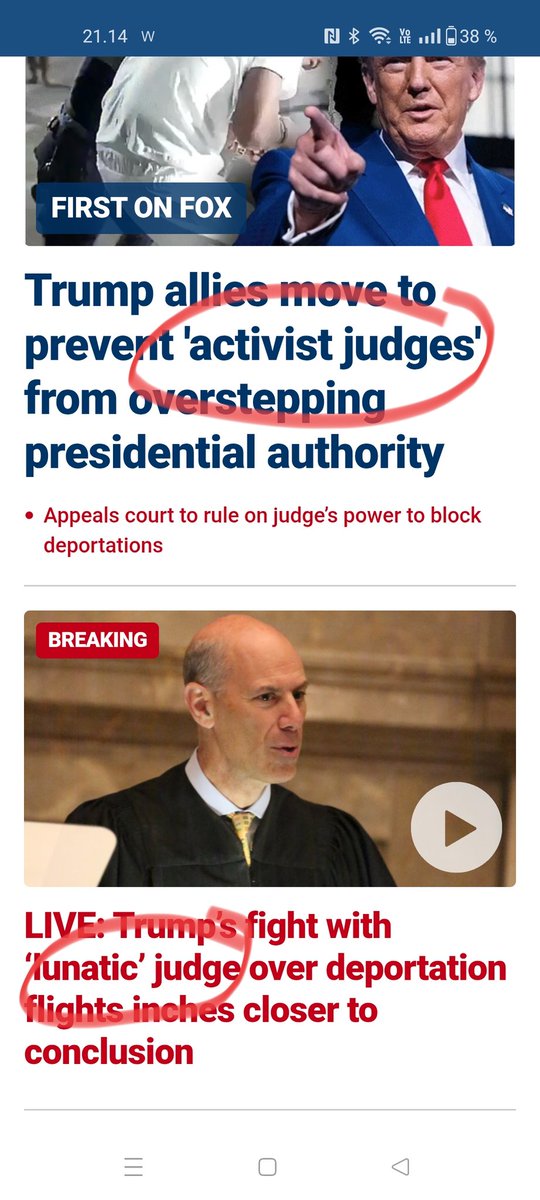
Jordmånen i Trumplandia bearbetas genom en medveten diskreditering av rättsväsendet. Varje dag utgör ett avskräckande exempel.
Jonas Jungar tweet media
Svenska
0
0
0
92
Jonas Jungar
Jonas Jungar@jonasjungar·
Domstolarna har setts som den allra sista bastionen i försvaret av rättsstaten då Trump & Musk gått bärsärkagång i statsapparaten. Nu har t.o.m. Högsta domstolen fått nog. reuters.com/legal/us-chief…
Svenska
4
0
0
146
Jonas Jungar retweetledi
Christopher Miller
Christopher Miller@ChristopherJM·
New @Gallup poll: 46% of Americans say US not doing enough to help Ukraine against Russia’s war, marking a 16% increase since December to new high that dates back to 2022. At same time, proportions thinking US is doing too much (30%) or the right amount (23%) for Ukraine shrunk.
Christopher Miller tweet media
English
90
612
2K
353.4K
Jonas Jungar retweetledi
Elina Valtonen
Elina Valtonen@elinavaltonen·
Wir, als Europa und als Koalition der Willigen, helfen dem Opfer sich zu verteidigen. Es geht darum, die Aggression Russlands einzudämmen. Das ist der einzige Weg, der zu einem haltbaren Frieden führen kann. Mit dem Völkerrecht macht man keine Kompromisse.
Deutsch
60
72
481
34.7K
Jonas Jungar retweetledi
Isaac Saul
Isaac Saul@Ike_Saul·
FYI, we're now on day 3 since Ukraine agreed to a U.S.-proposed ceasefire deal. Zero pressure from Elon Musk on Russia to sign it. Literally zero. Not a single post or comment. And that goes for most of the people who spent the last few weeks calling Zelensky a warmonger.
English
68
690
3.1K
131.7K